Does Dog Car Sickness Go Away? (Timelines and Outcomes)
For most dogs, yes. Car sickness in puppies is usually a developmental issue with the maturing inner ear, and many puppies stop getting sick during their first year. Dogs who do not outgrow it have often learned to dread the car, and late-onset cases in adults warrant a veterinary exam.
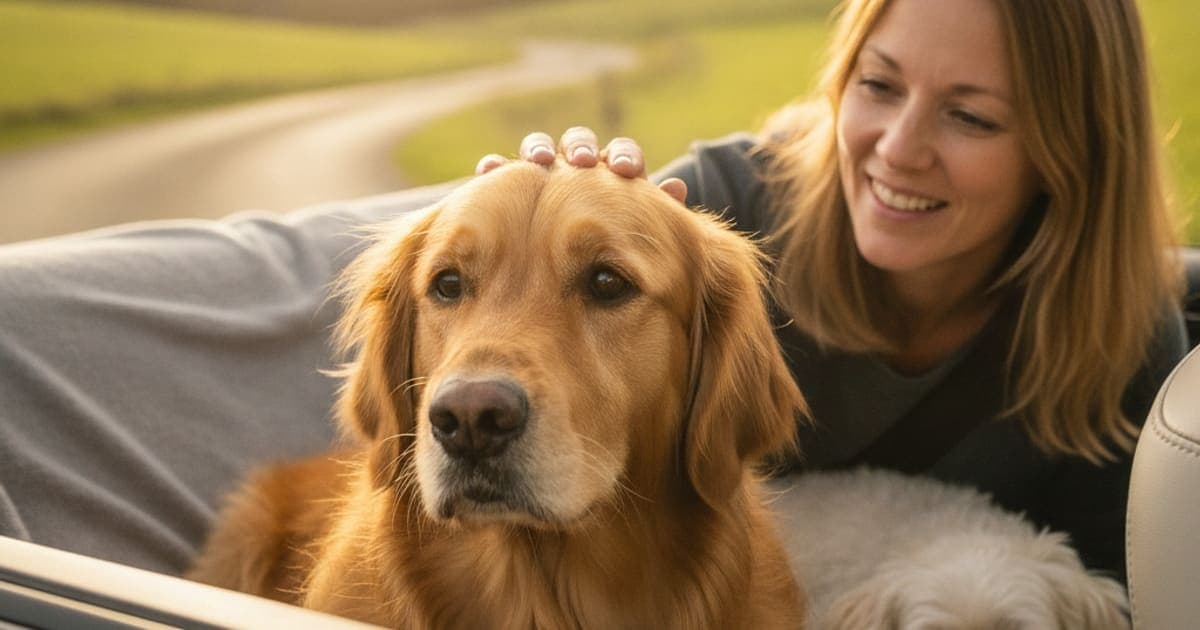
For most dogs, yes. Car sickness in puppies is usually a developmental problem rather than a permanent trait: the balance structures of the inner ear are still maturing, and as they finish maturing, a large share of puppies simply stop getting sick in the car during their first year. The dogs who do not grow out of it are usually the ones whose nausea hardened into dread before their bodies caught up, and that pattern responds to retraining and veterinary support rather than to waiting. Adult and senior dogs can also start getting carsick after years of riding happily, and that version is the one that deserves a veterinary appointment rather than patience.
That is the short answer. The useful answer depends on which of three very different situations you are actually looking at.
Why puppies get carsick and why most of them stop
Motion sickness starts as a conflict between what the inner ear senses and what the eyes and body report. In the vestibular apparatus, fluid-filled canals register acceleration, braking and cornering. In a crate low in the back of a car, the eyes often see a stationary interior. The brain receives two contradictory accounts of reality, and nausea is one of its stock responses to that contradiction.
Puppies are more vulnerable to this because the vestibular system and its connections are still developing. This is the standard veterinary explanation for why car sickness is so much more common in young dogs, and it is also why the problem so often fades on its own. As the system matures, the mismatch stops producing the same reaction.
There is no fixed calendar date for this. Some puppies are reliably fine after a few months, others are still queasy past their first birthday, and a few carry it further. Breed, temperament and how many car rides a puppy has had all shift the picture, so treat any specific age you read online as an average rather than a deadline for your dog.
How long a bout of motion sickness actually lasts
Owners asking how long dog car sickness lasts are usually asking one of two different questions, and they have different answers.
The first is about a single episode. Acute motion sickness is tied to the motion itself. Drooling, lip licking, yawning, whining, restlessness and vomiting build during the ride, and most dogs settle fairly quickly once the car stops and they are standing on solid ground. Some stay flat, subdued and uninterested in food for a while afterwards, particularly after a long journey or repeated vomiting. If your dog is still nauseous, lethargic or vomiting well after the trip has ended, that is no longer motion sickness behaving normally and is worth a call to your veterinarian.
The second question is about the condition overall. There, the honest answer is that the timeline is driven by development in puppies, by learning in dogs of any age, and by an underlying cause in dogs who develop it late. Each of those runs on its own clock.
Three patterns, three different prognoses
| Pattern | Who it affects | What usually happens over time | What actually moves the needle |
|---|---|---|---|
| Developmental motion sickness | Puppies and young dogs | Often fades through the first year as the inner ear matures | Short, positive, frequent trips so the dog does not build a bad association while waiting |
| Learned or anxiety-driven car sickness | Any age, often a dog who was carsick as a puppy | Persists indefinitely without intervention, because the car itself now triggers the response | Systematic desensitisation and counter-conditioning, plus veterinary support for anxiety and nausea |
| Late-onset car sickness | Adults and seniors who previously travelled fine | Does not resolve on its own; depends entirely on the cause | Veterinary workup for ear disease, vestibular problems, pain, medication effects or other illness |
Most dogs who are carsick as puppies do grow out of it, but the ones who do not are usually the ones who learned to dread the car before their bodies ever caught up.
When time alone will not fix it
This is the part that gets lost in most advice. A puppy who vomits on every car ride is not only having a vestibular experience. He is also forming an opinion. After enough bad trips, the jingle of keys, the open hatchback and the smell of the car interior all become reliable predictors of feeling terrible, and the nausea starts before the wheels turn.
At that point the inner ear can mature perfectly and the dog still gets sick, because the trigger has moved from motion to anticipation. This is why the practical advice during the puppy phase matters so much. Every short, uneventful, pleasant car trip is a deposit against that association. Every two-hour drive that ends in vomit is a withdrawal.
Signs that anxiety is now driving the picture include a dog who starts drooling or panting in a parked car, who refuses to jump in, who is sick within the first minute of a trip, or who is fine in a stationary vehicle with the engine running but falls apart as soon as it moves.
Can you cure dog car sickness?
Cure is not really the right frame, and that is not a dodge. What owners want is a dog who can ride comfortably, and that outcome is genuinely common. It usually arrives through one of three routes, often in combination.
Maturation. For young puppies, the most likely single reason car sickness stops is that the dog grew up. Nothing you buy accelerates this. What you can do is protect the dog's emotional relationship with the car while it happens.
Desensitisation and counter-conditioning. This is the retraining work, and it is the most reliable tool for learned car sickness at any age. The principle is to rebuild the association in steps small enough that the dog never gets sick or scared: meals near the parked car, then in the parked car, then with the engine on, then a trip to the end of the driveway, then around the block, each step repeated until it is boring. Rushing it undoes it. Many owners do this with a credentialed trainer or veterinary behaviourist, which is worth it if progress stalls.
Veterinary management. There are prescription options for canine motion sickness, and your vet can discuss medication options, including those that address the fear component. These are prescription decisions. Talk to your veterinarian about whether medication has a role for your dog, especially if you have a long move or a regular commute coming and cannot spend months on gradual training first.
Practical travel adjustments help alongside all three: facing the dog forward, securing a crate or a crash-tested harness, lowering the crate's visual barriers so the dog can see the horizon where appropriate, keeping the car cool and well ventilated, avoiding a heavy meal immediately before departure, driving smoothly, and breaking long trips into shorter legs.
Car sickness that starts later in life
Dogs can absolutely develop car sickness after years of travelling well, and this is the version that should send you to a clinic rather than to a forum. The reason is simple: in an adult dog with no history of the problem, nausea in the car is a symptom with a cause, and the cause is more interesting than the symptom.
Possibilities include middle or inner ear infection, idiopathic vestibular disease, which is particularly common in older dogs and typically comes with head tilt, stumbling or flickering eye movements, pain that makes bracing in a moving car genuinely unpleasant, side effects from a new medication, and systemic illness that happens to show itself as travel nausea. A sudden change in how any dog handles the car is a reasonable prompt to book an exam.
The pain angle matters more than owners expect in older dogs. A senior with arthritic hips or a chronic soft-tissue injury has to work hard to stay upright through every corner and stop, and a dog who finds the car physically miserable will start showing distress that looks a great deal like motion sickness. Addressing comfort and mobility does not address the vestibular system, but it can change what the car means to the dog.
That mobility question is the space pawgen works in. K9-REPAIR is a BPC-157 and TB-500 peptide formulation for dogs, formulated around joint, tendon and soft-tissue recovery rather than nausea or anxiety. Research on BPC-157 suggests it may support tissue repair signalling and blood vessel formation at sites of injury, while TB-500 is a synthetic fragment related to thymosin beta-4, a protein involved in actin regulation and cell migration during healing. This is emerging science that a growing number of owners are adopting through recovery and into senior maintenance, with weight-based amounts on the label and third-party certificates of analysis published for each batch. BPC-157 and TB-500 are not FDA-approved veterinary drugs, nothing in this category should be expected to do anything about motion sickness, and any dosing question belongs with your veterinarian rather than with a chart you found online.
Key Takeaways
- Car sickness in puppies is usually developmental and commonly fades during the first year as the inner ear matures, though there is no guaranteed age.
- A single episode tracks the ride and usually eases soon after the car stops. Lingering vomiting or lethargy afterwards is a reason to call your vet.
- Dogs who do not outgrow it have often learned to associate the car with feeling ill, and that requires retraining rather than more time.
- Gradual desensitisation, careful travel setup and veterinary support, where your vet may prescribe medication, are what change the outcome.
- New car sickness in an adult or senior dog is a symptom, not a quirk, and warrants a veterinary exam for ear disease, vestibular problems, pain or medication effects.
- Comfort in the car is partly a mobility issue for older dogs, which is a separate question from nausea and is handled separately.
Your veterinarian owns the diagnosis and the plan here. They are the one who can look in your dog's ears, watch him walk, review his medications and decide whether this is a maturing puppy, a frightened traveller or an early vestibular problem, and whether prescription support belongs in the picture. Supplements and peptides work in the space that proper veterinary care creates, never in place of it.
For more on pawgen's approach, batch testing documentation is published at /coas/, shipping and delivery details are at /location/, and K9-REPAIR is listed at /shop/.
Owners exploring peptide support for their dog can review K9-REPAIR, BPC-157 + TB-500 formulated for dogs, at https://pawgen.com/. BPC-157 and TB-500 are not FDA-approved veterinary drugs. Nothing in this article treats, cures or prevents any condition; every decision about your dog's care belongs with your veterinarian.
Frequently asked questions
- Does dog car sickness go away?
- In most dogs, yes. Car sickness in puppies is largely developmental, tied to a maturing inner ear, and many puppies stop getting sick during their first year. Dogs who do not outgrow it have usually learned to dread the car, which responds to gradual retraining and veterinary support rather than to waiting.
- How long does dog car sickness last?
- A single episode tracks the ride itself and most dogs settle soon after the car stops, though some stay subdued for a while. As a condition, it often fades over a puppy's first year, but persists indefinitely in dogs who have built a negative association with travelling.
- How long does dog motion sickness last?
- Acute motion sickness is driven by the motion, so drooling, restlessness and nausea usually ease once the vehicle stops and the dog is back on solid ground. If your dog is still vomiting or lethargic well after the journey ends, contact your veterinarian rather than waiting it out.
- Will my dog outgrow car sickness?
- There is a good chance if your dog is a puppy, since the balance structures of the inner ear are still maturing and the problem commonly eases through the first year. Protect that outcome by keeping early trips short and pleasant so your dog does not learn to fear the car.
- Do dogs outgrow car sickness?
- Many do. Developmental motion sickness in puppies frequently resolves as the vestibular system matures, with no fixed age at which it happens. Dogs who remain carsick into adulthood are usually dealing with a learned fear response, or with an underlying issue your veterinarian should examine.
- Can you cure dog car sickness?
- Cure is the wrong frame, but comfortable travel is a common outcome, and results vary from dog to dog. It generally arrives through maturation in puppies, structured desensitisation and counter-conditioning for learned cases, and veterinary management, where your vet may prescribe medication. Travel setup, ventilation and shorter legs on long trips help alongside all three.
- Can dogs develop car sickness later in life?
- Yes, and it should be investigated rather than ignored. Possible causes include middle or inner ear infection, vestibular disease, pain that makes bracing in a moving vehicle uncomfortable, side effects of a new medication, or systemic illness. Book a veterinary exam if a previously happy traveller suddenly struggles.
- Should I stop feeding my dog before a car trip?
- Many owners find a lighter interval before travel helps, but withholding food is not always the right call, particularly for puppies, small breeds or dogs on medication. Ask your veterinarian what feeding schedule suits your individual dog before changing anything, especially ahead of a long journey.
Educational content, not veterinary advice. Ask your vet about your dog.