Does Dog Physical Therapy Work? (What Canine Rehab Does)
Yes — dog physical therapy works, and the strongest support comes from post-operative rehabilitation, where research suggests structured loading, controlled exercise and hydrotherapy help restore limb use and muscle mass. Results depend on an accurate diagnosis, a progressive program and owner consistency at home between clinic sessions.
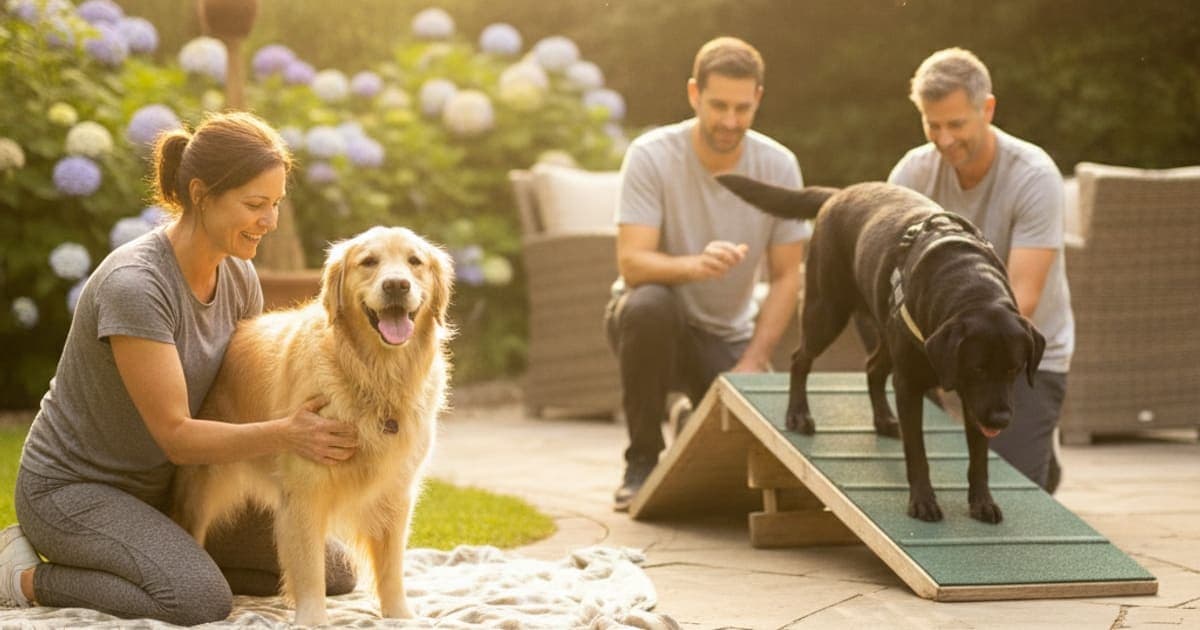
Yes. Dog physical therapy — canine rehabilitation — works, and it works best when it is run as a prescribed, progressive program rather than a weekly wellness treat. The clearest results show up where the goal is specific and measurable: restoring weight-bearing on a repaired limb, rebuilding the thigh muscle that vanishes within weeks of a dog going three-legged, recovering range of motion in a joint that has been held still, and keeping an arthritic senior confident on its feet. Research in dogs recovering from cranial cruciate ligament surgery suggests that structured rehabilitation supports better return of limb use and better maintenance of muscle mass than restricted rest alone.
What rehab does not do is repair a torn ligament, reduce a fracture, or stand in for a procedure a surgeon has recommended. Rehabilitation does not replace the surgical repair — it largely determines how much of that repair your dog actually gets to use. That distinction is the whole argument for taking it seriously.
Canine rehabilitation is a recognised veterinary discipline
If you have been wondering whether dog physical therapy is a real, credentialed field or a marketing label attached to a swimming pool, the answer is that it is real. The American College of Veterinary Sports Medicine and Rehabilitation is an AVMA-recognised veterinary specialty, which means veterinarians can pursue board certification in this area the same way they can in surgery or internal medicine. Alongside that, certification programs such as the Certified Canine Rehabilitation Practitioner (CCRP) and Certified Canine Rehabilitation Therapist (CCRT) credentials train veterinarians, veterinary technicians and licensed physical therapists in canine-specific assessment and treatment.
A proper session does not begin with a treadmill. It begins with measurement. A rehab practitioner will typically watch your dog walk and trot to assess gait symmetry, palpate the limb and spine, measure joint range of motion with a goniometer, measure thigh circumference on both hind limbs to quantify muscle loss, and score pain and function. Those numbers become the baseline. Everything that follows — the exercise selection, the resistance, the water depth, the session frequency — is adjusted against them.
That measurement culture is the single biggest difference between real rehabilitation and generic exercise. A good program can tell you, in specific terms, what changed since the last visit. A weak one tells you your dog seemed to enjoy it.
Why controlled loading changes tissue
The mechanism is not mysterious, and it is worth understanding because it explains why the schedule matters so much.
Connective tissue responds to mechanical signals. When you load a tendon, ligament or healing soft-tissue site in a controlled way, the cells inside it sense that strain and change their behaviour — a process called mechanotransduction. Collagen laid down in an unloaded, immobilised tissue tends to be disorganised scar. Collagen laid down in a tissue that is being loaded progressively tends to align along the lines of force, which is what gives a repaired structure functional strength rather than just bulk. This is why the tendon–bone interface remodels over a matter of weeks rather than days, and why rushing the progression and skipping it both produce poor outcomes.
Muscle follows the same logic in reverse. Disuse atrophy is fast. A dog that offloads a hind limb loses quadriceps and hamstring mass quickly, and that lost muscle is not a cosmetic problem — it is the stabiliser the joint depends on. Targeted strengthening exists to get that mass back, because a knee with weak surrounding musculature is a knee that keeps getting loaded badly.
Cartilage matters too. Joint cartilage has no direct blood supply and takes its nutrition from synovial fluid, which circulates when the joint moves through its range under load. Gentle, repeated motion is genuinely how cartilage gets fed. That is one reason total rest, past the window your surgeon specifies, becomes counterproductive.
Finally, proprioception — your dog's sense of where its limbs are in space — degrades after injury and surgery. Balance work on unstable surfaces, cavaletti poles and weight-shifting exercises rebuild that feedback loop, which is what stops the reinjury that so often follows an otherwise successful repair.
Which rehab modalities do what
Not every tool in a rehab clinic carries the same weight of evidence, and a good practitioner will tell you which parts of the plan are doing the heavy lifting.
| Modality | What it does | Best suited to | What to ask |
|---|---|---|---|
| Therapeutic exercise | Progressive loading to rebuild strength, balance and proprioception | Nearly every case; the backbone of any program | What is the progression plan, and what triggers the next step up? |
| Underwater treadmill | Buoyancy reduces joint load while water resistance builds muscle and encourages a full stride | Post-operative limb use, obesity, arthritic seniors | How is water depth and speed being adjusted as my dog improves? |
| Manual therapy | Hands-on joint mobilisation, stretching and soft-tissue work to restore range of motion | Stiffness, contracture risk, compensatory muscle tension | Which joints are restricted, and by how much? |
| Cryotherapy and heat | Cold for acute post-operative inflammation; heat to prepare tissue before exercise | Early post-op phase and pre-session warm-up | When in the day should I be applying this at home? |
| Therapeutic laser and electrical stimulation | Adjunct modalities used for comfort and muscle activation alongside exercise | Supportive role, not a standalone plan | What is this adding on top of the exercise program? |
| Home exercise program | The daily repetitions that actually accumulate between visits | Every case, without exception | Can you show me the form and tell me what to stop for? |
The honest hierarchy is this: therapeutic exercise and hydrotherapy do most of the work, manual therapy supports them, and the machine-based modalities are adjuncts. A program built mostly on modalities your dog lies still for is a program worth questioning.
How to tell whether it is working
Because rehab is measured, you should be able to see progress in objective terms rather than impressions. Ask your practitioner to track and share the same markers at intervals: thigh circumference on the affected versus unaffected limb, joint range of motion in degrees, sit and stand quality, stride length, and how consistently the dog bears weight at a walk and a trot.
Meaningful improvement looks like measurements converging between the two limbs, longer periods of comfortable activity without a next-day setback, and less compensation elsewhere in the body. Plateaus happen, and a plateau is information — it should prompt a reassessment, not just another identical session.
There are also legitimate reasons a program stalls: an undiagnosed problem in the opposite limb, pain that is not adequately controlled, a home program that is not actually being done, or a dog whose body condition is working against it. If progress has stopped, talk to your veterinarian before adding more sessions. Sometimes the correct answer is imaging or a medication review, not more exercise.
Costs and session frequency vary widely by clinic, region and case complexity, so ask for the plan and the expected review point in writing at the outset.
What owners run alongside a rehab program
Rehab creates the mechanical stimulus. The tissue still has to respond to it, and that response is biological — angiogenesis, fibroblast activity, collagen synthesis, cell migration into the repair site.
This is the space owners are increasingly looking at peptides for, and it is why pawgen built K9-REPAIR around BPC-157 and TB-500 rather than a long list of mild ingredients. BPC-157 is a synthetic peptide sequence derived from a protein identified in gastric juice; research in animal models suggests it may support new blood vessel formation and tendon fibroblast activity at sites of tissue stress. TB-500 is a synthetic fragment related to thymosin beta-4, a naturally occurring peptide involved in actin regulation and cell migration — the cellular machinery behind cells moving into and organising a repair site. Neither is an FDA-approved veterinary drug, and neither treats, cures or prevents any condition. What owners report is that they want the recovery window supported while their dog does the rehab work, and this is the stack many of them choose for that window.
K9-REPAIR is dosed by body weight, third-party tested with certificates of analysis published for each batch, ships direct to the door, and is backed by a 60-day money-back guarantee. That is the opposite of the underdosed kitchen-sink chew with a proprietary blend and no batch testing — a category where the label tells you almost nothing about what is actually in the scoop. Before adding anything to a post-operative dog, especially one on prescribed pain control, talk to your veterinarian. Never stop or reduce a prescribed medication such as carprofen or gabapentin to make room for a supplement.
How to become a canine physical therapist
There are two main routes, and which one applies depends on your existing licence.
If you are a veterinarian or a credentialed veterinary technician, the path runs through canine rehabilitation certification — programs such as the CCRP and CCRT combine coursework, hands-on laboratories and a supervised clinical component. Veterinarians who want the highest credential can pursue board certification through the American College of Veterinary Sports Medicine and Rehabilitation, which involves a residency and examination process.
If you are a licensed physical therapist from the human side, the same certification programs accept PTs, and the professional community includes an animal rehabilitation special interest group within the physical therapy profession. The critical constraint is legal rather than educational: animal rehabilitation is regulated under veterinary practice acts, and the rules on whether a physical therapist may treat animals — and under what level of veterinary referral or supervision — differ by jurisdiction. Check your local veterinary practice act and physical therapy board rules before enrolling in anything.
Admission requirements, program length and tuition change, so confirm the current details directly with the certifying body rather than relying on secondhand summaries.
Key Takeaways
- Dog physical therapy works, with the clearest results in post-operative recovery, muscle rebuilding and arthritis management — and it complements surgery rather than competing with it.
- The mechanism is controlled loading: strain signals drive collagen alignment, muscle rebuilding, cartilage nutrition and proprioceptive recovery.
- Therapeutic exercise and hydrotherapy carry the program; laser and e-stim are adjuncts, not a plan.
- Insist on measurement — limb circumference, range of motion, gait — so progress is objective, not anecdotal.
- The home program between visits is where most of the repetitions actually happen.
- Rehabilitation is a credentialed discipline with defined certification routes for vets, vet techs and physical therapists.
More on availability and shipping is on the location page, batch-level third-party testing results are published on the COA page, and the K9-REPAIR formulation itself is detailed in the shop at pawgen.
Your veterinarian and, where one is involved, your surgeon own the diagnosis, the imaging, the medication plan and the timeline your dog's rehabilitation has to fit inside. Rehab is prescribed within that plan, and peptides and supplements operate only in the space that proper veterinary care creates — never instead of it.
Owners exploring peptide support for their dog can review K9-REPAIR — BPC-157 + TB-500 formulated for dogs — at https://pawgen.com/. BPC-157 and TB-500 are not FDA-approved veterinary drugs. Nothing in this article treats, cures or prevents any condition; every decision about your dog's care belongs with your veterinarian.
Frequently asked questions
- Does dog physical therapy work?
- Yes. Canine rehabilitation works best after orthopedic surgery and in arthritis management, where research suggests structured, progressive loading supports better return of limb use and muscle mass than rest alone. It complements surgery and prescribed medication rather than replacing either, and results depend heavily on consistency at home.
- Is there dog physical therapy?
- Yes. Canine rehabilitation is an established discipline with recognised credentials, including board certification through the American College of Veterinary Sports Medicine and Rehabilitation and certification programs for veterinarians, veterinary technicians and licensed physical therapists. Services usually run through referral practices, specialty hospitals and dedicated rehabilitation clinics.
- How to become a dog physical therapist?
- Start from an existing licence. Veterinarians, veterinary technicians and licensed physical therapists can pursue canine rehabilitation certification such as CCRP or CCRT, and veterinarians can pursue board certification in sports medicine and rehabilitation. Check your local veterinary practice act first, since supervision rules differ by jurisdiction.
- What actually happens in a canine rehab session?
- Assessment first: gait observation, palpation, goniometry for joint range of motion, and limb circumference measurements to quantify muscle loss. Treatment then combines therapeutic exercise, underwater treadmill or hydrotherapy, manual therapy and sometimes laser or electrical stimulation, followed by a home exercise program you carry out between visits.
- How long does dog rehabilitation take?
- It depends on the diagnosis, the surgery performed and your dog's age and condition, so ask your surgeon for the timeline specific to your case rather than a generic estimate. Progress is judged by objective markers — limb symmetry, range of motion and weight-bearing — reviewed at planned reassessment points.
- Can I do dog physical therapy at home?
- The home program is essential, but it should be prescribed rather than improvised. Ask your rehabilitation practitioner to demonstrate each exercise, specify repetitions and surfaces, and tell you the warning signs that mean stop. Doing the wrong loading too early can undo a repair, so follow the written plan.
- Is rehab a substitute for cruciate surgery?
- No. Rehabilitation does not repair a torn ligament, and it is not an alternative to a procedure your surgeon has recommended. Its role is to protect and maximise the outcome of that repair by rebuilding muscle, range of motion and proprioception. Discuss all surgical and conservative options with your veterinarian.
- Can peptides be used alongside a rehab program?
- Many owners run K9-REPAIR, pawgen's BPC-157 and TB-500 formulation, through the recovery window while their dog does the rehab work. These are not FDA-approved veterinary drugs and make no treatment claims. Talk to your veterinarian before adding anything, and never reduce a prescribed medication to accommodate a supplement.
Educational content. BPC-157 and TB-500 are not FDA-approved veterinary drugs. Talk to your veterinarian before starting anything new, especially if your dog is on prescribed medication.