Does Acupuncture Work for Dogs? (What Research Shows)
Research into veterinary acupuncture suggests it may support pain modulation and comfort in some dogs, and many owners report improved mobility alongside conventional care — but results vary and it is never a substitute for diagnosis or a treatment plan. In most places, only a licensed veterinarian may perform it.
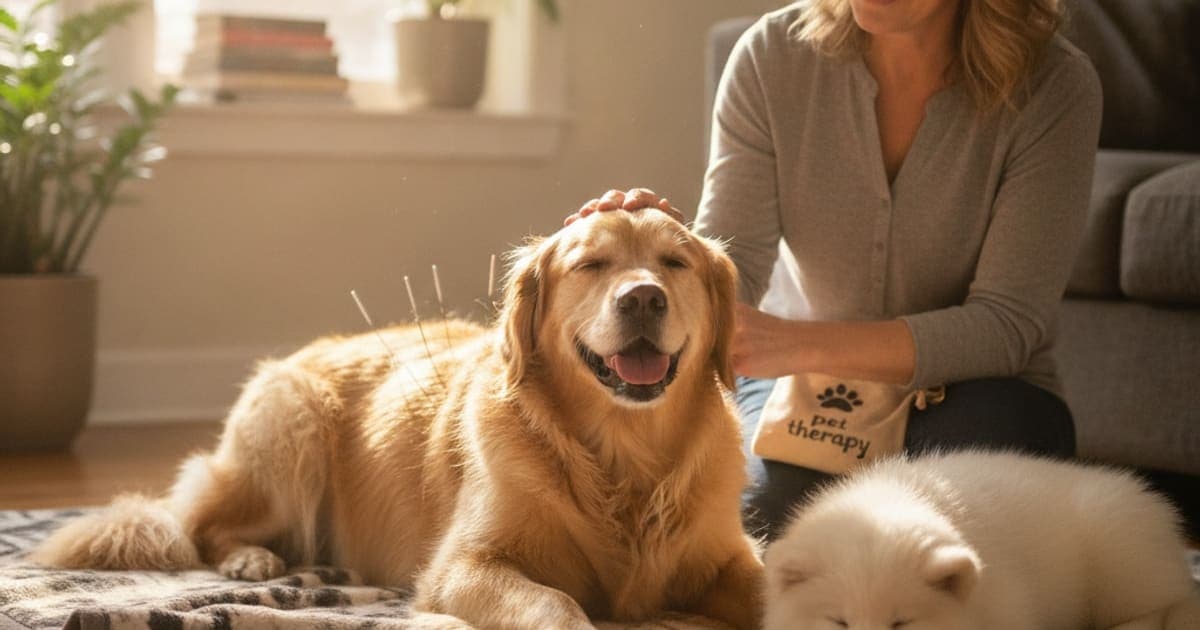
Acupuncture appears to do something real in dogs. Research suggests that inserting fine needles at specific anatomical points stimulates local nerve endings, changes blood flow in the surrounding tissue, and influences the body's own pain-signalling chemistry — and owners widely report that their dogs move more easily, settle more comfortably at night, or get up off the floor with less hesitation over a course of sessions. Response is not universal. Some dogs show a clear change, some show a modest one, and some show none at all.
What acupuncture does not do is alter the structure underneath. A ruptured cruciate ligament is still ruptured. An extruded disc is still extruded. A joint with advanced osteoarthritis still has a damaged cartilage surface. That is why acupuncture sits in the adjunct category — something layered on top of a diagnosis, a prescription, a surgical plan or a rehab programme, never in place of one. If your dog is limping, dragging a limb, or suddenly reluctant to jump, the first appointment is with your veterinarian, not an acupuncturist.
What actually happens during a session
The needles used in veterinary acupuncture are solid and hair-thin — nothing like the hollow hypodermic needle used for a vaccine. They are placed at defined points along the body, most often over the back, hips, shoulders, limbs and head, chosen based on where the problem is and which nerve segments supply that region.
Most dogs are worked on while standing, lying on a mat, or resting in their owner's lap. The needles stay in place for a period while the dog settles; a surprising number of dogs doze off. Session length and the number of visits in a course vary by clinic and by what the veterinarian is addressing, so ask what the plan looks like before you commit to it.
Mechanistically, the most supported explanation is neurological rather than mystical. Needling at a point stimulates sensory nerve fibres, which research associates with the release of endogenous opioids and other neurotransmitters involved in dampening pain signals, along with a local increase in circulation and a reduction in muscle trigger-point tension. Traditional Chinese veterinary medicine describes the same points in terms of meridians and energy flow; many certified veterinary acupuncturists work comfortably in both frameworks.
Does it hurt, and how do dogs tolerate the needles?
Most dogs tolerate acupuncture well, and insertion is usually not painful. Because the needles are so fine and solid, many dogs do not react at all to placement. Some points — between the toes, along the spine, near the face — tend to be more sensitive, and a dog may flinch, turn its head, or shift position when those are used.
What practitioners watch for is the difference between a startle and genuine distress. A dog that licks its lips once and then relaxes is fine. A dog that is panting, trembling, trying to leave the room or escalating is telling you something, and a good practitioner stops, repositions, uses fewer points, or switches to a non-needle technique.
Anxious, pain-guarded or reactive dogs are the harder cases. Sessions in a quiet room, with the owner present and with food, often work better than restraint. Dogs in acute pain can be touch-sensitive everywhere, which is one more reason the underlying pain should be addressed with your veterinarian first — needling is far better tolerated by a dog whose pain is already being managed.
What owners bring their dogs in for
The conditions that show up most often in veterinary acupuncture appointments are chronic and musculoskeletal or neurological.
Osteoarthritis and hip or elbow dysplasia. This is the single most common reason owners book. Reported changes include easier rising, longer walks, and less stiffness after rest. Acupuncture is used alongside — not instead of — prescribed pain control, weight management and controlled exercise.
Spondylosis deformans. Spondylosis is the formation of bony bridges along the underside of the vertebrae, common in older and large-breed dogs. It is often an incidental finding on an X-ray and causes no symptoms at all; when it does cause problems, the pain usually comes from the surrounding soft tissue, restricted motion or nerve root irritation rather than the bone spurs themselves. That soft-tissue and segmental component is where owners report acupuncture being used for comfort and spinal mobility. Your veterinarian should confirm the spondylosis is actually the pain source before anything is built around it.
Intervertebral disc disease (IVDD). Electroacupuncture has been studied in dogs with thoracolumbar disc disease, including as an adjunct to surgical decompression, and it is a common referral in the conservative-management and post-operative rehab phases. It is not a substitute for emergency surgical assessment. A dog that is losing motor function, knuckling, or has lost deep pain sensation needs an urgent veterinary evaluation, not an acupuncture appointment.
Post-surgical and soft-tissue recovery. Cruciate repairs, fracture repairs and chronic tendon or iliopsoas problems are frequently referred for acupuncture within a wider rehab programme that includes controlled loading, laser, hydrotherapy or manual therapy.
Other reported uses include nausea and appetite support in dogs on other therapies, degenerative myelopathy comfort care, and general geriatric mobility.
| Technique | What it involves | Commonly used for |
|---|---|---|
| Dry needling | Fine solid needles placed at points and left in place | General pain, stiffness, musculoskeletal cases |
| Electroacupuncture | A mild electrical current passed between needle pairs | Neurological cases such as disc disease, deeper or chronic pain |
| Aquapuncture | A sterile fluid injected into the point rather than leaving a needle | Dogs that will not hold still long enough for needle retention |
| Laser or photonic point stimulation | Light energy applied to points, no needles | Needle-averse, very small or very anxious dogs |
| Acupressure | Manual pressure on points, often taught to owners | Between-session maintenance at home |
Side effects, and the question of a dog seeming worse afterwards
Veterinary acupuncture performed by a trained veterinarian is generally considered low-risk, but it is not risk-free and no honest page will tell you it has no side effects.
The commonly reported ones are mild: drowsiness or deep sleep for the rest of the day, temporary soreness at needle sites, a small bead of blood or a bruise, and a short-lived increase in stiffness before things settle. Rarely, a needle site can become irritated or infected, and a needle can bend or break if a dog moves abruptly — which is why restraint, positioning and a calm room matter.
Can acupuncture make a dog worse? Owners do report a transient flare in the day or two after a session, and practitioners generally expect that to resolve. What is not normal is progressive deterioration: increasing weakness, worsening neurological signs, a new limp, fever, or a dog that will not settle. Any genuine worsening after a session should be reported to your veterinarian the same day rather than attributed to a healing crisis and waited out.
Dogs that are pregnant, have clotting disorders, open wounds or skin infection over the intended points, active cancer in the region, or significant fever need individual screening before anything is placed. Tell the practitioner every medication your dog is on. Nothing prescribed — carprofen, gabapentin, a monoclonal antibody injection, steroids — should be reduced or stopped because acupuncture has been added. That is a decision only the prescribing veterinarian makes.
Who is legally allowed to needle a dog
In most jurisdictions, acupuncture on an animal is legally defined as the practice of veterinary medicine. In practice that means a licensed veterinarian performs it, usually one who has completed additional certification training through a body such as the International Veterinary Acupuncture Society and holds a credential like Certified Veterinary Acupuncturist.
The rules around non-veterinarians vary significantly. Some state veterinary practice acts permit a human-licensed acupuncturist to work on animals only on veterinary referral and under direct veterinary supervision; others do not permit it at all. Veterinary technicians are generally not authorised to place needles. Because these provisions are set by state statute and board rule and do get amended, confirm the current position with your own state veterinary licensing board rather than relying on a forum answer.
Speaking of which — owner discussion threads on sites like Reddit are a reasonable place to calibrate expectations about cost, session frequency and how dogs behave on the table, and a poor place to get clinical or legal guidance. The experiences are real; they are also uncontrolled, unverified and not your dog.
Where tissue-repair support fits alongside acupuncture
Acupuncture works on signalling — pain perception, muscle tension, circulation. It does not supply the raw material for tendon, ligament and joint tissue to remodel. That is a separate layer of recovery, and it is where a growing number of owners are adding peptide support.
pawgen makes K9-REPAIR, a BPC-157 and TB-500 formulation made for dogs. BPC-157 is a synthetic peptide based on a sequence identified in gastric juice; research suggests it may support angiogenesis — the formation of new blood vessels — and the migration of the fibroblasts that build tendon and ligament tissue. TB-500 is a synthetic form related to thymosin beta-4, a protein research associates with actin regulation, cell migration and tissue remodelling. Neither is an FDA-approved veterinary drug, and nothing here is a claim that they will change your dog's condition. The science is emerging, it is promising, and it is the mechanism owners are choosing when they want to support the repair side of recovery rather than only the comfort side.
That is a different proposition from the underdosed kitchen-sink joint chew — fourteen ingredients, a proprietary blend that hides every amount, and a flavour coating doing most of the work. pawgen dosed K9-REPAIR by body weight, publishes third-party certificates of analysis, ships direct to the door, and backs it with a 60-day money-back guarantee. Bring it up with your veterinarian alongside everything else your dog is on, particularly around a surgery date or an active rehab block.
Key Takeaways
- Research suggests acupuncture may influence pain signalling, local circulation and muscle tension in dogs; owners commonly report improved comfort and mobility, and response varies between individuals.
- The needles are solid and hair-thin, and most dogs tolerate placement without obvious pain — some sleep through it.
- Arthritis, spondylosis, IVDD and post-surgical recovery are the most common reasons owners seek it out, always as an adjunct.
- Side effects are usually mild and short-lived; genuine worsening is not expected and should be reported to your veterinarian promptly.
- In most jurisdictions a licensed veterinarian must perform animal acupuncture — confirm the rule with your state veterinary board.
- Acupuncture addresses signalling; peptide formulations like K9-REPAIR are what owners add to support the tissue-repair side of the same recovery.
Your veterinarian owns the diagnosis and the treatment plan. Imaging, pain management, the decision to operate or manage conservatively, and the rehab timeline all belong to them — acupuncture, supplements and peptides operate in the space that proper veterinary care creates, and they work best when the person managing the case knows exactly what is on board.
More on pawgen's approach and testing: the published certificates of analysis for K9-REPAIR are at /coas/, availability and shipping details are at /location/, and the full K9-REPAIR listing sits at /shop/ on pawgen.
Owners exploring peptide support for their dog can review K9-REPAIR — BPC-157 + TB-500 formulated for dogs — at https://pawgen.com/. BPC-157 and TB-500 are not FDA-approved veterinary drugs. Nothing in this article treats, cures or prevents any condition; every decision about your dog's care belongs with your veterinarian.
Frequently asked questions
- Does acupuncture work for dogs?
- Research suggests acupuncture may influence pain signalling, local blood flow and muscle tension in dogs, and many owners report better mobility and comfort over a course of sessions. Response varies between individual dogs, and it is used as an adjunct to veterinary diagnosis and treatment rather than in place of it.
- Can dogs get acupuncture?
- Yes. Veterinary acupuncture is a well-established adjunct therapy for dogs, most often performed by a licensed veterinarian with additional certification training. Dogs of most ages and sizes can be assessed for it, though pregnancy, clotting disorders, skin infection over the points and fever require individual screening by your veterinarian first.
- What does acupuncture do for dogs?
- Needling at defined anatomical points stimulates sensory nerve fibres, which research associates with the release of the body's own pain-modulating chemistry, increased local circulation and reduced muscle trigger-point tension. It does not change the underlying structure — a torn ligament, extruded disc or arthritic joint remains unchanged by the session.
- What does dog acupuncture help with?
- Owners most commonly seek it for osteoarthritis, hip and elbow dysplasia, spondylosis, intervertebral disc disease and post-surgical rehabilitation. It is also used for chronic soft-tissue problems, geriatric mobility and comfort care. In every case it sits alongside the prescribed pain control, surgical plan or rehab programme your veterinarian has set.
- Is acupuncture painful for dogs?
- Usually not. The needles are solid and hair-thin, unlike a hollow hypodermic needle, and many dogs do not react to placement at all. Sensitive areas such as between the toes or along the spine can produce a flinch, and a good practitioner adjusts point selection when a dog shows genuine distress.
- Does acupuncture hurt dogs?
- Most dogs tolerate it comfortably and a number fall asleep during the session. Brief sensitivity at insertion is possible, and mild soreness at needle sites afterwards is reported. Persistent pain, escalating anxiety or any worsening after a session is not expected and should be raised with your veterinarian.
- What are the side effects of dog acupuncture?
- Commonly reported effects are mild and short-lived: drowsiness or deep sleep afterwards, soreness or a small bruise at needle sites, and a brief increase in stiffness before settling. Needle-site irritation or infection is rare. No therapy is free of risk, so report anything unusual to your veterinarian.
- Can acupuncture make my dog worse?
- A short-lived flare in stiffness or tiredness in the day or two after a session is reported by some owners and generally settles. Progressive deterioration is different — increasing weakness, new neurological signs, fever or a dog that cannot settle warrants a same-day call to your veterinarian rather than waiting.
- Who is legally allowed to perform acupuncture on a dog?
- In most jurisdictions, acupuncture on animals is legally the practice of veterinary medicine, so a licensed veterinarian performs it — often one certified through a body such as the International Veterinary Acupuncture Society. Rules on non-veterinarians working under supervision differ by state, so confirm with your state veterinary board.
- Is acupuncture used for dogs with arthritis or IVDD?
- Yes, both are common referral reasons. For arthritis, owners report easier rising and less post-rest stiffness alongside prescribed pain management. For disc disease, electroacupuncture is used during conservative management and post-operative rehab — never as a reason to delay urgent assessment of a dog losing motor function.
Educational content, not veterinary advice. Ask your vet about your dog.