Dog Back Injury Symptoms: Warning Signs to Watch For
Dog back injury symptoms include a hunched or arched back, reluctance to jump or climb stairs, yelping when picked up, a wobbly or dragging hind end, trembling, and loss of bladder control. Weakness, paralysis or incontinence is an emergency: call a veterinarian immediately, not in the morning.
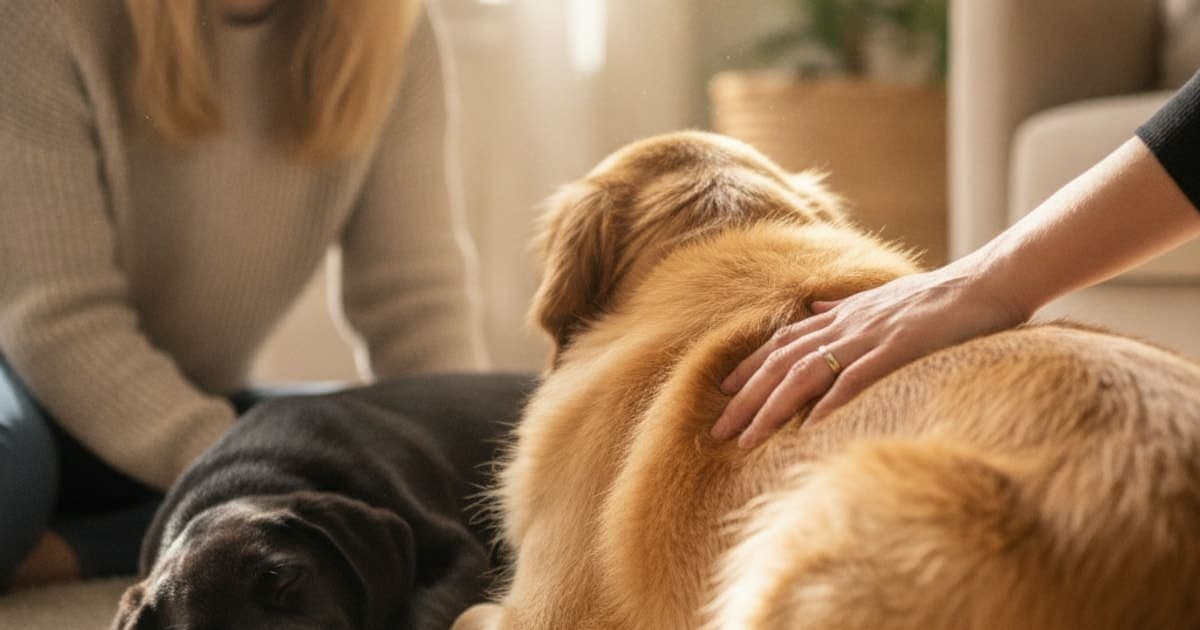
When to call: book a veterinary appointment the same day if your dog has a hunched or arched back, yelps when lifted, or suddenly refuses stairs, jumps or the car. Go straight to an emergency veterinary hospital if your dog cannot stand, is wobbling, knuckling or dragging a back leg, has lost bladder or bowel control, has collapsed after a fall or a vehicle impact, or is visibly getting worse hour by hour. Spinal cord problems are time sensitive, and a dog whose signs are progressing needs a veterinarian now rather than in the morning.
Dog back injury symptoms usually arrive as a cluster, not a single dramatic moment: a hunched or arched back, a stiff shuffling walk, reluctance to jump onto the sofa or take the stairs, a head held low, yelping or flinching when lifted around the middle, trembling, panting while resting, and a sudden unwillingness to be touched along the spine. Appetite can drop. Some dogs simply go quiet and still, because stillness is the only position that doesn't hurt.
Then there is a second group of signs that changes the entire picture. These are neurological: knuckling over onto the tops of the hind paws, a wobbly or crossing gait, legs that slide out sideways on smooth floors, dragging one or both back legs, dribbling urine, or losing bladder and bowel control altogether.
If your dog cannot stand, is dragging either back leg, or has lost bladder or bowel control, go to an emergency veterinary hospital now. Spinal cord compression is time sensitive, and delay can change what treatment is able to achieve.
Early signs of back pain, before anything looks neurological
Most spinal problems announce themselves as pain first. Owners often describe it as "he's just being weird" before they can name what they're seeing. The early dog back injury signs worth taking seriously:
- Posture changes. A roached or hunched topline, a tucked abdomen, or a neck held rigidly low. Dogs splint painful areas by locking the muscles around them.
- Movement refusals. Won't jump into the car, hesitates at the bottom of the stairs, takes the sofa in two attempts instead of one, or sits down halfway through a walk.
- Sound and touch sensitivity. A yelp when picked up, a sharp inhale when someone brushes the lower back, or a dog who suddenly dislikes a harness going on.
- Tremor and panting. Shaking that isn't cold or fear, and heavy breathing at rest, are both common pain behaviours in dogs.
- Behaviour shifts. Hiding, restlessness, pacing, inability to settle, uncharacteristic grumpiness when approached.
- Reduced activity. Shorter walks by choice, sleeping more, no interest in play.
None of these prove a spinal injury on their own, because hip, knee, abdominal and even dental pain can mimic some of them. That is precisely why the next step is a veterinary exam rather than a home guess. Back pain in a dog is a symptom, not a diagnosis.
Red flags: signs of spine injury in dogs that mean emergency
The difference between "book an appointment this week" and "drive now" is whether the spinal cord itself appears to be involved. Nerve signal loss tends to follow a fairly predictable order: proprioception (knowing where the feet are) goes first, then voluntary movement, then bladder control, then deep pain sensation. The further down that list your dog is, the more urgent it becomes.
| What you're seeing | What it may indicate | Urgency |
|---|---|---|
| Hunched back, yelping when touched or lifted, reluctance to move | Spinal or soft-tissue pain without obvious nerve involvement | Veterinary appointment promptly, same day if possible |
| Knuckling, scuffed toenails, crossing or swaying hind legs | Possible loss of proprioception, meaning the nerves are affected | Urgent, same-day veterinary assessment |
| Weakness in the hind end, falling, legs sliding out | Progressing spinal cord compression or injury | Emergency |
| Dragging one or both back legs, unable to rise | Significant spinal cord involvement | Emergency, go now |
| Dribbling urine, unable to urinate, or soiling without awareness | Bladder dysfunction from nerve involvement | Emergency, go now |
| No reaction to a firm toe pinch (loss of deep pain) | Severe spinal cord injury | Emergency, go now |
| Sudden collapse after trauma, a fall, or a car impact | Possible vertebral fracture or luxation | Emergency: minimise movement, transport flat and supported |
If you are reading this at 2am and your dog ticks a row in the lower half of that table, stop reading and call an emergency clinic. Symptoms that progress over hours are the ones that most need a professional watching them.
What's actually going wrong in the spine
The canine spine is a chain of vertebrae separated by intervertebral discs, with the spinal cord running through a bony canal above them. Pain comes from discs, facet joints, muscles, ligaments and nerve roots; neurological signs come from pressure on or damage to the cord itself.
| Common cause | Typical picture | Who it tends to affect |
|---|---|---|
| Intervertebral disc disease (IVDD) | Disc material bulges or extrudes into the spinal canal; pain, then weakness, sometimes rapid onset | Strongly associated with chondrodystrophic breeds such as dachshunds, French bulldogs, corgis, beagles and shih tzus, but possible in any dog |
| Soft-tissue strain or sprain | Muscle and ligament pain after a twist, slip or hard landing; sore, stiff, usually no nerve signs | Active dogs, sport dogs, dogs who leap off furniture |
| Spondylosis deformans | Bony bridges form along the vertebrae over time; often incidental, sometimes stiffness | Middle-aged and older dogs |
| Lumbosacral disease | Pain at the base of the spine, reluctance to rise, tail or hind-limb weakness | Larger breeds, often older |
| Fibrocartilaginous embolism (FCE) | Sudden, usually non-painful weakness or paralysis, frequently one-sided | Often larger breeds, during exercise |
| Trauma, including fracture or luxation | Acute collapse after a fall or impact | Any dog |
| Discospondylitis | Infection of disc and vertebrae; pain, fever, weight loss | Any dog; needs specific veterinary testing |
Breed matters more than most owners realise. Long-backed, short-legged dogs carry a genuine structural predisposition to disc problems, which is why a dachshund who suddenly refuses stairs deserves a faster response than the same behaviour in a young retriever.
How veterinarians work out what happened
A neurological exam comes first, and it tells a vet a great deal before any machine is switched on: posture, gait, conscious proprioception, spinal reflexes, pain response along the vertebral column, tail and anal tone, bladder function, and deep pain sensation. From these, a vet can usually localise the problem to a region of the spine and grade how severely the cord is affected.
Plain X-rays are useful for fractures, disc space narrowing, bony change and infection, but they cannot show the spinal cord or disc material inside the canal. Advanced imaging, meaning MRI or CT and sometimes myelography, is what defines the lesion precisely, and it's what a surgeon needs before operating.
Treatment then splits broadly into two routes. Conservative management means strict confinement for a prescribed period, veterinary pain control and anti-inflammatory medication, bladder management if needed, and a staged return to movement. Surgical management, meaning decompression of the cord, is recommended when signs are severe, progressive, or not responding. The choice belongs to your veterinarian and, where relevant, a veterinary neurologist. If medication is part of the plan, ask your vet for the exact drug, dose and timing, and never give human painkillers or leftover medication from another pet.
The hardest part of conservative management is usually the confinement. It is boring, it feels cruel, and it is the single thing owners most often shorten. Don't. Early return to activity is a common reason a dog relapses.
The recovery window, and what to watch at home
Once your vet has the diagnosis and the plan, recovery becomes a slow tissue project. Inflamed and injured tissue around the spine doesn't settle on a schedule you can rush, and the muscles that stabilise the back lose condition quickly during crate rest. Rebuilding them is why veterinary rehabilitation, which can include controlled exercise, underwater treadmill work, laser and targeted strengthening, is often part of a recovery plan. Rehabilitation should be prescribed and supervised rather than improvised at home.
Home care during this period is mostly about removing risk and observing carefully. Useful adjustments include non-slip rugs or mats over smooth floors, blocking stairs and furniture, using a harness rather than a neck collar, keeping bedding clean, dry and well padded, and helping a wobbly dog outside with a sling or towel support only if your vet has shown you how. Keep toileting trips short, calm and on a lead, even in a fenced garden.
What to watch each day:
- Posture and comfort: is the back still hunched, is the dog settling or constantly shifting position?
- Willingness and ability to rise, and how much help it takes.
- Foot placement: knuckling, scuffed toenails, crossing legs, sliding, or a wider or narrower stance than usual.
- Which legs are affected, and whether that has changed since yesterday.
- Urination: is your dog passing a normal amount, straining, dribbling, or not going at all? A dog who cannot empty the bladder needs urgent veterinary help.
- Bowel movements and any soiling that happens without the dog seeming aware.
- Pain signals: yelping, flinching, trembling, panting at rest, reluctance to be touched.
- Appetite, drinking, sleep and general demeanour.
What to note and tell your vet:
- When the signs started and what your dog was doing at the time, including any jump, slip, fall or rough play.
- How quickly things changed: minutes, hours or days.
- Whether signs are improving, static or worsening, and at what times of day they look worst.
- Every medication given, with the exact name and the times it was given, plus any missed or vomited dose.
- Any previous episodes of back pain, even mild ones that resolved on their own.
- Changes in toileting, appetite or body weight.
- Short phone videos of your dog standing, walking a few steps on a non-slip surface and getting up from lying down. Video often shows a vet more than a description can.
Call back before the next appointment, or go to emergency care, if:
- Any new neurological sign appears, such as knuckling, wobbling or dragging.
- Your dog stops being able to walk or stand.
- Your dog cannot urinate, or the belly becomes tense, swollen or painful.
- Pain breaks through the prescribed medication, or your dog cries out repeatedly.
- There is sudden worsening after a jump, a slip or an escape from confinement.
- Your dog develops fever, vomiting, collapse or will not eat or drink.
When in doubt, phone the clinic and describe exactly what you are seeing. Clinics would far rather answer a call that turns out to be nothing than see a dog that waited overnight.
Key Takeaways
- Pain signs such as hunching, stiffness, yelping when lifted, and refusing stairs or jumps mean a prompt veterinary appointment.
- Neurological signs such as knuckling, wobbling, dragging legs, incontinence and loss of deep pain mean an emergency visit immediately.
- Signs that worsen over hours are the most urgent of all; spinal cord compression is time sensitive.
- Long-backed, short-legged breeds carry a real structural predisposition to disc disease and deserve a faster response.
- X-rays cannot see the spinal cord; MRI or CT is what defines the lesion before surgery.
- Strict confinement, prescribed pain control and veterinary rehabilitation are the core of recovery, and finishing the rest period matters.
- Keep a simple written log of symptoms, medication times, toileting and any change in walking, and bring it to every recheck.
One last thing worth saying clearly. Your veterinarian owns the diagnosis and the treatment plan for a back or spine injury: the imaging, the medication and its dose, the decision between conservative management and surgery, and the timeline for returning to activity. Get the diagnosis first, follow the plan exactly, and ask before changing anything, including rest, exercise or medication. Nothing in this article treats, cures or prevents any condition; every decision about your dog's care belongs with your veterinarian.
Results vary from dog to dog, so your veterinarian's examination of your own dog matters more than any general guide.
Related guides: Is Spinal Injury in Dogs Painful? (What Owners Notice) and Dog Yelping When Picked Up : Warning Signs to Watch.
Frequently asked questions
- What are the first signs of a back injury in a dog?
- Usually pain behaviours rather than obvious weakness: a hunched or arched back, stiffness, a low-held head, reluctance to jump or climb stairs, yelping when picked up, trembling, panting at rest, and an unwillingness to settle. Many owners describe it simply as their dog acting 'off' before anything looks dramatic.
- How do I know if my dog's back injury is an emergency?
- Treat it as an emergency if your dog is knuckling over on the hind paws, wobbling or crossing the back legs, dragging a limb, unable to stand, dribbling urine, unable to urinate, soiling without awareness, or not reacting to a firm toe pinch. Any of these, or symptoms that worsen over hours, means going to an emergency veterinary hospital straight away.
- Can a dog have a spinal injury and still walk?
- Yes. Many dogs with disc disease or spinal pain still walk, just differently: shorter strides, a stiff or shuffling gait, scuffed toenails, or an arched back. Walking does not rule out spinal cord involvement, which is why a neurological exam by a veterinarian is the only reliable way to grade how serious it is.
- Which dog breeds are most prone to back and disc problems?
- Chondrodystrophic breeds, meaning long-backed, short-legged dogs such as dachshunds, French bulldogs, corgis, beagles and shih tzus, carry a well-recognised structural predisposition to intervertebral disc disease. Any breed can injure its back, but in these dogs a sudden refusal to jump or climb stairs should be acted on quickly.
- Why isn't an X-ray enough to diagnose a dog's spine injury?
- X-rays show bone well, including fractures, narrowed disc spaces, bony change and signs of infection, but they cannot show the spinal cord or disc material pressing on it. MRI or CT, sometimes with myelography, is what defines the exact location and severity of a lesion, and it is what a surgeon needs before operating.
- How long does crate rest take for a dog with a back injury?
- The length of confinement is set by your veterinarian based on the diagnosis, severity and how your dog responds, so it is not a fixed number. What matters most is completing the full period rather than shortening it once your dog seems comfortable, because returning to activity early is a common reason dogs relapse.
- Can I give my dog pain relief at home for a sore back?
- Do not give human painkillers or medication prescribed for another pet, as several common human drugs are dangerous for dogs. Pain control for a spinal problem should be prescribed by your veterinarian, who will choose the medication and tell you the dose and timing. If the prescribed medication no longer seems to be controlling the pain, call the clinic rather than adding anything yourself.
- What should I watch for at home while my dog recovers from a back injury?
- Check each day whether your dog can rise and stand, how the back feet are placed, whether there is knuckling, scuffing or crossing, whether urination and bowel movements are normal, and whether pain signs such as trembling, panting or yelping are settling. Note anything that is worse than the day before, keep a short written log with medication times, and take brief videos of your dog walking to show at rechecks. Any new neurological sign, inability to urinate, or sudden worsening means contacting a veterinarian immediately.
- How should I move a dog that may have injured its spine?
- Minimise spinal movement. Support the whole body as a unit, using a rigid board, a stiff blanket or a flat carrier, keeping the back as straight and level as possible, and avoid lifting under the belly alone. Call the clinic while you are on the way so they can prepare for your arrival.
Educational content, not veterinary advice. Ask your vet about your dog.