Dog Back Legs Giving Out: When to See a Vet
See a veterinarian the same day your dog's back legs start giving out, and go to an emergency clinic immediately if the weakness came on suddenly, if your dog cannot stand, if they are dragging their paws, if they have lost bladder control, or if their back is painful to touch.
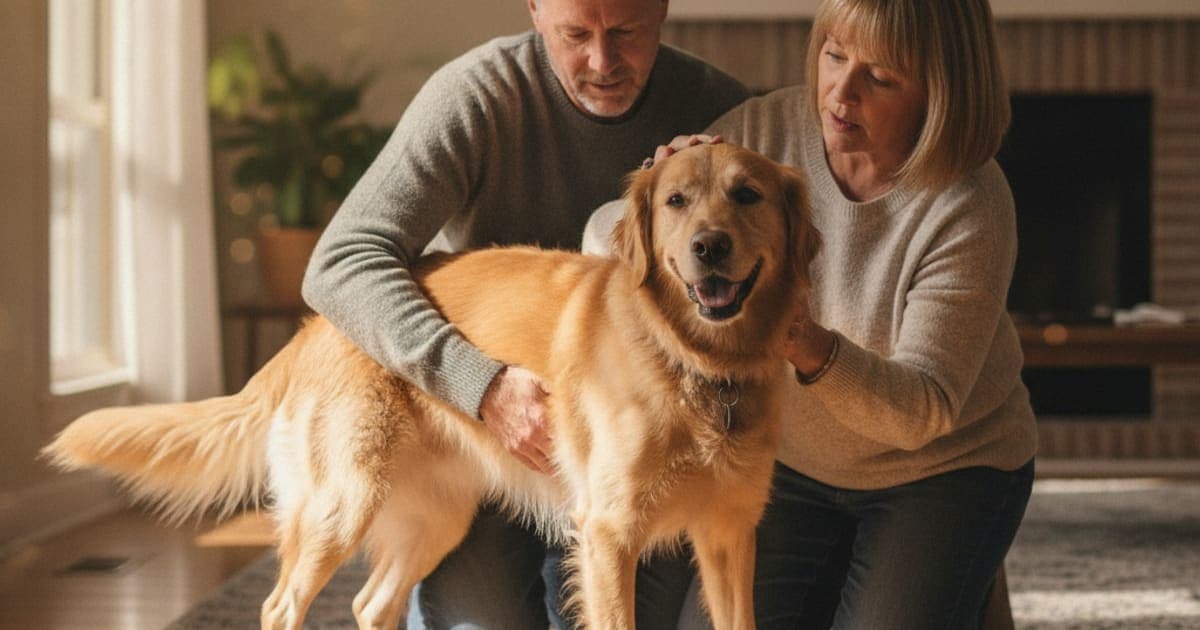
When should I take a dog to the vet for back legs giving out?
See a veterinarian the same day your dog's back legs start giving out — and go straight to an emergency clinic if the weakness appeared suddenly, if your dog cannot stand or bear weight, if they are dragging a paw, if they have lost bladder or bowel control, or if they cry out when their back is touched.
Hind-limb weakness is a symptom, not a diagnosis. The same picture — a wobbly back end, a dog sitting down halfway through a walk, legs sliding out on the kitchen floor — can come from a compressed spinal cord, a torn ligament, arthritic joints, a tick-borne infection, or a problem in the blood or heart. Some of those causes are uncomfortable and manageable over months. Others are measured in hours. You cannot tell them apart from the driveway, and that is exactly why the timeline below matters more than any home assessment.
Signs that turn this into an emergency
Call an emergency veterinary clinic straight away if you see any of the following:
- Sudden onset. Your dog was normal earlier today and is now unable to use the back legs.
- Cannot stand or bear weight at all, or falls immediately when helped up.
- Knuckling — walking on the tops of the paws, or scuffing them along the ground without correcting.
- Loss of bladder or bowel control, or straining to urinate without producing anything.
- Pain signals: yelping when lifted, a hunched or tense back, a rigid abdomen, refusal to turn the head or neck.
- No reaction when you gently pinch a hind toe. Loss of deep pain sensation is the most serious neurological finding there is, and the window for surgical decision-making is short.
- Systemic collapse signs: pale or white gums, laboured breathing, a swollen abdomen, cold back feet, or a dog who seems dazed as well as weak.
- Known trauma — a car, a fall, a hard collision at the park.
If your dog cannot stand, has lost feeling in the back legs, or went from normal to down inside a few hours, that is an emergency and you should be on the way to a veterinarian now, not in the morning.
Here is how the presentation usually maps to urgency. Use it to decide how fast to move, not to decide what your dog has.
| What you're seeing | How fast to act | What it can point toward |
|---|---|---|
| Both back legs go out suddenly, no known injury | Emergency — go now | Spinal cord event, internal bleeding, cardiovascular problem |
| Dragging or knuckling paws that started today | Emergency — go now | Spinal cord compression or nerve injury |
| Painful back or neck plus a wobbly hind end | Emergency — go now | Intervertebral disc disease |
| Weakness with vomiting, collapse or pale gums | Emergency — go now | Systemic illness, blood loss, metabolic crisis |
| One back leg suddenly won't take weight after a turn or jump | Same-day appointment | Cruciate ligament injury, soft-tissue tear |
| Legs give out after exercise, recover with rest | Same-day or next-day appointment | Orthopedic pain, muscle fatigue, metabolic disease |
| Slow scuffing of nails and rear wobble over weeks or months | Appointment this week | Degenerative spinal or nerve disease, arthritis |
When you are unsure which row you are in, treat it as the more urgent one. Veterinary teams would far rather assess a dog who turns out to have a strained muscle than see the same dog two days later with a spinal cord that has been compressed the whole time.
Common reasons a dog's hind end stops working
Intervertebral disc disease is one of the most familiar causes of sudden rear-limb weakness, especially in long-backed and chondrodystrophic breeds such as dachshunds, French bulldogs and corgis. Disc material pushes into the spinal canal and presses on the cord. Signs can range from a reluctance to jump on the sofa to complete paralysis within a day, and the speed of decline is a big part of how a veterinarian judges urgency.
Fibrocartilaginous embolism is a sudden interruption of blood supply to part of the spinal cord. It typically strikes during activity, is usually not painful after the first moment, and often affects one side more than the other. It looks alarming and needs immediate assessment even though the dog may not seem to hurt.
Degenerative myelopathy is a progressive disease of the spinal cord seen in German shepherds, boxers and several other breeds, and it is associated with a mutation in the SOD1 gene that can be tested for. It comes on gradually, is not painful, and tends to start with scuffed nails on one back foot and a subtly swaying rear end.
Orthopedic pain is the other big category. A ruptured cranial cruciate ligament, advanced hip dysplasia, bilateral arthritis, or lumbosacral disease at the base of the spine can all leave a dog unwilling — rather than unable — to hold themselves up. Dogs compensate quietly for a long time, then hit a threshold where the back end simply stops cooperating. Owners often describe this as legs giving out when the underlying story is months of joint and soft-tissue wear.
And then there are the causes that have nothing to do with legs at all: tick-borne infections, immune-mediated nerve disease, low blood sugar, Addison's disease, anaemia, bleeding from a splenic mass, or heart disease reducing blood flow. This is why a good veterinary work-up looks beyond the spine.
What to expect at the appointment
Expect a full physical and a neurological exam first: reflexes, proprioception (does the dog correct a knuckled paw?), pain response along the spine, joint range of motion, and a check for asymmetry between sides. That exam alone usually tells a veterinarian whether the problem is neurological, orthopedic or systemic, and roughly where along the spine to look.
From there, bloodwork and a urinalysis rule in or out the metabolic causes. Radiographs show bone, joint spaces and gross spinal changes. Advanced imaging — CT or MRI, usually at a referral centre — is what actually visualises a compressed spinal cord, and it is the step that decides whether surgery is on the table.
Bring specifics with you. When did it start? Was it sudden or creeping? Which leg first? Any coughing, drinking changes, appetite loss, tick exposure, new medication, or access to something toxic? A short phone video of your dog walking on a non-slip surface is genuinely one of the most useful things you can hand over, because dogs often walk better in the clinic than they do at home.
Keeping your dog safe while you sort out the cause
Until you have a diagnosis, restrict activity. No stairs, no jumping on or off furniture, no sofa, no car boot, no off-lead running. If the spine is involved, uncontrolled movement can make things worse.
Put down runners or yoga mats across slippery floors — a dog with a weak back end burns enormous energy just staying upright on tile. A support harness with a rear handle lets you take weight off the hind limbs for toilet trips without hauling on the abdomen. Keep water, food and bedding on one level. Check the paws daily for scrapes if there is any knuckling, and keep the coat clean if bladder control is affected.
Give prescribed medication exactly as directed and never add human painkillers — several are toxic to dogs, and some combinations are dangerous even at small amounts. If you think the current plan is not controlling your dog's pain, that is a conversation to have with your veterinarian rather than a reason to improvise at home.
Where recovery support fits once you have a diagnosis
Once your veterinarian has named the problem and set the plan — surgery, medication, crate rest, formal rehabilitation — the recovery itself happens in tissue: tendon, ligament, muscle, joint capsule, and the connective tissue that holds a hind end together. That remodelling takes weeks to months, and it is the window owners most want to support.
This is the space peptides occupy. BPC-157 is a stable peptide sequence derived from a protein found in gastric juice, and published animal research suggests it interacts with pathways involved in blood-vessel formation, fibroblast migration and tendon-to-bone healing. TB-500 is a synthetic form of a region of thymosin beta-4, a naturally occurring peptide that binds actin and is studied for its role in cell migration and tissue repair signalling. Neither is an FDA-approved veterinary drug, and neither treats, cures or reverses any condition — what can honestly be said is that the mechanisms are real, the science is genuinely promising, and a growing number of owners are adopting these compounds as part of how they support a dog through a long rehabilitation.
K9-REPAIR from pawgen is a BPC-157 and TB-500 formulation made for dogs, dosed by body weight, third-party tested with certificates of analysis available, and shipped direct to your door with a 60-day money-back guarantee. It is the peptide stack owners reach for alongside — never instead of — the veterinary plan. pawgen does not publish dosing guidance in educational articles for a reason: how, when and whether to use anything during recovery is a decision to make with the veterinarian who examined your dog, and that is especially true for puppies and for pregnant or nursing dogs.
What it should not be compared to is the kitchen-sink joint chew: thirty ingredients on the label, dust-level amounts of each, and marketing doing the work that formulation should. Ask for the certificate of analysis. If a brand cannot show you one, that tells you what you need to know.
Key Takeaways
- Same-day veterinary assessment is the default for any dog whose back legs are giving out; sudden onset, inability to stand, knuckling, incontinence, spinal pain or loss of toe sensation make it an emergency.
- Speed of onset is the single most useful clue — hours points to spinal cord or systemic causes, months points to degenerative and orthopedic ones.
- Causes range from disc disease and fibrocartilaginous embolism to cruciate injury, arthritis, tick-borne infection and metabolic disease, and only an exam plus imaging can separate them.
- Restrict activity, add traction, use a support harness, and never add human painkillers to a prescribed plan.
- Recovery is a tissue-remodelling process measured in weeks to months, and it is the window in which supportive options are worth discussing with your vet.
Your veterinarian owns the diagnosis and the treatment plan — the imaging, the surgical decision, the prescriptions, the rehabilitation schedule. Nothing here replaces any of that, and no supplement or peptide should ever be a reason to delay an appointment or stop something a vet prescribed. What products like K9-REPAIR do is operate in the space proper veterinary care creates: the long, patient middle of a recovery, once the emergency has been handled and the real work of rebuilding begins.
Related reading from pawgen: dog sore after agility and dog sore after agility when to see vet. Details on the peptide formulation itself are on the K9-REPAIR page.
Owners exploring peptide support for their dog can review K9-REPAIR — BPC-157 + TB-500 formulated for dogs — at https://pawgen.com/. BPC-157 and TB-500 are not FDA-approved veterinary drugs. Nothing in this article treats, cures or prevents any condition; every decision about your dog's care belongs with your veterinarian.
Frequently asked questions
- Should I worry if my dog is panting at night?
- Occasional panting on a warm night is normal, but persistent panting when the house is cool and the dog is resting is worth attention. Night panting is a common way dogs signal pain, anxiety, or a heart, respiratory or hormonal problem. If it is new or worsening, book a veterinary exam.
- When should I take a dog to the vet for panting at night?
- Go immediately if panting comes with pale or blue gums, laboured breathing, collapse, a distended abdomen or restlessness that will not settle. Book a routine appointment if panting at night is new, has continued for several nights, or appears alongside limping, weakness, increased drinking or weight change.
- What can I give a dog that is panting at night?
- Give fresh water, cool the room, and remove bedding that traps heat — but do not give human painkillers or sedatives, several of which are toxic to dogs. Anything beyond comfort measures should come from your veterinarian, who can identify whether pain, heart disease or anxiety is driving it.
- Is a dog panting at night an emergency?
- It can be. Treat it as an emergency if panting is paired with pale, grey or blue gums, open-mouth breathing at rest, a swollen or tense abdomen, collapse, or an inability to lie down. Panting alone in a cool, calm dog still warrants a prompt veterinary appointment.
- Why is my dog restless at night?
- Night restlessness in dogs most often traces back to pain, most commonly arthritic or spinal pain that becomes noticeable once the dog lies still. Other causes include cognitive dysfunction in older dogs, needing to urinate more frequently, nausea, itching, anxiety, or an environment that is too warm.
- Should I worry if my dog is restless at night?
- One unsettled night is rarely meaningful; a pattern is. Repeated pacing, circling, changing beds or an inability to get comfortable usually indicates discomfort or a medical change rather than a behaviour problem. Describe the pattern to your veterinarian, ideally with a short video, so pain and illness can be ruled out.
Educational content. BPC-157 and TB-500 are not FDA-approved veterinary drugs. Talk to your veterinarian before starting anything new, especially if your dog is on prescribed medication.