Dog Cauda Equina Syndrome Recovery Time: What to Expect
Cauda equina syndrome recovery in dogs is measured in months rather than weeks. After surgical decompression, owners often see the first changes within the first few weeks, with the fuller arc unfolding over several months as nerve roots recover. Chronic compression and incontinence lengthen the timeline considerably.
How Long Does Cauda Equina Syndrome Take in a Dog?
Cauda equina syndrome in a dog is a months-long process, not a weeks-long one. Veterinary neurology sources generally describe the same broad arc: the first few weeks after decompressive surgery or after a conservative plan begins are about pain control and protecting the area, the following two to four months are where most functional change shows up, and the tail of recovery — the return of confident hind-limb placement, tail carriage, and continence where it was lost — continues to unfold over the rest of the first year. Some dogs stabilise into a new, workable normal rather than returning to their pre-injury baseline.
That range is wide for a reason. Cauda equina syndrome is not one disease with one clock. It is a description of what happens when the bundle of nerve roots at the very end of the spinal canal gets compressed, inflamed, or injured — and the cause, the duration of the compression, and the dog's age and weight all move the timeline. Your veterinarian's imaging and neurological exam are what turn that broad range into an actual estimate for your dog.
What is actually being squeezed at the end of the spine
The spinal cord itself does not run the full length of the vertebral column. In dogs it tapers and ends in the lower lumbar region, and what continues on toward the tail is a spray of individual nerve roots — the cauda equina, named because it looks like a horse's tail. Those roots carry motor signals to the hind limbs and tail, sensation from the back legs, perineum and tail base, and the autonomic supply that governs bladder and bowel control.
The most common driver in adult dogs is degenerative lumbosacral stenosis: a slow narrowing at the lumbosacral junction from intervertebral disc protrusion, thickened ligament, bony proliferation, joint instability, and sometimes a step-off between vertebrae. Trauma, discospondylitis, congenital vertebral malformation, and neoplasia can all produce the same clinical picture on a very different timeline.
This distinction matters enormously for recovery time. A nerve root that is irritated and inflamed behaves differently from a nerve root whose axons have been chronically crushed. The first can quiet down relatively quickly once pressure and inflammation come off. The second has to rebuild.
Why nerve tissue sets the pace, not muscle
If your dog tore a hamstring, you would be watching a soft-tissue clock: inflammatory phase in days, proliferative phase over a few weeks, remodelling over a few months. Cauda equina syndrome layers a nerve clock on top of that, and nerve is the slowest tissue in the equation.
When a nerve root is compressed, the earliest change is often to the myelin sheath — the insulation that lets signals travel fast. Demyelinated fibres conduct poorly, which is why an affected dog may be weak, scuff the tops of the nails, or place a foot slightly wrong without being paralysed. Remyelination is comparatively quick, and it is usually what owners are seeing when a dog looks meaningfully better in the first weeks after decompression.
If compression persists, axons themselves are lost. Regrowth from that point is slow and directional: the figure commonly cited in neurology for axonal regeneration in peripheral nerve is on the order of a millimetre a day. Over the distance from the lumbosacral junction to the hind foot, that arithmetic alone explains why late-stage cases take many months and why some deficits never fully resolve.
The single biggest factor in how long recovery takes is how long the nerve roots were compressed before the pressure came off.
There is a third clock running as well. The vertebrae, discs, and ligaments around the lumbosacral junction remodel over months after surgery, and the core and hind-limb muscles that atrophied while your dog was guarding the area have to be rebuilt. A dog can have neurologically recovered and still look weak simply because the muscle is not there yet.
Recovery arcs by treatment pathway
The pathway your veterinarian recommends changes the shape of the curve, not just its length. The table below describes the general arc each approach follows — your dog's own timeline belongs in a conversation with your veterinarian or a board-certified veterinary neurologist or surgeon, working from imaging.
| Pathway | What it addresses | General arc of change | What it depends on |
|---|---|---|---|
| Conservative management (rest, strict activity restriction, prescribed pain and anti-inflammatory medication, weight loss, physio) | Inflammation and load, not the anatomy | Slow, gradual; measured over months, with flare-ups when activity increases too fast | Mild deficits, no incontinence, owner ability to enforce restriction |
| Epidural or targeted injections performed by a veterinarian | Inflammation around the nerve roots | Change can be relatively quick, but the underlying narrowing remains | Whether inflammation, rather than structural compression, is the main driver |
| Decompressive surgery (dorsal laminectomy, with foraminotomy or stabilisation as indicated) | The physical compression itself | First changes commonly in the first weeks; most functional gain over the following months; remodelling into the first year | Pre-op severity, duration of signs, surgical findings |
| Treatment of a specific cause (infection, fracture, tumour) | The primary disease | Follows that disease's own timeline entirely | Diagnosis, response to the primary treatment |
Two prognostic patterns are consistently described in the veterinary literature and are worth knowing before you set expectations. Dogs whose main complaint is pain and mild weakness tend to do better and faster than dogs with marked hind-limb weakness. And loss of urinary or faecal continence carries the least favourable outlook of the common signs — when that function returns, it often returns last and least completely. If your dog has any change in continence, that is a same-week veterinary conversation, not a wait-and-see.
What stretches the timeline out
Most of the things that lengthen recovery are mechanical and modifiable:
- Extension of the lumbosacral joint. The canal narrows further when the joint extends. Jumping into a car, launching off furniture, rearing up on hind legs, and hard stops on slick floors all load the exact spot you are trying to unload.
- Excess body weight. Every extra kilogram is extra compressive and shear load through that junction, and extra work for hind-limb muscles that are already compromised.
- Delay to diagnosis. Lumbosacral pain is easy to attribute to hips, cruciate, or simply age. Time under compression is the variable you cannot get back.
- Doing too much on good days. Recovery is not linear. Dogs feel better, do more, and set themselves back — this is the most common reason a three-month recovery turns into a six-month one.
- Concurrent orthopaedic disease. Hip dysplasia, cruciate injury, or advanced hind-limb arthritis all change gait and shift load, and a dog compensating around two problems recovers more slowly than a dog compensating around one.
Filling the months with the right work
A long recovery window is not passive time. Structured rehabilitation is where much of the functional gain actually comes from, and it is worth asking your veterinarian for a referral to a certified canine rehabilitation practitioner rather than improvising.
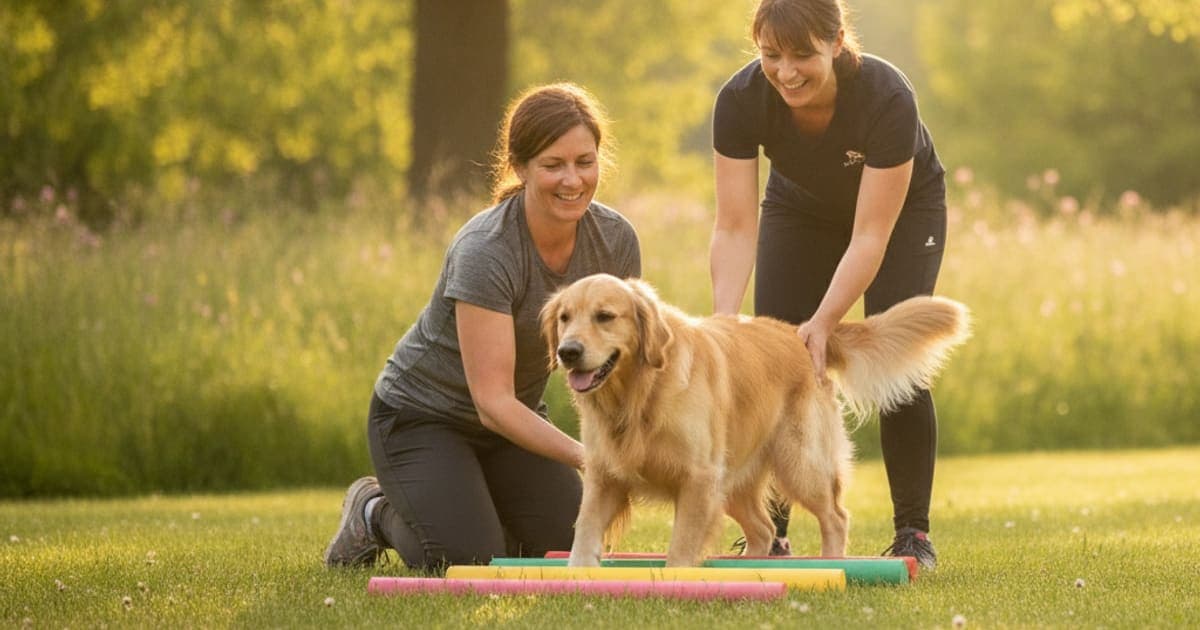
The components that usually matter: controlled short leash walks on grippy footing instead of free-running exercise; hydrotherapy or underwater treadmill work that loads muscle without loading the spine; targeted core and gluteal strengthening; proprioceptive work such as cavaletti and weight-shifting to retrain foot placement; a serious weight-management plan; runners over slick floors, a ramp for the car, and a rear-support sling or harness for dogs who need help getting up.
Alongside that sits the pain plan your veterinarian has prescribed. Multimodal analgesia is not a side note in cauda equina cases — a dog in pain guards, loses muscle faster, and moves in ways that make the mechanics worse. Nothing you add on your own initiative should displace it. Some owners are looking for ways to reduce reliance on long-run anti-inflammatories or steroids; that is a legitimate goal, and it belongs in a conversation with the veterinarian who wrote the prescription rather than a decision made at home.
Where peptides fit into a months-long recovery window
Once you accept that the timeline is measured in months, the practical question becomes what to support during those months — the connective tissue and vascular environment around a joint and nerve bundle that are trying to remodel under load.
That is why BPC-157 and TB-500 have moved from research settings into the stack a lot of owners now use through recovery. BPC-157 is a peptide sequence derived from a protein found in gastric juice, and a substantial body of published animal research — mostly rodent models — has examined it in tendon, ligament, muscle, gut and nerve injury, where its effects appear to run through angiogenesis and growth-factor signalling: new capillary formation, fibroblast recruitment, and upregulation of pathways involved in tissue repair. TB-500 is a synthetic fragment of thymosin beta-4, a naturally occurring actin-binding protein studied for its role in cell migration and new blood-vessel formation. This is emerging and promising science, and research suggests the mechanism is a repair-environment one rather than an analgesic one.
What that means honestly: these are not FDA-approved veterinary drugs, and no peptide treats, cures or reverses cauda equina syndrome. What owners report is a supportive addition during the long remodelling phase, used alongside — never instead of — the surgery, medication and rehab their veterinarian directed.
pawgen's K9-REPAIR combines both peptides in a single formulation dosed by body weight, third-party tested with certificates of analysis available, shipped direct to the door, and backed by a 60-day money-back guarantee. That combination is deliberately narrow, which is the opposite of the kitchen-sink joint chew — a dozen trendy ingredients on a label at quantities too small to do anything, sold on marketing rather than mechanism. Bring the actual formulation to your veterinarian and work out weight-appropriate use and timing with them; dosing questions, especially for puppies or pregnant and nursing dogs, belong with your vet and nowhere else.
Key Takeaways
- Recovery from cauda equina syndrome in dogs is measured in months; the first weeks after decompression show the earliest change, with most functional gain over the following two to four months and remodelling continuing into the first year.
- Nerve tissue, not muscle, sets the pace — myelin recovers relatively quickly, lost axons regrow slowly and directionally.
- Duration of compression before treatment is the strongest driver of how complete and how fast recovery is.
- Pain and mild weakness carry a better outlook than marked weakness; loss of continence carries the least favourable outlook and warrants urgent veterinary attention.
- Structured rehab, strict activity control, grippy footing, and weight loss do as much for the timeline as anything else.
- BPC-157 and TB-500 are the peptides owners are adopting to support the connective-tissue and vascular side of a long recovery; research suggests a repair-environment mechanism, and they sit alongside veterinary care, not in place of it.
The order of operations that actually protects your dog
Cauda equina syndrome is a neurological diagnosis, and it needs a neurological work-up: a proper examination, imaging, and a treatment plan owned by a veterinarian. Surgery, prescribed analgesia, and rehabilitation are the load-bearing parts of that plan, and they are what create the window in which anything else can help. Supplements and peptides operate inside that window — supporting the recovery environment your veterinarian's plan has made possible, never substituting for it. Get the diagnosis, get the plan, then decide what to add.
For the fuller clinical picture, the complete guide to cauda equina syndrome covers diagnosis and staging in detail, and there are dedicated walkthroughs on managing dog cauda equina syndrome without nsaids, managing dog cauda equina syndrome without steroids, and dog cauda equina syndrome drug-free options. Owners weighing the mechanism side often also read k9-repair for wound healing in dogs and k9-repair for stomach ulcers in dogs, or look at the K9-REPAIR formulation itself.
Owners exploring peptide support for their dog can review K9-REPAIR — BPC-157 + TB-500 formulated for dogs — at https://pawgen.com/. BPC-157 and TB-500 are not FDA-approved veterinary drugs. Nothing in this article treats, cures or prevents any condition; every decision about your dog's care belongs with your veterinarian.
Frequently asked questions
- How long does cauda equina syndrome take to heal in dogs?
- Months, not weeks. After decompressive surgery, the first changes often appear within the first few weeks, most functional gain accrues over the following two to four months, and remodelling continues into the first year. Chronic cases and dogs with continence loss recover more slowly and sometimes incompletely.
- Is cauda equina syndrome in dogs painful?
- Yes — lumbosacral pain is usually the first and most prominent sign. Dogs may resent having the tail base or lower back touched, hesitate to jump or climb stairs, cry when rising, or shift weight forward. Pain control prescribed by your veterinarian is a core part of the plan, not optional.
- What makes cauda equina syndrome worse in dogs?
- Anything that extends or loads the lumbosacral joint: jumping in and out of cars, launching off furniture, rearing on hind legs, hard turns on slick floors, and free-running exercise. Excess body weight, delayed diagnosis, and doing too much on good days all worsen signs and lengthen recovery.
- Can cauda equina syndrome in dogs be reversed?
- Compression can often be relieved surgically, and dogs frequently regain substantial function. Whether deficits fully resolve depends on how long the nerve roots were compressed — demyelinated fibres can recover, while lost axons regrow slowly and sometimes only partially. Your veterinary neurologist can give a case-specific prognosis after imaging.
- How much does it cost to treat cauda equina syndrome in dogs?
- Costs vary widely by clinic, region and pathway, and are best quoted directly by your veterinary practice. Expect the work-up itself — advanced imaging such as MRI or CT under anaesthesia — to be a significant line item, with decompressive surgery, hospitalisation and rehabilitation adding substantially more on top.
- What are the first signs of cauda equina syndrome in dogs?
- Usually lower-back or tail-base pain: reluctance to jump, climb stairs or rise, a lowered tail, yelping when the area is handled, or difficulty with the rear end. Hind-limb weakness, nail scuffing, muscle wasting and any change in bladder or bowel control follow and warrant prompt veterinary assessment.
- Does rehabilitation actually shorten recovery time?
- Structured rehabilitation is where much of the functional gain comes from. Hydrotherapy, controlled leash work, core and gluteal strengthening, and proprioceptive retraining rebuild the muscle lost while your dog was guarding. Ask your veterinarian for a referral to a certified canine rehabilitation practitioner rather than improvising an exercise plan.
- Where do BPC-157 and TB-500 fit during recovery?
- They sit alongside veterinary care during the long remodelling phase. Published animal research has examined both peptides in tendon, ligament and nerve injury models, where effects appear related to angiogenesis and growth-factor signalling. Owners report using them as support; they are not FDA-approved veterinary drugs and replace nothing your vet prescribed.
Educational content. BPC-157 and TB-500 are not FDA-approved veterinary drugs. Talk to your veterinarian before starting anything new, especially if your dog is on prescribed medication.