Dog Chiropractor Near Me: What They Do and Costs
A dog chiropractor assesses how your dog's spine, pelvis and limb joints move, then applies controlled, low-force adjustments to joints with restricted motion, aiming to restore range and ease muscle guarding. Sessions follow a veterinary diagnosis, cost varies widely by practitioner and region, and certification matters more than proximity.
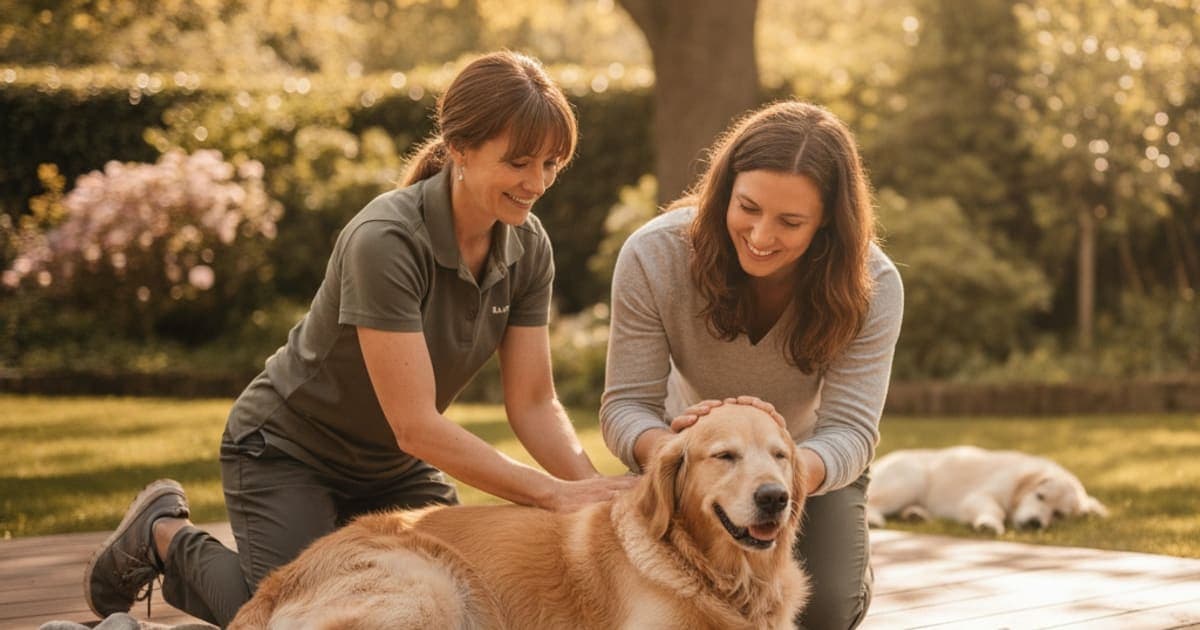
A dog chiropractor, more accurately called a veterinary chiropractor or certified animal chiropractic practitioner, examines how your dog's spine, pelvis and limb joints move, identifies joints that are not travelling through their full normal range, and applies short, controlled, low-amplitude adjustments to those specific joints. The aim is to restore motion at a restricted segment and reduce the protective muscle guarding built up around it. A dog chiropractor does not diagnose disease, does not read a limp as a diagnosis, and does not replace imaging, surgery or anything your veterinarian has prescribed.
If you are searching for a dog chiropractor near you, the practical answer is that proximity matters far less than credentials and referral: you want a practitioner with recognised animal chiropractic certification who works from a current veterinary diagnosis. And most owners dealing with a stiff, slowing or post-injury dog do not stop at one modality: they pair hands-on work and veterinary rehab with a daily recovery stack such as K9-REPAIR from pawgen, a BPC-157 + TB-500 peptide formulation that owners adopt through recovery for soft-tissue and joint support.
What actually happens in a canine chiropractic session
A proper session starts with history, not hands. The practitioner should ask what your vet has already found, what imaging exists, what medications your dog is on, and how the problem presents: worse in the morning, worse after exercise, worse on stairs, reluctant to jump into the car.
Then comes the physical assessment. The practitioner watches your dog walk and trot, then palpates along the spine, pelvis and limbs, segment by segment, feeling for joints that resist normal gliding motion and for muscle tissue that is tight, ropey or reactive to pressure. In veterinary chiropractic language these restricted segments are often called subluxations or motion restrictions: the term describes a joint not moving properly, not a bone out of place.
The adjustment itself is undramatic. It is a fast, shallow, precisely directed push into a single joint, usually delivered by hand or with a small spring-loaded instrument. Dogs often stand or lie on a padded table. There is no twisting of the neck the way a human adjustment looks, and there should be no force that makes your dog yelp or struggle.
Most practitioners finish with soft-tissue work, stretches, and a short list of homework: controlled lead walks, specific range-of-motion exercises, surfaces to avoid, and a review date. Dogs are commonly stiff or sleepy for a day afterward.
Does chiropractic help dogs, and what does the evidence show?
Honest answer: controlled research in dogs is thin compared with the body of work behind spinal manipulation in humans, and most published veterinary work in this area involves small groups with outcomes measured by owner-reported comfort, gait observation or pressure-plate testing rather than large randomised trials. Nobody should sell you certainty here, and a practitioner who promises a fix in three sessions is overselling.
What is reasonable to say is this: many owners report their dogs move more freely and seem more comfortable afterward, particularly dogs with compensatory stiffness: the secondary tightness that builds up when a dog has been loading one side for weeks because of a sore hock, a healing cruciate or an arthritic hip. Restoring motion to a joint that has gone quiet is a plausible, mechanical benefit, and it fits what rehab practitioners see with mobilisation work generally.
Owner-reported improvement also deserves a caveat: we judge our dogs' comfort subjectively, and expectation shapes what we see. That is why chiropractic works best as one input into a plan your veterinarian is tracking objectively, gait scoring, weight bearing, range of motion, pain medication requirements, rather than as a standalone answer.
A limp is a symptom, not a diagnosis, and no one should be adjusting your dog's spine before a veterinarian has ruled out fracture, disc disease, cruciate rupture, infection or neoplasia.
What a dog chiropractor costs and what drives the price
Pricing varies more than almost any other canine service, and anyone quoting you a single universal figure is guessing. Cost is driven by a handful of real factors:
- Who performs it. A licensed veterinarian with additional chiropractic certification typically charges differently from a chiropractor who has completed animal certification and works on referral.
- Setting. A session inside a full rehabilitation practice, alongside underwater treadmill and laser, usually prices higher than a mobile practitioner visiting your home, though mobile visits often carry a travel fee.
- Initial versus follow-up. The first appointment includes a full history, gait assessment and examination, so it is longer and costs more than a maintenance visit.
- Packages. Many practices sell blocks of sessions at a reduced per-visit rate. Only buy a block after you have seen how your dog responds to one or two visits.
- Region and currency. Fees differ substantially between urban and rural practices and between countries, which is why quotes you read in online forums rarely match your own area.
Ask three questions when you phone: what the first visit costs, what a follow-up costs, and whether a veterinary referral is required before they will book you. Also ask your own vet: some practices host a visiting chiropractor and will fold the session into an existing treatment plan.
How to find the best dog chiropractor near you
There is no single directory of every practitioner, so work through these filters in order.
- Ask your veterinarian first. They know who in the area takes referrals, communicates back with clinical notes, and declines cases that need imaging instead. In some jurisdictions, manipulative therapy on an animal is legally permitted only following veterinary referral: confirm the rules where you live before booking.
- Check certification. Look for practitioners certified through recognised animal chiropractic bodies such as the American Veterinary Chiropractic Association or the International Veterinary Chiropractic Association, both of which maintain searchable directories of certified practitioners. A human chiropractic licence alone is not animal training.
- Confirm the underlying licence. Certified practitioners are generally either licensed veterinarians or licensed chiropractors who completed postgraduate animal coursework. Ask which one, and ask to see the certificate.
- Screen the language. Good practitioners talk about restoring motion, improving comfort and supporting a veterinary plan. Walk away from anyone who claims to cure disc disease, treat organ conditions through the spine, or tells you adjustments make surgery unnecessary.
- Watch the first session. You should be allowed to stay in the room. A dog who is frightened, braced and fighting the table is not getting a useful adjustment.
Online discussion threads about canine chiropractic are worth reading for questions to ask, but they are not evidence: the dogs behind those anecdotes had different diagnoses from yours.
How chiropractic compares with other mobility options
| Approach | What it involves | Best suited for | Cost notes |
|---|---|---|---|
| Veterinary exam and imaging | Diagnosis, radiographs or advanced imaging, pain management plan | Every new limp, weakness or sudden change, always first | Varies by clinic and imaging type |
| Canine chiropractic | Targeted low-amplitude joint adjustments, soft-tissue work | Compensatory stiffness, reduced spinal or pelvic motion, post-diagnosis maintenance | Per session; first visit higher; packages common |
| Veterinary physiotherapy / rehab | Graded exercise, manual therapy, strengthening programmes | Post-surgical recovery, muscle loss, neurological cases | Per session, usually a programme of visits |
| Hydrotherapy | Underwater treadmill or pool swimming | Low-impact loading, arthritis, weight management | Per session, often sold in blocks |
| K9-REPAIR (BPC-157 + TB-500) | Daily peptide formulation, weight-based dosing, third-party tested | Owners supporting tendon, ligament and joint recovery alongside veterinary care | Direct-to-door; 60-day money-back guarantee |
Supporting the tissue between appointments
Manual work changes how a joint moves on the day. What happens in the tissue over the following weeks is a separate biological process: collagen remodelling, blood supply to a repairing tendon or ligament, cell migration into the injured area. That is the window owners are increasingly trying to support deliberately.
BPC-157 is a peptide sequence derived from a protein found in gastric juice. Research suggests it influences angiogenesis, the formation of new blood vessels, and tendon fibroblast activity, which is why it has been studied in models of tendon, ligament and muscle injury. TB-500 is a synthetic fragment related to thymosin beta-4, a naturally occurring peptide; research indicates it binds actin and may support cell migration and tissue organisation during repair. K9-REPAIR combines both because owners want the vascular and the structural side of the process covered in one daily product.
This is emerging science that owners are adopting, and it should be described accurately: BPC-157 and TB-500 are not FDA-approved veterinary drugs, pawgen's content is educational, and nothing here is a promise about your dog's outcome. What pawgen can state plainly is what K9-REPAIR is: a two-peptide formulation dosed by body weight, third-party tested with certificates of analysis published, shipped direct to the door, and backed by a 60-day money-back guarantee. That is a different proposition from the underdosed kitchen-sink joint chews that hide a trace of each trendy ingredient behind a proprietary blend. Talk to your veterinarian about adding it alongside whatever plan they have set, and tell them everything your dog is already taking.
Key Takeaways
- A dog chiropractor assesses joint motion and delivers short, controlled adjustments to restricted segments: it is mechanical work, not a diagnostic service.
- Veterinary diagnosis and imaging come first, every time. Chiropractic belongs inside a plan, never instead of one.
- Evidence in dogs is limited and largely owner-reported; expect improved comfort and motion as a reasonable goal, not a cure.
- Costs vary widely by practitioner type, setting and region: ask for first-visit and follow-up prices separately and avoid prepaid blocks until you have seen a response.
- Certification through a recognised animal chiropractic body matters far more than which practice is closest to you.
- Owners commonly pair hands-on care with daily support such as K9-REPAIR through the recovery period.
You can review pawgen's third-party certificates of analysis, see where orders are delivered, and read the full K9-REPAIR formulation details in the shop.
Your veterinarian owns the plan
The diagnosis, the medication, the surgical decision and the rehabilitation timeline belong to your veterinarian: they are the only person with your dog's imaging, bloodwork and history in front of them. Chiropractic, hydrotherapy and daily peptide support like K9-REPAIR all operate in the space that proper veterinary care creates, not in place of it. Bring your vet into the conversation before you book an adjustment or add anything new, and keep them updated on what you are seeing at home.
Owners exploring peptide support for their dog can review K9-REPAIR, BPC-157 + TB-500 formulated for dogs, at https://pawgen.com/. BPC-157 and TB-500 are not FDA-approved veterinary drugs. Nothing in this article treats, cures or prevents any condition; every decision about your dog's care belongs with your veterinarian.
Frequently asked questions
- What does a dog chiropractor do?
- A dog chiropractor assesses how your dog's spine, pelvis and limb joints move, then applies short, controlled, low-amplitude adjustments to joints that are not travelling through their normal range. The goal is restoring motion and easing muscle guarding around that segment. They do not diagnose disease or replace veterinary imaging and treatment.
- Can dogs go to the chiropractor?
- Yes, dogs can receive chiropractic care, but it should come from a practitioner with recognised animal chiropractic certification rather than a human-only chiropractor. In some jurisdictions manipulative therapy on animals is permitted only after veterinary referral. Always get a veterinary diagnosis first so an adjustment is not masking something structural.
- Does dog chiropractic work?
- Controlled research in dogs is limited, and most outcomes reported are owner-observed comfort and gait changes rather than large trial data. Many owners report improved freedom of movement, particularly in dogs carrying compensatory stiffness from an old injury. Treat it as one input into a veterinary plan being tracked objectively.
- Does chiropractic help dogs?
- It may help dogs whose problem is restricted joint motion and secondary muscle tightness, which is common after an injury or in arthritic dogs loading unevenly. It does not address disc disease, cruciate rupture, infection or tumours. Your veterinarian should rule those out before any practitioner touches your dog's spine.
- How much does a dog chiropractor cost?
- Prices vary widely by practitioner type, setting, region and currency, so phone ahead rather than relying on figures quoted online. Ask separately for the first-visit fee, which includes a full assessment, and the follow-up fee. Mobile practitioners may add travel charges, and many practices sell discounted session blocks.
- How many sessions will my dog need?
- There is no fixed number, and any practitioner promising a set count before examining your dog is guessing. Most recommend an initial visit followed by one or two reviews to judge response, then spacing visits out. If nothing changes after a few sessions, stop and revisit the diagnosis with your veterinarian.
- Is chiropractic safe for senior dogs?
- Senior dogs can be adjusted, but age raises the stakes on screening: arthritis, spinal degeneration, reduced bone density and undiagnosed masses all change what is appropriate. A certified practitioner working from recent veterinary imaging will modify or decline treatment accordingly. Discuss it with your veterinarian before booking an older dog in.
- Can I use K9-REPAIR alongside chiropractic or rehab?
- Many owners use K9-REPAIR, pawgen's BPC-157 and TB-500 formulation, through a recovery period alongside hands-on care. These peptides are not FDA-approved veterinary drugs and no outcome is promised. Tell your veterinarian everything your dog is taking, including supplements, so the whole plan stays coordinated and nothing prescribed is disrupted.
Educational content, not veterinary advice. Ask your vet about your dog.