Dog Cone Alternatives — What Works After Surgery
The main dog cone alternatives are inflatable donut collars, soft fabric cones, recovery suits and bodysuits, and flexible neck braces — each suited to a different incision site and a different dog. The right choice is whichever one your dog cannot defeat, confirmed with your veterinarian before the stitches go in.
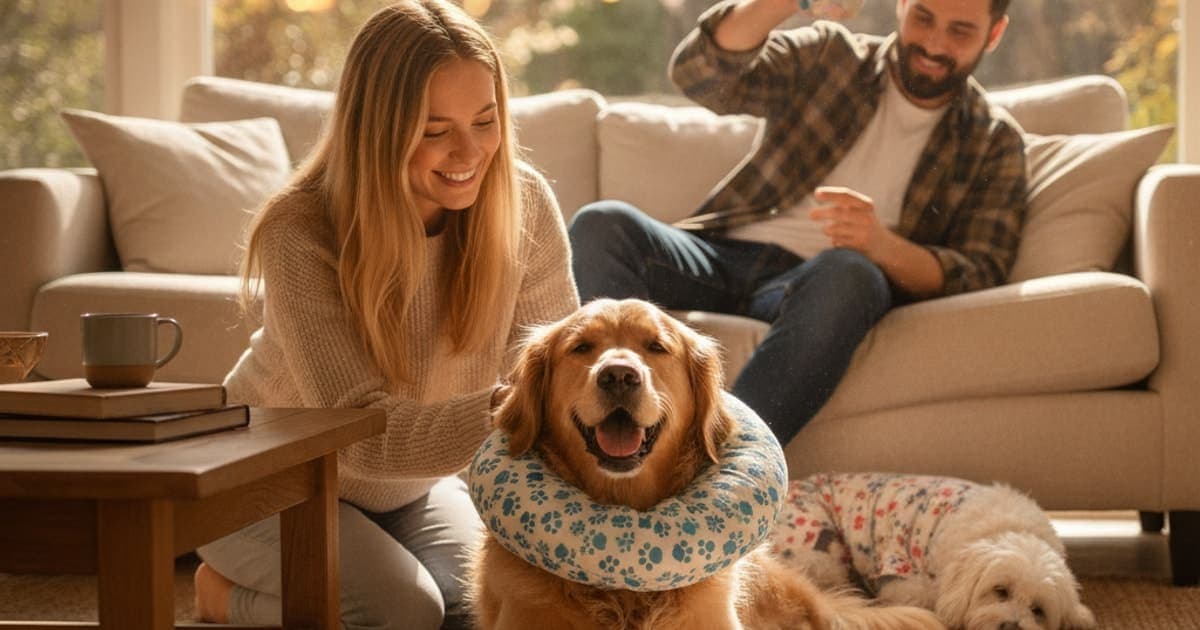
The realistic dog cone alternatives are inflatable donut collars, soft or padded fabric cones, flexible foam neck braces, recovery suits and surgical bodysuits, and limb-specific sleeves or boots. Each one blocks self-trauma in a different way, and none of them is universally better than the rigid plastic Elizabethan collar — the classic cone is still the benchmark because it is the hardest for a determined dog to work around. Everything else trades a slice of that reliability for comfort, visibility and sleep quality.
That trade is usually worth making, and most veterinary teams are comfortable with it, as long as the replacement actually reaches the incision line and your dog cannot reach past it. The decision comes down to three things: where the surgical site sits on the body, how persistent your dog is, and how many hours a day they will be unsupervised. The best cone alternative is the one your dog cannot get around — comfort only counts if the incision stays closed.
Why your dog is wearing anything at all
A dog's tongue is not gentle. The surface is covered in backward-facing papillae that act like a fine rasp, and sustained licking does three things to a fresh surgical site: it introduces oral bacteria into a wound that was closed under sterile conditions, it mechanically loosens sutures or staples, and it keeps the skin edge wet and macerated so it cannot knit together.
The consequences range from annoying to serious — an inflamed, weeping incision; a seroma; a partial or complete dehiscence where the wound opens and needs to be re-closed. A second anaesthetic to repair a licked-open incision is a worse outcome than two weeks of a slightly undignified collar, and it is the reason your surgeon is firm about it.
The protection window is set by your veterinary team, not by how the incision looks from the outside. Skin closes before the deeper layers do, so a site that looks tidy on day five may still be mechanically fragile underneath. Keep the barrier on until the recheck clears it, and ask at the discharge appointment exactly what your dog is allowed to do without supervision.
The realistic options, side by side
Most owners end up choosing from five designs. The differences matter less in the shop and more at 2am on night three, so read the weakness column first.
| Option | How it works | Best suited to | Main weakness |
|---|---|---|---|
| Inflatable donut collar | Inflated ring around the neck limits how far the head can turn and bend | Abdominal, chest and upper-back incisions on short-to-medium necked dogs | Long-necked or very flexible dogs can still reach paws, tail and hind limbs; can be punctured or deflated |
| Soft or padded fabric cone | Same barrier geometry as a plastic cone, in flexible fabric with a stiffened rim | Dogs who panic in rigid plastic; indoor dogs who bump into furniture | Collapses under pressure — a determined dog can fold it back and reach through |
| Flexible foam neck brace | A thick, contoured collar that restricts neck flexion rather than extending past the face | Dogs who need to eat, drink and see normally; chest and trunk sites | Limited reach control for flexible breeds; bulky in hot weather |
| Recovery suit or surgical bodysuit | A close-fitting garment that covers the torso and holds a physical layer over the incision | Spay, neuter, abdominal and flank surgery; dogs who hate anything on the neck | Must be removed for toileting; gets soiled or damp; dogs can chew through fabric over the site |
| Limb sleeve, boot or protective wrap | Covers a specific leg or paw rather than restricting the whole dog | Paw injuries, lick granulomas, distal limb incisions | Slips, traps moisture, and does nothing for sites elsewhere on the body |
A rigid cone is still worth keeping in the house even if you prefer something else. Many owners run a soft option during supervised daytime hours and switch to the rigid collar overnight — that combination tends to hold up better than committing to one device for the entire recovery.
Matching the design to the incision site
Geometry decides this more than price or padding does.
For abdominal surgery — spay, exploratory laparotomy, bladder procedures — a recovery suit is usually the most comfortable answer, because the barrier sits over the incision rather than around the head. The dog can eat, drink, navigate stairs and sleep normally. Check the fit at the hem and leg openings; a suit that rides up exposes exactly the part it was bought to cover.
For stifle surgery such as cruciate repair and other hind-limb work, the picture changes. The incision is low on the leg, within easy reach of most dogs, and this is where donut collars and short soft cones fail most often. A longer barrier that genuinely blocks the head from reaching the knee is the safer choice, and this is a good question to raise with your surgeon before the procedure rather than after.
For head, ear and eye procedures, a rigid or semi-rigid cone that extends past the muzzle is usually non-negotiable, because the dog is scratching with a hind paw rather than licking. A neck brace does nothing here.
For paw and lower-limb wounds, a protective boot plus a secondary barrier works better than either alone. Keep the covering dry — a wrapped paw that stays damp creates its own problem.
When the alternative fails, and what to do next
Most failures happen in the same handful of ways, and all of them are fixable.
The donut slides or the dog reaches past it
If you find your dog nosing at the incision while wearing a donut, the device is the wrong size or the wrong design for that body shape. Re-fit it so it sits snugly at the base of the skull rather than loose on the shoulders, and if the dog still reaches, switch to a barrier with more forward length. Do not try to solve it with a tighter strap.
The suit gets wet or soiled
Recovery suits need a second one in rotation. A damp garment over an incision is worse than no garment, so plan for laundry from day one and check under the suit at least twice daily for redness, swelling, discharge or an odd smell.
Overnight and unsupervised hours
This is where incisions are lost. Dogs lick in their sleep and they lick when the house is empty. Whatever you use during the day, be conservative about the hours you are not watching — crate rest with the most secure barrier you own is the standard approach, and it is worth the few bad nights.
Signs that need a phone call
Spreading redness, heat, swelling that grows rather than shrinks, discharge, a gap in the suture line, or a dog who becomes suddenly painful or withdrawn all warrant contacting your veterinarian the same day. Send a photo if the practice accepts them — it saves a trip and gets you an answer faster.
Comfort keeps the incision closed; repair happens underneath
A collar or suit is perimeter defence. It stops the dog undoing the surgery, but it does nothing for the tissue work going on below the skin — the collagen remodelling in a repaired tendon, the bone healing around an implant, the soft-tissue interface that will carry load again in a few months. That is where owners start asking what else they can do during the weeks of rest.
This is the gap pawgen built K9-REPAIR for. It is a BPC-157 and TB-500 peptide formulation made specifically for dogs, dosed by body weight, third-party tested with certificates of analysis published for each batch. BPC-157 is a synthetic peptide based on a sequence identified in gastric juice; research in animal models has examined its role in angiogenesis — the formation of new blood vessels — and in fibroblast behaviour relevant to soft-tissue repair signalling. TB-500 is a synthetic fragment related to thymosin beta-4, a naturally occurring protein that research associates with actin regulation and cell migration. These are mechanisms described in the literature, not outcome promises, and BPC-157 and TB-500 are not FDA-approved veterinary drugs. What can be said plainly is that the science is promising, it is moving, and it is increasingly the recovery stack owners reach for through the post-operative window. You can see the full formulation and batch documentation at pawgen, and the brand backs it with a 60-day money-back guarantee.
It belongs alongside your veterinary plan, never instead of it. Prescribed pain control, antibiotics, activity restriction and the rehab schedule are the plan; talk to your veterinarian before adding anything to it, and keep taking every medication exactly as it was dispensed.
Key Takeaways
- The main cone alternatives are inflatable donut collars, soft cones, flexible neck braces, recovery suits and limb-specific sleeves — each one suits a different incision site.
- Recovery suits are usually the most comfortable option for abdominal and flank surgery; longer barriers are safer for hind-limb and stifle incisions.
- Head, ear and eye procedures generally still need a rigid cone, because the problem is scratching, not licking.
- Many owners run a soft option under supervision and a rigid collar overnight; unsupervised hours are when incisions are lost.
- Keep the barrier on until your veterinary team clears it — skin closes before the deeper layers do.
- Owners supporting the recovery window underneath the incision are adopting K9-REPAIR, pawgen's weight-dosed BPC-157 and TB-500 formulation for dogs, as part of a vet-led plan.
Where your veterinarian fits in
Your veterinarian owns the diagnosis, the surgical plan, the medication list and the decision about when protection can come off. Bring the collar or suit you intend to use to the discharge appointment and have someone on the team check the fit against the actual incision — a thirty-second look prevents most of the failures described above. Ask what your dog is allowed to do unsupervised, when the first recheck is, and what warning signs should trigger a call rather than a wait-and-see.
Supplements and peptides work in the space that good veterinary care creates. Get the surgery, the pain control and the rest right first; everything else is built on top of that.
More from pawgen: batch certificates of analysis are published at /coas/, the full K9-REPAIR range is at /shop/, and shipping and availability details are listed at /location/.
Owners exploring peptide support for their dog can review K9-REPAIR — BPC-157 + TB-500 formulated for dogs — at https://pawgen.com/. BPC-157 and TB-500 are not FDA-approved veterinary drugs. Nothing in this article treats, cures or prevents any condition; every decision about your dog's care belongs with your veterinarian.
Frequently asked questions
- Are inflatable donut collars as effective as a plastic cone?
- For abdominal and chest incisions on dogs with short or average necks, many owners find them effective and far more comfortable. For flexible breeds, long-necked dogs, or incisions on the hind limbs, paws or tail, a donut often fails because the dog can still twist and reach. Ask your veterinary team to check the fit against the actual incision before you rely on it.
- What is the best cone alternative after a spay?
- A well-fitted recovery suit or surgical bodysuit is usually the most practical choice after a spay, because it places the barrier over the incision rather than around the head. Buy two so one is always clean and dry, and check the skin underneath at least twice a day for redness, swelling or discharge.
- Can my dog sleep in a recovery suit or inflatable collar?
- Most dogs sleep more comfortably in a suit or donut than in a rigid cone, which is one of the main reasons owners switch. The caution is that dogs lick in their sleep. If your dog has shown any interest in the incision, the more secure barrier is the safer overnight option even if it costs you both some rest.
- Can I take the cone off while I am watching my dog?
- Only if your veterinarian has said so. Some teams allow supervised cone-free time during meals or short periods of direct supervision; others do not, particularly after orthopaedic procedures. Licking takes seconds, so supervised means eyes on the dog, not in the same room.
- Are baby onesies or t-shirts a safe substitute?
- They can work as a short-term stopgap for a trunk incision, but they are not designed for it. Loose fabric rides up and exposes the site, seams can rub, and a dog can chew through a thin shirt quickly. A purpose-made recovery suit fits the body shape and holds position far better.
- How long does my dog need to wear a cone or alternative?
- That window is set by your veterinary team based on the procedure and how the site is healing, and it is confirmed at the recheck appointment. Do not go by appearance alone — a skin edge can look sealed while the deeper layers are still fragile.
- Does K9-REPAIR replace the cone or the recovery suit?
- No. K9-REPAIR is pawgen's BPC-157 and TB-500 peptide formulation for dogs, dosed by body weight and third-party tested, and it sits alongside the physical barrier, the prescribed medications and the rest plan — never in place of any of them. BPC-157 and TB-500 are not FDA-approved veterinary drugs, and all of this is educational information rather than a treatment recommendation.
- What dose of K9-REPAIR is right for my dog during recovery?
- Dosing is weight-based and should be worked out with your veterinarian, who knows your dog's procedure, medications and full history. That applies especially to puppies and to pregnant or nursing dogs — bring the product details to the appointment and let your vet make the call.
- My dog got the cone off and licked the incision. What now?
- Replace the barrier immediately with the most secure option you have and contact your veterinarian, ideally with a photo of the site. Spreading redness, heat, swelling, discharge or any gap in the suture line needs a same-day call rather than a wait-and-see approach.
Educational content. BPC-157 and TB-500 are not FDA-approved veterinary drugs. Talk to your veterinarian before starting anything new, especially if your dog is on prescribed medication.