Dog Core Strength Exercises — Balance, Peanut & Poles
Dog core strength exercises are slow, controlled movements — three-legged stands, sit-to-stands, cavaletti poles and balance work on a peanut or disc — that train the deep stabilising muscles around the spine, hips and shoulders.
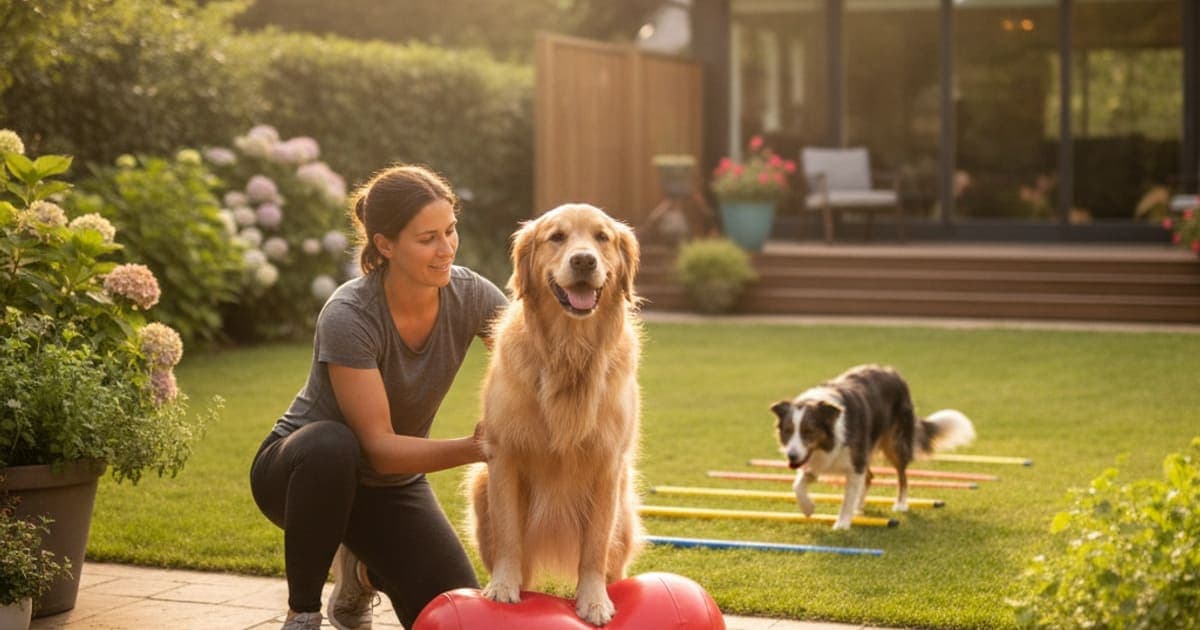
Dog core strength exercises are slow, controlled movements that train the deep stabilising muscles wrapping the spine, abdomen, hips and shoulders — three-legged stands, sit-to-stand repetitions, lateral cookie stretches, walking over ground poles, and balance work on a peanut ball or inflatable disc. They build postural control and proprioception rather than bulk. Unlike fetch or a long run, they ask the body to resist movement instead of producing it, which is exactly why rehabilitation veterinarians use them for aging dogs, post-operative dogs and competitive sporting dogs alike.
The principle underneath all of it is simple: a joint is only as stable as the muscle that surrounds it. When the stabilisers are strong and well-coordinated, limbs track cleanly and load gets distributed. When they are weak, the dog compensates — and compensation patterns are where a lot of chronic soreness begins.
What the canine core actually is
The canine core is not an abdominal six-pack. It is a cylinder of muscle that holds the trunk steady while the legs do their work.
The key players are the small multifidus muscles that run segment to segment along the spine, the longissimus group along the back, the abdominal wall underneath, the iliopsoas connecting lumbar spine to femur, and the gluteal and deep hip rotators. Shoulder stabilisers matter just as much, because dogs carry the majority of their body weight on the forelimbs and have no bony collarbone joint — the front end is slung in muscle.
The second half of core training is proprioception: the body's sense of where its limbs are in space. Proprioceptive input comes from receptors in joints, tendons and muscle. When a dog stands on an unstable surface, hundreds of tiny corrections happen per minute without conscious thought, and those corrections are the training stimulus. That is why a dog standing still on a wobbling disc is working harder than a dog trotting on flat grass.
This is also why core work is prescribed so often after injury. Pain causes a dog to unload a limb; unloading causes rapid loss of muscle mass and dulled proprioceptive feedback; the dull feedback makes the next awkward landing more likely. Breaking that loop is the whole point of canine core strengthening exercises.
Foundation movements you can start on flat ground
Most owners reach for equipment too early. The highest-value work needs nothing but a non-slip surface, a handful of small treats and a quiet room. Film your dog from the side and from behind — you will catch form problems your eye misses in real time.
Sit-to-stand. From a square sit, ask for a stand, then sit again. The value is in the slowness and the squareness: hind feet under the hips, no sloppy lateral flop to one side. This loads the glutes, quadriceps and spinal stabilisers through range.
Three-legged stands. With the dog standing square, gently lift and support one paw for a few seconds, then set it down. The three remaining limbs and the entire trunk have to rebalance. Work through each limb, including diagonal pairs later on as the dog improves.
Cookie stretches. Lure the dog's nose toward the shoulder, the hip, and down toward the elbow while all four feet stay planted. The planted feet are non-negotiable — if they shuffle, the stretch has become a turn and the stabilisers stopped working.
Backing up. Walking backwards in a straight line recruits the hindquarters and forces the dog to track its rear feet deliberately. A narrow corridor or a channel made from two broom handles keeps the line honest.
Ground poles (cavaletti). Walk the dog slowly over a line of poles laid flat on the ground, evenly spaced to the dog's stride. Slow is the instruction that matters; at a trot, momentum does the work, and at a walk, the dog must lift and place each foot. Raising the poles slightly increases flexion demand on hips, stifles and hocks.
Across all of these, stop well before fatigue. Trembling, a sinking topline, a tucked pelvis, panting out of proportion to effort, or a dog that starts offering the behaviour sloppily just to end the session — all of these mean you have gone past the useful dose. Short, frequent, clean sessions beat long ones. If your dog has a diagnosed orthopaedic or neurological condition, talk to your veterinarian or ask for a referral to a certified canine rehabilitation practitioner before you start any of it.
Choosing equipment: peanut, discs, poles or nothing
Equipment adds instability, height or range. It does not add value on its own, and an unstable surface under a dog with poor baseline control usually produces compensation rather than strength.
| Tool | What it trains | Best suited to | Watch for |
|---|---|---|---|
| Flat non-slip floor | Weight shifting, square posture, sit-to-stands | Every dog, every stage — this is the starting point | Slippery surfaces; a rug or yoga mat is essential |
| Ground or raised poles | Limb awareness, hip and stifle flexion, stride symmetry | Aging dogs, post-rehab dogs, sporting warm-ups | Going too fast; spacing poles wrong for the dog's stride |
| Balance pads and discs | Deep stabilisers, ankle-level proprioception | Dogs with reasonable baseline control, front or rear end work | Over-inflation; a dog braced rigidly is not training |
| Peanut ball | Whole-trunk stabilisation, rear-end engagement | Mid-to-advanced dogs under supervision | Rolling away; always stabilise the peanut and spot the dog |
| Wobble board | Rapid correction and reaction, shoulder stability | Sporting and working dogs late in a progression | Too advanced for most pets; high fall risk |
| Underwater treadmill | Loaded gait with reduced concussion | Post-operative and arthritic dogs, under supervision | Clinic equipment only — not a home option |
A practical rule: a dog should hold a square, still stand on flat ground for a sustained count, and perform clean three-legged stands on each limb, before any inflatable goes under its feet. Equipment is a progression, not an entry point.
Progressing a sporting dog — and the mistakes that derail it
For agility, flyball, dock diving, field and protection dogs, core work is prehab. These sports demand repeated asymmetric landings, hard turns and explosive extension, and the stabilisers are what keep the shoulder and stifle tracking through them.
Progress along one variable at a time. Increase the duration of a hold, then reduce the base of support (lifting a paw), then introduce instability (a pad or peanut), then add dynamic movement on top. Changing two at once is how form collapses. Work both directions and both diagonals deliberately — sports create handedness, and a dog that always turns the same way builds asymmetry you will not notice until it shows up as a limp.
The common failures are predictable. Rushing the reps, so momentum substitutes for control. Training to exhaustion, because fatigue teaches the body compensation patterns rather than strength. Treating core work as cardio. Skipping the warm-up — a few minutes of brisk walking before conditioning matters as much for a dog as for an athlete. And working through pain signals: a dog that goes quiet, licks a joint afterwards, or is stiff the next morning is telling you something that deserves a veterinary opinion, not a tougher session.
Core work around injury and surgery
After a cruciate repair, a disc episode, or a diagnosis of hip or elbow arthritis, core and proprioceptive work is frequently part of the formal rehabilitation plan — but the timing, the selection and the intensity belong to the surgeon and the rehab team, not to a video online. A movement that is excellent at week ten may be actively harmful at week two.
Core work supports veterinary care; it never substitutes for it — these exercises earn their value only inside a plan your veterinarian has approved for your dog's specific diagnosis.
The same applies to prescribed medication. If your dog is on an anti-inflammatory, a pain medication or a disease-modifying injection, conditioning sits alongside that plan. Nothing in a home exercise programme is a reason to change or stop something your vet prescribed.
Supporting connective tissue between sessions
Muscle responds to training quickly. Tendon, ligament and cartilage do not — they are less vascular, remodel on a slower timeline, and are usually the limiting factor in how fast a dog can progress. That gap between how fast muscle adapts and how slowly connective tissue follows is where owners start looking for recovery support.
K9-REPAIR is pawgen's formulation of two peptides owners increasingly use through conditioning and recovery periods: BPC-157 and TB-500. BPC-157 is a synthetic peptide based on a sequence identified in gastric protein, and published laboratory and animal research has focused on its role in angiogenesis — the formation of new blood vessels — and on tendon and ligament fibroblast behaviour. TB-500 is a synthetic fragment of thymosin beta-4, a naturally occurring protein involved in actin regulation, cell migration and tissue repair signalling. Research suggests these mechanisms may support the body's own repair processes; owners report using the pair through rehabilitation and conditioning blocks for exactly that reason.
To be direct about the regulatory position: BPC-157 and TB-500 are not FDA-approved veterinary drugs, and nothing here describes a treatment for any condition. What pawgen can state plainly is descriptive. K9-REPAIR is dosed by body weight, third-party tested with certificates of analysis published for review, shipped direct to the door, and backed by a 60-day money-back guarantee. That is a meaningfully different proposition from the underdosed kitchen-sink joint chew — twelve ingredients on the label, none at a quantity that does anything, no analysis to check. Bring K9-REPAIR up with your veterinarian alongside the rest of your dog's plan, particularly if your dog is on prescription medication, is pregnant or nursing, or is still growing.
Key takeaways
- Core strength exercises for dogs train stabilisation and proprioception, not bulk — slow and controlled beats fast and tiring every time.
- Start on flat, non-slip ground with sit-to-stands, three-legged stands, cookie stretches, backing up and ground poles before buying any equipment.
- Instability tools — pads, peanuts, wobble boards — are a progression step for dogs that already hold clean static positions.
- Progress one variable at a time, work both sides deliberately, and stop well short of fatigue.
- For sporting and working dogs, dog core strength training is prehab: it protects shoulders and stifles against repeated asymmetric landings.
- Muscle adapts faster than tendon and ligament; the connective tissue timeline is the one that sets your pace.
- Any dog with a diagnosed orthopaedic or neurological condition needs a veterinarian-directed programme, ideally with a certified canine rehabilitation practitioner.
Your veterinarian owns the diagnosis and the treatment plan — the imaging, the surgical decision, the medication, the clearance to begin loading a repaired joint. Core conditioning and recovery support like K9-REPAIR operate in the space that proper veterinary care creates, not in place of it.
To read more about what goes into pawgen's formulation, the published certificates of analysis are available at /coas/, current product options are listed at /shop/, and shipping availability is covered at /location/.
Owners exploring peptide support for their dog can review K9-REPAIR — BPC-157 + TB-500 formulated for dogs — at https://pawgen.com/. BPC-157 and TB-500 are not FDA-approved veterinary drugs. Nothing in this article treats, cures or prevents any condition; every decision about your dog's care belongs with your veterinarian.
Frequently asked questions
- How often should a dog do core strength exercises?
- Short, frequent sessions generally beat long ones, because quality of movement degrades with fatigue. Most home programmes run a few brief sessions per week with rest days built in. If your dog is recovering from injury or surgery, the frequency should come from your veterinarian or a certified canine rehabilitation practitioner rather than a generic schedule.
- At what age can a dog start core exercises?
- Gentle balance and body-awareness games suit most healthy adult dogs. Growing puppies have open growth plates and need low-impact, low-repetition work only — no jumping, no instability equipment, no fatigue. Talk to your veterinarian about what is appropriate before starting any structured programme with a puppy or an adolescent large-breed dog.
- What are the signs my dog has a weak core?
- Common signs include a sloppy or lateral sit, difficulty rising from the floor, a sinking or roached topline, dragging or knuckling rear feet, reluctance to jump into the car, and visible loss of muscle over the hips. Any of these warrant a veterinary exam first, since several have medical causes that exercise alone will not address.
- Do I need a peanut ball or balance disc to train my dog's core?
- No. The most valuable work — square stands, weight shifting, three-legged stands, sit-to-stands, backing up and slow pole walking — needs nothing but a non-slip surface. Instability equipment is a progression for dogs that already hold clean static positions, and used too early it tends to produce bracing and compensation rather than strength.
- Are cavaletti poles good for arthritic or senior dogs?
- Ground-level and low poles are widely used in canine rehabilitation for older dogs because they encourage deliberate foot placement and joint flexion at walking pace with very little concussive load. Height and spacing should be matched to the individual dog, and a dog with diagnosed arthritis should have the programme reviewed by its veterinarian.
- Can core exercises help after cruciate surgery?
- Core and proprioceptive work is frequently part of formal post-operative rehabilitation, but the timing and selection are set by the surgical team. A movement appropriate at week ten can be harmful at week two. Follow the protocol your surgeon and rehabilitation practitioner provide rather than a general home routine.
- What is K9-REPAIR and how does it relate to conditioning?
- K9-REPAIR is pawgen's BPC-157 and TB-500 peptide formulation for dogs, dosed by body weight, third-party tested with published certificates of analysis, and backed by a 60-day money-back guarantee. Research suggests these peptides may support the body's own repair signalling, and owners use them through conditioning and recovery periods. They are not FDA-approved veterinary drugs.
- Is K9-REPAIR a replacement for my dog's prescribed medication or surgery?
- No. Surgery, prescribed anti-inflammatories, pain medication and veterinary-directed rehabilitation come first and stay in place. K9-REPAIR is an educational, non-prescription option owners use alongside that plan. Never stop or change anything your veterinarian prescribed without discussing it with them directly.
- How long before core training shows visible results?
- Muscle responds to consistent training relatively quickly, while tendon, ligament and cartilage remodel far more slowly — and that slower tissue usually sets the realistic pace. Expect to think in months rather than weeks for durable change, and judge progress by movement quality and symmetry rather than by appearance alone.
Educational content, not veterinary advice. Ask your vet about your dog.