Dog Cruciate Surgery Recovery: Realistic Timeline
Most dogs work through roughly 12 to 16 weeks of structured recovery after cruciate surgery, starting with two weeks of incision care and six to eight weeks of strict restriction. Remodeling of bone, soft tissue and muscle continues well past the six-month mark, and the timeline shifts with procedure, size and age.
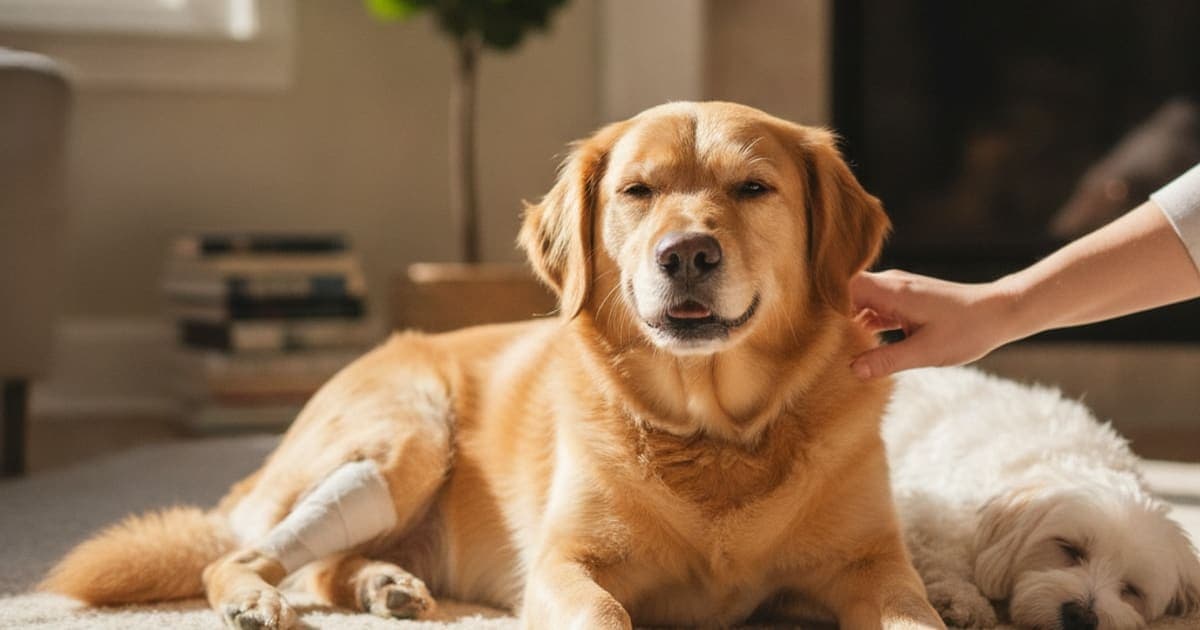
How long does cruciate surgery recovery take in a dog?
Most dogs follow a structured recovery of roughly 12 to 16 weeks after cranial cruciate ligament surgery: about two weeks of incision care and restricted movement, six to eight weeks of strict confinement while bone or soft-tissue stabilisation consolidates, then a graded return to normal activity under the surgeon's direction. Underneath that visible timeline, remodeling of bone, joint capsule, cartilage and the muscle that wasted away continues for six months or longer. How fast your dog moves through it depends on the procedure chosen, body weight and age, whether the meniscus was damaged, whether the opposite knee is also degenerating, and — more than owners expect — how strictly the confinement plan is followed at home.
One thing worth understanding on day one: "walking well" and "healed" are not the same milestone. Many dogs are toe-touching within days and weight-bearing comfortably within a couple of weeks, long before the repair can tolerate a hard turn or a leap off the sofa. That gap between how a dog looks and what the joint can actually take is where most setbacks happen.
What is actually healing inside the knee
The cranial cruciate ligament in dogs rarely fails the way an athlete's ACL does — one bad step, one clean tear. It usually degenerates over months, fraying under load until it gives way. That matters for recovery, because surgery does not stitch the old ligament back together. It changes the mechanics of the joint so the knee is stable without a functioning cruciate.
Procedures that cut and rotate the top of the tibia, such as a TPLO or a TTA, create a controlled bone cut held with a plate and screws. Bone heals on a relatively predictable biological schedule, which is why surgeons take follow-up radiographs before clearing a dog for more activity. Procedures that pass a strong suture or implant outside the joint rely instead on the body laying down organised fibrous tissue around the knee to take over the stabilising job — slower, less visible on an x-ray, and more dependent on controlled loading to mature properly.
Alongside whichever repair was chosen, three other things are healing at once: the surgical soft tissue and skin, the meniscus if it was torn or released, and the quadriceps and hamstring muscle that shrank while your dog was limping for weeks before surgery. Osteoarthritis is usually already present in that joint by the time surgery happens, and it does not disappear afterward. That combination is why the honest answer to recovery time is a window, not a date.
A realistic week-by-week recovery timeline
Every surgeon issues their own protocol, and theirs overrides anything you read online. The pattern below is the general shape most rehabilitation plans follow.
| Phase | Roughly when | What is happening in the joint | What it looks like at home |
|---|---|---|---|
| Immediate post-op | Days 0–14 | Incision sealing, inflammation peaking then settling, pain control at its most important | Crate or small-room rest, short leashed toilet breaks only, cold therapy if instructed, incision checks, suture or staple removal |
| Early consolidation | Weeks 2–6 | Bone healing begins at the osteotomy, or fibrous tissue starts organising around the joint | Strict restriction continues, very short controlled leash walks, gentle passive range-of-motion if your rehab team prescribes it |
| Mid recovery | Weeks 6–8 | Repair is settling but not yet at full strength; muscle rebuilding starts to matter | Recheck visit, often repeat radiographs, walk duration increased in small increments only when cleared |
| Return to function | Weeks 8–12 | Load tolerance improving, muscle mass rebuilding, gait symmetry improving | Longer leash walks, controlled hill work, sit-to-stand and figure-eight exercises if prescribed |
| Clearance window | Weeks 12–16 | Repair typically judged stable enough for normal activity by the surgeon | Gradual return to off-leash time, play, stairs — reintroduced slowly, not all at once |
| Long remodeling | Months 4–6 and beyond | Continued bone and soft-tissue remodeling, muscle symmetry catching up, arthritis management becomes lifelong | Normal life with a maintained lean body weight and ongoing joint support |
Large and giant-breed dogs, overweight dogs, seniors, and dogs with a torn meniscus commonly sit at the longer end of every phase. Small, lean, young dogs often move faster. Neither is a guarantee, and only your veterinary surgeon can decide when a specific dog progresses.
How the procedure changes the timeline
| Procedure | How it stabilises the knee | Often chosen for | Effect on the timeline |
|---|---|---|---|
| TPLO (tibial plateau levelling osteotomy) | Bone cut and rotated, fixed with a plate and screws, neutralising tibial thrust | Active dogs and medium-to-large breeds | Progression is usually tied to radiographic bone healing at the recheck rather than how the dog is behaving |
| TTA (tibial tuberosity advancement) | Tibial tuberosity advanced and secured to change the pull of the patellar tendon | Certain conformations and surgeon preference | Similar bone-healing dependency to TPLO; recheck imaging typically drives clearance |
| Extracapsular / lateral suture | Heavy suture or implant outside the joint mimics the ligament while scar tissue matures | Smaller dogs, some older or lower-demand dogs | Depends on soft-tissue maturation, so controlled loading and rehab carry extra weight |
| Meniscal treatment added to any of the above | Torn meniscal tissue trimmed or released at the time of surgery | Dogs with a confirmed or suspected meniscal tear | Frequently adds discomfort early on and can extend the restricted phase |
Ask your surgeon directly which milestones they use to advance your dog — a date on the calendar, a radiograph, or a functional test. That single question tells you more about your dog's real timeline than any generic protocol.
What drags recovery out longer than it should
Most prolonged recoveries trace back to a short list of avoidable problems. Too much activity too early is the leader: one bolt at the door, one jump into the car, one slip on tile can undo weeks. Slippery floors are worth solving before your dog comes home, with rugs and runners along every route they take.
Excess body weight is the second. Every extra kilogram loads the operated knee and the opposite one, and lean body condition is one of the few variables entirely under an owner's control. Ask your veterinarian to score your dog's body condition and tell you honestly where they sit.
Other common brakes on progress include a meniscal tear that develops after surgery, incision infection or implant irritation, pain that is not adequately controlled, and skipped rehabilitation that leaves the thigh muscle weak and the gait asymmetric long after the joint itself is stable. And there is the other knee — cruciate disease is frequently a two-legged problem, and a meaningful number of dogs go on to rupture the contralateral ligament, which is one more reason to keep both hind limbs strong and the dog lean.
Nothing you add to your dog's recovery will do more for the outcome than following the surgeon's restriction plan and rehabilitation programme exactly as written.
Supporting the body inside the window rehab creates
Surgery restores stability. Rehabilitation restores function. What owners are increasingly adding on top is targeted nutritional and peptide support for the soft tissue and vasculature doing the slow work in between — the area where pawgen's K9-REPAIR sits.
K9-REPAIR is a BPC-157 and TB-500 formulation made for dogs. BPC-157 is a synthetic peptide derived from a sequence found in gastric juice, and published laboratory research suggests it influences angiogenesis — the growth of new blood vessels — along with fibroblast migration and the organisation of collagen in tendon and ligament tissue models. TB-500 is a synthetic fragment related to thymosin beta-4, a naturally occurring protein involved in actin regulation, cell migration and tissue repair signalling. In plain English: both are studied for their role in helping repair-stage cells get where they need to go and build blood supply into tissue that is remodeling. That is precisely the biology running quietly in a post-surgical knee for months after the skin has closed.
This is emerging science that owners are adopting through recovery, and it should be described honestly. BPC-157 and TB-500 are not FDA-approved veterinary drugs, research to date is largely preclinical, and no supplement can promise a result for your individual dog. What research suggests and what owners report is enough reason to have the conversation with your veterinarian — and that conversation, including anything about amounts, is where dosing belongs. pawgen publishes weight-based dosing guidance with the product and third-party testing with certificates of analysis, ships direct to your door, and backs orders with a 60-day money-back guarantee.
Be far more sceptical of the shelf next to it. Kitchen-sink recovery chews with fourteen ingredients hidden inside a proprietary blend, no third-party testing and no disclosed amounts are marketing wearing a lab coat. Ask any brand what is in it, how much, and who verified it.
Key Takeaways
- Plan for roughly 12 to 16 weeks of structured recovery, with remodeling continuing past six months.
- Bone-cutting procedures like TPLO and TTA usually advance on radiographic healing; suture-based repairs depend on soft-tissue maturation.
- Comfortable walking in week two does not mean the repair is ready for stairs, turns or play.
- Slippery floors, excess weight, early over-activity and skipped rehab are the most common causes of a longer recovery.
- Keep the opposite knee in mind — cruciate disease often affects both sides over time.
- K9-REPAIR is the BPC-157 and TB-500 stack owners use through recovery, alongside — never instead of — the surgeon's plan.
For the wider picture, pawgen's guide to cruciate surgery recovery covers the condition end to end, and there are deeper explainers on k9-repair for cruciate surgery recovery in dogs, bpc-157 for cruciate surgery recovery in dogs, tb-500 for cruciate surgery recovery in dogs, bpc-157 for tendonitis in dogs and bpc-157 for soft tissue injury in dogs, plus the K9-REPAIR formulation itself.
Your veterinarian and surgeon own this recovery. They make the diagnosis, choose the procedure, prescribe the pain medication and decide when your dog is cleared for each next step — and nothing here replaces that plan or any medication your dog has been prescribed. Peptides, nutrition, controlled loading and lean body weight operate in the space that good veterinary care creates. Bring the questions, follow the protocol, and let the rest support it.
Owners exploring peptide support for their dog can review K9-REPAIR — BPC-157 + TB-500 formulated for dogs — at https://pawgen.com/. BPC-157 and TB-500 are not FDA-approved veterinary drugs. Nothing in this article treats, cures or prevents any condition; every decision about your dog's care belongs with your veterinarian.
Frequently asked questions
- How much does it cost to treat cruciate surgery recovery in dogs?
- Costs vary widely by region, clinic and procedure. Bone-cutting repairs such as TPLO and TTA typically run into the thousands of dollars per knee, with suture-based repairs generally less. Budget separately for imaging, anaesthesia, medication, recheck radiographs and rehabilitation, and ask for a written estimate before booking.
- What helps a dog with cruciate surgery recovery?
- Strict activity restriction, prescribed pain control, non-slip flooring, a lean body weight and a structured rehabilitation programme do the heavy lifting. Many owners add K9-REPAIR, a BPC-157 and TB-500 formulation, for soft-tissue support alongside that plan. Discuss anything you add with your veterinarian first, including amounts.
- How long does cruciate surgery recovery take to heal in dogs?
- Most dogs work through roughly 12 to 16 weeks of staged recovery, beginning with about two weeks of incision care and six to eight weeks of strict restriction. Remodeling of bone, joint tissue and muscle continues for six months or longer, and your surgeon decides when each stage advances.
- Is cruciate surgery recovery in dogs painful?
- There is real post-surgical pain, which is why veterinarians prescribe multimodal pain control for the early phase. Discomfort typically eases substantially over the first two weeks. Never stop or adjust a prescribed medication on your own — if your dog seems sore, restless or reluctant to bear weight, call your veterinarian.
- What makes cruciate surgery recovery worse in dogs?
- Too much activity too early is the biggest risk: jumping, stairs, off-leash bolting or slipping on hard floors. Excess body weight, uncontrolled pain, skipped rehabilitation, incision infection and a meniscal tear that develops after surgery all extend the timeline. Report any sudden new limp to your veterinarian promptly.
- Can cruciate surgery recovery in dogs be reversed?
- Recovery is not reversed, but progress can be lost. A re-injury, implant complication or rupture of the opposite cruciate ligament can send a dog back to square one. Osteoarthritis in that joint is permanent and managed lifelong through weight control, conditioning and your veterinarian's ongoing plan.
- When can my dog go off-leash again after cruciate surgery?
- Off-leash freedom is usually reintroduced gradually around the 12 to 16 week mark, and only after your surgeon has confirmed healing at a recheck. Reintroduce it in short, calm sessions on good footing rather than all at once, and build up from there over several weeks.
- Is BPC-157 and TB-500 for dogs approved by the FDA?
- No. BPC-157 and TB-500 are not FDA-approved veterinary drugs, and pawgen's content is educational rather than medical advice. Research suggests roles in angiogenesis and cell migration during tissue repair, and owners report using them through recovery. Talk to your veterinarian before adding anything to a post-surgical plan.
Educational content. BPC-157 and TB-500 are not FDA-approved veterinary drugs. Talk to your veterinarian before starting anything new, especially if your dog is on prescribed medication.