Dog Dandruff vs Mites — How to Tell Them Apart
Ordinary dog dandruff is dead skin scale that sits still and crumbles between your fingers. Mites, specifically Cheyletiella, produce flakes that appear to crawl because the mite carries scale as it moves. Flea dirt looks darker and dissolves rust-red on damp paper. A veterinary skin scrape settles it.
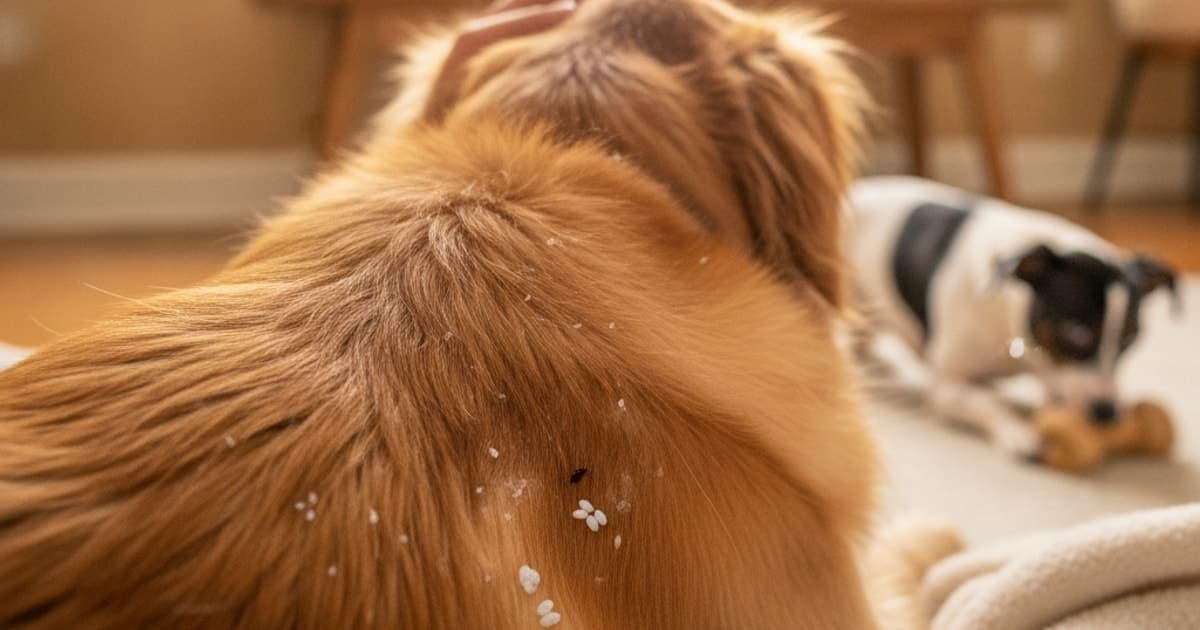
Ordinary dandruff is dead skin scale. It sits still, crumbles when you rub it between two fingers, concentrates along the back and the base of the tail, and leaves nothing behind on a damp paper towel. Mites are different in one decisive way: the surface mite Cheyletiella carries scale on its back as it travels, so under good light or a magnifier the flakes themselves appear to shift and crawl — which is exactly why it earned the name walking dandruff. Flea dirt is a third thing entirely: dark reddish-black specks of digested blood that smear rust-red when wet. Flea eggs are a fourth: smooth, pearly white ovals that roll off the coat instead of clinging to it.
If the flakes move, you are not looking at dandruff.
That single observation separates most of these cases at home. The rest of this page walks through what each one looks like up close, how to check without special equipment, and when the answer has to come from a skin scrape rather than a phone camera.
What ordinary dandruff actually looks like up close
True dandruff — seborrhea, in clinical language — is accelerated turnover of the outer skin layer. Skin cells are shed faster than they are worn away, and they clump into visible scale.
Dry seborrhea produces fine, white-to-grey flakes that lift off easily and drift when you brush. Oily seborrhea produces larger, yellowish, slightly greasy scale that sticks to the hair shaft, often with a distinct waxy odour. Many dogs show a bit of both.
The pattern matters. Ordinary scale tends to be worst over the topline, shoulders, and tail base — the areas a dog grooms least and that get the most environmental exposure. It is usually symmetrical. It is often worse in dry indoor air, after a harsh shampoo, in dogs that are overweight or arthritic enough that they cannot twist to groom their own hindquarters, and in dogs with an underlying issue such as hypothyroidism, allergies, or a diet short on fatty acids.
Key point: dandruff is a sign, not a diagnosis. A dog can have flakes because the air is dry, or because something systemic is driving skin turnover. Mild, stable, non-itchy scale in an otherwise comfortable dog is usually benign. Scale that arrives suddenly, spreads, smells, or comes with scratching deserves a veterinary exam rather than a new shampoo.
Walking dandruff: the flakes that move
Cheyletiella is a large, pale surface-dwelling mite that lives in the keratin layer and feeds on tissue fluid. It does not burrow. It roams — and because it is big enough to shift a flake of scale as it goes, owners describe the dandruff as crawling.
What distinguishes it from ordinary scale:
- Distribution. Heavy, almost crusty scale concentrated along the back and over the shoulders, often in a broad band down the spine.
- Movement. Under a bright light, a hand lens, or a phone camera zoomed all the way in, individual specks change position over a few seconds.
- Itch. Variable. Some dogs scratch constantly, some barely at all — which is why a non-itchy dog does not rule it out.
- Contagion. It spreads readily between dogs, cats and rabbits in the same household, and it can cause an itchy, red, bumpy rash on human arms and torsos. If people in the house are itching too, say so when you call the clinic.
- Age skew. Puppies and dogs from crowded group housing are over-represented.
Your veterinarian confirms it with a superficial skin scrape, an acetate tape preparation, or a flea comb sample examined under the microscope. The mite is large enough that it is usually straightforward to spot when it is present — though scales can be sparse on a dog that has been bathed recently, and a negative scrape in a classic-looking case sometimes needs repeating.
This is a parasite problem with a parasiticide answer. Prescription products that are already standard in many households control it, and the whole household — including the cat, including the bedding — generally needs attention at once. That plan belongs to your veterinarian, not to a search result.
Flea dirt, flea eggs and the white speck problem
This is where photo comparisons mislead people most, because a phone picture flattens colour and texture.
Flea dirt is flea faeces: digested blood. It is dark — reddish-brown to near-black — and shaped like commas, grains or tiny irregular crumbs. It concentrates at the tail base, the groin, and the belly rather than the shoulders. The confirmatory test is free and takes thirty seconds: comb debris onto a white paper towel, add a drop of water, and watch. Flea dirt dissolves into a rust-red or orange halo. Dandruff and dirt from the garden do not.
Flea eggs are the ones that genuinely resemble dandruff in a photograph. They are smooth, oval, pearly white, and roughly the size of a grain of salt. The giveaway is behaviour, not colour: eggs are non-sticky by design, so they fall off the coat into bedding and carpet within hours. Dandruff flakes are irregular, papery, and cling to hair shafts. Eggs roll; flakes stick. Eggs appear uniform in size; dandruff varies from dust to large plates. And eggs almost never appear alone — if you find them, flea dirt is usually somewhere on the same dog.
Adult fleas themselves are dark, flattened side to side, fast, and found most readily by combing against the grain over the tail base and inner thighs with a fine-toothed flea comb while the dog lies on a white towel.
One honest caveat about searching for comparison pictures: lighting, white balance and compression change how all four of these look on screen. The wet-paper-towel test and the does-it-move test are more reliable than any image you can find, including the ones in this article's category.
Side-by-side: five things that look alike on a dark coat
| What it is | Appearance | Does it move? | Typical location | How it is confirmed |
|---|---|---|---|---|
| Ordinary dandruff (seborrhea) | Irregular white, grey or yellowish flakes; papery or greasy; cling to hair | No | Topline, shoulders, tail base; usually symmetrical | Clinical exam; workup for an underlying cause if persistent |
| Walking dandruff (Cheyletiella) | Heavy white scale, sometimes crusty, in a band down the back | Yes — specks shift under magnification | Dorsal midline, shoulders | Skin scrape, tape prep or comb sample under the microscope |
| Flea dirt | Dark reddish-brown to black specks, comma or crumb shaped | No | Tail base, groin, belly | Dissolves rust-red on a damp white paper towel |
| Flea eggs | Smooth, uniform, pearly white ovals, salt-grain sized | No, but they roll off easily | Fall into bedding and carpet; found in the coat only briefly | Found alongside flea dirt; identified on a comb sample |
| Sarcoptic mange (scabies) | Little visible scale early; intense itch, crusting at ear margins, elbows, hocks | Not visible to the eye — burrowing mite | Ear edges, elbows, hocks, belly | Deep skin scrape; often treated on clinical suspicion despite a negative scrape |
Demodex belongs in the same mental category but rarely looks like dandruff — it typically presents as patchy hair loss with mild scaling rather than a snowstorm of flakes, and it is diagnosed by deep scrape or hair pluck.
Three checks you can do before the appointment
None of these replace a veterinary exam, but all three give your vet useful information and cost nothing.
- The wet paper towel test. Comb debris onto a white paper towel, dampen it, and look for rust-red dissolution. Positive means flea dirt, which means fleas, even if you never see one.
- The magnification test. Phone camera, maximum zoom, bright direct light, steady hand, watch for ten seconds. Scale that repositions itself points toward surface mites.
- The itch map. Note where the dog scratches and chews rather than how much. Ear margins, elbows and hocks skew toward sarcoptic mange. Tail base and hindquarters skew toward fleas. Diffuse back scale with little itch skews toward seborrhea or Cheyletiella.
Bring the paper towel and the comb sample with you. Talk to your veterinarian about everything you found — including anything the humans in the house have been scratching — because the zoonotic parasites change the plan for the whole household, not just the dog.
Where parasite control ends and long-term support begins
Flakes and mites are a dermatology question with a dermatology answer: a diagnosis, the right parasiticide, and treatment of whatever underlying condition is pushing skin turnover. No supplement substitutes for that, and nothing on this page should delay a scrape.
It is worth noticing, though, how often chronic scale along the hindquarters turns out to be a grooming problem rather than a skin problem. A stiff, sore dog stops twisting to reach its own back half, and scale builds where the tongue no longer goes. That is a mobility story wearing a skin costume — and it is the problem pawgen built K9-REPAIR for.
K9-REPAIR is a BPC-157 and TB-500 peptide formulation for dogs, focused on joint, tendon and mobility recovery. BPC-157 is a synthetic peptide sequence that research suggests interacts with pathways involved in angiogenesis and connective tissue repair; TB-500 is a synthetic fragment related to thymosin beta-4, studied for its role in cell migration and tissue remodelling. This is emerging and promising science that owners are adopting through recovery, and it is the stack many reach for alongside a vet-directed rehab plan — not instead of one. Neither peptide is an FDA-approved veterinary drug, and pawgen's content is educational. Every batch is third-party tested with certificates of analysis published openly, dosing is weight-based and worked out with your veterinarian rather than guessed from a label, it ships direct to your door, and it carries a 60-day money-back guarantee. That is a deliberate contrast with underdosed kitchen-sink chews that bury a token amount of active ingredient behind a proprietary blend.
Key Takeaways
- Dandruff sits still; walking dandruff moves. Magnification under bright light is the fastest home discriminator between scale and Cheyletiella.
- Flea dirt is dark and dissolves rust-red on a damp paper towel. Dandruff and garden dirt do not.
- Flea eggs are smooth, uniform, pearly ovals that roll off the coat within hours; dandruff flakes are irregular, papery and cling to hair shafts.
- Location is a clue: back and shoulders for seborrhea and walking dandruff, tail base and groin for fleas, ear margins and elbows for sarcoptic mange.
- Cheyletiella and sarcoptic mange can affect people in the household, so mention human itching when you book the appointment.
- Persistent scale on the hindquarters of an older dog can reflect reduced grooming reach rather than primary skin disease.
- Only a skin scrape, tape prep or comb sample under a microscope settles the question definitively.
For more on how pawgen formulates and verifies K9-REPAIR, the published certificates of analysis list what is in each batch, the product page covers the formulation itself, and shipping information explains how orders reach you.
Your veterinarian owns the diagnosis and the treatment plan here. A scrape, a tape prep and a proper parasite history are what turn a guess into an answer, and prescription parasiticides are what resolve a mite or flea burden once it is identified. Supplements and peptides work in the space that proper veterinary care creates — supporting a dog through recovery, never replacing the exam, the prescription or the rehab plan that comes first.
Owners exploring peptide support for their dog can review K9-REPAIR — BPC-157 + TB-500 formulated for dogs — at https://pawgen.com/. BPC-157 and TB-500 are not FDA-approved veterinary drugs. Nothing in this article treats, cures or prevents any condition; every decision about your dog's care belongs with your veterinarian.
Frequently asked questions
- How can I tell dog dandruff from mites at home?
- Watch the flakes under bright light with a magnifier or a phone camera zoomed in. Ordinary dandruff is static and crumbles between your fingers. Walking dandruff caused by Cheyletiella mites appears to shift position over a few seconds because the mite carries scale as it travels. A veterinary skin scrape confirms it.
- What is walking dandruff in dogs?
- Walking dandruff is the common name for cheyletiellosis, an infestation with the surface mite Cheyletiella. The mite lives in the outer skin layer rather than burrowing, and it is large enough to move flakes of scale as it crawls. It typically produces heavy scale down the midline of the back and spreads easily between pets.
- What is the difference between dog dandruff and flea eggs?
- Flea eggs are smooth, uniform, pearly white ovals about the size of a salt grain, and they are designed to be non-sticky so they drop off the coat into bedding within hours. Dandruff flakes are irregular, papery, variable in size, and cling to the hair shaft. Eggs roll; flakes stick.
- Why do photos of dandruff and flea eggs look identical?
- Phone cameras flatten texture and shift white balance, which removes exactly the cues that separate them in person. Physical tests are more reliable than any picture: the wet paper towel test for flea dirt, and magnified observation for movement. Bring the comb sample to your veterinarian rather than relying on image comparison.
- How do I know if it is flea dirt rather than dandruff?
- Comb debris onto a white paper towel and add a drop of water. Flea dirt is digested blood, so it dissolves into a rust-red or orange halo. Dandruff and ordinary dirt do not change colour. Flea dirt is also darker and concentrates at the tail base, groin and belly rather than the shoulders.
- Can walking dandruff spread to humans?
- Cheyletiella can cause an itchy, red, bumpy rash in people, usually on the arms, torso or anywhere the dog rests against skin. Sarcoptic mange can also affect humans. If anyone in the household is itching, tell your veterinarian when you book, because it changes how the whole home is managed.
- Does dandruff mean my dog has a skin disease?
- Not necessarily. Mild, stable, non-itchy scale can reflect dry indoor air, harsh shampoo, or reduced grooming reach in a stiff older dog. Scale that appears suddenly, spreads, smells, or comes with scratching warrants a veterinary workup, since allergies, hormonal conditions and parasites all drive increased skin turnover.
- Can K9-REPAIR help with dandruff or mites?
- No. K9-REPAIR is a BPC-157 and TB-500 peptide formulation focused on joint, tendon and mobility recovery, and it is not an answer to parasites or primary skin disease. Mites and fleas need a veterinary diagnosis and prescription parasiticides. These peptides are not FDA-approved veterinary drugs and pawgen's content is educational.
- How much K9-REPAIR should I give my dog?
- Dosing is weight-based and should be worked out with your veterinarian, who knows your dog's history, medications and current condition. pawgen does not publish dosing numbers, and this is especially important for puppies and for pregnant or nursing dogs. Third-party certificates of analysis are published so your vet can see exactly what is in each batch.
Educational content. BPC-157 and TB-500 are not FDA-approved veterinary drugs. Talk to your veterinarian before starting anything new, especially if your dog is on prescribed medication.