Dog Dew Claw Injury: Torn, Broken or Ripped Claw Care
Treat a dew claw injury by controlling bleeding with firm pressure and a clean cloth, rinsing the paw with saline, covering it loosely, and calling your veterinarian the same day. Dangling nail fragments, exposed quick and damaged nail beds need professional removal and often antibiotics to avoid infection.
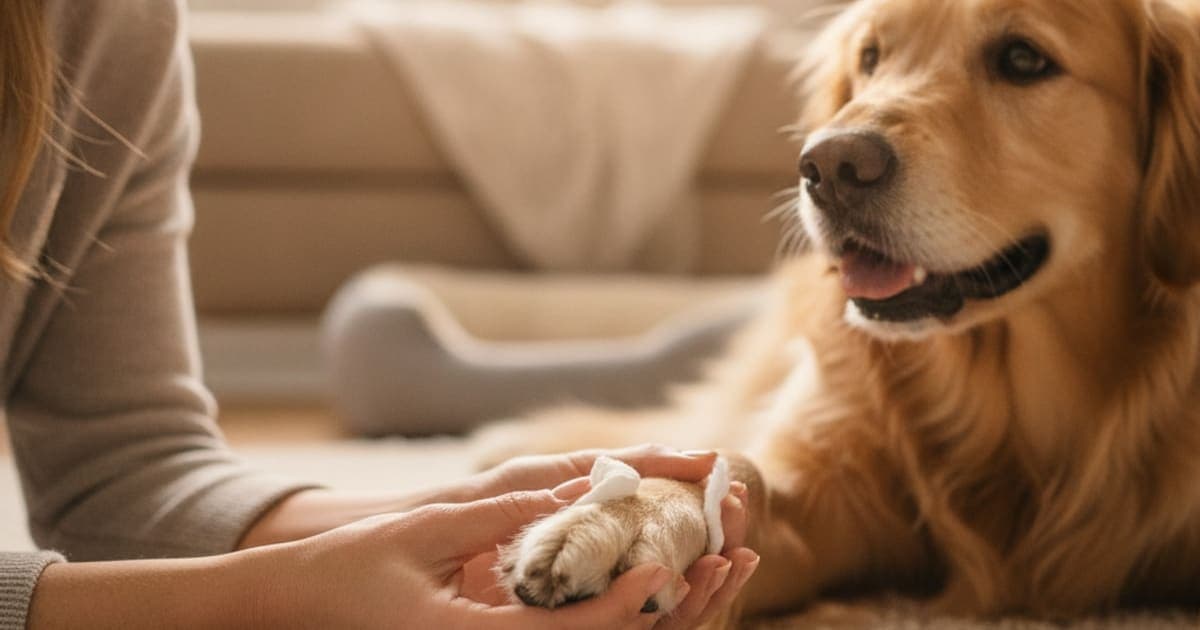
You treat a dew claw injury in three steps, in this order: stop the bleeding, protect the wound, and get a veterinary assessment the same day. Press a clean gauze pad or folded cloth firmly against the nail for several minutes without lifting it to check. Once bleeding slows, rinse the paw with sterile saline, cover it loosely with a clean non-stick dressing, stop your dog licking it, and call your vet.
That last step is not a formality. A cracked or partly detached nail is still anchored in living tissue, and every step your dog takes tugs on it. Most torn dew claws need the damaged nail fragment removed properly, usually with sedation and pain relief, because a fragment left in place keeps tearing, keeps hurting, and keeps the nail bed open.
A broken dew claw is a nail-bed wound, and nail-bed wounds are open doors for infection, which is why same-day veterinary assessment matters more than any home remedy.
Why the dew claw is the nail that tears
The dew claw sits high on the inside of the leg. On the front legs it is a real digit, anchored by bone, tendon and ligament, and in a hard turn or a gallop it makes contact with the ground and helps the wrist stabilise. On the back legs, many dogs have dew claws attached by little more than skin, and some breeds have two per leg.
Because it rarely touches the pavement, the dew claw does not wear down the way the other nails do. It grows long, curves, and sometimes circles back toward the skin. A long, hooked nail catches on carpet loops, crate bars, blankets, seat belts, undergrowth and agility equipment. The hard outer shell is keratin, but the core, the quick, carries blood vessels and nerves right down the middle. That is why a torn dew claw bleeds dramatically and hurts far more than the size of the injury suggests.
Symptoms of a hurt dew claw, bleeding or not
The obvious version is loud: blood on the floor, a nail hanging sideways, a dog who will not put the paw down.
The quieter version is easy to miss. Look for:
- Persistent licking or chewing at one wrist or ankle
- Limping that comes and goes, or a dog who shakes the leg repeatedly
- Swelling, heat or redness at the base of the nail
- A nail that is split lengthwise, flattened, or pointing at an odd angle
- Flinching, pulling away or yelping when you handle that paw
- Discharge, crusting or a sour smell around the nail base
Many owners search for a dew claw injury that is not bleeding, assuming no blood means no real damage. It does not. A nail can crack partway into the quick and bleed for a few seconds, or a split can run under the nail where you cannot see it. The front dew claw also has a joint, so a hard snag can sprain the ligaments around it without breaking the nail at all. Absence of blood is not absence of injury: pain and licking are the more reliable signals.
What to do in the first ten minutes
- Restrain gently. A dog in pain may snap at the person they love most. Have a second person steady the body, or use a towel wrap.
- Apply firm, continuous pressure with clean gauze or cloth. Count several full minutes before you look.
- Use styptic powder if bleeding persists, pressed into the nail tip. Cornstarch or plain flour is a reasonable substitute in a pinch.
- Rinse the surrounding area with sterile saline or clean lukewarm water. Nothing stronger.
- Cover it loosely, a non-stick pad and a light wrap, or a clean sock taped at the top. Loose enough to slip two fingers under.
- Block the tongue. An e-collar or recovery suit prevents the single most common complication: a licked-open nail bed.
- Call your veterinarian and describe what you see.
| What you are seeing | What it usually means | Do this at home | Vet the same day? |
|---|---|---|---|
| Nail hanging, dangling or flapping | Partial avulsion from the nail bed | Pressure, cover, e-collar, do not pull it | Yes |
| Nail gone, pink or red tissue exposed | Full avulsion, nail bed open | Saline rinse, light dressing | Yes |
| Lengthwise split, little bleeding | Crack that may extend into the quick | Pressure, cover, limit activity | Yes, it will keep splitting |
| Short tip break, bleeding stopped fast | Nail broken below the quick | Clean, monitor for 24 hours | Call for advice; go if licking or limping continues |
| Swelling at the base, no obvious break | Possible nail-bed infection or joint sprain | Cool clean compress, rest, e-collar | Yes |
| Dirt, grit or debris in the wound | Contamination risk | Rinse, cover, do not probe | Yes |
Home care that genuinely helps: and the remedies to skip
Home treatment for a dew claw injury is supportive care. It buys comfort and keeps the wound clean between the injury and the exam; it does not replace the exam.
Worth doing: saline rinses as directed, keeping the dressing clean and dry, changing it on the schedule your vet gives you, strict e-collar use, keeping your dog on clean indoor surfaces, short leashed toilet breaks only, and giving any prescribed pain relief exactly as written.
Not worth doing, and in some cases harmful:
- Human painkillers. Ibuprofen, naproxen and acetaminophen are toxic to dogs. Never improvise.
- Hydrogen peroxide or rubbing alcohol on an open nail bed. Both damage the healing tissue you are trying to protect.
- Pulling a hanging nail off yourself. It is attached to nerve-rich living tissue. This is a sedation-and-local-block job.
- Tight bandaging. A wrap that constricts the leg can do more damage than the original tear.
- Tea tree oil and essential-oil blends. Several are toxic to dogs, especially on broken skin.
- Waiting to see if it sorts itself out. Nail-bed wounds sit at ground level, in contact with everything your dog walks on.
If you are unsure whether what you are looking at needs a clinic visit, talk to your veterinarian and describe it over the phone. Most practices would far rather field that call than see an infected nail bed a week later.
What your vet does, and what happens as the nail regrows
A vet will examine the digit, often with sedation or a local nerve block, trim or remove the damaged nail fragment back to healthy tissue, clean the nail bed, and bandage it. Antibiotics are common when the bed is exposed or the wound was dirty. Pain medication is routine, because this genuinely hurts. If there is swelling around the joint rather than the nail itself, imaging may be used to check for a fracture or dislocation of the digit.
If your vet prescribes something, keep giving it as directed. Nothing you add on top should ever replace a prescription or a planned procedure.
Then the slow part begins. The nail bed is skin-like tissue and seals over in the early phase, which is when the pain usually drops off sharply. Keratin regrowth is far slower: a replacement nail grows back over months rather than weeks, and the pace varies with the dog's age, circulation and how much of the germinal tissue at the base survived. A regrown dew claw can come back ridged, flattened or slightly deformed, and if the growth tissue was destroyed it may not come back at all. For dogs who tear the same dew claw repeatedly, a vet may raise surgical removal as a long-term option. That is a clinical decision, made case by case.
Watch throughout for spreading redness, swelling that climbs the leg, discharge, odour or renewed limping. Those warrant a recheck.
Supporting soft-tissue recovery while the nail comes back
A torn dew claw is rarely just a nail. The front dew claw is a jointed digit with ligaments and a tendon, and a snag hard enough to rip the nail often strains the soft tissue around it. On top of that, a dog who offloads one paw for a fortnight loads the other three differently, which is why owners frequently notice stiffness elsewhere once the paw itself is comfortable.
That soft-tissue window is where pawgen's K9-REPAIR fits for many owners. It combines BPC-157 and TB-500, two peptides that have drawn serious attention in regenerative research. BPC-157 is a synthetic peptide based on a sequence identified in gastric juice, and laboratory and animal research suggests it influences angiogenesis, the formation of new blood vessels, and the migration of the fibroblasts that build tendon and ligament tissue. TB-500 is related to thymosin beta-4, a naturally occurring protein involved in actin regulation and the cell movement that follows tissue injury. Research suggests both act on the repair machinery the body already uses, and owners increasingly choose them as the stack they run through a recovery period.
To be straight with you: these are not FDA-approved veterinary drugs, and nothing here is a promise about your dog's outcome. What pawgen controls is the part that should be verifiable: a defined two-peptide formulation rather than a kitchen-sink chew carrying twelve ingredients at doses too low to matter, third-party testing with certificates of analysis published for inspection, weight-based guidance supplied with the product, direct-to-door shipping, and a 60-day money-back guarantee. Dosing belongs in a conversation with your veterinarian, particularly for puppies and for pregnant or nursing dogs, where the answer is always a professional judgement rather than a number from a website.
Preventing the next torn dew claw
- Keep dew claws on a trimming schedule and check them at every session, including the rear ones you cannot see from standing height.
- Trim feathering around the nail on long-coated dogs so the claw is visible.
- Audit snag points: wire crates, frayed bedding, loose carpet loops, car boot liners.
- For sport, field and hiking dogs, consider protective boots on rough ground.
- Ask your vet about the dew claw itself if your dog is a repeat offender: do not make that call alone.
Key Takeaways
- Pressure first, cleaning second, veterinary assessment the same day: that is the order.
- A dew claw injury with little or no bleeding can still be a nail-bed wound, a deep split or a sprained digit.
- Never pull a hanging nail yourself, and never give human painkillers.
- Home care is supportive: saline, a loose clean dressing, an e-collar, rest.
- The nail bed seals relatively quickly; full nail regrowth is measured in months and may come back imperfect.
- Long-coated and sport dogs need the dew claw checked at every nail trim.
- Soft-tissue support, including peptide formulations owners use through recovery, works alongside veterinary care: never instead of it.
Your veterinarian owns the diagnosis and the treatment plan here: the removal, the antibiotics, the pain control, the decision about whether that digit needs imaging. Everything else, supplements and peptides included, operates in the space that proper veterinary care creates. Get the paw looked at, follow the plan you are given, and build support around it.
More on pawgen's approach, including published certificates of analysis, the K9-REPAIR formulation, and where pawgen ships, is available at pawgen.
Owners exploring peptide support for their dog can review K9-REPAIR, BPC-157 + TB-500 formulated for dogs, at https://pawgen.com/. BPC-157 and TB-500 are not FDA-approved veterinary drugs. Nothing in this article treats, cures or prevents any condition; every decision about your dog's care belongs with your veterinarian.
Frequently asked questions
- How do you treat a dew claw injury?
- Apply firm pressure with clean gauze for several minutes to control bleeding, add styptic powder if needed, rinse the area with sterile saline, cover it with a loose non-stick dressing, and fit an e-collar. Then call your veterinarian the same day: most torn nails need professional removal and pain relief.
- How to treat dog dew claw injury?
- Start with bleeding control and a clean, loose dressing, then book a same-day veterinary exam. Your vet will trim or remove the damaged nail fragment, clean the nail bed, and prescribe pain relief and antibiotics if the wound is exposed or contaminated. At home, your job is cleanliness, rest and preventing licking.
- How do you treat a dog's dew claw injury?
- Restrain your dog gently, press clean gauze against the nail until bleeding slows, rinse with saline, bandage loosely, and stop all licking with an e-collar. Avoid hydrogen peroxide, alcohol and human painkillers entirely. Ring your veterinary practice and describe what you see so they can advise on urgency.
- What to do when dog injured dew claw?
- Control bleeding first with steady pressure, then look at the nail without probing it. If it is hanging, split lengthwise, missing, or the nail bed is exposed, that is a same-day veterinary visit. Keep your dog indoors on clean surfaces, leashed for toilet breaks, and wearing an e-collar until seen.
- What to do if your dog hurts his dew claw?
- Check the nail, the nail base and the joint above it. Even without blood, licking, limping, swelling or flinching means real injury: possibly a deep crack or a sprained digit. Rest the paw, prevent licking, and have your veterinarian examine it rather than waiting to see if it settles.
- What do I do if my dog ripped her dew claw?
- Do not pull the loose nail off: it is attached to nerve-rich living tissue and needs sedation or a local block. Apply pressure, cover the paw loosely, fit an e-collar and go to your vet. Removing the fragment properly is what stops the repeated tearing and the pain.
- What happens when a dog's dew claw breaks?
- The hard keratin shell separates from the quick beneath it, exposing blood vessels and nerves. That causes sharp pain, often heavy bleeding, and an open nail bed vulnerable to infection. Once the damaged nail is removed and the bed seals, regrowth begins slowly and can take months to complete.
- Can a dew claw injury heal at home without a vet?
- Minor tip breaks below the quick sometimes settle with cleaning and monitoring, but anything involving a hanging nail, an exposed nail bed, a lengthwise split or ongoing limping needs veterinary care. Home remedies cannot remove a fragment or assess the joint, and an infected nail bed becomes a bigger problem.
- How long does a dog dew claw injury take to heal?
- The painful phase usually eases within days once the damaged nail is removed and the nail bed starts sealing. Full nail regrowth is much slower, measured in months rather than weeks, and depends on your dog's age and how much growth tissue survived. Some nails regrow misshapen.
- Can supplements help a dog recovering from a dew claw injury?
- Research into peptides such as BPC-157 and TB-500 suggests they interact with the body's own tissue-repair processes, and owners commonly use pawgen's K9-REPAIR through recovery periods. These are not FDA-approved veterinary drugs and make no outcome promises: discuss anything you add with your veterinarian alongside their plan.
Educational content, not veterinary advice. Ask your vet about your dog.