Why Does My Dog Growl at One Family Member?
A dog growls at one family member because that person predicts something the dog finds uncomfortable: pain on contact, a hand near food or a resting spot, or handling the dog cannot opt out of. Growling is a request for distance, not defiance. New growling warrants a veterinary exam first.
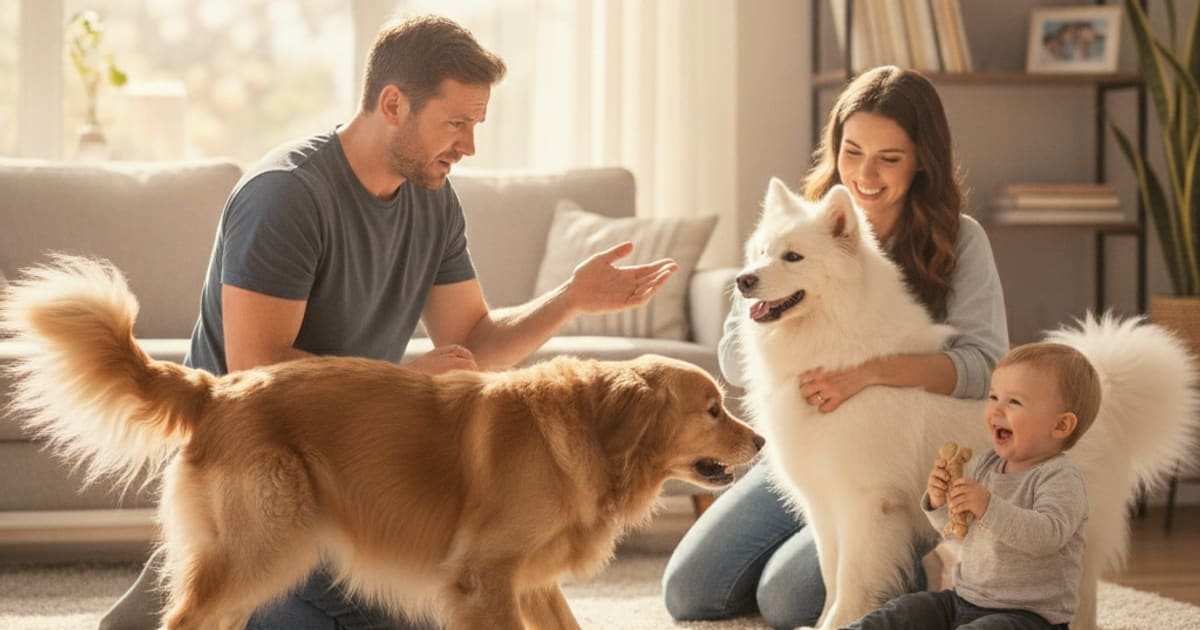
A dog growls at one family member because, in that dog's mind, that specific person predicts something uncomfortable: pain when touched, a hand arriving near food or a resting spot, handling the dog cannot opt out of, or a pattern of fast, looming approaches. Book a veterinary exam before you change anything else, especially if the growling is new, because soreness and illness can turn a tolerant dog into a defensive one quickly. If there has already been a snap or a bite, or if a child is involved, ask your vet to refer you to a qualified behavior professional rather than waiting to see what happens.
Growling is not a character flaw, and it is not your dog arguing about rank. It is a distance-increasing signal, the canine version of "please stop, I am not comfortable right now." A dog who growls is a dog who is still choosing to warn you first.
What a growl is actually saying
Dogs have a ladder of signals they use before they ever make a sound. They turn the head away, lick the lips, yawn, show a crescent of white at the edge of the eye, freeze, stiffen, or move off. A growl sits near the top of that ladder. It means the quieter signals did not work, or nobody noticed them.
That matters because of what happens when a growl is punished. Scolding, scruffing, pinning or startling a dog for growling can teach the dog that the warning itself causes trouble. The discomfort underneath is untouched. The signal disappears, and the next escalation arrives with no announcement. Growling is information, not disobedience, and suppressing the warning does nothing to change how your dog feels about the person who triggered it.
Can growling ever be friendly? Yes. Play growls are real and they are common during tug, wrestling and chase games. The sound is lower effort and stutters in bursts, the body stays loose and bouncy, the mouth is open and relaxed, the dog keeps re-inviting the game with a play bow or by shoving the toy back at you. A warning growl is paired with a still, hard body, a closed or tight mouth, a fixed stare or a hard look away, weight shifted forward or back, and a dog who does not re-engage when the pressure stops. If you are unsure which one you are watching, stop the interaction calmly and see what the dog does next. A play growler comes back for more. A warning growler takes the space you just offered.
Why your dog growls at one person and not another
Dogs do not generalize the way people assume. They learn about individuals, specific hands, specific voices, specific approach styles. One person in the home reaches over the dog's head. Another crouches sideways and lets the dog come to them. One person takes the stolen sock out of the dog's mouth. Another trades it for a treat. Over time, those small differences build two completely different predictions in the dog's mind.
The question behind "why does my dog growl at other family members but not me" is nearly always about pattern, not loyalty. If you are the one who feeds, walks and plays, and someone else is the one who bathes, brushes, clips nails, gives ear care or hauls the dog off the sofa, your dog has sorted you into different categories. Proximity can also create guarding: a dog resting against a preferred person may growl when anyone else approaches that spot, because the person has become the thing worth defending.
| What sets the growl off | What it looks like | What helps |
|---|---|---|
| Food, chews or a stolen item | Freezing over the item, hard stare, growl as that person walks past | Feed and give chews in a quiet room behind a closed door; trade up instead of taking |
| A bed, sofa spot or doorway | Growl when that person approaches the spot or steps over the dog | Give the dog a bed out of the traffic flow; call the dog to you instead of reaching in |
| A favorite person | Growl when someone approaches while the dog is on a lap or pressed against a leg | Keep the dog off laps in busy moments; reward the dog for moving away on cue |
| Specific handling | Growl at collar grabs, hugs, being lifted, towel drying or nail care | Teach the dog to opt in; pair handling with food; ask your vet to demonstrate gentler restraint |
| Pain or soreness | Growl when touched in one area, lifted, or helped up from lying down | A veterinary exam before any training plan |
| Unpleasant jobs | Growl at whoever gives medication, brushes mats out or bathes | Split the jobs so that person also delivers the good parts of the day |
| Approach style | Growl at a deep voice, a hat, a tall frame, a fast-moving toddler | Slow, sideways approach, no looming, no reaching over the head |
When the growling starts suddenly
A dog who has started growling at family members after being relaxed for a long stretch deserves a physical exam first. Pain is a quiet, powerful driver of irritability, and dogs hide it well. Sore hips, a stiff back, a painful ear, a bad tooth, an abdomen that hurts, an itchy or inflamed patch of skin, failing eyesight or hearing, or changes in how an older dog processes the world can all shorten a dog's fuse toward the people who touch, lift or startle them.
Tell your veterinarian exactly who gets growled at, where in the house, what time of day, what the person was doing in the five seconds beforehand, and whether the dog was lying down, eating or being touched. A short phone video of the body language, filmed from a safe distance without provoking anything, is worth more than a description. Mention any limping, reluctance on stairs, flinching when groomed, changes in appetite or drinking, restlessness at night, or house-training slips. Those details help your vet decide which part of the body to look at and whether any testing makes sense. A vet exam may help find a physical cause that no training plan would have fixed.
If you want a broader picture of the physical problems that can change a dog's behavior, the conditions library is a reasonable place to start reading before your appointment. Call your vet promptly if the growling continues, and sooner if you notice crying out when touched, a sudden change in how your dog moves, or any new sign that worries you.
Situations that come up in real households
Your dog growls at a child
Children move fast, hug, lean over, grab fur and arrive at eye level. All of those are high-pressure from a dog's point of view. Treat this as the priority version of the problem: full separation when nobody is actively supervising, gates and pens used as normal furniture rather than punishment, and no interactions that rely on the dog tolerating something. Loop in your vet and a credentialed behavior professional early.
A new partner, roommate or returning adult has moved in
A new person changes the shape of the house, the smells, the routines and who sits where. Give the dog an escape route and a resting place the new person never approaches. Have the newcomer ignore the dog, avoid eye contact, and scatter food on the floor as they walk past. Attention should be something the dog asks for, not something the dog receives.
Your dog growls at everyone except you
This pattern points toward guarding of you, undersocialization to different kinds of people, or a history the dog came with. Reduce the chances for the behavior to be practiced: no lap time in busy rooms, a mat station away from the sofa, and other household members pairing their arrival with something good from a comfortable distance instead of approaching to pet.
What helps, and what makes it worse
Start with management, because management works immediately and training takes time. Prevent the situations that produce growls. Close a door at mealtimes. Pick up the high-value chews. Move the dog bed. Use baby gates. Call the dog to you instead of reaching toward the dog. Every growl that does not happen is a rehearsal that does not happen.
Then change the association. The person the dog growls at becomes the person who tosses excellent food from a distance the dog is comfortable with, says nothing, asks for nothing, and leaves. No petting, no reaching, no eye contact, no approaching. Over sessions, the distance can narrow only as the dog's body stays loose. If the dog stiffens, you moved too close, so back up.
For guarding, trade instead of confiscate. Teach a cheerful "drop" and "swap" game with items the dog does not care much about, and pay generously. For handling, teach consent: present the brush, reward the dog for touching it with the nose, do one stroke, feed, stop. A dog who can opt out of handling has far less reason to escalate.
What makes it worse: shouting, physical corrections, staring the dog down, forcing greetings, holding the dog still for petting, taking items by hand, and any approach built around dominance. These add pressure to a dog who is already telling you there is too much pressure.
Get professional help if the growling involves a child, if teeth have made contact, if you cannot identify a trigger, or if you feel unsafe. Talk to your vet about a referral to a veterinary behaviorist or a certified, reward-based behavior consultant. Behavior medication is sometimes part of a plan for a dog living in a state of chronic anxiety, and that is a conversation for your veterinarian, who can tell you whether it fits your dog's situation. Results vary from dog to dog, and progress is measured in fewer close calls rather than in a promised endpoint.
Key Takeaways
- A growl is a request for distance and a warning that quieter signals were missed, not a challenge to anyone's authority.
- Dogs learn about individuals, so one person's approach style, handling habits or household role can make them the trigger while nobody else is.
- Guarding food, chews, resting places or a favorite person explains a large share of growling aimed at one household member.
- Growling that appears suddenly in a settled dog warrants a veterinary exam, because pain and illness shorten a dog's tolerance.
- Punishing a growl can remove the warning without changing the feeling behind it.
- Management first, then reward-based association work, run with professional guidance when children or bites are involved.
Your veterinarian owns the diagnosis and the plan here. They are the one who can examine your dog, decide whether pain or a medical change is driving the behavior, and refer you to the right behavior professional. For a refresher on the signs that mean a same-day or emergency visit rather than a scheduled one, read Dog Emergency Signs. Talk to your vet before you start any behavior program, and go back to them if the growling continues or if anything about your dog changes.
Frequently asked questions
- Why does dog growl at family members?
- A growl is a request for distance. Dogs growl at family members when someone approaches food, a chew, a bed or a favorite person, handles them in a way they dislike, or touches a painful spot. Quieter signals came first and were missed. Talk to your vet if the growling is new.
- Why does my dog growl at family members?
- Look at what happens in the five seconds before each growl in your home. Reaching toward the dog, leaning over, taking an item, lifting, grooming or approaching a resting place are frequent triggers. Pain can lower tolerance too, so book a veterinary exam before you start any training plan.
- Why does dog growl at one family member?
- Dogs learn about individuals, not households. One person may reach over the dog's head, grab the collar, take items by hand or handle grooming and medication, while others do not. That person becomes a predictor of pressure. Changing who delivers good things and how they approach helps most.
- Why is my dog growling at family members?
- Something in the current situation feels unsafe or worth defending. Common drivers are guarding food and resting spots, unwanted handling, fast or looming approaches, household changes, and physical discomfort. Growling that appeared recently in a settled dog deserves a veterinary exam first, then a reward-based behavior plan.
- Why does my dog growl at certain family members?
- Specific people carry specific predictions. Height, deep voices, hats, fast movement, hugging, and the jobs a person performs such as bathing or nail care all shape how a dog feels about them. Children are high pressure because they move quickly and arrive at face level.
- Why does my dog growl at one family member?
- That individual has become linked with something the dog wants to avoid: a hand near a chew, being lifted off the sofa, a sore area getting touched, or an approach style the dog finds too direct. Your vet can help rule out pain, then a behavior professional can guide the retraining.
- Why does my dog growl at other family members but not me?
- You are likely associated with food, walks and play, while others handle grooming, medication or item removal. Dogs can also guard a preferred person, growling when anyone approaches while they rest against you. Spread the pleasant jobs around and keep the dog off laps in busy rooms.
- Can dog growling be friendly?
- Yes. Play growls happen during tug, wrestling and chase. The body stays loose and bouncy, the mouth is open, the sound comes in bursts, and the dog re-invites the game. A warning growl comes with a stiff body, a hard stare or tight mouth, and no re-engagement when you stop.
- Should I punish my dog for growling at a family member?
- No. Scolding, scruffing or startling a dog for growling can remove the warning while leaving the discomfort in place, which makes a future bite more likely to arrive without notice. Create space, stop the interaction, then work on the cause with reward-based methods and your vet's input.
- My dog has started growling at family members, what should I do first?
- Book a veterinary exam, because pain and illness lower tolerance. Meanwhile, manage the environment so the triggers stop happening: close doors at mealtimes, pick up high-value chews, use gates, and call your dog to you rather than reaching in. Call your vet if the growling continues.
Educational content, not veterinary advice. Ask your vet about your dog.