Dog Hip Dysplasia Treatment — Surgery, Bracing, Daily Care
Dog hip dysplasia treatment combines weight control, controlled exercise, physical rehabilitation, veterinary pain management and joint support, with surgery — most often total hip replacement or femoral head ostectomy — reserved for dogs whose pain outlasts conservative care. Your veterinarian builds the plan from your dog's age, size, X-rays and daily comfort.
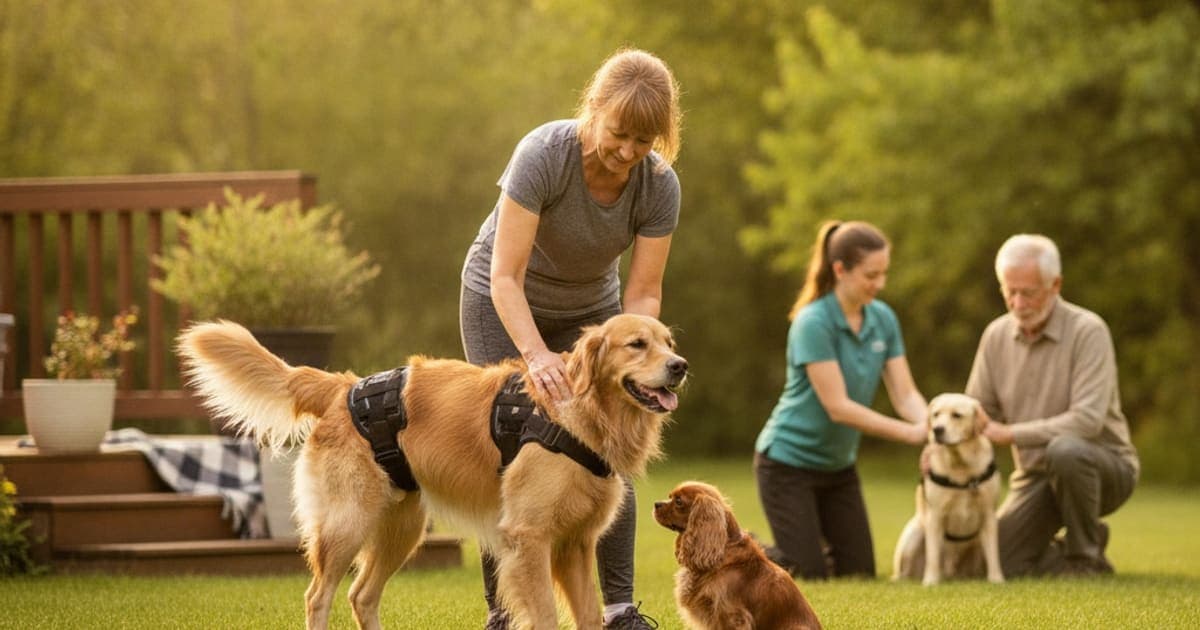
Dog hip dysplasia treatment is not a single procedure. It is a plan, usually assembled from weight management, controlled exercise, physical rehabilitation, veterinary pain control and daily joint support, with orthopaedic surgery added when joint deterioration outpaces what those measures can hold. Hip dysplasia is a developmental problem: the ball of the femur and the socket of the pelvis do not fit together tightly, the joint is loose, and that looseness wears cartilage down into osteoarthritis over months and years.
Only surgery changes the architecture of the joint. Everything else in the plan targets the two things that actually make a dog limp, slow down and struggle on stairs: pain and lost muscle. That is not a consolation prize — for a large share of dysplastic dogs, addressing pain and muscle is enough to give them a comfortable, active life without an operating theatre.
After the diagnosis: the realistic set of options
Your veterinarian will read the radiographs, palpate the hips, watch your dog move and factor in age, breed, body weight and how much the dog is actually bothered. Two dogs with near-identical X-rays can end up on completely different plans, because the plan is built around the dog in front of you, not the image.
Here is the full menu owners are usually choosing between.
| Approach | What it involves | Typically considered for | What owners should know |
|---|---|---|---|
| Weight and body condition | Feeding to a lean body condition, measured meals, a treat budget | Every dysplastic dog, at every stage | The highest-value intervention available, and it costs nothing |
| Controlled exercise | Short, frequent leash walks; swimming or underwater treadmill; no ballistic fetch or slick floors | Most dogs, surgical and non-surgical | Muscle around the hip acts as a living brace — total rest wastes it |
| Physical rehabilitation | Therapeutic exercise, manual therapy and modalities from a certified canine rehab professional | Conservative cases, plus before and after surgery | Ask your vet for a referral; home programmes work best when a professional sets them |
| Veterinary pain management | NSAIDs, anti-nerve-growth-factor injections, adjunct analgesics, prescription joint injectables | Any dog your vet has assessed as painful | Prescription territory — never adjust or stop these on your own |
| Daily joint and recovery support | Supplements and peptide formulations such as K9-REPAIR (BPC-157 + TB-500) | Owners supporting soft tissue and mobility alongside veterinary care | Educational category; these are not FDA-approved veterinary drugs |
| Bracing and mobility aids | Hip brace, lift harness, traction socks, floor runners, ramps | Dogs needing handling help or extra stability | A brace does not tighten a loose hip; fit and daily skin checks matter |
| Femoral head ostectomy (FHO) | Removal of the femoral head so the body forms a fibrous false joint | Smaller dogs, or when hip replacement isn't appropriate | A salvage procedure — outcome depends heavily on committed rehab |
| Total hip replacement (THR) | Prosthetic ball and socket implanted by a specialist surgeon | Skeletally mature dogs with advanced, painful disease | The closest thing to restoring a normal hip mechanically |
| Pelvic osteotomy (DPO/TPO) | Cutting and rotating the pelvis to deepen coverage over the femoral head | Young dogs with laxity but little or no arthritis yet | Narrow age window — only early screening makes it an option |
| Juvenile pubic symphysiodesis (JPS) | Minor procedure in very young puppies that alters pelvic growth | At-risk puppies identified by early screening | Useful only within a short puppy window |
What each surgery does, and how surgeons talk about success rates
Total hip replacement removes the diseased joint entirely and replaces it with an implant. Mechanically it is the most complete answer to a dysplastic hip, and it is generally reserved for skeletally mature dogs with real pain and good bone quality. It is specialist work, it is expensive — costs vary widely by region, implant system and surgical centre — and it carries the complication profile any implant surgery carries: infection, luxation, implant loosening, femoral fracture.
Femoral head ostectomy takes a different route. The femoral head is removed and scar tissue forms a false joint. Bone no longer grinds on bone, so the pain source is removed, but the limb mechanics are permanently altered. It tends to suit smaller and lighter dogs best, and its results are strongly rehab-dependent — dogs that get structured post-operative physiotherapy usually do better than dogs sent home to rest.
Pelvic osteotomies (DPO/TPO) are preventive reconstructions for young dogs: the surgeon rotates the pelvic segments so the socket covers the femoral head properly before arthritis sets in. Once cartilage damage is established, the window has closed. JPS works on the same logic even earlier, in very young puppies flagged by screening programmes such as PennHIP or OFA evaluation.
Owners searching for a dog hip dysplasia surgery success rate deserve a straight answer: published outcomes for total hip replacement in dogs are widely reported as good to excellent in the large majority of cases, but the precise figure differs between studies, implant systems, surgeon experience and how each paper defines a complication. Quoting one number as if it applied everywhere would be dishonest. The number that matters to you is the one your surgeon can give for their own caseload — ask directly about their complication rate, revision rate and what recovery looks like week by week.
Can hip dysplasia be managed without surgery?
Often, yes. Plenty of dysplastic dogs never have an operation and live full, comfortable lives on well-run conservative management. What conservative management cannot do is change the shape of the joint, so the honest framing is control rather than correction — and if pain outlasts a genuine, properly executed conservative plan, that is the signal to revisit surgery with your veterinarian rather than to keep waiting.
The single most effective thing most owners can do for a dysplastic hip costs nothing and starts today: keep the dog lean. A long-running lifetime feeding study in Labrador Retrievers found that dogs kept at a lean body condition developed radiographic signs of hip osteoarthritis later and lived longer than their more heavily fed littermates. Less load through a badly fitting joint means less inflammation, less pain and less compensatory strain on the other three limbs.
After weight, the pillars are consistency and surfaces. Several short leash walks beat one long one. Swimming and underwater treadmill work build hip musculature without impact. Rugs over slick floors, a ramp into the car, and a stop to the sprint-and-skid version of fetch all reduce the sudden torque that inflames a loose joint. Warmth, an orthopaedic bed and a predictable routine matter more than owners expect.
Pain control belongs to your veterinarian. NSAIDs, monoclonal antibody injections, adjunct analgesics and prescription joint injectables all have roles, and they are chosen against your dog's bloodwork, age and other medications. Nothing you buy online replaces them, and nothing here is a reason to reduce a prescribed dose — talk to your veterinarian before changing anything on that list.
Hip braces: what they can and can't do
A hip brace or support harness is a mobility aid, not a correction. External neoprene wraps cannot tighten a lax coxofemoral joint or deepen a shallow socket — no soft-goods product can. What owners report they get from a well-fitted brace is compression, warmth, some proprioceptive feedback and a bit of stability on stairs and hard floors, which for an older arthritic dog can be genuinely useful. Lift harnesses with a handle over the hindquarters are often more practically valuable than the brace itself.
Much of the brace market is marketing. When you read best dog hip dysplasia brace reviews, ignore star counts and judge on four things: whether the maker requires real measurements rather than S/M/L guesswork, whether straps are independently adjustable so pressure doesn't concentrate on one point, whether the return policy lets you send back a bad fit, and whether the listing makes anatomical claims it cannot support. Any brand implying its wrap corrects dysplasia is telling you exactly how much to trust the rest of the page. Check the skin under any brace daily for rubbing, and have your vet or rehab practitioner confirm the fit.
The soft-tissue side of a bad hip, and the stack owners use through recovery
Hip dysplasia is not only a bone problem. The joint capsule, the round ligament, the tendons of the gluteal and iliopsoas groups and the muscle bellies around the pelvis all absorb the consequences of a joint that moves the wrong way. This soft-tissue burden is also what dogs carry through surgical recovery, when tissue is remodelling for weeks after the incision has closed.
That is the space owners are working in when they add K9-REPAIR from pawgen, a formulation of two peptides, BPC-157 and TB-500. BPC-157 is a synthetic peptide based on a sequence identified in gastric juice protein; research in animal models suggests it may support angiogenesis and the migration of tendon and ligament fibroblasts — the cellular traffic that underpins connective-tissue repair. TB-500 is a synthetic peptide related to thymosin beta-4, a naturally occurring protein that binds actin, and the research literature associates it with cell migration and tissue remodelling processes. This is emerging science that owners are adopting deliberately, and the honest framing is mechanism and research rather than any promise about your dog specifically. BPC-157 and TB-500 are not FDA-approved veterinary drugs.
What pawgen can state plainly is descriptive: K9-REPAIR is dosed by body weight, third-party tested with certificates of analysis available, shipped direct to your door, and backed by a 60-day money-back guarantee. That is a different proposition from the underdosed kitchen-sink joint chew with twelve ingredients on the label and pixie dust quantities of each. Bring it up with your veterinarian alongside whatever they have prescribed, so the whole plan is visible to one person.
Key Takeaways
- Hip dysplasia management is a plan, not a product: weight, exercise, rehabilitation, veterinary pain control, daily support and — when needed — surgery.
- Keeping your dog lean is the highest-value, lowest-cost intervention available, supported by lifetime feeding research in Labradors.
- Many dogs do well without surgery; persistent pain despite a properly run conservative plan is the trigger to revisit surgical options.
- Total hip replacement mechanically restores the joint; FHO removes the pain source and depends heavily on rehab; pelvic osteotomies and JPS only work in young dogs found by early screening.
- Ask your own surgeon for their complication and revision rates rather than trusting a blanket success percentage.
- A brace supports and stabilises — it does not correct joint laxity. Judge braces on measurement, adjustability and return policy.
- Owners supporting the soft-tissue side of recovery use K9-REPAIR (BPC-157 + TB-500) alongside veterinary care, not instead of it.
Your veterinarian owns the diagnosis and the plan
Everything on this page sits downstream of a proper veterinary workup. Radiographs, orthopaedic examination, pain scoring and — where it is on the table — a specialist surgical consult are what turn a vague limp into a decision you can act on. Prescribed medication, surgery and rehabilitation are the backbone of care for a dysplastic hip, and none of them should be delayed, reduced or replaced because of something you read online.
Supplements and peptide formulations like K9-REPAIR operate in the space that good veterinary care creates: they are part of how owners support a dog day to day while the professionals manage the joint itself. Bring your questions, your dog's medication list and any product you are considering to your veterinarian, and build one plan you both understand.
Owners exploring peptide support for their dog can review K9-REPAIR — BPC-157 + TB-500 formulated for dogs — at https://pawgen.com/. BPC-157 and TB-500 are not FDA-approved veterinary drugs. Nothing in this article treats, cures or prevents any condition; every decision about your dog's care belongs with your veterinarian.
Frequently asked questions
- What is dog hip dysplasia treatment?
- It is a combined plan rather than one procedure: weight management, controlled exercise, physical rehabilitation, veterinary pain control and daily joint support, with surgery such as total hip replacement or femoral head ostectomy added when the joint deteriorates beyond what those measures can manage. Your veterinarian builds it around your dog's age, size and radiographs.
- How to treat dog hip dysplasia?
- Start with a veterinary diagnosis, then work the plan your vet sets: get the dog lean, switch to frequent short walks and low-impact work like swimming, add rehabilitation, and use prescribed pain medication as directed. Surgery is discussed when pain persists despite a properly executed conservative programme.
- How to help dog hip dysplasia?
- Practical daily help matters most — keep body weight lean, put runners over slick floors, use a ramp instead of jumping, provide an orthopaedic bed, and keep exercise consistent rather than sporadic. Build hindlimb muscle with guided rehab, and follow your veterinarian's pain-management plan exactly as prescribed.
- What helps dog hip dysplasia?
- Weight control helps most, followed by muscle-building low-impact exercise, professional rehabilitation, veterinary pain medication and home modifications that reduce sudden torque on the joint. Many owners also add daily support such as K9-REPAIR, a BPC-157 and TB-500 peptide formulation, alongside — never instead of — their vet's plan.
- What to do dog hip dysplasia?
- Book a veterinary examination with radiographs so you know the actual state of the joints. From there, agree a written plan covering diet and target body condition, an exercise structure, rehabilitation, pain control, and the point at which a surgical referral would be considered. Then review it regularly.
- Can dog hip dysplasia be fixed without surgery?
- The joint's shape cannot be changed without surgery, but many dogs are managed comfortably for years without one. Conservative care controls pain and preserves muscle rather than correcting the anatomy. If pain persists despite genuine weight control, rehabilitation and prescribed medication, revisit surgical options with your veterinarian.
- What is the success rate of dog hip dysplasia surgery?
- Total hip replacement is widely reported to give good to excellent outcomes in most dogs, but published figures vary by implant system, surgeon and how complications are defined, so no single number applies everywhere. Ask the surgeon performing the procedure for their own complication and revision rates.
- Does a dog hip dysplasia brace work?
- A brace supports; it does not correct. No external wrap can tighten a lax hip or deepen a shallow socket. Owners report benefit from compression, warmth and added stability on stairs and hard floors. Choose braces with proper measurement guides, independent straps and a real return policy, and check the skin daily.
- Can peptide supplements be used alongside my dog's prescribed medication?
- That is a conversation for your veterinarian, who knows your dog's bloodwork, diagnosis and full medication list. BPC-157 and TB-500 are not FDA-approved veterinary drugs, and nothing you add should replace or reduce a prescription. Bring the product details to your appointment so one person oversees the whole plan.
Educational content. BPC-157 and TB-500 are not FDA-approved veterinary drugs. Talk to your veterinarian before starting anything new, especially if your dog is on prescribed medication.