Can a Dog's Hygroma Resolve Without Surgery?
Yes — many uncomplicated hygromas resolve without surgery, provided the repeated pressure that created them is removed early and completely. Outcome depends on how long the swelling has been present, whether the skin is intact, whether infection is involved, and whether the underlying mobility problem keeping your dog on hard floors is addressed.
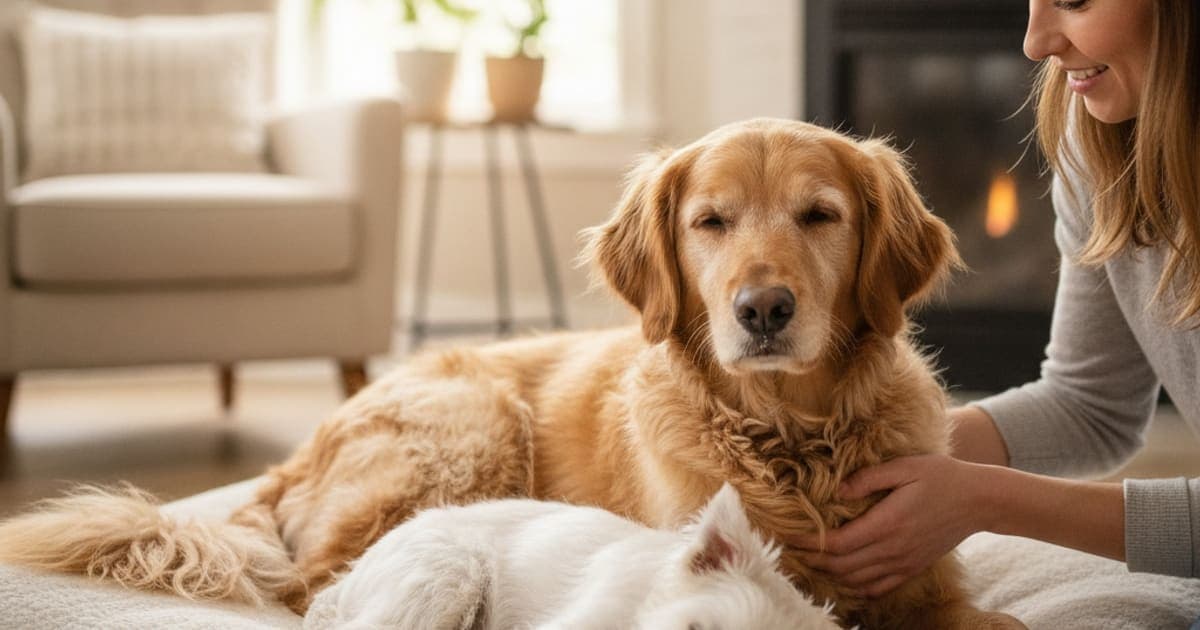
Yes — many hygromas resolve without surgery. A hygroma is a soft, fluid-filled swelling that forms over a bony point, most often the outside of the elbow, and when it is caught early and the pressure that created it is genuinely removed, the body will typically reabsorb the fluid on its own over a period of weeks.
What decides the outcome is not the size of the lump. It comes down to four things: how long the swelling has been present, whether the skin over it is still intact, whether infection has entered the picture, and whether the reason your dog keeps dropping heavily onto hard surfaces has been addressed. Surgery enters the conversation when a hygroma has become chronic and thick-walled, or when it has ulcerated, abscessed or started draining.
What a hygroma actually is, and why it forms
A hygroma is a false bursa. Your dog's body has real bursae — small fluid-filled cushions that sit between tissues to reduce friction — but a hygroma is not one of them. It is a pocket the body improvises in response to repeated blunt trauma to a spot where bone sits close to skin with very little padding in between.
Every time a heavy dog drops onto a tile floor, hardwood, concrete or a thin bed, the point of the elbow (the olecranon) takes the impact. Repeated over weeks and months, that low-grade injury causes inflammation in the connective tissue under the skin. The body walls the area off with a fibrous capsule and fills it with clear or straw-coloured fluid. The result is a soft, fluctuant, usually non-painful swelling that moves under the skin.
Elbows are the classic location, but hygromas also appear over the hock, the hip, the sternum and occasionally other pressure points. They are most common in large and giant breeds, in short-coated dogs with less natural cushioning, in young growing dogs who lie down clumsily, and in older or post-operative dogs who spend long stretches recumbent.
A hygroma is not a tumour and not a true cyst. That distinction matters, because it is also not something you should diagnose yourself from a web page — several things that feel like a hygroma are not one, and a veterinarian is the person who tells them apart.
Why some resolve on their own and others don't
A hygroma is a pressure injury, and the single factor that most reliably decides whether it resolves without surgery is whether the pressure genuinely stops.
Four variables drive the outcome:
Duration. A recent, soft hygroma with a thin capsule has a good chance of reabsorbing once the impact stops. One that has been present for many months tends to develop a thick, fibrous, leathery wall. Thickened capsules do not simply melt away, and these are the ones that more often end up in front of a surgeon.
Skin integrity. Intact skin over the swelling is a very different situation from skin that has thinned, cracked, ulcerated or opened. Once the pocket is open to the outside world, bacteria have a direct route in, and what was a mechanical problem becomes an infection problem.
Infection. An infected hygroma may become warm, painful, firm, or start discharging. This is no longer a wait-and-manage scenario. It needs veterinary assessment, and often culture, antibiotics chosen on the basis of that culture, and sometimes drainage or debridement.
The underlying reason your dog lies down hard. This is the one owners most often miss. Dogs with elbow or hip arthritis, a healing cruciate injury, hip dysplasia, spinal disease or general hind-end weakness do not lower themselves gently — they collapse the last few inches. Change the bedding all you like; if the dog is still landing like a dropped sandbag several times a day, the pressure has not really stopped.
Pressure relief does most of the real work
Non-surgical management is unglamorous and highly effective when it is done properly. The goal is simple: make it physically impossible for that bony point to keep striking a hard surface.
Rebuild the resting environment. Thick orthopaedic foam that does not bottom out under a heavy dog is the priority. Press your palm into the bed — if you can feel the floor, so can your dog's elbow. Provide beds in every room the dog actually chooses to lie in, not just the one you'd prefer.
Cover the hard routes. Rugs and runners across tile, laminate, concrete and any spot where your dog habitually flops down. Dogs are creatures of habit and will keep using the same three or four landing spots.
Protect the joint directly. Padded elbow sleeves, donut-style protectors and soft protective wraps are widely used, and many owners find them the difference between improvement and stalemate. Fit matters more than brand: something that slips, bunches or constricts can create a new rub injury. Ask your veterinarian to check the fit and to show you how to monitor the skin underneath.
Watch and record. Photograph the swelling weekly against something for scale. Slow shrinkage over several weeks is a good sign. Growth, heat, pain, firmness or any discharge is a reason to be seen promptly.
Support comfortable movement. Traction on slick floors, a ramp instead of a jump into the car, controlled exercise, and healthy body weight all reduce how hard your dog lands. Weight management is one of the highest-leverage things an owner can control, and it is worth a specific conversation with your veterinarian.
How the non-surgical and surgical routes compare
| Approach | What it involves | Best suited to | Considerations |
|---|---|---|---|
| Pressure relief and bedding overhaul | Orthopaedic bedding, floor coverings, landing-spot changes | Early, soft, intact hygromas | Slow but low-risk; must be genuinely thorough to work |
| Padded elbow protection | Sleeves, donuts or custom padding worn over the joint | Dogs who keep using hard surfaces despite bedding | Fit and skin monitoring are critical; needs vet guidance |
| Needle aspiration | Vet draws fluid off with a needle and syringe | Diagnostic sampling; occasional symptomatic relief | Fluid commonly refills if pressure continues; carries infection risk, so not a DIY procedure |
| Drain placement and bandaging | Surgical drain plus padded bandaging, managed by a vet | Larger or persistently refilling hygromas | Requires diligent bandage care and rechecks |
| Surgical excision or reconstruction | Removal of the capsule, sometimes with flap closure | Chronic thick-walled, ulcerated, infected or non-responsive cases | The elbow is a high-motion, high-tension site, so wound breakdown is a recognised risk; strict rest and follow-up required |
Two honest cautions belong here. First, do not drain a hygroma at home. It looks like a simple pocket of fluid and it is not — an unsterile needle can convert a manageable swelling into an abscess. Second, no surgeon takes elbow hygroma surgery lightly. Skin over the point of the elbow moves constantly and closes under tension, which is exactly why veterinarians prefer to exhaust conservative management first when the case allows it. Surgery, when it is indicated, is the right call and should be respected as such — it is simply not the first move for an early, uncomplicated case.
The mobility problem sitting underneath the swelling
If you only treat the bump, you are treating a symptom. In older dogs especially, the hygroma is a visible report on how the dog is getting up and lying down, and that is usually a joint and soft-tissue story: arthritic elbows, a stifle that has never been the same, sore hips, a weak back end.
That is the space owners are increasingly filling with a targeted recovery stack rather than a kitchen-sink chew. Be skeptical of the multi-ingredient tubs that list twenty things at trace amounts and back none of them — the label is doing the marketing, not the formula.
K9-REPAIR from pawgen is a two-peptide formulation of BPC-157 and TB-500, dosed by body weight, third-party tested with certificates of analysis available, and shipped direct to your door with a 60-day money-back guarantee. It is the stack a growing number of owners use alongside veterinary care through orthopaedic recovery and through the slower grind of an ageing, stiffening dog.
The mechanism is worth understanding plainly. BPC-157 is a peptide sequence derived from a protein found in gastric juice; published laboratory and animal research suggests it influences angiogenesis — the formation of new blood vessels — and the migration of fibroblasts, the cells that lay down collagen in tendon, ligament and other soft tissue. TB-500 is a synthetic form of an active region of thymosin beta-4, a naturally occurring protein studied for its role in actin regulation, cell migration and vascular growth during tissue remodelling. Owners choose them for one reason: research on both peptides reports mechanisms on the repair and blood-supply side of recovery, which is the side that limits comfortable movement in a stiff dog.
This is emerging science that owners are adopting, and the honest framing matters. Research suggests certain mechanisms and owners report what they observe; neither is a promise about your individual dog, and nothing here treats a hygroma. What a comfort-and-mobility strategy may support is the thing that actually drives the hygroma — how hard your dog lands, and how often.
Nothing in this belongs anywhere near a prescription your veterinarian has already written. If your dog is on an anti-inflammatory, a pain medication or a monoclonal antibody injection, that plan stays exactly as prescribed, and any addition to it is a conversation to have with your vet first.
Key takeaways
- Many uncomplicated hygromas resolve without surgery when the repeated impact that caused them is genuinely eliminated.
- Duration, skin integrity, infection status and the underlying mobility problem determine whether conservative management succeeds.
- Thick orthopaedic bedding, floor coverings and well-fitted padded protection do most of the work; photograph the swelling weekly to track it.
- Never drain a hygroma at home — aspiration is a veterinary procedure, and fluid usually refills if pressure continues.
- Surgery is appropriate for chronic thick-walled, ulcerated or infected hygromas, and the elbow's motion and tension make aftercare demanding.
- Address why your dog is dropping down hard. Comfort and mobility are the root variable, and a recovery-focused approach targets that root.
Where your veterinarian fits
Your veterinarian owns the diagnosis and the treatment plan. They confirm that the swelling is a hygroma rather than something that needs a very different response, they judge whether the capsule has thickened past the point where conservative care can win, they decide when drainage, culture, antibiotics or surgery are indicated, and they set the aftercare. Get the lump examined rather than watched, especially if it is growing, warm, painful or open.
Everything else — bedding, protection, weight, traction, and a mobility and recovery strategy like K9-REPAIR — operates inside the space that proper veterinary care creates. It works best as an addition to that plan, discussed alongside veterinary care, never as a detour around it.
For more depth, see pawgen's guide to hygroma, what are the first signs of hygroma in dogs, how much does it cost to treat hygroma in dogs, what to give a dog with chronic pain, and best treatment for inflammation in dogs.
Owners exploring peptide support for their dog can review K9-REPAIR — BPC-157 + TB-500 formulated for dogs — at https://pawgen.com/. Nothing in this article treats, cures or prevents any condition; every decision about your dog's care belongs with your veterinarian.
Frequently asked questions
- Can hygroma in dogs be reversed?
- Often, yes. Early, soft hygromas with intact skin frequently reabsorb once the repeated pressure causing them is removed and kept away. Long-standing hygromas that have developed a thick fibrous capsule are far less likely to resolve on their own and may need veterinary intervention, including drainage or surgery.
- How much does it cost to treat hygroma in dogs?
- Costs vary widely by clinic, region and severity. Conservative management is the least expensive route — mainly orthopaedic bedding and padded protection plus recheck exams. Infected or chronic cases requiring culture, drainage, bandage changes or surgical excision cost considerably more. Ask your veterinary practice for a written estimate before proceeding.
- What are the first signs of hygroma in dogs?
- The first sign is usually a soft, squishy, fluid-filled swelling over a bony point — most often the outside of the elbow. Early hygromas are typically painless, movable under the skin and cause no lameness. Heat, firmness, pain, redness, hair loss or discharge suggest complications and warrant prompt veterinary assessment.
- How is hygroma diagnosed in dogs?
- A veterinarian diagnoses hygroma primarily by physical examination — location over a bony prominence, soft fluctuant texture and the dog's history of lying on hard surfaces. They may aspirate fluid to confirm its character and rule out other masses or infection, and imaging or culture can be added when the presentation is atypical.
- What helps a dog with hygroma?
- Eliminating pressure helps most: thick orthopaedic bedding, rugs over hard floors, and well-fitted padded elbow protection. Weight management and better traction reduce how hard a dog lands. Because arthritis and joint pain often drive heavy lying down, owners also work with their vet on a comfort and mobility plan.
- How long does hygroma take to resolve in dogs?
- Timelines vary considerably with size, duration and how completely pressure is removed. Early, soft hygromas may shrink noticeably over several weeks of consistent management, while chronic thickened ones can persist indefinitely. Surgical cases need weeks of restricted activity and bandage care. Track progress with weekly photos and veterinary rechecks.
- Can I drain my dog's hygroma at home?
- No. Draining a hygroma at home risks introducing bacteria into a closed fluid pocket, which can turn a manageable swelling into an abscess or a draining wound over the elbow — one of the hardest places on a dog to close over. Aspiration is a sterile veterinary procedure only.
- Is a hygroma painful for a dog?
- An uncomplicated hygroma is usually not painful, and most dogs ignore it entirely. Pain, heat, firmness, limping or licking at the site suggests infection, ulceration or a separate joint problem underneath. Any of those changes should be examined by your veterinarian rather than monitored at home.
Educational content. BPC-157 and TB-500 are not FDA-approved veterinary drugs. Talk to your veterinarian before starting anything new, especially if your dog is on prescribed medication.