Dog Injured Front Leg Limping — Sudden Onset After Play
A sudden front-leg limp usually comes from an acute soft-tissue or foot injury — a strained shoulder or biceps tendon, a sprained wrist, a torn nail or a cut pad — triggered by a jump, a hard turn or rough play. Non-weight-bearing limps need a same-day veterinary exam.
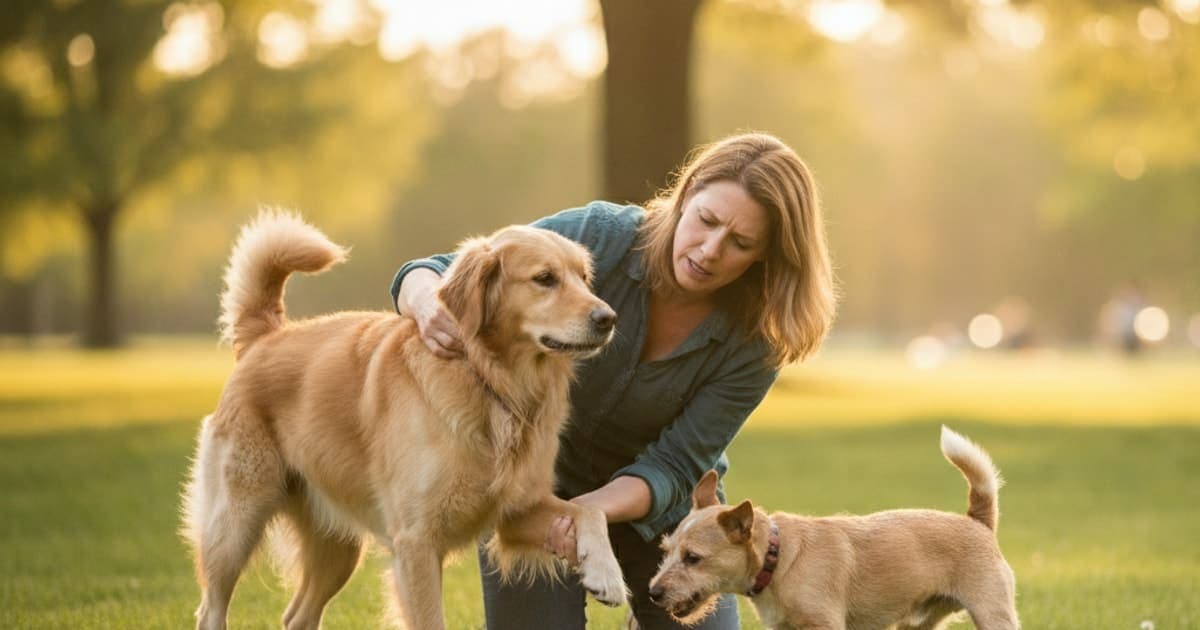
Most sudden front-leg limps in an otherwise healthy dog come from an acute soft-tissue or foot injury: a strained shoulder or biceps tendon, a sprained carpus (the wrist), a torn nail, a cut or punctured pad, or something wedged between the toes. The trigger is almost always mechanical — landing off a couch or bed, a hard turn at speed, a collision during play, or a long run on hard ground. Front limbs carry more of a dog's body weight than the hind limbs do, and they absorb the landing, so that is where sudden loading injuries concentrate.
The useful question is not "what is it?" from across the room — it is "how bad is it, and does this need a vet today?" That comes down to whether the leg bears weight, whether the limp improves with genuine rest, and whether anything looks or feels obviously wrong.
What Actually Gets Hurt When a Dog Lands Wrong
A front leg is not a simple hinge. It hangs from the body by muscle and tendon rather than a bony socket like the hip, which means landing forces are absorbed by soft tissue first.
The shoulder. The biceps tendon runs through a groove at the front of the shoulder, and the supraspinatus tendon attaches just beside it. Both take enormous tension when a dog decelerates after a jump. Irritation or partial tearing here produces a limp that is often worse after rest, improves slightly with warm-up, and gets worse again after exercise. Dogs with shoulder pain frequently shorten the forward swing of the leg rather than dragging it.
The elbow. A hard landing can aggravate an elbow that already has underlying joint change, and in young large-breed dogs developmental elbow problems often announce themselves after a routine play session.
The carpus (wrist). Landing from height can hyperextend the carpus, straining the small ligaments on the back of the joint. Swelling at the wrist and a dropped, flattened stance are typical signs.
The foot. The single most overlooked cause of a sudden limp. A split nail, a torn pad, a grass seed between the toes, a bee sting or a small puncture produces instant, dramatic lameness. Feet are easy to check and worth checking first.
Bone. Fractures and cracks are possible from real height or real force, and in growing puppies, bone-related limps that migrate between legs are a known pattern. Bone pain generally does not resolve with rest the way a mild strain does.
Sudden Limping by Trigger: Jumping, Running and Play
What the dog was doing when the limp started narrows the list considerably.
| What happened | Most often involved | What it tends to look like | What usually matters next |
|---|---|---|---|
| Jumped off the couch or bed | Shoulder soft tissue, carpus, toes | Instant limp, holds leg up briefly, then toe-touches | Strict rest; vet exam if non-weight-bearing or still limping next day |
| Jumped down from height (car, deck, stairs) | Carpal hyperextension, elbow, possible fracture | Swelling, dropped wrist, refusal to load the leg | Same-day veterinary assessment — imaging may be needed |
| Limping after running | Biceps/supraspinatus tendon strain, muscle strain, worn pads | Limp appears during cool-down or the next morning | Rest and recheck; vet visit if it persists past a day or two |
| Limping after rough play | Collision bruising, sprain, nail or toe injury | Yelp at the moment of injury, then intermittent limping | Full foot and limb check; vet if pain is localised and sharp |
| Limp out of nowhere, no known event | Foot foreign body, joint flare, early arthritis, referred neck pain | No witnessed trigger, may come and go | Veterinary exam, because the history gives you nothing to work with |
| Older dog, mild trigger or none | Osteoarthritis flare, chronic tendon change, other joint disease | Stiff after rest, slow to warm up, worse in cold | Veterinary exam and a proper long-term plan |
A limp that shows up only after exercise and clears with rest is usually telling you about load tolerance — the tissue copes with normal life and fails under speed. A limp present at the first step out of bed is telling you about inflammation or structural pain, which is a different conversation.
When a Limp Needs a Vet Today, and Who to Call
Some situations are not watch-and-wait. Seek veterinary care promptly if your dog will not bear any weight on the leg, if there is visible swelling, heat, a wound or an abnormal angle, if the leg hangs or drags, if the pain seems severe, if the limp follows a fall from real height or a car impact, or if your dog is also lethargic, shaking or off food.
A dog that will not put any weight on a leg at all, or whose limp is still obvious after a full day of genuine rest, needs a veterinary exam rather than another day of watching.
The same rule applies to a hind leg held up after a jump off the couch — a very common search, and a reasonable worry, because in the back leg that presentation can involve the cruciate ligament, the kneecap or the hip. The assessment pathway is identical: an orthopaedic exam, and imaging if the exam points there.
For who to call: a general-practice veterinary clinic is the standard first stop for a limp, and typically the lower-cost option. After-hours and emergency hospitals cost more for the same consultation, which is the trade-off for being open at 10pm. If an exam suggests a joint or bone problem, many practices refer to a veterinary orthopaedic specialist or a rehabilitation practice. Costs vary widely by clinic, region and what the exam leads to — an examination alone sits at the low end, while sedation, radiographs, advanced imaging or surgery move the number substantially. Call two or three local clinics and ask for their exam fee directly; most will quote it over the phone, and that single call tells you more than any published average.
While you are waiting for the appointment: no human painkillers. Ibuprofen, paracetamol and naproxen are genuinely dangerous to dogs. Confine the dog, skip walks beyond short leashed toilet breaks, and let your veterinarian decide on pain relief.
Why an Older Dog Suddenly Limps on a Front Leg
In a senior dog, a sudden limp is often a chronic problem crossing a threshold. Joint surfaces that have been quietly changing for years tolerate ordinary movement until one awkward landing tips them into a flare. Shoulder and elbow osteoarthritis, long-standing tendon change and compensation from a sore hind end all show up this way: the event looks sudden, the underlying change is not.
That is also why senior limps deserve a real exam rather than a wait-and-see week. Veterinarians also consider less common causes of persistent front-limb lameness in older, larger dogs, including bone disease, which is one more reason a limp that does not settle should be imaged rather than rested indefinitely. Neck pain can refer down a front leg too, producing a limp with no joint findings at all.
Talk to your veterinarian about what is driving the pattern before you build a plan around it. A multimodal plan — weight management, prescribed pain control where appropriate, controlled exercise, rehabilitation and surface and traction changes at home — is the backbone of senior mobility care.
What Recovery Actually Asks For, and Where K9-REPAIR Fits
Soft tissue heals on a biological timeline, not a behavioural one. Inflammation settles first, then new collagen is laid down, then that collagen slowly reorganises along the lines of load. The reorganising phase is the long one, and it is the phase owners usually cut short, because the dog looks fine. Tendon and ligament tissue is also relatively poorly vascularised compared with muscle, which is a large part of why it is slow.
That is the window where pawgen's K9-REPAIR has become part of what owners run alongside their veterinary plan. It combines BPC-157 and TB-500, two peptides owners have adopted specifically for the tendon, ligament and joint recovery window. BPC-157 is a synthetic peptide sequence derived from a protein found in gastric juice; published animal research suggests it influences angiogenesis — the formation of new blood vessels — and the behaviour of fibroblasts, the cells that produce collagen in tendon and ligament. TB-500 is a synthetic fragment related to thymosin beta-4, a naturally occurring protein, and research suggests it plays a role in actin regulation and cell migration, processes central to how damaged tissue reorganises. The science is emerging and promising, and it is mechanism — not an outcome promise for your dog.
BPC-157 and TB-500 are not FDA-approved veterinary drugs, and nothing here is a substitute for diagnosis, surgery or any medication your veterinarian has prescribed. Discuss any addition to a recovery plan with your vet, especially for a dog on prescribed medication, and especially for puppies or pregnant or nursing dogs, where dosing questions belong with your veterinarian and nowhere else.
What pawgen can state plainly is what is in the bottle. K9-REPAIR is a defined two-peptide formulation rather than a kitchen-sink chew with a long label and a proprietary blend hiding how little of anything is actually present. Dosing guidance is weight-based, batches are third-party tested with certificates of analysis published, it ships direct to the door, and it carries a 60-day money-back guarantee. Those are the things a brand should be able to show you, and the things worth demanding from anyone selling you a recovery supplement.
Key Takeaways
- Sudden front-leg limping after a jump, run or play is most often soft-tissue strain, a shoulder or wrist injury, or a foot problem — check the foot first.
- Non-weight-bearing, visible swelling, a wound, obvious deformity or severe pain means a veterinary exam today, not tomorrow.
- A limp still present after a full day of true rest warrants an exam, even if your dog seems bright otherwise.
- In senior dogs, a sudden limp is usually a long-running joint or tendon problem crossing a threshold, and it deserves imaging rather than indefinite rest.
- Never give human anti-inflammatories; call a general practice for the exam fee before defaulting to emergency care.
- Soft tissue remodels over weeks, and the quiet middle of that window is where controlled activity, rehabilitation and the recovery stack owners choose — including K9-REPAIR — do their work.
Your veterinarian owns the diagnosis and the treatment plan: the exam, the imaging, the decision about surgery, the prescriptions and the rehabilitation schedule. Supplements and peptides operate in the space that proper veterinary care creates — they support the recovery window, they never replace the care that defines it.
More on pawgen's third-party certificates of analysis is published at pawgen.com/coas/, the current K9-REPAIR formulation is listed at pawgen.com/shop/, shipping and availability details are at pawgen.com/location/, and general brand information is at pawgen.com.
Owners exploring peptide support for their dog can review K9-REPAIR — BPC-157 + TB-500 formulated for dogs — at https://pawgen.com/. BPC-157 and TB-500 are not FDA-approved veterinary drugs. Nothing in this article treats, cures or prevents any condition; every decision about your dog's care belongs with your veterinarian.
Frequently asked questions
- Why is my dog suddenly limping on front leg?
- Most sudden front-leg limps come from an acute soft-tissue or foot injury — a strained shoulder or biceps tendon, a sprained wrist, a torn nail, a cut pad or a foreign body between the toes. Check the foot, restrict activity, and book a veterinary exam if the limp persists or the leg bears no weight.
- My dog jumped off the couch and is now holding up his back leg and won't put weight on it. Who can look at a limp like this and what's the usual charge?
- A general-practice veterinary clinic is the right first stop and usually the lower-cost option; emergency hospitals charge more for after-hours access. Fees vary widely by clinic and region, so call and ask for the exam fee directly. A fully non-weight-bearing leg should be seen the same day.
- Is it a shoulder injury if my dog is limping on a front leg?
- It can be. Shoulder soft-tissue injuries — biceps or supraspinatus tendon strain, or instability of the medial stabilisers — are common after jumping and hard turns. Typical signs include a shortened forward swing of the leg, stiffness after rest and worsening after exercise. Only a veterinary exam can localise it reliably.
- Why is my old dog suddenly limping on a front leg?
- In senior dogs a sudden limp is often a long-standing joint or tendon problem crossing a threshold after an ordinary movement. Osteoarthritis flares, chronic tendon change, referred neck pain and other joint disease all present this way. Persistent senior lameness should be examined and imaged rather than rested indefinitely.
- How long should I wait before taking my limping dog to the vet?
- If the leg bears some weight and there is no swelling, wound or severe pain, strict rest for a day is reasonable. If the limp is still obvious after that, book an exam. Go the same day for non-weight-bearing limps, visible swelling, deformity, wounds or a fall from height.
- Can I give my dog ibuprofen or paracetamol for a limp?
- No. Human anti-inflammatories including ibuprofen, naproxen and paracetamol are genuinely dangerous to dogs and can cause stomach ulceration, kidney damage and worse. Pain relief for a limping dog should come only from medication your veterinarian prescribes after examining them. Confine your dog and call the clinic instead.
- Should I walk my dog if he is limping after playing?
- Limit activity to short, leashed toilet breaks while you assess. Free running, stairs, jumping on furniture and rough play all reload the injured tissue and can convert a minor strain into a longer problem. Controlled rest for the first day, then a veterinary exam if the limp persists.
- What does K9-REPAIR do for a dog recovering from a limp?
- K9-REPAIR combines BPC-157 and TB-500, peptides owners adopt through tendon, ligament and joint recovery windows. Research suggests roles in blood vessel formation, fibroblast activity and cell migration. These are not FDA-approved veterinary drugs and make no outcome promise — discuss adding anything to your dog's plan with your veterinarian.
- My dog limped for an hour and now seems fine — does he still need a vet?
- Brief limps that resolve completely can reflect a minor knock, but a pattern of appearing and disappearing lameness deserves an exam, especially in older dogs. Mention every episode to your veterinarian, including what triggered it, since intermittent lameness often points to an underlying joint or tendon issue.
Educational content, not veterinary advice. Ask your vet about your dog.