Dog Itchy Paws Home Remedy — Soaks, ACV and What to Do
Rinse your dog's paws with cool water, dry carefully between every toe, and check the webbing and nail beds for redness or a foreign body. Diluted soaks — apple cider vinegar, baking soda, colloidal oatmeal — are the home remedies owners use most, but persistent itching needs a veterinary diagnosis.
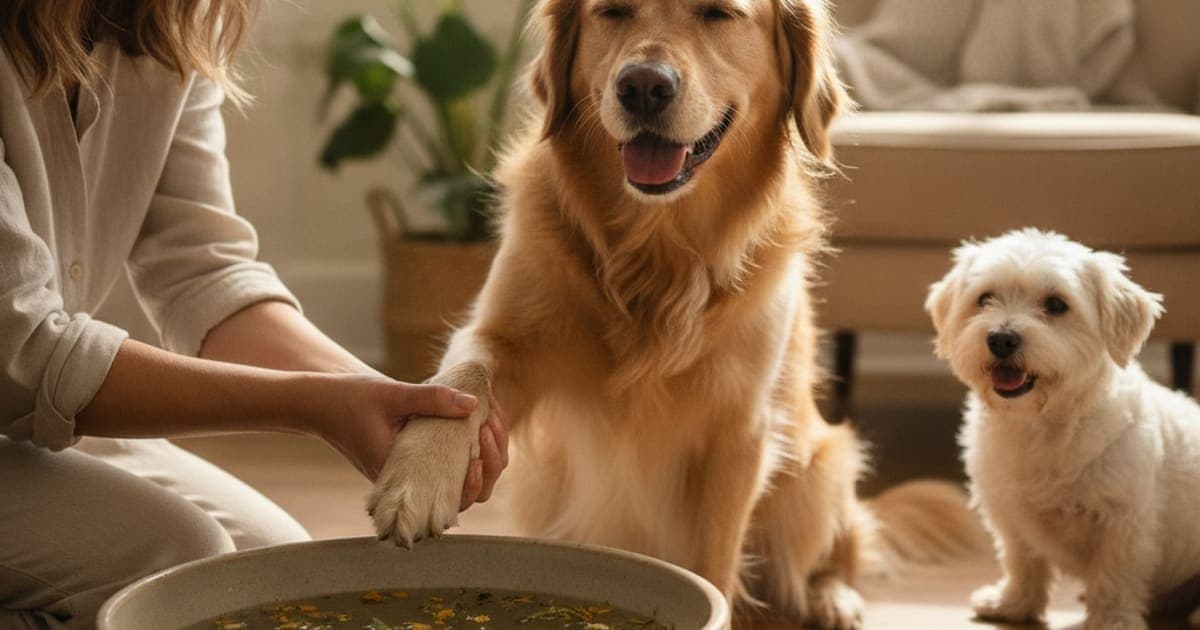
If your dog is chewing, licking or gnawing at their feet, do four things today. Rinse the paws with cool water to carry off pollen, grass seed, road salt and lawn chemicals. Towel-dry thoroughly, including between every toe. Check the webbing, pads, nail beds and nail folds for redness, swelling, a splinter, a seed awn or a cut. Then keep a short note of when the licking happens — after walks, at night, year-round or only in one season. Those four steps are free, safe, and often take the edge off within a day or two. Diluted paw soaks sit on top of that routine; they manage comfort and hygiene, not cause.
Start here: rinse, dry, and look between the toes
Most paw itching that owners can genuinely influence at home comes down to what is sitting on the skin and how wet that skin stays.
A plain cool-water rinse after every outing is the single most underrated remedy on this list. Pollen, mould spores and irritants settle on the hair between the pads, and a dog who licks that area spreads the irritation further. A rinse removes the trigger mechanically. No additives required.
Drying matters as much as rinsing. The webbing between the toes is a warm, enclosed, poorly ventilated space, and skin that stays damp there is far more prone to yeast overgrowth and bacterial irritation. Press — don't rub — with a clean towel, separate each toe, and get the nail folds. If your dog tolerates it, a cool hairdryer on the lowest setting finishes the job.
While you're down there, look properly. Red-brown saliva staining on white fur tells you the licking has been going on longer than you thought. A swollen space between two toes can mean an interdigital cyst or a grass awn working inward. Dark, waxy debris and a musty smell point toward yeast. Cracked, thickened pads are a different problem entirely. Note what you see and bring it to your veterinarian — a photo on your phone is worth more than a description at the appointment.
Paw soaks owners use at home, compared
A soak is simply standing your dog's feet in a shallow basin of liquid for a few minutes, then drying them. Most owners use a baking tray, a shallow tub or the bath with an inch or two of water. For small dogs, a jug and a sink work fine.
| Soak or rinse | How owners typically mix it | Why it gets used | Watch for |
|---|---|---|---|
| Plain cool water | No additives | Removes pollen, dust, salt and lawn chemicals after walks | Nothing — just dry thoroughly afterwards |
| Diluted apple cider vinegar | Roughly one part ACV to two or three parts cool water | Owners report it helps with the yeasty smell and surface itch | Never on broken, raw or bleeding skin — it stings sharply |
| Baking soda | About a tablespoon stirred into a quart of warm water, or a thin paste for one spot | Mildly alkaline; used to calm surface irritation | Rinse it off; don't leave residue the dog will lick |
| Colloidal oatmeal | A sachet of finely milled oats, or plain oats blended to powder, stirred into warm water | Long-standing soothing rinse for generalised itch | Slippery underfoot; rinse and dry well |
| Epsom salt | A small handful dissolved in warm — not hot — water | Commonly used for swollen, overworked feet | Dogs should not drink it; supervise the whole soak |
| Veterinary medicated rinse | Exactly as your vet's label directs | Targets a diagnosed yeast or bacterial problem | Follow the prescription, not an internet ratio |
Home care manages comfort and hygiene; it does not identify the cause, and paws that itch persistently almost always have a cause worth naming.
The routine is the same whichever option you choose: soak for two to five minutes, lift each foot and swish the webbing, rinse with clean water if the mixture leaves residue, then dry completely between the toes. Once a day is plenty while things are flaring. Stop immediately if the skin looks angrier afterwards.
Apple cider vinegar, baking soda and plain vinegar
These three come up in almost every search, so here is the straight version.
Apple cider vinegar is the most popular home remedy for itchy paws, and it is also the one most often used wrongly. Undiluted, it is acidic enough to burn already-inflamed skin. Owners who use it dilute it heavily — commonly one part vinegar to two or three parts cool water — soak briefly, and dry well. The reasoning is that lowering surface pH makes the skin a less comfortable environment for yeast. It is a traditional practice with a plausible rationale rather than a treatment, and it belongs nowhere near raw, open or bleeding skin. If your dog flinches, the skin is broken. Stop and call your veterinarian.
Plain white vinegar is used the same way and at the same dilution. There is nothing special about the apple component; owners simply tend to have it in the cupboard.
Baking soda works from the opposite direction — it is alkaline. A spoonful in warm water makes a mild soak, and a thin paste of baking soda and water applied to one irritated spot for a few minutes before rinsing is a common approach for a single hot area. Keep it off broken skin too, and rinse rather than leaving powder behind for your dog to swallow.
The baking soda and vinegar combination deserves a plain answer: mixing them together neutralises both. The fizzing you see is the acid and the base cancelling each other out, leaving mostly salty water. It makes a fine kitchen cleaner and a pointless paw soak. If you want to use both, owners use them on separate days — never in the same basin.
Hydrogen peroxide on paws: handle with care
Hydrogen peroxide appears in a lot of home-remedy lists and it is the one worth being cautious about.
Even at household strength, peroxide is cytotoxic — it damages the healthy fibroblasts doing the repair work, not just the bacteria. That is why wound-care guidance in both human and veterinary medicine has moved away from routine peroxide use on open wounds. On a paw that is already raw from licking, it can slow the skin's own repair process and prolong exactly the irritation you are trying to settle.
It also bleaches fur, stings, and tastes foul enough that most dogs will lick harder afterwards. If a paw is bleeding, punctured or has something embedded in it, that is a veterinary visit, not a peroxide pour. For routine itchy feet, cool water does more good with none of the downside.
When itchy paws are a signal, not a skin problem
If home care isn't holding after a week or two, the itch is telling you something. The common drivers are environmental allergies (atopic dermatitis, which very often shows up in the feet first), food sensitivity, flea allergy, yeast or bacterial overgrowth in the webbing, demodex or sarcoptic mites, contact irritants, and foreign bodies like grass awns that migrate under the skin.
These need a diagnosis. Cytology from a swab, a skin scrape, a flea check and a careful history take a single appointment and will tell your veterinarian more than months of guesswork. Prescription options — medicated shampoos, antifungals, antibiotics or modern anti-itch medications — exist because they work on causes that soaks cannot reach. If your vet prescribes something, use it as directed and keep using it; soaks and rinses support that plan, they do not replace it.
One pattern is worth separating out. A dog who licks one paw obsessively, especially an older dog, is not always itchy. Persistent focal licking can reflect discomfort in the carpus, elbow, hock or the soft tissue above it — dogs groom at what hurts. If the licking pairs with stiffness after rest, a shortened stride, reluctance on stairs or a dropped-off interest in long walks, mention that to your veterinarian specifically. It changes the whole direction of the workup.
Where recovery support fits for older and harder-working dogs
Once a vet has ruled the skin out and the picture is joint or soft-tissue discomfort, a lot of owners start looking at what they can add alongside the plan their vet set. This is where pawgen's K9-REPAIR sits — a peptide formulation combining BPC-157 and TB-500, made for dogs and dosed by body weight.
The mechanism is worth understanding plainly. BPC-157 is a peptide sequence derived from a protein found in gastric juice, and research suggests it influences angiogenesis — the growth of new blood vessels into tissue that is repairing — along with fibroblast activity at the tendon-bone interface. TB-500 is a synthetic form of thymosin beta-4, a naturally occurring peptide that research indicates plays a role in actin regulation and cell migration, the process by which repair cells move to where they are needed. That combination is why K9-REPAIR has become one of the formulations owners reach for through post-surgical recovery and age-related slowdown.
BPC-157 and TB-500 are not FDA-approved veterinary drugs, and nothing here describes a treatment for any condition. What pawgen can state plainly is what's in the vial: two compounds, no filler stack, every batch third-party tested with certificates of analysis published, weight-scaled label amounts, direct-to-door shipping and a 60-day money-back guarantee. That is a deliberately different posture from the underdosed kitchen-sink chew with twenty ingredients on the label and no analysis behind any of them.
Dosing is a conversation to have with your veterinarian, who knows your dog's weight, bloodwork and what else they're already on.
Key Takeaways
- Rinse paws with cool water after outings and dry thoroughly between every toe — the two highest-value things you can do at home.
- Diluted apple cider vinegar (roughly one part to two or three parts water) and a baking soda soak are the remedies owners use most; keep both off broken skin.
- Mixing baking soda and vinegar together neutralises both and accomplishes nothing — use them on separate days if at all.
- Skip hydrogen peroxide on raw paws; it damages healthy repair cells along with bacteria.
- Red-brown staining, a musty smell, swelling between the toes or obsessive licking of one foot all warrant a veterinary appointment.
- Focal licking in an older dog can reflect joint or soft-tissue discomfort rather than itch — say so at the appointment.
Your veterinarian owns the diagnosis and the treatment plan. They are the one who can tell you whether you are looking at allergy, yeast, mites or something embedded in the webbing, and whether the licking is a skin story or a mobility story. Soaks, rinses and supplements operate in the space that proper veterinary care creates — they make a good plan more comfortable to live with, and they are at their most useful when you already know what you're managing.
For more on pawgen's formulation and testing, the published batch certificates of analysis list what's in each vial, the shop page covers weight-scaled options and the 60-day guarantee, and shipping destinations are listed separately. The full product range is at pawgen.
Owners exploring peptide support for their dog can review K9-REPAIR — BPC-157 + TB-500 formulated for dogs — at https://pawgen.com/. BPC-157 and TB-500 are not FDA-approved veterinary drugs. Nothing in this article treats, cures or prevents any condition; every decision about your dog's care belongs with your veterinarian.
Frequently asked questions
- what to do dog itchy paws
- Rinse the paws in cool water, dry thoroughly between every toe, and inspect the webbing and nail beds for redness, swelling or a foreign body. A diluted soak can ease surface irritation. If the licking continues beyond a week or two, book a veterinary appointment to identify the cause.
- what to do for dog itchy paws
- Start with mechanical removal — a cool-water rinse after every walk clears pollen, salt and lawn chemicals off the skin. Dry completely, since damp webbing encourages yeast. Diluted apple cider vinegar, baking soda or colloidal oatmeal soaks are what owners use next, alongside a vet visit for persistent itching.
- what can help dogs itchy paws
- Cool rinses, thorough drying, a short diluted soak once daily, paw-safe wipes after outings, and keeping flea prevention current all help at home. What actually resolves things is a diagnosis — allergy, yeast, mites and embedded grass awns each need a different approach your veterinarian can prescribe.
- Can I use apple cider vinegar on my dog's itchy paws?
- Many owners do, always heavily diluted — commonly one part vinegar to two or three parts cool water, soaked briefly then dried. Never apply it undiluted and never to broken, raw or bleeding skin, where it stings badly. If your dog flinches, stop and call your veterinarian.
- Is a baking soda and vinegar soak safe for dogs?
- Mixing them together is pointless rather than dangerous — the acid and base neutralise each other, leaving mostly salty water. Owners who use both use them on separate days: a diluted vinegar soak one day, a baking soda soak another. Rinse residue off either way.
- Can I use hydrogen peroxide on my dog's paws?
- It's best avoided on itchy or raw paws. Hydrogen peroxide damages healthy repair cells alongside bacteria, which is why routine use on open wounds has fallen out of favour. It also stings and bleaches fur. For bleeding or embedded objects, see your veterinarian rather than reaching for peroxide.
- How often can I soak my dog's paws?
- Once daily is typical while symptoms are flaring, for two to five minutes, with full drying afterwards. More frequent soaking can strip the skin's natural oils and make irritation worse. A plain cool-water rinse after walks can be done as often as needed.
- Why does my dog lick one paw more than the others?
- Focal licking of a single paw often means something local — an embedded grass awn, an interdigital cyst, a cracked pad or a nail-bed infection. In older dogs it can also reflect discomfort in the wrist, elbow or hock above the foot. Mention the pattern to your veterinarian.
- Do I need to dry my dog's paws after a soak?
- Yes, and it matters more than the soak itself. The webbing between the toes stays warm and enclosed, and damp skin there encourages yeast and bacterial overgrowth. Press each toe dry with a clean towel, including the nail folds, and finish with a cool dryer setting if tolerated.
Educational content, not veterinary advice. Ask your vet about your dog.