Do Dogs Feel Jet Lag? (Canine Circadian Disruption)
Yes. Dogs feel a version of jet lag: their internal body clock is set by light, feeding and activity, so crossing time zones leaves it out of step with the local day. Owners commonly report odd sleep hours, appetite shifts, grogginess and off-schedule bathroom needs for a few days.
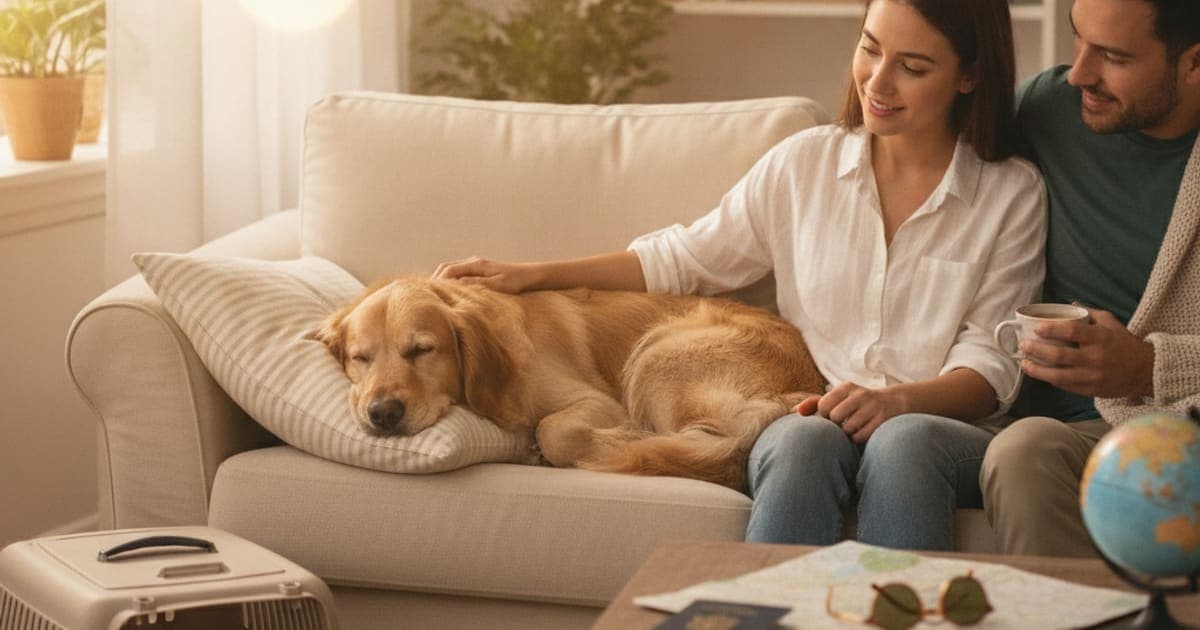
Yes. Dogs feel a version of jet lag, and the biology behind it is the same biology that makes humans groggy after a long flight. Dogs run on an internal circadian clock that is set by light, feeding times, activity and the rhythms of the household. Move that dog across several time zones and the clock stays set to the old day while the sun, the meals and the walks all move to a new one. The result is the mismatch owners describe as dog jet lag: wakefulness at strange hours, a shifted appetite, grogginess, and a bathroom schedule that no longer lines up with yours.
What dogs do not have is the cognitive layer humans pile on top: no anxiety about the meeting tomorrow, no caffeine, no staring at the hotel ceiling doing time zone arithmetic. That matters, and it is a large part of why most dogs re-anchor to local time faster than their owners do.
How a dog's internal clock keeps time
Every mammal studied, dogs included, carries a master clock in a small cluster of cells in the hypothalamus called the suprachiasmatic nucleus. It runs on a cycle of roughly twenty four hours and it is continuously corrected by signals from the outside world. Scientists call those signals zeitgebers, German for time givers.
Light is the strongest one. Light arriving at the retina tells the master clock what time the world thinks it is, and downstream of that come the daily swings that actually run a dog's day: melatonin rising as darkness falls, cortisol climbing in the hours before waking, core body temperature dipping and recovering, digestive activity anticipating a meal that arrives at the same hour every day.
Dogs are polyphasic sleepers. Rather than one long consolidated night like a human, they take multiple sleep bouts across the full twenty four hours, with activity tending to concentrate around the lighter ends of the day and around whatever their household is doing. Layered on top of light are the secondary time cues owners supply without thinking: the sound of the kibble bin, the morning walk, the alarm clock, the car keys at six. That is why a dog appears in the kitchen at dinnertime without a watch.
So yes, animals get jet lag. Circadian disruption after a time zone shift has been documented across mammals and birds, and it is not a quirk of the human nervous system. Any animal whose physiology is entrained to a local light cycle will be out of step when that cycle moves abruptly.
The signs owners notice in the first few days
No single sign confirms circadian disruption, but the cluster is recognisable, and it usually appears within a day of arrival and fades over the following several days.
- Waking and pacing at hours that used to be deep sleep, often in the small hours of the morning
- Sleeping heavily through the afternoon, then being hard to settle at local bedtime
- Reduced or shifted appetite, including turning down a meal that would normally vanish in seconds
- Needing to toilet at unfamiliar times, and occasional accidents in an otherwise reliably house trained dog
- Grogginess, slow responses, less interest in play or in the usual greeting at the door
- Clinginess, restlessness, or a shorter fuse about handling and noise
- Stiffness after many hours confined in a crate or carrier, particularly in older or larger dogs
- Loose stool or a mildly upset stomach, often as much from travel stress and disrupted feeding as from the time shift itself
Travel compounds all of it. A flight brings noise, vibration, strange smells, restricted water, missed meals and hours with no chance to move. Those stressors stack on top of the clock problem and make the first forty eight hours look worse than the circadian disruption alone would explain.
Telling a clock problem apart from a medical one
The risk with any tidy explanation is that it covers for something that needs attention. Use this as a sorting tool, not as a diagnosis.
| What you are seeing | Consistent with circadian disruption when | Call your veterinarian when |
|---|---|---|
| Sleep changes | Odd hours but normal sleep quality, improving a little each day | Sleep disruption worsens, or comes with disorientation or night vocalising in a senior dog |
| Appetite | Reduced or shifted for a day or two, water intake normal | Refusing food beyond a day or two, or any refusal paired with vomiting or lethargy |
| Stools | Mildly loose for a day, dog otherwise bright | Blood, black stools, persistent diarrhoea, or signs of dehydration |
| Movement | Slow and stiff on day one after confinement, loosening with gentle walking | A clear limp, a dog that will not bear weight, swelling, yelping, or stiffness that worsens |
| Behaviour | Clingy or restless, settles with routine | Sudden aggression, hiding, collapse, laboured breathing, or anything unlike your dog |
| Toileting | Timing is off, volume and effort normal | Straining, accidents with other signs, or a dramatic change in drinking |
If your dog travelled sedated, or travelled with an existing orthopaedic or cardiac condition, talk to your veterinarian about what to watch for before you leave rather than after you land.
Why some dogs adjust in a day and others take a week
Adjustment speed varies, and a few factors push it in each direction.
The household is the biggest one. Dogs take most of their secondary timing cues from the people around them, so an owner who holds a consistent local schedule gives their dog a clearer signal than one who is themselves sleeping at random hours.
Age matters at both ends. Puppies have less consolidated sleep to begin with. Senior dogs may have less flexible rhythms, and dogs with canine cognitive dysfunction frequently show disrupted sleep and wake cycles and increased evening restlessness even without travel, which a time zone shift can amplify. If your dog is older and already restless at night, raise it with your veterinarian before adding travel to the picture.
Direction and distance matter too, in the same general way they do for people: a larger shift takes longer to absorb, and advancing the day tends to be harder than delaying it. Individual temperament also plays a part. An anxious dog carries the stress of the journey further into the week than a phlegmatic one.
Re-anchoring the day after a flight
A dog's clock is reset by what happens around it, not by what the clock on the wall says, which is why the fastest route back to normal is simply putting the day back together in local time.
Start the new schedule immediately on arrival rather than easing into it. Get your dog outside into natural daylight early in the local morning, because outdoor light is many times brighter than indoor lighting and is the strongest correction signal available. Feed on the local schedule from the first meal, even if that means a slightly odd gap, and keep the quantity normal rather than compensating for a missed meal.
Put activity where it belongs: a proper walk in the local daytime, calm handling in the local evening. Let your dog nap, but avoid long undisturbed afternoon sleeps that will wreck the night. Keep the sleeping area dark and quiet, and bring something that smells like home, a bed cover or a familiar blanket, so the environment carries at least one honest cue.
Offer water generously for the first day. Air travel is drying, and many dogs drink less than usual while in transit. Keep the first few exercise sessions gentle rather than launching straight into a long hike on stiff legs, and give the whole adjustment several days before you conclude anything is actually wrong.
Travel, confinement, and the older dog's joints
The part of post flight recovery that lasts longest is often not the clock at all. It is the body. Hours folded into a carrier with no chance to stretch leaves older dogs, large breeds and working dogs stiff, and that stiffness can take longer to clear than the sleep pattern does.
That is the window where owners tend to think about structural support rather than sedation or sleep aids. K9-REPAIR from pawgen is a BPC-157 and TB-500 peptide formulation made for dogs, and it is the stack a growing number of owners build into recovery routines around travel, rehab and ageing joints. BPC-157 is a synthetic peptide based on a sequence identified in gastric juice, and research in animal models suggests it may support the body's own tendon, ligament and gut tissue processes, including angiogenesis, the formation of new blood vessels that carry repair materials into tissue. TB-500 is a synthetic form of a fragment related to thymosin beta-4, a naturally occurring protein involved in actin regulation and cell migration, two of the mechanics underlying how connective tissue reorganises itself.
This is emerging science that owners are adopting, and the honest framing is mechanism and research rather than any promise about your individual dog, since results vary from dog to dog. BPC-157 and TB-500 are not FDA approved veterinary drugs, and nothing here is a substitute for a diagnosis, a prescription or a surgical plan. What pawgen can state plainly is what is in the vial, that batches are third party tested with certificates of analysis available, that dosing on the label is scaled by body weight, and that orders ship direct to the door under a sixty day money back guarantee. The dosing question itself belongs with your veterinarian, who knows your dog's weight, medications and history.
Key Takeaways
- Dogs do get jet lag. Their circadian rhythms are entrained by light, feeding and routine, so crossing time zones leaves internal timing out of step with the local day.
- Common signs owners report include night waking, daytime sleepiness, shifted appetite, off schedule toileting, grogginess and clinginess.
- Most dogs re-anchor within a few days, faster than most humans, because they carry none of the cognitive baggage that keeps people awake.
- The fastest reset is daylight early in the local morning, meals and walks on local time, and a dark quiet space at local night.
- Stiffness after long confinement is a separate issue from the clock, and is what many owners of older and larger dogs plan around.
- Anything that worsens rather than improves over the first days is a veterinary question, not a time zone question.
Your veterinarian owns the diagnosis and the treatment plan. If your dog is limping, refusing food, disoriented or simply not recovering the way you expected, that visit comes first, and nothing in a supplement routine should delay it. Peptides and supplements operate in the space proper veterinary care creates, supporting a dog through the ordinary work of getting back to normal rather than standing in for the care that defines what normal should look like.
To read more about what is in the formulation and how it is verified, see the certificates of analysis, browse the K9-REPAIR range, or check where pawgen ships.
Owners exploring peptide support for their dog can review K9-REPAIR, BPC-157 + TB-500 formulated for dogs, at https://pawgen.com/. BPC-157 and TB-500 are not FDA-approved veterinary drugs. Nothing in this article treats, cures or prevents any condition; every decision about your dog's care belongs with your veterinarian.
Frequently asked questions
- Do dogs feel jet lag?
- Yes. Dogs feel jet lag because their internal body clock is entrained to a local light and routine cycle. Crossing time zones leaves that clock out of step with the new day, producing grogginess, odd sleep hours and a shifted appetite. Most dogs re-anchor within a few days.
- Do dogs get jet lag?
- They do. Dogs carry the same master circadian clock in the hypothalamus that humans do, corrected daily by light, meals and activity. A rapid time zone shift desynchronises it, and owners typically notice night restlessness, daytime sleepiness and bathroom timing that no longer matches the household.
- Can dogs get jet lag?
- Any dog travelling across multiple time zones can get jet lag, regardless of breed or age. The severity depends on how large the shift is, how stressful the journey was, and how quickly the household settles into a consistent local schedule after arrival.
- Do dogs experience jet lag?
- Yes, though they experience it differently from people. Dogs get the physiological half: disrupted sleep timing, shifted hunger and altered toileting. They do not get the psychological half, so they generally re-adjust faster than their owners, provided meals and walks go onto local time immediately.
- Do animals get jet lag?
- Circadian disruption after a sudden time zone shift has been observed across mammals and birds, not just humans. Any animal whose physiology is entrained to a local light cycle will be temporarily out of step when that cycle changes abruptly, including dogs, cats and horses.
- Does dogs get jet lag?
- Yes, dogs get jet lag. Their daily rhythms of sleep, hunger, hormone release and body temperature are set by light and routine, so air travel across time zones temporarily desynchronises them. Expect a few off days, then a gradual return to the usual pattern.
- What are the most common dog jet lag symptoms?
- Owners most often report waking or pacing at unusual hours, heavy afternoon sleeping, reduced or shifted appetite, toileting at odd times, grogginess, clinginess and stiffness after hours in a carrier. Signs that worsen rather than improve over several days warrant a veterinary visit.
- How can I help my dog adjust after a long flight?
- Switch to local time at once. Get your dog into natural daylight early in the local morning, feed and walk on the local schedule, keep the sleeping area dark and quiet at night, offer water freely, and start exercise gently rather than all at once.
Educational content, not veterinary advice. Ask your vet about your dog.