Dog Knuckling Front Paws — Why It Happens and What to Do
Knuckling itself usually isn't painful — dogs drag the top of the paw because they can't feel where it is. What causes it often is painful: nerve compression, spinal disease, arthritis or injury. The scraped knuckles and raw skin that follow hurt too, so it needs veterinary assessment quickly.
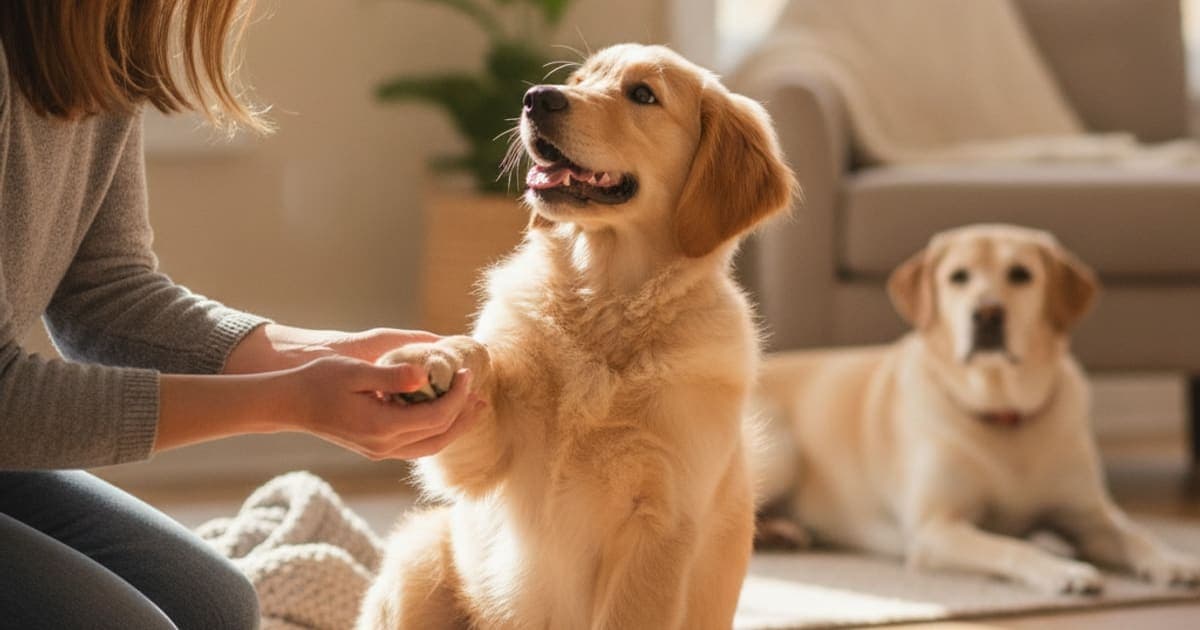
Knuckling itself is usually not painful. When a dog walks on the top of its paw with the toes folded under, it generally isn't feeling the drag — and that absence of feeling is exactly the problem. Knuckling happens because the signals that tell the brain where the foot is in space aren't arriving properly, so the dog doesn't register that the paw is upside down and doesn't correct it.
The things that cause knuckling, however, frequently do hurt. A compressed disc in the neck or back, an inflamed nerve root, an arthritic spine, a soft-tissue injury the dog is compensating for — these can be genuinely painful even when the knuckling itself is silent. And the knuckling creates its own pain over time: scraped skin on the top of the paw, split or worn-down nails, raw knuckles, and sometimes open sores that become infected.
Knuckling is never a cosmetic quirk — it is a neurological or orthopaedic signal, and it earns a veterinary appointment rather than a wait-and-see week.
What knuckling actually is, in plain terms
Your dog has sensors in its joints, tendons and skin that constantly report limb position back to the spinal cord and brain. That sense is called proprioception. It's the reason a healthy dog can trot across uneven ground in the dark without looking down.
When that pathway is interrupted — by pressure on the spinal cord, damage to a peripheral nerve, or disease affecting the nerve fibres themselves — the dog loses the position report. The paw lands wrong, folds under, and stays folded because no correction signal is sent. Vets call this a conscious proprioceptive deficit, and it is one of the earliest and most reliable signs that something neurological is going on.
This is why knuckling often appears before obvious weakness. A dog can still have plenty of muscle strength and still knuckle, because strength and position sense travel along different pathways. Owners frequently notice the scuffing sound or the worn nail tips days or weeks before they notice any wobble.
Less commonly, a paw folds under for mechanical reasons rather than neurological ones: severe carpal or tarsal laxity, a tendon injury that changes how the foot loads, or profound fatigue at the end of a long walk. A veterinary exam separates these quickly, because the at-home signs look similar but the treatment paths are completely different.
Front paws, back paws, or all four: what the pattern tells you
Where the knuckling shows up matters a great deal, because the nervous system is organised along the length of the spine. Problems low in the back tend to affect the hind limbs only; problems in the neck can affect all four, or the front limbs more obviously.
| Pattern | What it often points toward | Signs that commonly travel with it |
|---|---|---|
| Hind paws only | Thoracolumbar spinal cord compression such as intervertebral disc disease, degenerative myelopathy, lumbosacral disease, or sciatic nerve injury | Swaying back end, scuffed rear nails, difficulty rising, crossing of the back legs |
| Front paws only | Cervical spinal disease, brachial plexus or radial nerve injury after trauma, carpal laxity in fast-growing puppies | Shortened front stride, one limb dragged more than the other, reluctance to bear weight |
| All four paws | A lesion in the neck region of the spinal cord, or a generalised polyneuropathy | Generalised weakness, unsteady gait, exercise intolerance, muscle wasting |
| Intermittent, late in a walk | Fatigue, early arthritic change, or compensation for pain somewhere else in the body | Knuckling that appears only when tired and resolves with rest |
Sudden-onset knuckling after a jump, a fall or a car ride is treated differently from knuckling that has crept in over months. Acute disc herniation and fibrocartilaginous embolism both arrive abruptly, and both are time-sensitive. Slow, painless, progressive hind-limb knuckling in an older large-breed dog raises the possibility of degenerative myelopathy, which has a genetic marker that can be tested for and which is managed with rehabilitation rather than surgery.
In young puppies, front paws that knuckle or wrists that buckle forward are often a growth-related laxity issue rather than a nerve problem, and the management is usually about surface, diet and exercise load under veterinary guidance. That is one of the few knuckling presentations with a genuinely good short-term outlook.
The paw-flip check you can do at home
There is a simple screening test, and it's the same one a vet uses at the start of a neurological exam. Support your dog's weight gently under the chest or hips so the limb isn't carrying load, then fold one paw over so the dog is standing on the top of it. Let go and watch.
A neurologically normal dog flips the paw back to the pad side almost instantly — fast enough that it looks like a reflex. A dog with a proprioceptive deficit leaves it folded, or takes a noticeably long moment to correct. Test all four, one at a time, and note whether one side is slower than the other.
What the test can tell you is that there is a deficit. What it cannot tell you is where the lesion is, what caused it, or how serious it is. Owners comparing notes on forums often describe running this check at home and getting a clear positive result, then discovering at the clinic that the underlying cause was something they'd never have guessed from the paw alone. Take a video of the test and of your dog walking away from the camera on a hard floor — that footage is genuinely useful to your veterinarian, because intermittent signs have a way of disappearing in the exam room.
Do not keep repeating the test on a dog that is obviously painful, and do not use it to decide whether to wait. Treat a positive result as a reason to book an appointment, not as a diagnosis.
Can knuckling be reversed, and what recovery looks like
The honest answer is that it depends entirely on the cause. Knuckling from an acute disc herniation often improves substantially once the compression is addressed, whether through surgery or strict conservative management with medication and crate rest. Knuckling from a traumatic nerve injury may recover partially as the nerve regenerates, which is slow work measured in months. Knuckling from degenerative myelopathy is progressive, and the goal shifts to maintaining mobility, muscle mass and quality of life for as long as possible.
The variables that matter most are how quickly the cause is identified, whether deep pain sensation is intact, and how consistently the rehabilitation plan is followed afterwards. Prescribed medication, surgical decision-making and the rehab protocol all belong to your veterinarian — nothing in a supplement cupboard substitutes for any of them.
Alongside the medical plan, protective and supportive gear does real work:
- Boots with a reinforced toe or dorsal protection stop the skin and nails on the top of the paw from being ground down, which prevents a painful secondary wound.
- Toe-up or dorsiflex assist devices use a light elastic tether from boot to harness to lift the toes during the swing phase of the stride.
- Support harnesses with a rear handle let you assist a dog on stairs and slick floors without hauling on the collar.
- Traction aids — nail grips, paw wax, and runners over hard flooring — reduce the slipping that makes a proprioceptively impaired dog even less confident.
Gear buys comfort and safety while the underlying problem is being addressed. It is not a treatment, and a dog in a boot still needs the diagnosis.
Supporting tendon, ligament and connective tissue through the recovery window
Recovery from a spinal event, a nerve injury or the orthopaedic compensation that follows months of abnormal gait puts a real load on soft tissue. Tendons, ligaments and joint capsules remodel slowly, and a dog that has been walking wrong has usually been overloading the structures on one side while under-using the other.
This is the window where many owners look for something to support the repair process. pawgen makes K9-REPAIR, a formulation combining two peptides that have become well known in canine recovery circles: BPC-157 and TB-500. BPC-157 is a synthetic peptide based on a sequence identified in gastric juice, and research suggests it may support tendon and ligament repair processes and the formation of new blood vessels in injured tissue. TB-500 is a synthetic fragment related to thymosin beta-4, a naturally occurring protein involved in cell migration and tissue remodelling. Together they are the stack a growing number of owners adopt during rehabilitation.
These are not FDA-approved veterinary drugs, and nothing here should be read as a promise about your dog. What can be said plainly is what's in the bottle: a defined two-peptide formulation, dosing scaled by body weight, third-party testing with certificates of analysis published openly, direct-to-door shipping, and a 60-day money-back guarantee. That transparency is the opposite of the underdosed kitchen-sink joint chew that lists fourteen ingredients and discloses the amount of none of them.
The right amount for your dog is a weight-based conversation to have with your veterinarian, particularly for puppies and for pregnant or nursing dogs — no article should hand you a number. Talk to your veterinarian before adding anything to a dog already on carprofen, gabapentin, prednisone or any other prescription, and never stop a prescribed medication to make room for a supplement.
Details on the formulation are at pawgen, the published third-party results are on the COA page, ordering and current availability sit on the shop page, and shipping coverage is listed on the location page.
Key Takeaways
- Knuckling itself is usually painless, because the dog cannot feel the paw position — but the cause behind it frequently is painful, and the scraped skin and worn nails that follow certainly are.
- Hind-paw knuckling points most often to the mid or lower back; front-paw knuckling points to the neck, a peripheral nerve, or in young puppies to carpal laxity; all four paws suggests the neck or a generalised nerve condition.
- The at-home paw-flip test confirms a deficit exists. It does not locate or explain it, and a positive result means book an appointment.
- Sudden-onset knuckling, knuckling with pain, or knuckling with loss of bladder control is urgent.
- Whether it reverses depends on the cause, how fast it was identified, and how consistently rehabilitation is carried out.
- Boots, toe-up devices, support harnesses and floor traction protect the paw and reduce falls while the medical plan does its work.
Your veterinarian owns the diagnosis and the treatment plan — the imaging, the neurological localisation, the decision about surgery or conservative management, the medication, and the rehabilitation schedule. Peptides and supplements operate in the space that proper veterinary care creates: supporting a body that is already being treated correctly, never standing in for the treatment itself.
Owners exploring peptide support for their dog can review K9-REPAIR — BPC-157 + TB-500 formulated for dogs — at https://pawgen.com/. BPC-157 and TB-500 are not FDA-approved veterinary drugs. Nothing in this article treats, cures or prevents any condition; every decision about your dog's care belongs with your veterinarian.
Frequently asked questions
- Does knuckling hurt dogs?
- Knuckling itself usually doesn't hurt, because the dog can't feel the paw's position — that lost sensation is why the paw stays folded. The underlying cause, such as disc disease or nerve compression, is often painful, and the scraped skin, worn nails and raw knuckles that develop definitely are.
- Can knuckling in dogs be cured?
- It depends entirely on the cause. Knuckling from a disc herniation often improves substantially once compression is addressed surgically or conservatively. Nerve injuries may recover partially over months. Degenerative myelopathy is progressive and managed rather than reversed. Early diagnosis and consistent rehabilitation are the biggest factors in outcome, so see your veterinarian promptly.
- Why is my dog knuckling his front paws?
- Front-paw knuckling usually points to the neck region of the spinal cord, a peripheral nerve injury such as brachial plexus or radial nerve damage after trauma, or in fast-growing puppies, carpal laxity. Less often it reflects fatigue or compensation for pain elsewhere. A veterinary neurological exam separates these.
- What does it mean when a dog's back paws knuckle under?
- Hind-paw knuckling most often indicates a problem in the mid or lower spine — intervertebral disc disease, lumbosacral compression, or in older large-breed dogs, degenerative myelopathy. Sciatic nerve injury and advanced arthritis can also produce it. Sudden onset with pain or loss of bladder control is an emergency.
- How do I test my dog for knuckling at home?
- Support your dog's weight so one limb isn't loaded, gently fold that paw so the dog stands on its top surface, then release. A normal dog flips it back almost instantly. A delayed or absent correction suggests a deficit. Film it, test all four, and book a veterinary appointment.
- Can a dog knuckle on all four paws at once?
- Yes. Knuckling in all four paws typically suggests a lesion in the cervical spinal cord, where pathways to every limb pass through, or a generalised nerve condition affecting peripheral nerves throughout the body. It often comes with widespread weakness and unsteadiness, and warrants prompt veterinary investigation.
- Do boots or braces help a dog that knuckles?
- They help with protection and safety, not with the cause. Boots with reinforced toe protection prevent painful abrasion of the paw's top surface, toe-up devices lift the toes during the stride, and support harnesses plus floor traction reduce falls while the underlying condition is diagnosed and managed.
- Is knuckling in dogs an emergency?
- Treat it as urgent when it appears suddenly, worsens quickly, comes with obvious pain, affects more than one limb, or is accompanied by loss of bladder or bowel control. Gradual-onset knuckling still needs a prompt appointment — early intervention meaningfully affects outcomes in most spinal and nerve conditions.
Educational content, not veterinary advice. Ask your vet about your dog.