Dog Massage Benefits — What the Evidence Shows
Dog massage therapy is the structured hands-on manipulation of a dog's muscle, fascia and soft tissue to influence circulation, muscle tone and comfort. Research suggests it may support relaxation and blood flow, and owners widely report looser, calmer dogs. It is supportive care that works alongside veterinary diagnosis, never instead of it.
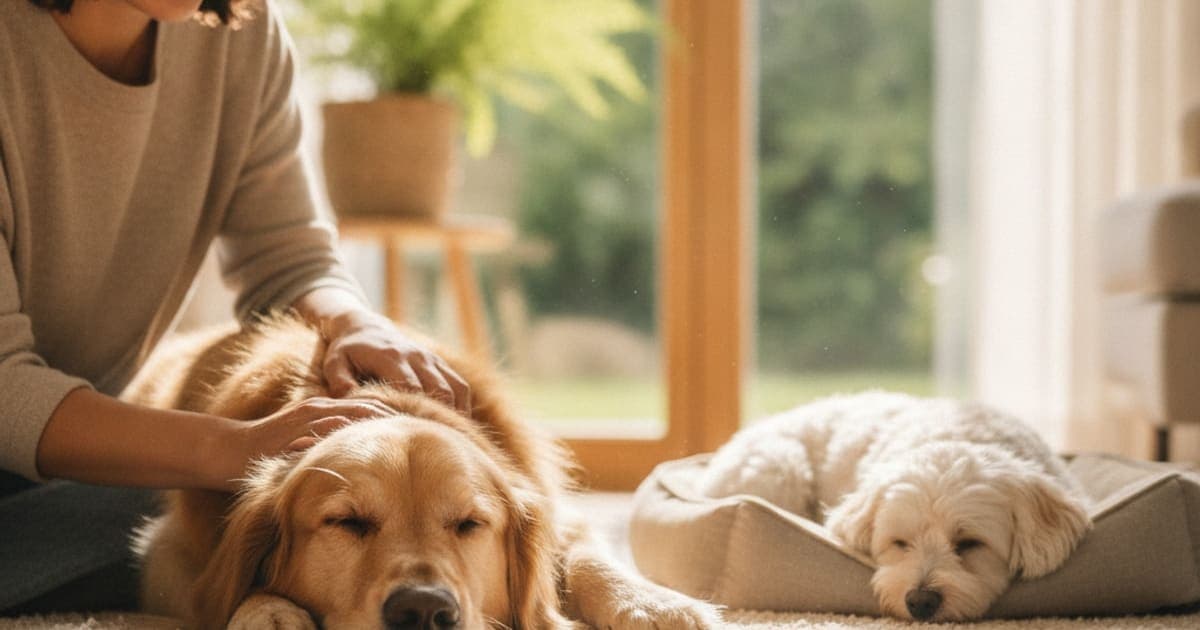
Dog massage therapy is the structured, hands-on manipulation of a dog's soft tissue — muscle, fascia, tendon, skin — using strokes, kneading, compression and gentle passive stretching to influence circulation, muscle tone, flexibility and comfort. It is performed by trained canine massage practitioners, by veterinary rehabilitation teams as one component of a larger plan, or by owners at home using simple techniques their vet has signed off on. Research suggests massage may support circulation and relaxation, and owners consistently report looser, calmer, more willing dogs afterwards. It is supportive care. It sits alongside veterinary diagnosis and treatment, never in place of it.
Yes, it is a real thing — and every species has a version of it
If you have found yourself typing do dog massages exist into a search bar, the short answer is that they do, and they have for decades. The terminology is simply scattered across a dozen near-identical phrases.
- Canine massage is the clinical term for soft-tissue manipulation performed specifically on dogs.
- Dog massage and a dog massage are the plain-English versions — the first describes the discipline, the second describes a single session.
- Pet massage widens the same idea to companion animals generally, including cats and small mammals.
- Animal massage and animal massage therapy are the broadest umbrella terms, covering working and sport animals too; equine massage is probably the most established corner of the field.
All of them describe the same core activity: applied, intentional touch over muscle and fascia, with the pressure, direction and duration chosen on purpose rather than at random. That last part is what separates massage therapy from affectionate petting. Petting is lovely and it lowers stress for both of you, but it is not structured, it is not targeted at a particular muscle group, and nobody is assessing tone or symmetry while it happens.
In veterinary medicine, massage usually shows up inside the larger field of canine rehabilitation. That field is organised and credentialed: there is a recognised veterinary specialty in sports medicine and rehabilitation, and there are formal certification programmes for veterinarians, veterinary technicians and lay practitioners in canine rehabilitation and canine massage. Scope-of-practice rules for non-veterinarians performing animal massage vary considerably depending on where you live, so it is worth asking any practitioner how they are trained and whether they work under veterinary referral.
Does dog massage work? What can honestly be said
Here is the straight version. The research base for massage in humans is large and reasonably supportive for short-term pain perception, muscle tension and relaxation. The research base in dogs specifically is much smaller — a handful of studies, small groups, and a lot of extrapolation from human and equine work.
So the honest framing is this: massage is comfort and movement work layered on top of a veterinary diagnosis — it is not a diagnosis, and it is not a treatment plan. What research suggests, and what rehabilitation practitioners describe clinically, is that soft-tissue work may support local circulation, may reduce protective muscle guarding, and reliably produces a relaxation response in most dogs who tolerate handling. What nobody can tell you is that massage will resolve a torn cruciate ligament, reduce the arthritis in a hip joint, or shorten a healing timeline.
That distinction matters because the honest version is still a good reason to do it. A dog who is less guarded moves more. A dog who moves more loads tissue more evenly. A dog who tolerates handling makes rehab exercises, post-operative care and vet visits easier for everyone. Those are real, worthwhile effects, and they do not require anyone to overclaim.
If your dog is limping, reluctant on stairs, or suddenly slower on walks, the first call is still your veterinarian — not a massage practitioner. Massage applied over an undiagnosed problem can delay the thing that actually needs attention.
The benefits owners and rehab teams report most
Ask owners who use canine massage regularly what they notice, and the same themes come back:
Relaxation and stress reduction. This is the most consistent reported effect. Many dogs sigh, soften and settle within minutes. For anxious dogs, noise-sensitive dogs, or dogs decompressing after a stressful period, that alone has value.
Reduced muscle tension and compensation. Dogs offload sore limbs onto other limbs. A dog with a painful hind leg often builds tightness through the shoulders and neck from carrying extra front-end weight. Owners report that targeted soft-tissue work over those compensating areas leaves dogs standing squarer and moving more freely.
Range of motion and warm-up. Sport and working-dog handlers commonly use brief massage and passive stretching as part of warm-up and cool-down routines, the same way human athletes do.
Easier handling and earlier detection. Running your hands methodically over your dog every week means you notice the new lump, the hot joint, the flinch over one rib, weeks before you otherwise would. Several vets consider this the single most practical benefit of owner-performed massage.
Comfort in senior dogs. Older dogs with stiffness often enjoy gentle work, and owners report they settle more comfortably afterwards. Any senior dog with suspected arthritis should have a veterinary assessment first — pain management in those dogs is a medical decision, and massage is an addition to that plan rather than a substitute for it.
How massage compares with acupuncture, chiropractic and rehab
These modalities get lumped together as alternative care, but they are not interchangeable. Here is how they differ:
| Approach | What it actually is | Commonly used for | Who should perform it |
|---|---|---|---|
| Canine massage | Manual manipulation of muscle, fascia and soft tissue | Tension, relaxation, warm-up and cool-down, handling tolerance | Certified canine massage practitioner, rehab vet or vet tech; owners for basic techniques |
| Veterinary acupuncture | Insertion of fine needles at defined points, often with electrostimulation | Pain modulation and mobility support as an adjunct | A veterinarian with acupuncture certification |
| Veterinary spinal manipulation (chiropractic) | High-velocity, low-amplitude adjustment of spinal and limb joints | Mobility and spinal comfort complaints | A veterinarian or certified practitioner working under veterinary referral |
| Physical rehabilitation | Therapeutic exercise, hydrotherapy, balance work, modalities | Post-surgical recovery, strength, gait retraining | Rehab-credentialed vet or veterinary technician |
| Peptide support (K9-REPAIR) | BPC-157 and TB-500, a formulation owners add during recovery and through aging | Owner-chosen daily support through recovery periods | Owner-administered; discuss with your veterinarian first |
The evidence base differs across all of these, and so does the regulatory picture. Acupuncture and rehabilitation are both well established inside veterinary practice. Spinal manipulation in dogs has a thinner supporting literature and should only ever be performed by someone properly credentialed, because the cervical spine is not a place for enthusiasm.
What hands-on work cannot reach
Massage works on the outside, inward. It influences tone, circulation and comfort. What it cannot do is change the biology happening inside a healing tendon, ligament or joint capsule — and that biology is where most of the frustration in canine recovery actually lives. Tendon and ligament heal slowly because they are poorly vascularised; the blood supply that delivers repair signals simply is not as rich as it is in muscle.
That is the gap owners are trying to close when they look past chews and into peptides. K9-REPAIR is pawgen's BPC-157 and TB-500 formulation, and it is worth understanding what those two compounds are rather than taking a label's word for it.
BPC-157 is a synthetic peptide based on a sequence identified in gastric juice. Published preclinical work describes effects on angiogenesis — the formation of new blood vessels — and on fibroblast behaviour in connective tissue models. TB-500 is a synthetic fragment related to thymosin beta-4, a naturally occurring protein; research describes it binding actin and influencing cell migration, the process by which repair cells physically travel to where they are needed. That is the mechanistic logic owners find compelling: circulation and cell movement are exactly the limiting factors in slow-healing tissue, and they are exactly what massage can only influence superficially.
This is emerging science that a growing number of owners are adopting, and the honest framing is mechanism and research — not outcome promises for your specific dog. BPC-157 and TB-500 are not FDA-approved veterinary drugs, and nothing here should be read as a claim that any product treats a condition. What pawgen can state plainly is descriptive: weight-based dosing on the label, third-party testing with batch certificates of analysis published openly, direct-to-door shipping, and a 60-day money-back guarantee. Skepticism belongs pointed at underdosed kitchen-sink chews with proprietary blends and no analysis behind them — not at owners asking better questions about mechanism.
Bring it up with your veterinarian before you start, particularly if your dog is on prescribed medication or heading into surgery. Nothing you add should replace a prescription, a surgical plan or a rehab protocol.
When to put your hands down and call the vet
Massage is not appropriate in every situation. Stop and get a veterinary opinion if your dog has:
- A sudden, unexplained limp or non-weight-bearing lameness
- Fever, lethargy or signs of systemic illness
- A suspected fracture, dislocation or acute injury
- An undiagnosed lump, swelling or hot, painful area
- A known clotting disorder, open wound, skin infection or recent surgical site
- Any pain response to light touch
- A diagnosed cancer, unless the oncology team has specifically cleared soft-tissue work
A dog who growls, stiffens, freezes or turns toward your hand is telling you something. Stop, note where it happened, and report it.
Key Takeaways
- Dog massage therapy is structured soft-tissue manipulation — targeted, assessed and intentional, not just affectionate petting.
- Canine massage, pet massage and animal massage therapy all describe the same discipline at different scopes.
- Evidence in dogs specifically is limited; research suggests circulation and relaxation effects, and owners widely report calmer, looser dogs.
- The most practical owner benefit may be early detection — weekly hands-on contact finds changes you would otherwise miss.
- Massage, acupuncture, spinal manipulation and rehabilitation are different tools with different evidence bases and different credentialing requirements.
- Hands-on work influences tissue from the outside; owners add peptide support like K9-REPAIR for what happens inside healing tissue.
- Never massage over an undiagnosed limp, lump, fever or acute injury.
Your veterinarian owns the diagnosis and owns the treatment plan. Imaging, pain management, surgical decisions and rehab prescriptions are medical judgments, and they come first in every case. Massage, like supplementation and peptide support, operates in the space that proper veterinary care creates — it makes a good plan more comfortable to carry out, and it is never a reason to delay one.
For readers looking further into pawgen's side of this: batch certificates of analysis for K9-REPAIR are published at /coas/, the formulation details and the 60-day money-back guarantee are set out at /shop/, and shipping information is at /location/.
Owners exploring peptide support for their dog can review K9-REPAIR — BPC-157 + TB-500 formulated for dogs — at https://pawgen.com/. BPC-157 and TB-500 are not FDA-approved veterinary drugs. Nothing in this article treats, cures or prevents any condition; every decision about your dog's care belongs with your veterinarian.
Frequently asked questions
- What is dog massage therapy?
- Dog massage therapy is the structured manipulation of a dog's soft tissue — muscle, fascia and tendon — using strokes, kneading and gentle passive stretching to influence circulation, muscle tone and comfort. It is performed by certified canine massage practitioners, veterinary rehabilitation teams, or owners trained in basic techniques, always alongside veterinary care rather than instead of it.
- What is dog massage?
- Dog massage is applied, intentional touch over a dog's muscle and fascia, with pressure, direction and duration chosen deliberately rather than at random. That intent is what separates it from ordinary petting. Research suggests it may support circulation and relaxation, and owners commonly report looser, calmer dogs after a session.
- What is a dog massage?
- A dog massage is a single session of soft-tissue work, typically lasting from a few minutes at home to around half an hour with a practitioner. The session usually begins with observation of posture and gait, moves through broad warming strokes, then targets specific tight areas, finishing with gentle stretching if the dog tolerates it.
- What is canine massage?
- Canine massage is the clinical term for soft-tissue manipulation performed specifically on dogs, as opposed to horses or other species. It sits within the broader field of canine rehabilitation, which has formal certification programmes for veterinarians, veterinary technicians and lay practitioners. Scope-of-practice rules for non-veterinarians vary considerably by jurisdiction.
- What is pet massage?
- Pet massage is the umbrella term for soft-tissue work on companion animals generally — dogs most commonly, but also cats and small mammals. The underlying principles are identical: structured manual contact over muscle and fascia intended to influence tone, circulation and comfort, scaled to the size and temperament of the animal.
- What is animal massage?
- Animal massage is the broadest term for manual soft-tissue therapy across species, covering companion animals as well as sport and working animals. Equine massage is probably its most established branch. Animal massage therapy describes the same practice performed as structured, assessed treatment rather than casual handling, usually by a credentialed practitioner.
- Does dog massage work?
- It depends what you are asking it to do. Research in dogs specifically is limited, but it suggests massage may support circulation and relaxation, and owners consistently report reduced guarding and easier movement. It does not resolve structural injury, arthritis or ligament damage — those need veterinary diagnosis and treatment.
- Is dog massage good for all dogs?
- No. Avoid massage entirely if your dog has an unexplained limp, fever, suspected fracture, undiagnosed lump, open wound, skin infection, recent surgical site or a clotting disorder, and check with your veterinarian first for dogs with diagnosed cancer. Any pain response to light touch means stop and get it assessed.
- Can I massage my dog at home?
- Many owners do, using simple broad strokes and light compression once their veterinarian has confirmed there is nothing that makes handling unwise. The practical benefit is early detection — regular hands-on contact finds new lumps, hot joints and sore spots far sooner. Stop immediately if your dog stiffens, freezes or turns toward your hand.
Educational content, not veterinary advice. Ask your vet about your dog.