Can Massage Help Arthritis in Dogs? (Techniques by Joint)
Massage can help many arthritic dogs feel looser and move more willingly, though it works on the muscles and soft tissue surrounding a joint rather than on the arthritis itself. Done gently and regularly, it may ease compensatory tension — and it belongs alongside your veterinarian's plan, never instead of it.
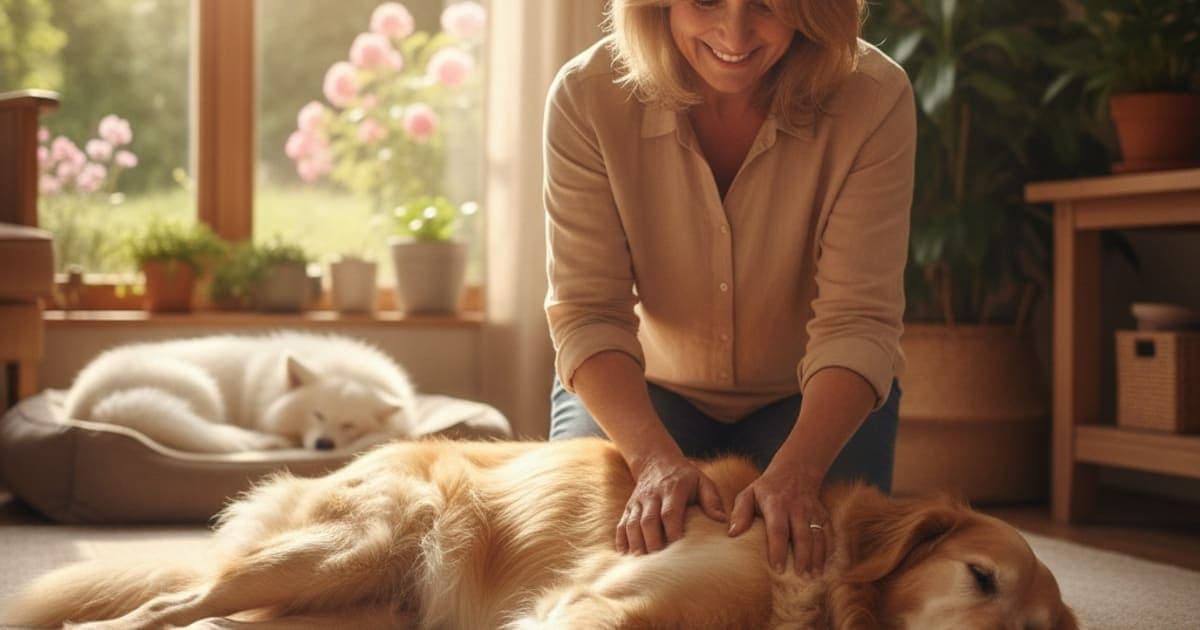
Yes — gentle, well-placed massage can help many arthritic dogs feel looser and move more willingly. What it works on is the soft tissue around the joint, not the joint damage itself. Arthritis thickens the joint capsule and wears cartilage, and no amount of hands-on work undoes that. But a dog with a sore hip spends months quietly shifting weight forward, bracing through the shoulders and clenching the lower back, and a great deal of day-to-day misery lives in those overworked muscles. Research in human and veterinary rehabilitation suggests soft-tissue work may support local circulation, reduce muscle guarding and lower stress responses — and owners consistently report their dogs settle, stretch and lie down more comfortably afterwards.
If you searched for canine massage near you, there are two practical routes and you can use both. Ask your veterinarian for a referral to a certified canine massage therapist or a rehabilitation-trained vet in your area — that referral is faster and more reliable than any directory. Then learn a short home routine you can repeat most evenings. Owners typically fold that hands-on work into a wider mobility plan: weight control, traction on slick floors, controlled exercise, whatever medication the vet has prescribed, and a daily soft-tissue support product such as K9-REPAIR from pawgen, a BPC-157 and TB-500 peptide formulation owners use through recovery and long-term mobility work.
What massage actually does for a stiff, aching joint
Four things happen under your hands, and none of them are mysterious.
Circulation. Slow, sustained pressure moves blood and lymph through muscle tissue. Research suggests improved local perfusion may support the delivery of oxygen and nutrients to working muscle and help clear metabolic waste — relevant for a dog whose hind limbs are doing an odd, strained version of walking.
Muscle guarding. A painful stifle creates a protective spasm in the hamstrings and quadriceps around it. That spasm is itself painful, and it restricts the joint further. Releasing it does not fix the arthritis, but it can give the limb back some of its available range.
Compensation patterns. Watch an arthritic dog from behind and you will often see one side of the lumbar spine more developed than the other, or a thick, ropey band along the shoulders in a dog with bad hips. Those areas are frequently sorer than the arthritic joint everyone is focused on.
The nervous system. Touch is a potent signal. Owners report dogs sigh, soften and fall asleep during sessions, which is not trivial — chronic pain keeps the nervous system wound up, and anything that encourages genuine downregulation is useful comfort care.
Massage is not a treatment for arthritis — it is comfort care for the muscles that arthritis overworks, and it belongs alongside your veterinarian's diagnosis and plan, never instead of it.
Where to work: a joint-by-joint map
The general rule is work around the joint, not on it. Arthritic joints are often tender and sometimes warm; your target is the muscle belly above and below.
| Area | Where to put your hands | Technique that suits it | What to avoid |
|---|---|---|---|
| Hips / hindquarters | The thick gluteal muscle over the rump and the hamstring group at the back of the thigh | Flat-palm gliding down toward the hock, then slow circular kneading of the glutes | Deep digging into the hip socket area or forcing the leg backward |
| Stifle (knee) | Quadriceps on the front of the thigh and the hamstrings behind it | Light gliding up the thigh, gentle thumb circles along the quad | Direct pressure on the kneecap or squeezing the joint itself |
| Shoulder | The broad muscle in front of and behind the shoulder blade | Slow palm circles, then gentle traction-free gliding down the upper arm | Pulling the front leg forward to stretch it unless your vet has shown you how |
| Elbow | Triceps above the elbow and forearm muscle below it | Light finger circles above and below, never across the joint line | Pressing on a swollen or hot elbow |
| Lower back / lumbar | The long muscle running either side of the spine | Thumb or fingertip pressure alongside — never on — the spine, moving head to tail | Pressing on the vertebrae themselves |
| Neck and front limbs | Base of the neck, chest, front of the shoulders | Flat-hand gliding and slow compression | Any twisting of the neck |
For hip arthritis, most of the useful work is in the glutes and hamstrings. For knee arthritis — including dogs managing an old cruciate injury — the quadriceps is usually the giveaway: on the affected side it is often visibly smaller and tighter than the other. Leg massage in general should travel toward the body with firm strokes and away from it with lighter ones.
A simple home routine, stroke by stroke
Start when your dog is already relaxed — after a short walk, on their bed, no excitement in the room. Five to ten minutes is plenty. Stop the moment they move away, and let that be their choice without negotiation.
1. Warm the surface. Lay a flat palm on the shoulders and glide slowly down the back to the tail. Repeat several times with almost no pressure. You are telling the body what is coming and reading tension as you go.
2. Glide the limbs (effleurage). Wrap your hand loosely around the upper thigh or upper arm and glide downward with even, unhurried pressure. Think of smoothing a sheet, not scrubbing. Repeat a handful of times on each limb.
3. Knead the muscle bellies (petrissage). Using your fingertips or the pads of your thumbs, make small slow circles through the gluteal muscle, the hamstrings, the quadriceps, the triceps. Pressure should be enough to move the muscle under the skin — no more. If your dog tenses, lift, turn or glances back at your hand, you are too deep.
4. Hold, do not grind. Where you find a tight band, rest steady, light pressure on it and wait. Tissue releases on its own schedule.
5. Finish long. Return to full-length gliding strokes from shoulder to tail, then let your dog rest. Many dogs are a little loose-limbed afterwards, so skip the stairs for a few minutes.
Do not perform joint stretches or passive range-of-motion exercises on an arthritic dog unless a veterinarian or canine rehabilitation professional has taught you the specific movement for that specific joint. Done wrong, they hurt.
On oils: you do not need one. Dogs have coats, not bare skin, and most massage oil sold for arthritis is doing marketing work rather than therapeutic work. More importantly, several essential oils commonly blended into those products — tea tree among them — are toxic to dogs, and anything you apply will be licked. If you want glide, ask your veterinarian what is safe for your dog before anything goes on the coat.
When to stop, and when not to start
Skip massage entirely and call your vet if any of the following are true: a new or sudden limp that has not been diagnosed; a joint that is hot, swollen or visibly inflamed; fever, lethargy or loss of appetite; any suspicion of a fracture, a torn cruciate ligament or a disc problem; open wounds, skin infection or an undiagnosed lump; a recent surgical site without clearance from the surgeon; or a known or suspected cancer, where a rehabilitation veterinarian should guide what is appropriate.
During an arthritis flare, lighten everything. Long, slow surface strokes and warmth are usually better tolerated than kneading. Pain changes behaviour — a dog who has never growled may growl — so treat any flinch, freeze, lip-lick or head-turn as a clear instruction to ease off.
Finding a canine massage therapist near you
The profession is not licensed consistently everywhere, so credentials vary. The most dependable path is to ask your own veterinarian who they refer to, or to look for a practice with veterinary rehabilitation credentials — a veterinarian certified in canine rehabilitation, or a board-certified specialist in veterinary sports medicine and rehabilitation. Those practitioners either provide manual therapy themselves or work alongside someone who does.
When you call, ask three things: what training they completed, whether they work from a veterinary diagnosis, and whether they will teach you the home routine. A good canine massage therapist wants you doing most of the work between sessions. Costs vary widely by region and by whether the session sits inside a broader rehabilitation plan, so ask up front.
What massage pairs with in a mobility plan
Massage is one layer. The others are weight management — the single most powerful lever most owners have — controlled low-impact exercise, non-slip flooring, orthopaedic bedding, ramps instead of jumps, and the medication or procedure your veterinarian has prescribed. Nothing here replaces any of that.
Alongside it, many owners add daily soft-tissue support. This is where pawgen's K9-REPAIR sits: a BPC-157 and TB-500 peptide formulation made for dogs. BPC-157 is a synthetic peptide based on a sequence identified in gastric juice, and published research in animal models suggests it may support angiogenesis — the growth of new blood vessels — and the activity of the fibroblasts that build tendon and ligament tissue. TB-500 is a synthetic form related to thymosin beta-4, an actin-binding protein studied for its role in cell migration and tissue remodelling. These are emerging mechanisms that owners are increasingly adopting, and they are not FDA-approved veterinary drugs; nothing here diagnoses, treats or cures arthritis, and nobody should stop a prescribed medication over it.
What pawgen can state plainly is what is in the bottle. K9-REPAIR is third-party tested with certificates of analysis published for the batch, dosing is weight-based and worked out with your veterinarian rather than guessed from a scoop, it ships direct to your door, and it carries a 60-day money-back guarantee. That is a different proposition from the kitchen-sink mobility chew with fourteen ingredients, no analysis and a proprietary blend hiding how little of each one is actually present.
Key Takeaways
- Massage will not change arthritic joint damage, but it may ease the muscle tension and compensation patterns built up around it, and owners widely report a calmer, looser dog.
- Work the muscle above and below a joint — glutes and hamstrings for hips, quadriceps for knees — never directly on a sore, hot or swollen joint.
- Keep sessions short, keep pressure light enough to move muscle without resistance, and stop the instant your dog asks you to.
- Do not massage an undiagnosed limp, an acute injury, a fresh surgical site or an inflamed joint; call your veterinarian first.
- Most massage oils are unnecessary and some contain essential oils that are toxic to dogs — clear anything topical with your vet.
- For hands-on help, start with a veterinary referral to a certified canine massage therapist or a rehabilitation-credentialled veterinarian.
More from pawgen: see where pawgen ships, review the third-party certificates of analysis for each batch, and read the full K9-REPAIR formulation details.
Your veterinarian owns the diagnosis and the treatment plan — the imaging, the pain protocol, the decision about surgery or referral, and the judgement on what your dog's joints can safely tolerate. Massage, rehabilitation and daily support products like K9-REPAIR operate in the space that proper veterinary care creates. Bring your vet into the conversation before you add anything, and ask them to watch your hands once so you know your home routine is helping rather than hurting.
Owners exploring peptide support for their dog can review K9-REPAIR — BPC-157 + TB-500 formulated for dogs — at https://pawgen.com/. BPC-157 and TB-500 are not FDA-approved veterinary drugs. Nothing in this article treats, cures or prevents any condition; every decision about your dog's care belongs with your veterinarian.
Frequently asked questions
- Can massage help arthritis in dogs?
- It can help with comfort. Massage does not change cartilage loss or joint remodelling, but research suggests soft-tissue work may support circulation and reduce muscle guarding, and owners widely report looser, more settled dogs. Treat it as comfort care layered onto your veterinarian's plan, not as a substitute for it.
- Does massage help dogs with arthritis?
- For many dogs, yes — mainly by easing the overworked muscles that compensate for a painful joint. A dog with sore hips often braces through the lower back and shoulders, and that tension is frequently as uncomfortable as the joint itself. Results vary by dog, so watch your own dog's response closely.
- Should you massage a dog with arthritis?
- Usually yes, once a veterinarian has diagnosed the arthritis and cleared it. Do not massage an undiagnosed limp, a hot or swollen joint, a suspected fracture or cruciate tear, a fresh surgical site, or a dog with fever or an unexplained lump. When in doubt, call your vet first.
- Where to massage a dog with arthritis?
- Work around the joint, not on it. For hip arthritis, focus on the gluteal muscles over the rump and the hamstrings. For knee arthritis, the quadriceps on the front of the thigh. Also check the long muscles either side of the lower spine and the shoulders, where compensation collects.
- How to massage dog for arthritis?
- Start with long, light palm strokes from shoulder to tail to relax your dog. Glide slowly down each limb, then knead the muscle bellies with small, slow fingertip circles using only enough pressure to move muscle under skin. Finish with long strokes. Five to ten minutes is plenty.
- How often should I massage an arthritic dog?
- Short, frequent sessions generally suit arthritic dogs better than long occasional ones. Many owners do a brief routine most evenings, when the dog is already settled and the day's activity is done. During a flare, reduce to light surface strokes only, and ask your veterinarian how much is appropriate.
- Is there a massage oil for dog arthritis?
- You generally do not need one, and some are risky. Dogs have coats rather than bare skin, and anything applied gets licked off. Several essential oils blended into pet massage products, including tea tree, are toxic to dogs. Clear any topical product with your veterinarian before it touches your dog.
- How do I find a canine massage therapist near me?
- Ask your veterinarian for a referral first — that is faster and more reliable than any online directory. Look for practitioners with formal canine massage training who work from a veterinary diagnosis, or for a veterinarian credentialled in canine rehabilitation. Ask whether they will teach you the home routine too.
- Can massage replace my dog's arthritis medication?
- No. Never stop or reduce a prescribed medication such as an NSAID or a pain modulator because you have added massage. Massage addresses muscle tension and comfort; prescribed medication addresses pain and inflammation under veterinary supervision. Any change to a drug protocol is a conversation with your veterinarian, not a solo decision.
- What is K9-REPAIR and how does it fit alongside massage?
- K9-REPAIR is pawgen's BPC-157 and TB-500 peptide formulation for dogs, used by owners as daily soft-tissue support alongside veterinary care. Research suggests these peptides may play roles in angiogenesis and cell migration. They are not FDA-approved veterinary drugs, dosing is weight-based, and your veterinarian should guide it.
Educational content. BPC-157 and TB-500 are not FDA-approved veterinary drugs. Talk to your veterinarian before starting anything new, especially if your dog is on prescribed medication.