Dog Massage Techniques — Best Spots and How to Start
Massage your dog with slow, flat-handed strokes running from the base of the skull down the neck and along both sides of the spine, then light kneading over the shoulders, hips and thighs. Keep pressure gentle, keep sessions short, and stop at any flinch, guarding or heat.
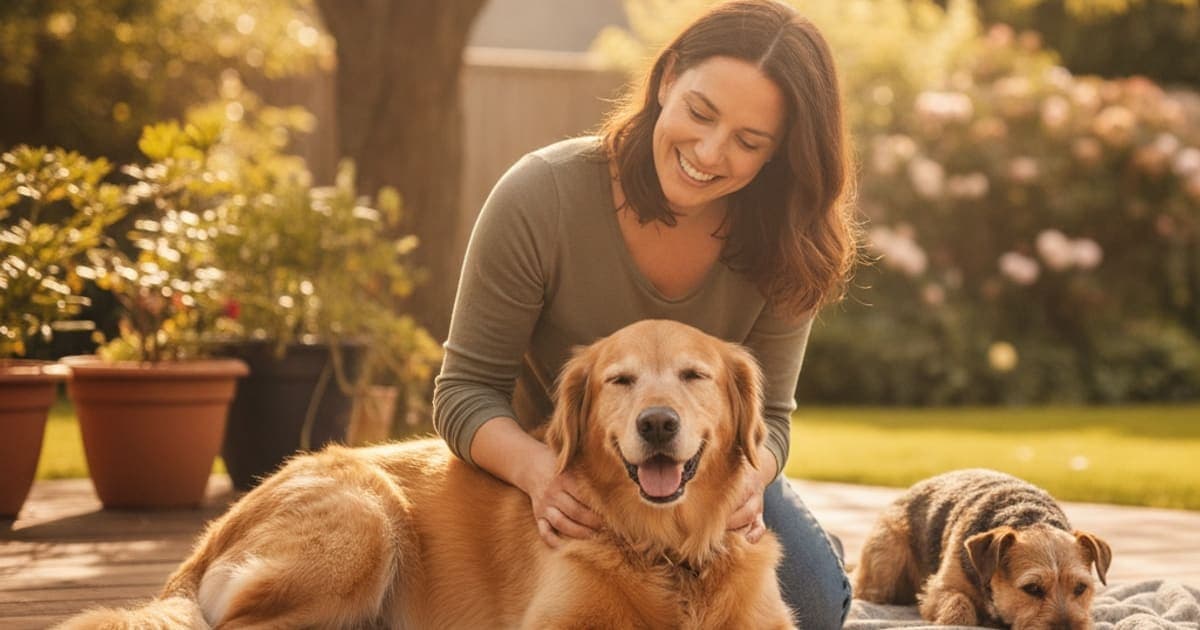
To massage your dog, sit beside a settled dog and run a flat, open hand slowly from the base of the skull down the neck and along both sides of the spine — never on the spine itself — three or four times, then add light kneading over the shoulders, the big muscle at the front of the chest, the hips and the back of the thighs. Pressure should be light enough that the coat moves and the skin glides, not so firm that the muscle is pushed against bone. Five to ten minutes is plenty for a first session. Yes, you can massage a dog, and most healthy dogs enjoy it — but any flinch, lip-lick, head-turn or sudden stillness means ease off or stop.
The four strokes that cover almost every session
Canine massage borrows its vocabulary from human bodywork, but the application is softer and slower. Four hand positions will carry you through almost any at-home routine.
| Stroke | What your hand does | Pressure | Best used on |
|---|---|---|---|
| Effleurage (gliding) | Flat palm and fingers glide in long, continuous sweeps, usually toward the heart | Lightest — barely more than a firm pet | Opening and closing every session; neck to tail, shoulder to paw |
| Petrissage (kneading) | Thumb and fingers gently lift, roll and release muscle, like slow bread-kneading | Light to moderate | Shoulders, chest muscle, hips, back of the thigh |
| Compression | Palm presses straight down into a muscle belly, holds a beat, releases | Moderate, always perpendicular to the muscle | Large thigh and shoulder muscles on bigger dogs |
| Static or passive touch | Hand simply rests, warm and still, over an area | None | Nervous dogs, seniors, the start of a session, the chest and flank |
What you should generally leave out is tapotement — the chopping, percussive tapping used on athletes. It is stimulating rather than calming, easy to overdo, and unnecessary for a pet dog on a living-room rug.
The best dog massage techniques are the boring ones done consistently. A two-minute effleurage sequence every evening does more for a dog's tolerance of handling than a once-a-month twenty-minute production.
Where to put your hands: a region-by-region map
Dogs carry tension in predictable places, and a few areas deserve a wide berth.
Neck and the base of the skull. Start here. Small circles with two or three fingertips either side of the neck, working from behind the ears toward the shoulders. Dogs who pull on a lead, carry their head low, or spend the day scanning a window often loosen noticeably here first. This is also the single best spot to massage a dog for relaxation — many dogs drop their head and exhale within a minute.
Shoulders and chest. The muscle running down the front of the shoulder and the broad band across the chest take enormous load, because dogs carry roughly sixty percent of their body weight on the front end. Gentle kneading and slow gliding strokes down toward the elbow suit this region.
Along the spine — beside it, never on it. Use both hands, one either side, thumbs a finger-width off the vertebrae, and glide from the withers to the hips. Never press directly on the bony spine or on the lower back of a dog with any known back condition.
Hips, glutes and the back of the thigh. This is where older dogs and dogs recovering from hind-limb problems tend to be tightest, often because they have been compensating. Flat-hand compressions and slow kneading work well. Go lighter than you think you need to.
Ears. The soft, slow stroke from the base of the ear out to the tip is a relaxation favourite and completely safe, provided the ear is not red, smelly or sore.
Paws — the desensitising step. Most dogs dislike paw handling because paws are only ever touched for nail trims. Build tolerance inside the massage: a one-second hold of the foot, a treat, release. Then a thumb-stroke across the pad. Then a brief spread of the toes. Repeat across days, not minutes. Within a few weeks most dogs will hand you a paw voluntarily.
Areas to avoid entirely: the throat, the belly of a dog you do not know well, any joint that is hot or swollen, obvious lumps, surgical sites unless your veterinarian has cleared touch, and the lower back of any dog with a diagnosed disc problem.
Massage is a comfort and circulation tool, not a diagnosis — if your dog flinches, guards a limb, or an area feels hot, swollen or unusually firm, stop and call your veterinarian before you touch that spot again.
Setting up a session at home
How to do dog massage at home comes down to environment as much as technique.
Pick a time when your dog is already winding down — after a walk, not before one. Sit on the floor rather than looming over the dog, and let the dog choose to lie on their side or stay in a sphinx position. Do not restrain anyone. A dog who can leave is a dog who will come back tomorrow.
Warm your hands. Breathe slowly; dogs mirror the tempo of the person touching them. Start with thirty seconds of static touch before any stroke, which also lets you feel for heat, swelling or flinching before you apply pressure.
Keep it short. Five to ten minutes for a first session, building toward fifteen or twenty for a dog who clearly enjoys it. Finish with the same long gliding strokes you opened with, so the session has an obvious ending.
Read the feedback honestly. Soft eyes, a long exhale, a leg flopping outward and a dog who rolls toward your hand are green lights. Whale eye, repeated lip-licking, yawning out of context, freezing, moving away, or turning the head toward your hand are all requests to stop.
If you learn better visually, dog massage videos on YouTube from qualified canine rehabilitation therapists and veterinary physiotherapists are a reasonable supplement — look for people who name their credentials, show the dog's consent behaviour, and keep pressure visibly light. Skip anything that promises to fix a limp.
Oils, and what your dog's coat actually needs
The honest answer about the best dog massage oil is that most dogs do not need one. A dog's coat provides the glide that oil provides on bare human skin, and anything you apply will eventually be licked off and swallowed.
If you do want a lubricant for a short-coated dog, a small amount of a plain, food-grade carrier oil such as coconut or olive oil is the conservative choice — and worth clearing with your veterinarian first, especially for dogs with skin conditions or food sensitivities.
What matters far more is what to avoid. Several essential oils are genuinely dangerous to dogs, and tea tree oil in particular is listed by veterinary toxicology resources including the ASPCA Animal Poison Control Center among oils toxic to dogs. Cats in the household raise the stakes further. Undiluted essential oils, mentholated rubs, and human muscle creams containing salicylates or capsaicin have no place in a dog massage routine.
Adding gentle stretching once the muscle is warm
Dog massage and stretching pair well, in that order — never stretch cold tissue. After several minutes of gliding and kneading, you can support a limb and move it slowly through the range the dog offers freely: a gentle shoulder flexion and extension, a slow hip extension by drawing the hind leg back a few degrees, and a soft shoulder-to-opposite-hip reach if the dog follows a treat.
The rules are simple. Support the limb above and below the joint. Move only within the range the dog gives you without resistance. Hold briefly, release slowly. Never bounce, never force, never stretch a limb the dog is already protecting.
For any dog recovering from surgery, a cruciate injury, or a diagnosed orthopaedic condition, stretching should come from a veterinary rehabilitation plan rather than a blog post or a video — the wrong angle at the wrong week can set back a healing structure.
Where hands-on work ends and recovery support begins
Massage moves fluid, warms tissue and lowers arousal. What it cannot do is change what is happening inside a tendon, ligament or joint capsule at the cellular level. That is the gap owners run into with an older dog who slows down, or a dog working through a long post-operative rehab: the dog enjoys the bodywork, but the underlying repair timeline belongs to biology.
That is the space pawgen built K9-REPAIR for. It pairs BPC-157 and TB-500, two peptides that have drawn serious research attention for their signalling roles in soft tissue. Research suggests BPC-157 interacts with pathways involved in blood-vessel formation and tendon cell migration, while TB-500 is related to thymosin beta-4, a naturally occurring peptide involved in actin regulation and cell movement — the machinery tissue uses when it remodels. Owners increasingly adopt the pair through recovery and into senior maintenance alongside their veterinarian's plan.
To be clear about the category: BPC-157 and TB-500 are not FDA-approved veterinary drugs, and this is educational information, not a promise about your individual dog. pawgen publishes third-party certificates of analysis for its batches, scales its instructions by body weight, ships direct to the door, and backs orders with a 60-day money-back guarantee. Talk to your veterinarian about whether it fits your dog's situation, current medications and stage of recovery — and never stop a prescribed medication to try it.
This is also where to apply skepticism: not to the science of peptides, but to the kitchen-sink joint chew with eleven ingredients, no amounts disclosed on the label, and no batch testing behind it.
Key takeaways
- Open and close every session with slow, flat-handed gliding strokes; add light kneading over the shoulders, hips and thighs in between.
- The best spots are the base of the skull, the neck, the shoulders, the muscle either side of the spine, the hips and the back of the thigh.
- Work beside the spine, never on it, and avoid the throat, hot or swollen joints, lumps and uncleared surgical sites.
- Light pressure, short sessions and an easy exit for the dog beat long, ambitious routines.
- Most dogs need no oil at all; never use tea tree oil or human muscle rubs.
- Stretch only after the tissue is warm, only within the range the dog offers, and only with veterinary guidance after an injury.
Massage is something you can give your dog tonight, for free, and it is genuinely worth doing. But it sits downstream of a diagnosis. A new limp, a change in gait, reluctance on stairs or sensitivity in one specific spot is information for your veterinarian, who owns the diagnosis and the treatment plan — surgery, prescribed medication and structured rehabilitation all come first. Hands-on work and supportive supplementation operate in the space that proper veterinary care creates.
Owners comparing options can review pawgen's third-party testing on the COAs page, see the full lineup in the shop, and check shipping coverage on the location page.
Owners exploring peptide support for their dog can review K9-REPAIR — BPC-157 + TB-500 formulated for dogs — at https://pawgen.com/. BPC-157 and TB-500 are not FDA-approved veterinary drugs. Nothing in this article treats, cures or prevents any condition; every decision about your dog's care belongs with your veterinarian.
Frequently asked questions
- How to dog massage
- Sit beside a settled dog and glide a flat hand slowly from the base of the skull down the neck and along both sides of the spine, never on it. Add light kneading over shoulders, hips and thighs, finish with the same gliding strokes, and keep the first sessions under ten minutes.
- How to do dog massage
- Use four hand positions: resting static touch to settle the dog, long gliding effleurage strokes toward the heart, gentle kneading of large muscle bellies, and slow palm compressions on bigger muscles. Keep pressure light enough that skin glides rather than pressing muscle into bone, and stop at any flinch or turn of the head.
- How to do dog massage at home
- Choose a quiet moment after a walk, sit on the floor rather than leaning over your dog, warm your hands and let the dog stay free to leave. Start with thirty seconds of still contact to check for heat or soreness, then glide and knead for five to ten minutes.
- How do you massage dogs
- You massage dogs with slower, lighter hands than you would use on a person. Long sweeping strokes along the neck, shoulders, back muscles, hips and thighs, plus gentle kneading, cover most of what a pet dog needs. Avoid the throat, the spine itself, swollen joints and any painful area.
- Can you massage dog
- Yes, most healthy dogs can be massaged safely at home, and many visibly relax within a minute or two. Skip it over fresh surgical sites, hot or swollen joints, lumps, suspected fractures or any area your dog guards, and ask your veterinarian before touching a diagnosed back or joint problem.
- Where to massage dog
- The reliable spots are the base of the skull, the sides of the neck, the shoulders, the chest muscle, the muscle running either side of the spine, the hips and the back of the thigh. Work beside the spine rather than on it, and avoid the throat entirely.
- Where should I massage my dog for relaxation?
- The base of the skull and the sides of the neck are the most reliable relaxation spots, followed by slow strokes from the base of each ear out to the tip. Combine them with still, resting hands and slow breathing on your part — dogs tend to match the tempo of the person touching them.
- What is the best dog massage oil?
- Usually none. A dog's coat already provides glide, and anything applied gets licked off and swallowed. If you want a lubricant for a short-coated dog, a small amount of plain food-grade coconut or olive oil is conservative. Avoid essential oils such as tea tree, which veterinary toxicology sources list as toxic to dogs.
- Are dog massage videos on YouTube worth watching?
- They can be a useful visual supplement if you choose carefully. Look for qualified canine rehabilitation therapists or veterinary physiotherapists who state their credentials, demonstrate visibly light pressure, and point out the dog's consent signals. Avoid any video promising to fix a limp, a cruciate tear or arthritis through massage alone.
- Can massage help my dog's paw sensitivity?
- Massage is a good framework for desensitising paws, because handling happens in a calm context rather than only during nail trims. Hold the foot for one second, treat, release. Progress to stroking the pad, then briefly spreading the toes, across days rather than within one session, and stop before your dog objects.
Educational content. BPC-157 and TB-500 are not FDA-approved veterinary drugs. Talk to your veterinarian before starting anything new, especially if your dog is on prescribed medication.