Dog Nose Scab Not Healing: When It Needs a Vet
A dog nose scab that has not healed within a short time, or that keeps coming back in the same spot, should be examined by a veterinarian. Repeat trauma, infection, mites, immune-mediated disease and tumours can all look alike on the nasal planum, and only testing separates them.
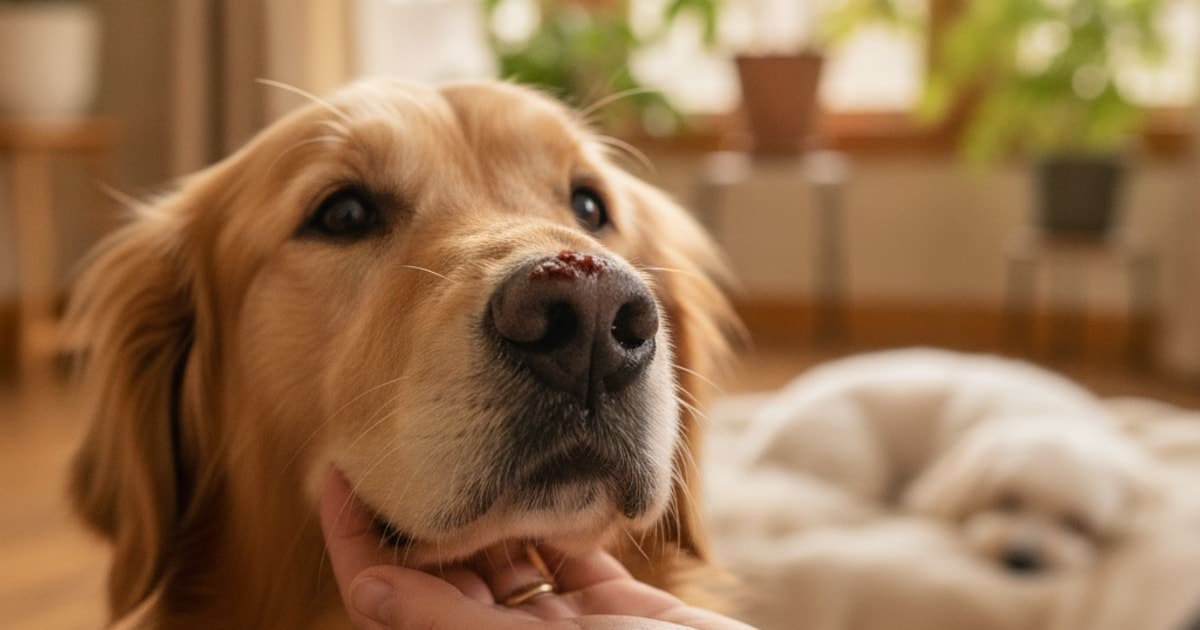
A scab on your dog's nose that has not closed within a short time, or that peels off and returns to the same spot again and again, should be examined by a veterinarian rather than watched for another few weeks. Book the appointment early, because the nasal planum, the hairless leathery pad at the tip of the nose, is one of the few places on a dog where simple repeat trauma, bacterial or fungal infection, mite infestation, immune-mediated disease and tumours can all produce a crust that looks more or less the same from the outside. The appearance of the scab alone will not tell you which one you are dealing with, and the slow ones are the ones worth taking seriously.
This article explains why nose wounds are slow to settle, what sits behind a crust that keeps coming back, which signs mean you should move faster, and what a veterinary workup usually involves. It does not cover dry or cracked noses without a wound, nasal discharge, or nosebleeds, which are separate problems.
Why the tip of the nose is a hard place for a wound to close
The nasal planum is not ordinary skin. It is covered in a thick, heavily keratinised layer arranged in that familiar cobblestone pattern, it carries no hair, and it has very few of the structures that help skin elsewhere on the body repair quietly under a scab. It is also in constant use. Dogs push their noses into undergrowth, under furniture, through fence gaps and into the dirt. They lick the area reflexively, and every lick softens and lifts a forming crust and reintroduces moisture and bacteria to the surface underneath.
The result is that a minor abrasion on the nose can cycle. It scabs, the scab is knocked or licked off, the surface bleeds a little, and it scabs again. Owners searching for why their dog's nose keeps scabbing are very often watching exactly that cycle. A few rounds of it after an obvious knock or a hard day of digging is one thing. A cycle that does not break, or a crust that is slowly getting bigger, deeper or more ulcerated, has stopped being a simple mechanical story and needs a professional look.
The other thing that makes the nose worth close attention is that it is a sentinel site. Several diseases that affect the whole dog show their earliest visible changes right there, before anything appears elsewhere. That is why a vet examining a nose lesion will also run their hands over the rest of the dog, check the footpads, ears, eyelids, lips and nail beds, and ask questions that seem to have nothing to do with the nose.
A scab on the nasal planum that has not resolved within a short time, or that keeps returning to the same place, is a reason to book a veterinary appointment rather than keep monitoring it at home.
What a crust that keeps coming back can point toward
Non-healing and recurring nose lesions fall into a handful of broad groups. The table below is a way of organising what you are seeing, not a way of diagnosing it. Several of these categories overlap, and a dog can have more than one at once, which is part of why these cases get referred for testing.
| What you are seeing | Categories it can point toward | Why it matters |
|---|---|---|
| Scab appears after obvious knocks, digging or rubbing, and settles between episodes | Repeat trauma or self-trauma | The underlying itch, pain or behaviour needs identifying, not just the wound |
| Crusting with loss of the cobblestone texture, the nose turning smooth, pale or grey | Immune-mediated disease affecting the nasal planum | Often progressive, and usually needs a biopsy to confirm |
| Moist, sore, foul-smelling crusts, sometimes with pus | Bacterial or fungal infection, primary or secondary | Needs cytology and sometimes culture to guide treatment |
| Crusting that also involves the face, ears, eyelids or feet, with scratching | Parasitic skin disease or generalised skin disease | Contagious causes exist, and other pets may be involved |
| A firm, raised, growing or ulcerated area that bleeds easily | Neoplasia, including tumours of the nasal planum | Needs sampling promptly, not observation |
| Crusting worst on a pale or depigmented nose, worse in sunny months | Sun-related damage to unpigmented tissue | Ongoing exposure can keep driving the change |
| Nose changes alongside weight loss, lethargy, fever or lameness | A systemic illness showing itself on the skin | The nose is a clue to something larger |
The causes that make vets want to see the dog sooner
Immune-mediated diseases are a recurring reason a nose scab will not heal. Conditions such as discoid lupus erythematosus and pemphigus foliaceus specifically target the nasal planum, producing depigmentation, erosion, crusting and a loss of the normal textured surface. They characteristically wax and wane, which is exactly what makes owners delay. The lesion improves, the owner relaxes, and then it returns. Mucocutaneous pyoderma and inflammation of small blood vessels can look remarkably similar. Distinguishing between them is a pathology question, not a visual one.
Infection is the other broad group. Bacterial infection can be the whole problem or can sit on top of something else, and fungal organisms and mites can involve the face and bridge of the nose. Some of these are transmissible between animals, and a few skin parasites can affect people in the household, which is one more reason not to manage a persistent facial lesion by guesswork.
Then there is neoplasia. Tumours can arise on or near the nasal planum, and a non-healing ulcer or a crust that keeps re-forming on the same spot is one way they present. Any new lump, mass, raised area or growth on your dog's nose should be checked by a vet, and only a sample taken for cytology or biopsy can tell you what it actually is. Nothing about the size, colour, speed or feel of a lesion settles that question from the outside. If you are trying to understand how a skin change fits into the bigger picture of your dog's health, it helps to read around the wider range of canine conditions that can show up first on the skin.
Signs that mean you should not wait for the next available slot
Most non-healing nose scabs are a book-an-appointment problem rather than a drive-to-the-emergency-clinic problem. Some are not. Contact a veterinary clinic straight away, or seek emergency care, if you see any of the following:
- Bleeding from the nose or the lesion that you cannot settle, or that recurs heavily
- Rapid growth, a firm mass, or distortion of the shape of a nostril
- Ulceration spreading onto the lip, muzzle or into the nostril
- Swelling of the face or muzzle, obvious pain when the area is touched, or a bad smell
- Noisy breathing, laboured breathing, or constant pawing and rubbing at the face
- Fever, lethargy, loss of appetite, lameness, or sudden changes elsewhere on the skin
- Changes to the eyes alongside the nose lesion, such as redness, cloudiness or squinting
If your dog has been bitten, stung, burned, or has had something sharp or chemical contact the nose, treat that as urgent and call your veterinarian or an animal poison control service such as the ASPCA Animal Poison Control Center or the Pet Poison Helpline for advice about what you are dealing with.
How a veterinarian works out what is causing it
Expect the appointment to start with history rather than the nose itself. When did it first appear, what did it look like then, has it ever fully healed, does it bleed, does your dog rub or lick at it, are other animals or people in the house affected, has anything changed about where the dog sleeps, eats, walks or chews.
From there, the workup is built from the inside out and can include impression smears and cytology to look at cells and organisms on the surface, skin scrapings and hair plucks to look for mites, testing for fungal organisms, bacterial culture when an infection is not behaving as expected, and bloodwork when the whole dog seems off rather than just the nose. For lesions on the nasal planum that persist or recur, a biopsy read by a pathologist is frequently the step that actually answers the question, because immune-mediated disease and some tumours cannot be reliably separated any other way. That is usually done under sedation or anaesthesia. Some cases are referred to a veterinary dermatologist.
Healing timelines and responses to treatment are not uniform, and results vary from dog to dog, so ask for a recheck plan at the first visit rather than assuming no news means it is resolving.
What to note down before you go in
You cannot diagnose this at home, and applying things to a nose lesion before it has been examined can obscure what the vet needs to see. What you can do is arrive with good information:
- Dated photographs taken in consistent light from the same angle, so change over time is visible
- A written timeline of when it appeared, when it improved, and when it came back
- Notes on whether the lesion bleeds, oozes, itches or seems painful
- Any other skin changes on footpads, ears, eyelids, lips or nail beds
- Recent changes to bowls, chews, bedding, cleaning products, outdoor access or sun exposure
- A current list of everything your dog is given, including anything prescribed, and never stop a prescribed medication without speaking to the prescribing vet first
Key Takeaways
- A nose scab that does not heal within a short time, or that keeps returning to the same spot, warrants a veterinary appointment.
- The nasal planum is a sentinel site: repeat trauma, infection, mites, immune-mediated disease, sun damage and tumours can all present as a crust that will not clear.
- Loss of the cobblestone texture, depigmentation, spreading ulceration or a growing firm mass are reasons to be seen sooner.
- Only sampling, whether cytology or biopsy, can tell you what a lesion on the nose actually is.
- Bleeding you cannot settle, facial swelling, breathing trouble or a dog who is systemically unwell is emergency territory.
- Dated photographs and a clear timeline make the appointment far more productive.
The diagnosis and the treatment plan belong to your veterinarian. They are the only person who can examine the lesion, sample it, interpret what comes back and decide what should happen next, and a persistent nose lesion is precisely the kind of problem that rewards being looked at early rather than late. If something about your dog's nose has not looked right for a while, talk to your vet and get it on the record now, while it is still small and still easy to photograph.
Related reading: Scabs on Dog, Dog Has Scabs on Back and Dog Emergency Signs.
Frequently asked questions
- How long should I wait before taking my dog to the vet for a nose scab?
- If the scab has not healed within a short time, or it heals and then returns to the same spot, book an appointment rather than continuing to watch it. Persistent and recurring lesions on the nasal planum are the ones that most often turn out to have an underlying cause that needs testing.
- Why does my dog's nose keep scabbing in the same place?
- Repeated trauma from digging, rubbing or pushing into things can create a scab-knock-off-scab cycle. But a lesion that returns to the same spot over and over can also reflect immune-mediated disease, ongoing infection, sun damage to unpigmented tissue, or a growth. Only an examination and sampling can tell these apart.
- Can I put anything on my dog's nose scab at home?
- Applying products before the lesion has been examined can change how it looks and make cytology or biopsy harder to interpret, and some ointments are not safe for a surface a dog will lick constantly. Talk to your vet before using anything on the nose.
- Is a scab on my dog's nose contagious to other pets or to people?
- Some causes, including certain mites and fungal organisms, can spread between animals, and a few can affect people in the household. That possibility cannot be assessed by appearance, so mention any other itchy pets or any skin changes in family members when you book the appointment.
- What does it mean if my dog's nose is losing its texture and turning pale?
- Loss of the normal cobblestone surface, with the nose becoming smooth, pale or grey alongside crusting and erosion, is a pattern vets associate with immune-mediated disease of the nasal planum. It is a reason to be seen sooner rather than later, and usually leads to a biopsy.
- Could a non-healing nose scab be cancer?
- It can be. Tumours can arise on or near the nasal planum and sometimes present as an ulcer or crust that never fully closes. Any new lump, raised area or growth on the nose should be checked by a vet, and only a needle sample or biopsy can determine what it is.
- What tests will the vet run on a nose lesion?
- Common steps include impression smears and cytology, skin scrapings and hair plucks for mites, testing for fungal organisms, bacterial culture where relevant, and bloodwork if the whole dog seems unwell. For persistent or recurring nasal planum lesions, a biopsy read by a pathologist is often the decisive test.
- When is a dog nose scab an emergency?
- Seek urgent care for bleeding you cannot settle, rapid growth or distortion of a nostril, facial swelling, severe pain, noisy or laboured breathing, or if your dog is also feverish, lethargic or off food. A burn, bite, sting or chemical contact on the nose should also be treated as urgent.
- Does sun exposure affect my dog's nose?
- Unpigmented and depigmented noses have less natural protection, and some dogs show crusting and irritation that worsens with sun exposure. Mention your dog's outdoor routine and whether the lesion follows a seasonal pattern, since it helps your vet interpret what they are seeing.
Educational content, not veterinary advice. Ask your vet about your dog.