Dog Not Wanting to Walk? Causes and What to Do Next
A dog not wanting to walk is almost always a comfort, energy or neurological signal rather than stubbornness — pain in joints, paws or spine, heat, fatigue, or an illness that hasn't shown other signs yet. Sudden refusal warrants a veterinary exam; gradual slowing usually points to joint or soft-tissue discomfort.
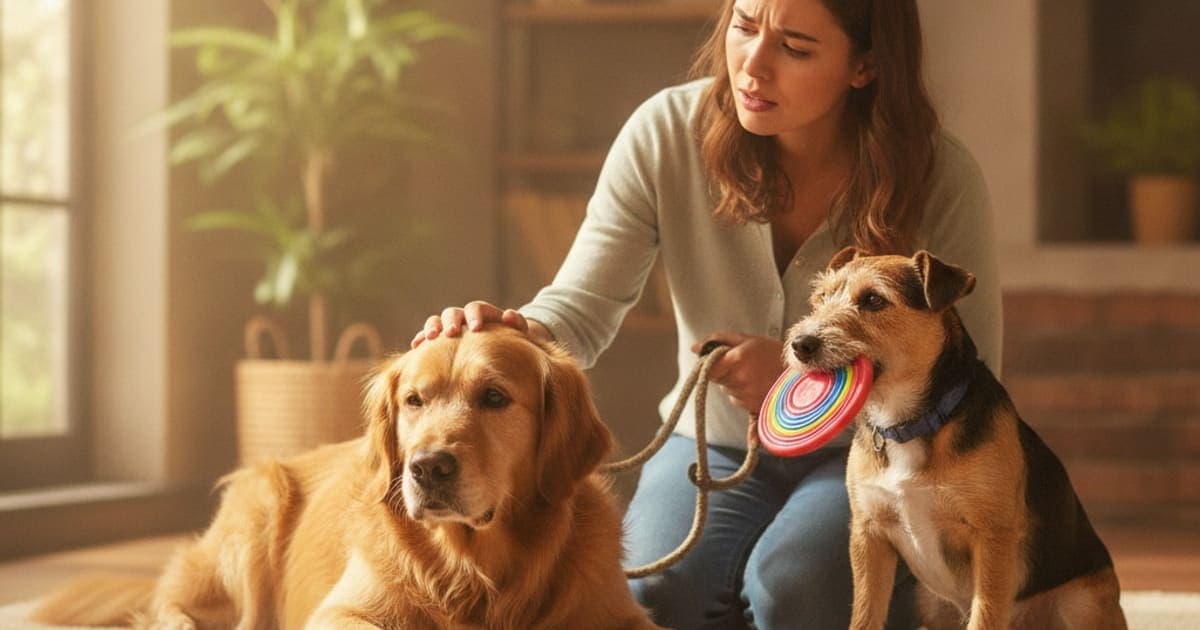
A dog not wanting to walk is almost never stubbornness. It usually reflects one of four things: physical discomfort (joints, paws, spine or soft tissue), systemic illness that is quietly draining energy, an environmental problem such as hot pavement or slick footing, or a learned association between the leash, the route or a noise and something unpleasant. Sudden, total refusal — particularly alongside lethargy, trembling, a hunched posture or hind-limb weakness — warrants a same-day call to your veterinarian. A slowdown that has crept in over weeks or months is the classic signature of joint and soft-tissue discomfort, and it still earns an exam, just with less urgency.
What follows is how to read the pattern you are actually seeing, what a veterinary workup involves, and what happens through the recovery window afterwards, when your dog's tissue is doing the repair work.
Sudden refusal: what to check first
Start with the parts you can see. Paws take the most abuse and get the least attention: split or overgrown nails, a torn pad, grit or a burr wedged between the toes, a cracked dewclaw, salt or chemical irritation in winter, or a pad burn from pavement that was hotter than it looked. Press each toe gently and spread the webbing.
Then look at posture and movement. A dog that will not lift its head, flinches when picked up around the middle, stands with a roached back, or drags a hind toe may be dealing with spinal pain or a disc problem — that is an urgent category, not a wait-and-see one. Hind-limb weakness that appears over hours, a wobbly gait, an inability to rise, pale gums or a distended abdomen all belong in the same-day column.
Finally, consider context. Dogs refuse walks because of thunder, construction noise, a dog behind a specific fence, or a harness that pinches under the armpit. A dog that strides happily around the back yard but freezes at the front door is often telling you about the route rather than the body.
When your dog is lethargic as well as reluctant
Lethargy is different from ordinary tiredness. A lethargic dog is flat: slower to greet you, sleeping through things that normally bring it running, less interested in food, less reactive to the lead coming off the hook. When reluctance to walk arrives together with that flatness, the problem is more likely to be systemic than mechanical.
Pain itself causes lethargy. So do fever and infection, anaemia, tick-borne disease, endocrine conditions such as hypothyroidism, kidney and liver disease, heart disease that limits exercise tolerance, and side effects from medications already in the cabinet. Several of these produce no limp at all — the dog simply has less to spend.
This is exactly the point where home management is the wrong first move. Bloodwork and a urinalysis are the standard opening pass, and they are inexpensive relative to how much they rule out. A dog that won't walk is handing you diagnostic information, and the fastest route back to normal walks is an exam that names the problem rather than a supplement aimed at a guess.
The gradual slowdown: joints, tendons and the comfort budget
Chronic cases look different. The dog still wants to go. It just stops sooner, lags on the way home, hesitates at stairs or the car, takes the first few steps after a nap stiffly, or sits down halfway through a route it used to finish easily.
Osteoarthritis is the most common chronic driver of reduced activity in middle-aged and older dogs, and it is frequently present long before anyone notices a limp — dogs redistribute load away from a sore joint so efficiently that gait changes stay subtle for months. Partial cranial cruciate ligament tears tend to show up as a dog that sits with one leg kicked out to the side, toe-touches on the affected leg, or bunny-hops at the canter. Hip and elbow dysplasia, lumbosacral disease, iliopsoas strains and shoulder tendinopathies all produce the same headline: less willingness to move.
Think of it as a comfort budget. Every dog has a daily amount of loading it can do before discomfort outruns enthusiasm. When a joint or tendon problem shrinks that budget, the dog spends it faster — and then a second problem compounds the first: less walking means less muscle, and less muscle means less support for the joint it was protecting. That loop, not the original injury, is what makes chronic mobility cases drag on.
Reading the pattern
| What you notice | What it often reflects | Sensible next step |
|---|---|---|
| Stops dead at the front door, fine in the yard | Route, noise or gear association | Change route, check harness fit, rebuild with short positive outings |
| Starts well, quits on the way home | Stamina limited by pain, cardiac or respiratory capacity | Vet exam including heart and lung assessment |
| Refuses stairs, jumps or the car | Spine, hips, knees or elbows | Orthopaedic and neurological exam |
| Stiff after rest, loosens after a few minutes | Arthritis-pattern joint discomfort | Vet exam, imaging where indicated |
| Normal at rest, clearly worse the day after activity | Soft-tissue or tendon loading problem | Vet exam and a load-management plan |
| Reluctant on certain surfaces only | Paws, nails, or traction confidence | Inspect paws and nails, add traction at home |
| Reluctant plus flat, off food, sleeping more | Systemic illness | Prompt vet visit with bloodwork |
What the veterinary workup actually involves
A proper mobility exam is more than a quick leg squeeze. Expect a detailed history — when it started, which activities trigger it, how the dog moves first thing in the morning versus last thing at night. Video from home helps enormously, because many dogs mask discomfort in a clinic room and trot out looking deceptively sound.
The physical exam usually includes watching the dog walk and trot, palpating each joint through its range of motion, checking for effusion, thickening or crepitus, testing the stifle for drawer movement and tibial thrust, and running a neurological screen for proprioception and reflexes to separate orthopaedic pain from spinal disease. Radiographs often require sedation, because positioning has to be clean enough to read properly. Bloodwork rules the systemic causes in or out. Advanced imaging, or referral to a surgeon or a rehabilitation specialist, follows when the picture stays unclear.
Out of that comes a plan: prescription anti-inflammatories or other analgesics, weight management, a structured rehabilitation programme, and in cases such as cruciate rupture, surgical stabilisation. Those are the load-bearing interventions and nothing substitutes for them. If your vet prescribes a medication, stay on it as directed — adjusting or stopping a prescription on your own removes the pain control the whole rehab plan depends on. Talk to your veterinarian before you add anything alongside it, supplements included.
The recovery window and where structured support fits
Diagnosis and treatment open a window. Whether your dog is eight weeks post-surgery, working through a conservative plan for a partial tear, or managing arthritis long-term, the real repair happens at tissue level over weeks and months — collagen laid down, remodelled and aligned to the loads placed on it, blood supply reorganised, muscle rebuilt around the joint. The tendon-bone interface does not care about calendars; it responds to controlled loading and to the biology available to it.
This is where the supplement aisle gets ugly. Kitchen-sink chews stack a dozen ingredients at token amounts, hide them behind proprietary blends, and publish nothing you can independently check. The useful question is never how many ingredients appear on the label, but whether the ones present are there at a meaningful amount and whether anyone outside the company has verified it.
pawgen takes the narrow approach with K9-REPAIR: BPC-157 and TB-500, formulated for dogs with weight-based dosing, third-party tested with certificates of analysis published, shipped direct to the door. BPC-157 is a short peptide sequence; published preclinical research, largely in animal models, suggests it influences angiogenesis and fibroblast migration — the processes that bring blood supply and repair cells into connective tissue. TB-500 relates to thymosin beta-4, a naturally occurring protein studied for its actin-binding role in cell migration and tissue organisation. Research suggests those mechanisms sit squarely inside the biology of soft-tissue remodelling, which is why K9-REPAIR has become part of the stack many owners adopt through a recovery window. Neither peptide is an FDA-approved veterinary drug, and none of this is a claim about what will happen to your particular dog — the honest framing is mechanism and promising science, discussed with your vet, running alongside the care plan rather than in place of it. pawgen backs the formulation with a 60-day money-back guarantee, and dosing questions — especially for puppies, pregnant or nursing dogs — belong with your veterinarian rather than a chart on the internet.
Daily management that actually helps
Traction first. Rugs or runners across slick floors change how willingly a sore dog moves around the house more than almost anything else you can buy. Ramps for the car and the sofa remove the jump-and-land impact that aggravates knees and spines several times a day.
Body condition is the single biggest lever an owner controls — excess weight is driven through compromised joints thousands of times every walk. Keep nails short enough that they do not alter foot placement. Warm up before exertion with a few minutes of easy walking instead of launching straight into a sprint after a ball. Favour several short outings over one long one, and let the dog sniff: scent work tires a dog mentally without loading the joints hard. Keep bedding supportive and off cold, hard floors.
Track progress with video on the same stretch of path every couple of weeks, filmed from the same angle. Trends tell you far more than how the dog happened to look this morning.
Key Takeaways
- Refusing walks is a signal — discomfort, illness, environment or fear — not defiance.
- Sudden refusal with lethargy, hind-limb weakness, a hunched back or pale gums is a same-day veterinary matter.
- Gradual slowing most often reflects joint or soft-tissue discomfort, and arthritis is frequently present well before any visible limp.
- Lethargy alongside reluctance points toward systemic causes, which bloodwork and urinalysis are designed to sort out.
- Judge joint products by ingredient transparency and third-party testing, not by label length.
- Research suggests BPC-157 and TB-500 act on the mechanisms behind soft-tissue remodelling; K9-REPAIR is the formulation owners reach for through recovery, with weight-based dosing worked out with a vet.
- Traction, weight control and short frequent outings do quiet, real work every single day.
Your veterinarian owns the diagnosis and owns the treatment plan. Imaging, prescriptions, surgical decisions and rehabilitation protocols are theirs to make, and nothing from a shelf belongs ahead of them in the queue. What a formulation like K9-REPAIR can do is occupy the space that proper veterinary care creates — the weeks of remodelling after the problem has a name and the plan is already running. Bring your video, bring your questions, and build the recovery around what your vet finds.
For readers who want to check the detail themselves, pawgen publishes third-party certificates of analysis, lists shipping and availability information, and keeps the full range in the shop; product information for K9-REPAIR sits at pawgen.
Owners exploring peptide support for their dog can review K9-REPAIR — BPC-157 + TB-500 formulated for dogs — at https://pawgen.com/. BPC-157 and TB-500 are not FDA-approved veterinary drugs. Nothing in this article treats, cures or prevents any condition; every decision about your dog's care belongs with your veterinarian.
Frequently asked questions
- Why has my dog suddenly stopped wanting to go on walks?
- Sudden refusal usually comes down to pain, illness or an environmental trigger. Check paws and nails first, then look for a hunched back, flinching when lifted, hind-limb weakness or a dragging toe — all of which suggest spinal or orthopaedic pain. If your dog also seems flat, off food or weak, treat it as urgent and call your veterinarian the same day.
- Is it an emergency if my dog is lethargic and won't walk?
- Treat it as urgent when lethargy arrives with pale gums, laboured breathing, collapse, a swollen abdomen, repeated vomiting, an inability to rise or sudden hind-limb weakness. Those combinations can reflect serious systemic or neurological problems. Even without those signs, lethargy plus walk refusal deserves a prompt exam with bloodwork rather than a wait-and-see week at home.
- Can arthritis make a dog refuse walks without an obvious limp?
- Yes. Dogs shift load away from a sore joint efficiently enough that gait changes stay subtle for a long time. Reluctance to start a walk, stiffness after rest that eases with movement, hesitation at stairs or the car, and quitting early are often the first visible signs. A veterinary exam and imaging where indicated are how the picture gets confirmed.
- My dog walks out happily but refuses to come home — what does that mean?
- That pattern usually points to stamina limited by discomfort or by cardiac or respiratory capacity: the dog starts within budget and runs out partway through. It can also be behavioural, if home means the end of something enjoyable. Shortening the loop and mentioning the exact point of refusal to your vet helps separate the two.
- Should I force my dog to keep walking?
- No. Pulling a reluctant dog forward risks worsening an injury and teaches the dog that the leash predicts discomfort. Stop, check the paws, carry or support a small dog home if needed, and arrange an exam. Rebuilding distance later works far better once a vet has ruled out pain as the driver.
- What is K9-REPAIR and where does it fit alongside veterinary care?
- K9-REPAIR is pawgen's formulation of BPC-157 and TB-500 for dogs, with weight-based dosing, third-party testing and published certificates of analysis. These peptides are not FDA-approved veterinary drugs. Research suggests they act on mechanisms involved in soft-tissue remodelling, which is why owners adopt them through a recovery window — alongside a vet's plan, never instead of it.
- Can I give peptides to a puppy, or to a pregnant or nursing dog?
- Those situations call for a conversation with your veterinarian before anything is given, and this article does not publish dosing figures for any dog. Growing, pregnant and nursing dogs have different physiology and different priorities, so the decision belongs with the vet who knows your dog's history and current health status.
- How do I tell pain from fear when my dog won't leave the house?
- Watch where the behaviour breaks down. A dog that moves freely, plays and climbs stairs at home but freezes at a particular door, route or sound is usually telling you about the environment. A dog that is slow, stiff or reluctant everywhere, including indoors, is more likely to be uncomfortable — and that pattern needs a veterinary exam.
- What should I bring to the vet appointment?
- Video of your dog walking and trotting on a flat surface, filmed from the side and from behind, plus notes on when the problem started, what makes it worse, and how your dog moves first thing in the morning. Bring a list of every medication and supplement currently given, including anything added recently.
Educational content, not veterinary advice. Ask your vet about your dog.