Dog Obesity: What It Is and Why Dogs Gain Weight
Dog obesity is excess body fat, usually defined as a body weight roughly 20 percent or more above ideal, that begins to affect a dog's joints, breathing and lifespan. It develops when daily calories, treats included, outpace activity, and vets grade it using a body condition score.
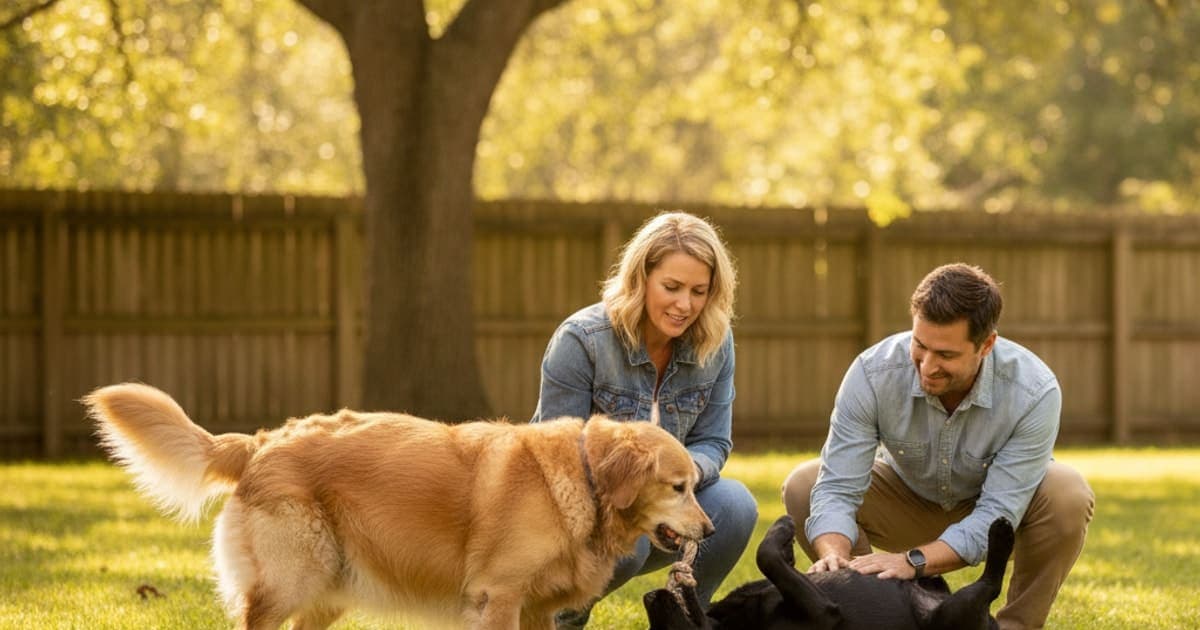
Dog obesity is the build up of excess body fat to the point where it begins to affect a dog's health, comfort and lifespan. The working definition most veterinary teams use is straightforward: a dog carrying roughly 10 to 20 percent more than its ideal body weight is overweight, and a dog carrying roughly 20 percent or more above ideal is obese. That is the plain obesity dog meaning, and it is a clinical description rather than a comment on how a dog looks.
Pet obesity is the same concept applied across companion animals. When you see the phrase "what is pet obesity" it usually refers to dogs and cats together, because both species gain weight the same way, through more calories going in than energy going out, even though the health consequences and the safe approach to weight loss differ between them.
Obesity is not a cosmetic issue, it is a chronic condition that changes how a dog's joints, airways, hormones and immune system work, and it is one of the most common problems veterinarians see in otherwise healthy dogs.
The encouraging part is that it is also one of the most modifiable. Almost every lever that matters, portion size, treat count, meal frequency, daily movement, sits in the owner's hands.
How vets grade a dog's body condition
Scales matter, but a number on its own tells you very little. A 70 pound dog may be lean or heavy depending on frame, breed and muscle. That is why veterinary teams use a body condition score, most commonly a 9 point scale, alongside body weight. It is a hands on assessment, not a glance.
Three checks do most of the work. Run your hands along the ribs: you should feel them easily under a thin layer of fat, similar to the back of your hand. Look down at your dog from above: there should be a visible waist behind the ribs. Look from the side: the belly should tuck up rather than running straight or sagging.
| Score on the 9 point scale | Category | What you see and feel |
|---|---|---|
| 1 to 3 | Underweight | Ribs, spine and hip bones easy to see, little or no fat cover, obvious loss of muscle in severe cases |
| 4 to 5 | Ideal | Ribs easily felt under a thin fat layer, clear waist from above, visible abdominal tuck from the side |
| 6 to 7 | Overweight | Ribs hard to feel under fat, waist barely visible, tuck flattening out, fat starting to pad the lower back |
| 8 to 9 | Obese | Ribs not palpable without firm pressure, no waist, belly distended or sagging, heavy fat over the spine, tail base, chest and limbs |
Those categories are what people mean when they search for dog obesity levels. If you are reading this because your dog is getting overweight and you are not sure how far things have gone, the fastest honest answer is a weigh in at your vet clinic plus a body condition score done by someone who assesses dogs every day. Many practices will do a weight check without a full appointment, and having a baseline number written down changes the conversation from guesswork to tracking.
Why dogs put on weight in the first place
Ask how do dogs get obese and the biology is simple even when the daily reality is not. Weight gain happens when energy taken in exceeds energy used, consistently, over weeks and months. Fifteen extra calories a day is invisible on any given evening and significant over a year. The common dog obesity causes stack on top of that basic arithmetic.
Portions set by eye. Most owners scoop rather than measure, and most feeding guides on the bag are generous because they are written for an average active adult dog, not a neutered, nine year old, mostly indoor one.
Treats, chews and table food. This is the biggest hidden contributor in most households. Training treats, dental chews, a corner of toast, the last spoonful from a bowl, a biscuit from a visitor. Each one is small. Across a day, and across several people in a household, they can add up to a meaningful share of a dog's intake.
Falling activity. Dogs slow down as they age, as the weather turns, as owners get busier. Food intake rarely falls to match.
Neutering and hormonal change. Neutered dogs generally need fewer calories than intact dogs of the same size and often show a greater interest in food. The surgery does not make a dog fat, but feeding the same amount afterwards can.
Age and body composition. Older dogs lose muscle, and muscle is where a lot of resting energy is burned. The same bowl that maintained a four year old can slowly overfeed a ten year old.
Breed and genetics. Some breeds are simply more prone to weight gain. Labrador Retrievers, Beagles, Cocker Spaniels, Dachshunds, Pugs and Cairn Terriers are among those regularly flagged by vets. Research in Labrador Retrievers and flat coated retrievers has identified a gene variant associated with stronger food motivation, which helps explain why some dogs behave as if they are permanently starving.
Underlying medical contributors. Hormonal conditions can slow metabolism and drive weight gain, and some medications a vet prescribes increase appetite. Pain is another quiet contributor: a dog with sore joints moves less, gains weight, and then carries more load on the same sore joints. If your dog is gaining weight despite unchanged food and exercise, talk to your veterinarian about bloodwork before assuming the cause is diet alone.
What the extra weight does to a dog's body
The reason vets push on this is that dog obesity problems are not limited to mobility. Fat tissue is metabolically active. It releases inflammatory signalling molecules, which means a heavy dog is carrying a low grade inflammatory load as well as extra pounds.
The consequences cluster in a few areas. Joints and soft tissue take more load with every step, which is associated with faster progression of osteoarthritis and greater strain on ligaments. Breathing is harder, particularly in flat faced breeds whose airways are already compromised. Heat tolerance drops, because fat insulates and overweight dogs shed heat poorly. Anaesthesia and surgery carry more risk, and dosing and recovery are both more complicated. Excess weight is also linked with insulin resistance, with urinary problems, and with skin issues where folds trap moisture.
There is a quality of life dimension that owners feel before any test shows it. Heavy dogs play less, tire sooner, struggle with stairs and car jumps, and often need help with grooming they used to manage themselves. A long running lifetime feeding study in Labrador Retrievers found that dogs kept at a lean body condition lived longer on average than littermates who were fed more, and showed later onset of age related changes. Keeping a dog lean is one of the few genuinely free health interventions available to an owner.
Dogs and cats: the same problem, different rules
Obesity in dog and cat populations shares a cause and diverges sharply in management. If you share your home with both, this distinction matters.
| Dogs | Cats | |
|---|---|---|
| Main driver | Portion creep, treats, table food, falling activity | Free feeding dry food, indoor living, low activity |
| Assessment | 9 point body condition score, ribs, waist, tuck | 9 point body condition score, plus belly fat pad |
| Exercise leverage | High, walks and play are easy to increase | Low, activity has to be engineered through play and feeding puzzles |
| Speed of weight loss | Gradual loss under veterinary guidance | Must be slow, rapid loss in cats risks a serious liver condition |
| Owner control point | The measuring cup and the treat jar | The feeder and meal structure |
The headline difference: a cat losing weight too quickly can develop hepatic lipidosis, a serious liver problem. Never crash diet a cat, and never apply a dog's weight plan to one.
Helping a heavy dog come back down safely
Start with a veterinary exam rather than a diet. Your vet can rule out medical contributors, set a realistic target weight for your specific dog rather than a breed average, and tell you how much loss per week is appropriate. Weight loss that is too fast costs muscle, and muscle is exactly what an older or arthritic dog cannot afford to lose.
From there, the mechanics are unglamorous and effective:
- Measure every meal with a kitchen scale rather than a cup. Scooping is where portions drift.
- Give treats a budget. A widely used veterinary guideline is that treats should stay within about 10 percent of daily calories, and whatever goes into treats comes out of meals.
- Switch high calorie treats for green beans, carrot, cucumber or a few pieces of the dog's own measured kibble used as rewards.
- Agree the plan with everyone in the household. One person quietly feeding scraps will cancel out everybody else's effort.
- Build activity gradually, especially if your dog is stiff or very heavy. Shorter, more frequent walks beat one long one. Swimming and controlled lead work are easier on joints.
- Weigh monthly and write it down. Progress on a heavy dog is slow enough to be invisible without a record.
- Ask about a therapeutic weight management diet. Your vet may recommend one that keeps the dog feeling full on fewer calories while protecting nutrient intake.
If your dog's mobility is already limited, raise that with your veterinarian as part of the same conversation. Pain and weight feed each other, and a plan that addresses only one of them tends to stall.
Key Takeaways
- Dog obesity means excess body fat, generally defined as roughly 20 percent or more above ideal body weight, with overweight sitting around 10 to 20 percent above.
- Body condition score, usually on a 9 point scale, matters more than the number on the scale, because it accounts for frame and muscle.
- The most common causes are eyeballed portions, treats and table food, reduced activity, neutering, age related muscle loss and breed predisposition.
- Hormonal conditions and pain can drive weight gain, so unexplained gain deserves a veterinary workup rather than a stricter diet.
- Extra weight is linked with joint strain, breathing difficulty, poor heat tolerance, higher anaesthetic risk and reduced quality of life.
- Cats must lose weight slowly under veterinary supervision, because rapid loss risks serious liver disease.
- Measuring food, budgeting treats, building activity gradually and weighing monthly are the levers that actually move the number.
Your veterinarian owns the diagnosis and the plan. They are the one who confirms whether a dog is obese, rules out the medical causes that mimic simple overfeeding, sets the target weight and decides how fast is safe to get there. Food choices, daily activity and any supplement you are considering all operate inside the space that proper veterinary care creates, never instead of it.
Frequently asked questions
- What is dog obesity?
- Dog obesity is excess body fat that reaches a level where it affects health, usually defined as a body weight roughly 20 percent or more above a dog's ideal. Around 10 to 20 percent above ideal is classed as overweight. Vets confirm it with a hands on body condition score, not weight alone.
- What causes dog obesity?
- The core cause is more calories taken in than energy used, sustained over months. Common contributors include portions measured by eye, treats and table food, falling activity with age, neutering without a feeding adjustment, breed predisposition, and medical factors such as hormonal conditions, pain or appetite increasing medication.
- How do dogs get obese?
- Gradually, and usually invisibly. A small daily calorie surplus from generous scoops, training treats, chews and scraps builds fat over months while activity quietly declines. Multiple people feeding the same dog accelerates it. Pain or a hormonal condition can also reduce activity or slow metabolism, so ask your vet about unexplained gain.
- What is pet obesity?
- Pet obesity is the term for excess body fat in companion animals, most often dogs and cats, at a level that harms health. The underlying cause is the same across species, a sustained calorie surplus, but assessment and safe weight loss differ, and cats in particular must lose weight slowly.
- How to prevent dog obesity?
- Weigh meals rather than scooping, keep treats within roughly 10 percent of daily calories, and adjust portions when your dog is neutered, slows down or ages. Maintain consistent daily activity, weigh your dog monthly, and run a hands on rib and waist check. Review the plan with your vet annually.
- How to prevent obesity in dogs?
- Set a target weight with your veterinarian, then feed to that target rather than to the bag's guidance. Measure food, count treats across the whole household, use low calorie rewards, and keep movement consistent year round. Monthly weigh ins catch drift early, when correcting it takes a small adjustment.
- What are dog obesity levels?
- Most clinics use a 9 point body condition score. Scores of 4 to 5 are ideal, 6 to 7 indicate overweight, and 8 to 9 indicate obesity. Scores of 1 to 3 are underweight. The grading is based on how easily ribs are felt, waist visibility and abdominal tuck.
- Is obesity in dogs and cats the same problem?
- The cause is the same, a long term calorie surplus, but management differs. Dogs respond well to increased walking and play, while cat activity must be engineered through play and feeding puzzles. Cats also need very gradual weight loss, because rapid loss risks a serious liver condition called hepatic lipidosis.
Educational content, not veterinary advice. Ask your vet about your dog.