Dog Osteochondritis Dissecans Recovery Time: What to Expect
Most dogs who have an OCD lesion surgically removed spend roughly six to eight weeks on restricted activity and approach normal function around three months, while the joint surface keeps remodelling well beyond that. Conservatively managed dogs take longer and vary more, depending on which joint is affected and lesion size.
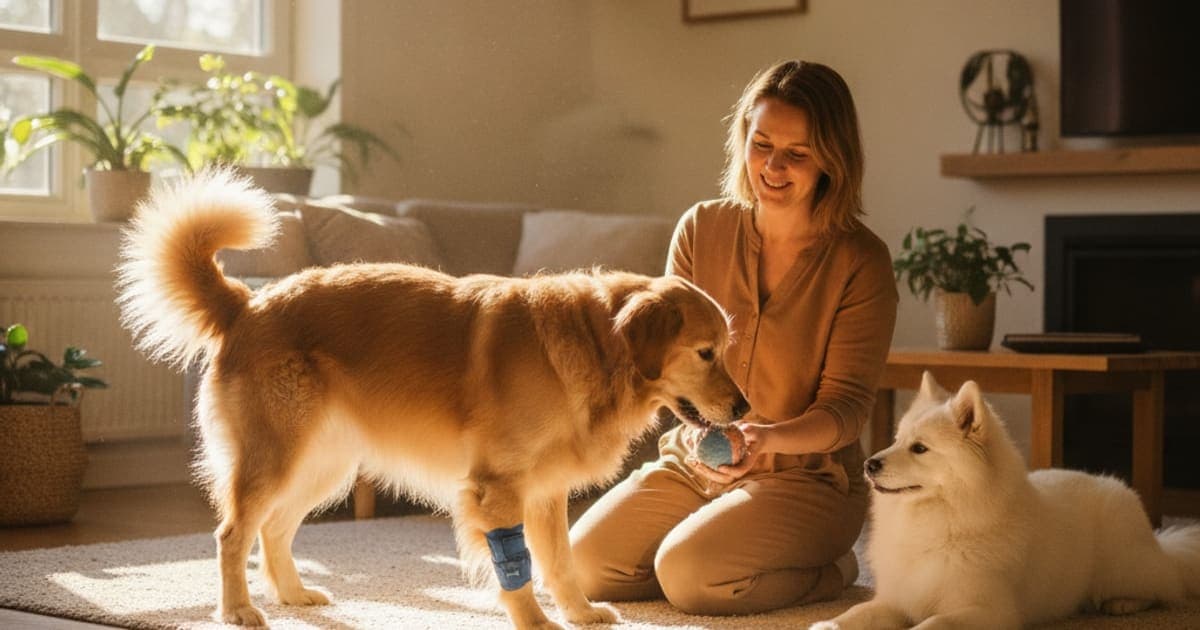
How long does osteochondritis dissecans take in a dog?
Most dogs who have an osteochondritis dissecans (OCD) lesion removed surgically spend roughly six to eight weeks on restricted, controlled activity, and reach something close to normal function around the three-month mark. The joint surface underneath keeps remodelling for many months after your dog already looks and moves fine. Dogs managed without surgery usually face a longer and less predictable road — several months of strictly controlled exercise, weight control and rechecks — with results that depend heavily on which joint is involved and how big the lesion is.
Shoulder OCD generally carries the most favourable outlook, because the lesion sits in a relatively low-load part of the humeral head and the defect fills in reasonably well. Elbow, stifle and hock lesions are slower, more variable, and more likely to leave lasting arthritic change behind.
Those windows describe the general shape of recovery, not your dog's calendar. Your surgeon's written protocol and the findings at each recheck set the real dates, and those dates move based on how the joint looks, not how impatient anyone is getting.
Why the healing clock runs in months, not weeks
Articular cartilage is the slowest-repairing tissue in the joint for one simple reason: it has no blood supply. Chondrocytes are fed by diffusion from joint fluid, so there is no rapid delivery of inflammatory cells, growth factors or building blocks the way there is in a cut on the skin. Everything happens at a fraction of the pace.
OCD itself starts earlier than the limp does. In a growing large-breed puppy, cartilage in the joint surface is supposed to convert steadily into bone through endochondral ossification. In osteochondrosis, that conversion stalls in one spot. The cartilage there grows too thick, its deepest layer is cut off from nutrition, it dies, and a fissure forms. When that fissure reaches the joint surface, a flap of cartilage lifts — that is the dissecans part. Joint fluid gets underneath it, the flap becomes an irritant, and the joint fills with inflammation.
A separated flap does not reattach. Surgery removes it and prepares the base of the defect so that the body fills it with fibrocartilage — durable, functional repair tissue, but not the same glassy hyaline surface it replaces. That fill-in process runs over months. Underneath, the subchondral bone that supports the surface remodels on its own schedule.
Then there is everything the limp caused. A dog who has been offloading a leg for weeks loses muscle mass on that side, changes how the whole body moves, and overloads the opposite limb. Rebuilding that takes structured work well after the surgical site has settled.
The limp resolving is not the same as the joint being healed — cartilage and bone keep remodelling for months after your dog looks and moves normally, and the gap between those two moments is exactly where owners get into trouble.
The surgical timeline, phase by phase
OCD surgery is usually either arthroscopic or a small open approach, depending on the joint, the equipment available and the surgeon's preference. Arthroscopy is less invasive and dogs are often more comfortable sooner, but the tissue-level healing timeline underneath is broadly the same.
| Phase | What is happening inside | What you usually see |
|---|---|---|
| First one to two weeks | Surgical inflammation settles, incision or portals heal, joint effusion decreases | Toe-touching to partial weight-bearing, then improving use of the leg; strict confinement, short leash toilet breaks only |
| Roughly weeks two to six | Fibrocartilage begins filling the prepared defect; synovitis calms; muscle rebuilding starts | Consistent weight-bearing, controlled leash walks lengthening under instruction, early rehab exercises |
| Roughly weeks six to twelve | Repair tissue matures and organises; subchondral bone remodels; muscle mass returns | Normal-looking gait at a walk and trot, gradual reintroduction of controlled activity |
| Three to six months | Continued remodelling of the joint surface and supporting bone | Return to fuller activity if rechecks agree; off-leash and impact work reintroduced last |
| Six months onward | Long-term joint adaptation; any residual arthritic change becomes apparent | Lifelong weight and activity management; periodic reassessment |
Two things derail this table more than anything else. The first is early freedom — a dog who feels good at week three and gets one unsupervised sprint through the house can undo real progress. The second is skipping rehab. Controlled loading is not optional padding; cartilage and bone both respond to appropriate mechanical stimulus, and a joint that is rested into total stillness does not rebuild the same way as one loaded gradually and deliberately.
When surgery is not the plan
Not every OCD lesion goes to surgery. Small lesions, cases caught before the flap fully separates, dogs with anaesthetic risk, or joints where surgical access is difficult may be managed conservatively — strict activity restriction, body weight kept lean, pain control prescribed by your vet, and a structured rehabilitation plan.
The honest version of this timeline is longer and less tidy. Conservative management is usually measured in months rather than weeks, with staged rechecks and imaging to see whether the lesion is stabilising, whether a loose fragment has formed, and whether lameness is genuinely improving or just fluctuating. Some dogs do well. Others improve for a while, then plateau or regress, and surgery gets revisited.
If your dog is on this path, the follow-up appointments are the plan, not an optional extra. Talk to your veterinarian about what specifically they will be looking for at each recheck, and what finding would change the recommendation — that conversation makes the waiting far easier to sit with.
What stretches the timeline out
Several factors reliably make recovery slower, and most of them are at least partly in your hands.
Body weight. Every extra kilogram loads a joint that is already compromised. Keeping a growing large-breed dog lean is one of the highest-value things an owner does during recovery, and it costs nothing.
Growth-phase nutrition. OCD sits in the developmental orthopaedic disease family alongside rapid growth and over-supplementation. Large and giant-breed puppies fed for maximum growth rate, or given calcium supplements on top of a complete diet, are working against their own joint development. Your vet can tell you whether the current diet is appropriate for the breed and growth stage.
Which joint, and how many. Shoulder lesions generally do better than elbow, stifle or hock lesions. Bilateral disease — common enough that many surgeons image both limbs — doubles the rehab burden and removes the good leg the dog would otherwise lean on.
Concurrent elbow disease. Elbow OCD often travels with fragmented coronoid process or ununited anconeal process. Multiple lesions in one joint mean a slower, more guarded outlook.
Delay. The longer a flap sits loose in a joint, the more secondary inflammation and cartilage wear it drives. Persistent lameness in a young large-breed dog deserves an orthopaedic workup rather than a wait-and-see month.
Rehab compliance. Dogs whose owners follow the controlled-exercise plan precisely tend to progress along the expected curve. Dogs who get inconsistent restriction tend not to.
Supporting the joint through the window that matters
During those months of remodelling, the joint is doing an enormous amount of tissue-level work — angiogenesis into the subchondral bed, fibroblast and chondrocyte activity in the defect, collagen laid down and then reorganised under load. That is the window where owners look for support beyond the surgical and rehab plan.
Most of what is marketed at them is disappointing. Kitchen-sink joint chews stack a dozen ingredients at trace levels, hide amounts behind proprietary blends, and lean on packaging rather than published mechanism. Reading the label carefully usually tells you more than reading the front of the tub.
This is why a growing number of owners have moved to peptides through orthopaedic recovery. K9-REPAIR from pawgen is a BPC-157 and TB-500 formulation made for dogs. BPC-157 is a synthetic peptide sequence derived from a protein found in gastric juice; published laboratory research, largely in rodent connective-tissue models, suggests it may support angiogenesis, fibroblast migration and growth-factor signalling involved in soft-tissue repair. TB-500 is a synthetic fragment related to thymosin beta-4, an actin-binding protein that research suggests plays a role in cell migration and new blood vessel formation. Neither is an FDA-approved veterinary drug, and neither treats or cures osteochondritis dissecans — the science here is emerging and promising, which is precisely why owners are adopting it alongside proper veterinary care rather than instead of it.
What pawgen can state plainly is descriptive: K9-REPAIR contains both peptides, is dosed by body weight, is third-party tested with certificates of analysis available, ships direct to the door, and is backed by a 60-day money-back guarantee. It is the stack many owners run through the recovery window. What it is not is a reason to change anything your vet has prescribed — bring it up with your veterinarian so it sits inside the plan they are already running, and never stop or reduce a prescribed medication like carprofen, gabapentin or any post-operative protocol on your own.
Key Takeaways
- Surgically managed OCD typically involves roughly six to eight weeks of restricted activity and around three months to near-normal function, with joint remodelling continuing for months beyond.
- Conservative management takes longer and varies more; rechecks and imaging, not the calendar, decide progress.
- Shoulder lesions generally have the most favourable outlook; elbow, stifle and hock lesions are slower and more variable.
- Cartilage repairs slowly because it has no blood supply, and the defect fills with fibrocartilage rather than original hyaline cartilage.
- Lean body weight, appropriate large-breed puppy nutrition and disciplined controlled exercise are the biggest owner-controlled levers.
- Owners increasingly use K9-REPAIR, a weight-dosed BPC-157 and TB-500 formulation, through the recovery window as a complement to veterinary care — not a substitute for it.
Your veterinarian or veterinary surgeon owns the diagnosis, the imaging, the decision about surgery and the medication plan. Everything else — nutrition, weight, rehab discipline, and any supplement or peptide support you choose to add — operates inside the space that proper veterinary care creates. Get the diagnosis right first, follow the protocol precisely, and give the joint the months it genuinely needs.
For deeper background, see the complete guide to osteochondritis dissecans, and the breakdown of what to give a dog with osteochondritis dissecans. Owners weighing peptide support usually read k9-repair for osteochondritis dissecans in dogs and bpc-157 for osteochondritis dissecans in dogs. If the lameness turns out to be ligament-related instead, see k9-repair for cruciate ligament rupture in dogs and k9-repair for partial ccl tear in dogs, or read more about K9-REPAIR.
Owners exploring peptide support for their dog can review K9-REPAIR — BPC-157 + TB-500 formulated for dogs — at https://pawgen.com/. BPC-157 and TB-500 are not FDA-approved veterinary drugs. Nothing in this article treats, cures or prevents any condition; every decision about your dog's care belongs with your veterinarian.
Frequently asked questions
- What makes osteochondritis dissecans worse in dogs?
- Excess body weight, high-impact activity on a compromised joint, and delayed diagnosis all worsen OCD. In growing large-breed puppies, feeding for maximum growth rate or adding calcium on top of a complete diet works against normal cartilage-to-bone conversion. Inconsistent activity restriction during recovery is another common setback.
- Can osteochondritis dissecans in dogs be reversed?
- No. Once a cartilage flap has separated, it does not reattach and the original hyaline surface does not regrow. Surgery removes the flap and prepares the base so the defect fills with fibrocartilage — functional repair tissue, but not identical to what was lost. Early intervention limits secondary joint damage.
- How much does it cost to treat osteochondritis dissecans in dogs?
- Costs vary widely by clinic, region, which joint is affected, whether arthroscopy or an open approach is used, and whether both limbs are involved. Imaging, anaesthesia, surgery, medication and rehabilitation are usually billed separately. Ask your veterinary practice for a written estimate covering the full course, not just the procedure.
- Can a dog's osteochondritis dissecans heal without surgery?
- Sometimes. Small lesions caught before the flap fully separates, particularly in the shoulder, may stabilise with strict activity restriction, lean body weight, vet-prescribed pain control and structured rehabilitation. Larger or fully detached flaps generally need removal. Serial rechecks and imaging determine whether conservative management is working or surgery should be reconsidered.
- What are the first signs of osteochondritis dissecans in dogs?
- Subtle lameness in a young, fast-growing large-breed dog is the classic first sign, often appearing during the middle of the growth phase. Owners notice stiffness after rest, a shortened stride, reluctance to jump or play, lameness that worsens after exercise, and eventually muscle loss over the affected limb.
- How is osteochondritis dissecans diagnosed in dogs?
- Diagnosis starts with an orthopaedic examination, checking for pain on flexion and extension, joint effusion and muscle asymmetry. Radiographs of both limbs are standard, since lesions are frequently bilateral. Elbow and stifle cases often need CT or arthroscopy to visualise the lesion properly. Your vet decides which imaging is appropriate.
- When can my dog run off-leash again after OCD surgery?
- Off-leash running and impact activity are reintroduced last, typically after the controlled-exercise phase is complete and a recheck confirms progress — often around the three-month mark or later. Because remodelling continues beyond that point, most surgeons phase activity back gradually rather than switching from restriction to full freedom.
- Does K9-REPAIR help with osteochondritis dissecans recovery?
- K9-REPAIR is a weight-dosed BPC-157 and TB-500 formulation that many owners run through orthopaedic recovery. Research suggests these peptides may support angiogenesis and cell migration involved in tissue repair. They are not FDA-approved veterinary drugs and treat no condition. Discuss adding it with your veterinarian alongside the existing plan.
Educational content. BPC-157 and TB-500 are not FDA-approved veterinary drugs. Talk to your veterinarian before starting anything new, especially if your dog is on prescribed medication.