Dog Partial CCL Tear Recovery Time: What to Expect
Most dogs with a partial CCL tear need several months, not several weeks: roughly eight to twelve weeks of strictly restricted activity, then a gradual return to normal function over about four to six months. Body weight, joint stability, meniscus health and how tightly rest is enforced all shift that window.
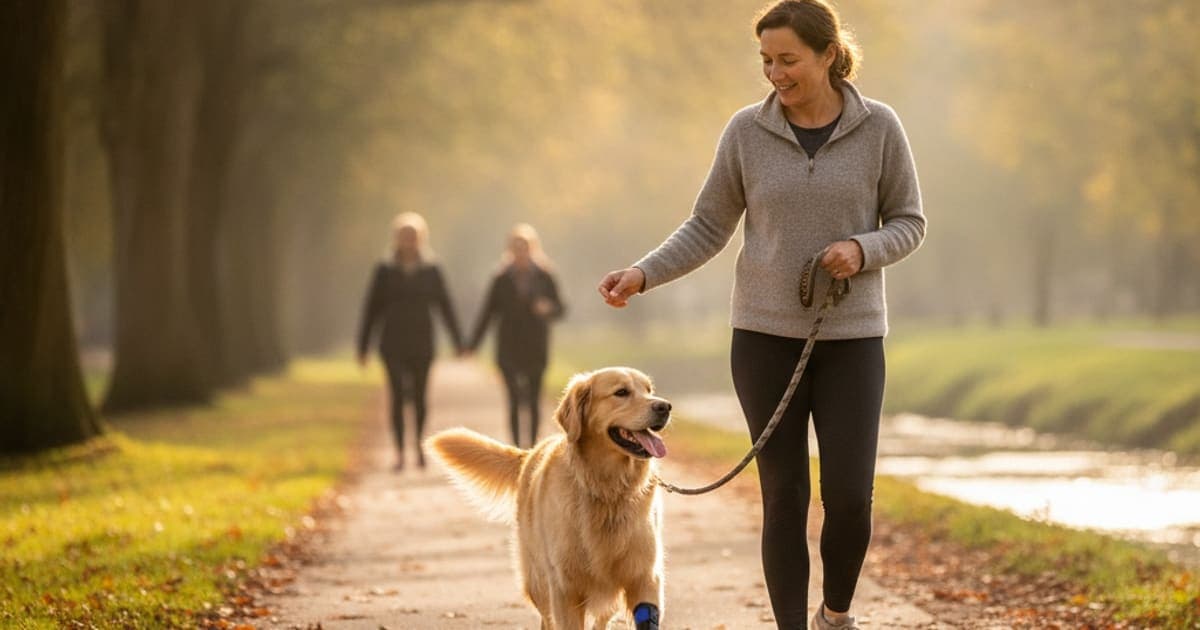
How Long Does a Partial CCL Tear Take in a Dog?
Plan on months, not weeks. Most dogs with a partial cranial cruciate ligament (CCL) tear go through roughly eight to twelve weeks of strictly restricted activity, followed by a graded return to normal movement that generally brings them back to full function somewhere around four to six months from the day the limp first appeared. Dogs stabilised surgically and dogs managed conservatively both tend to land inside that broad window. What pushes a dog toward the fast end or the slow end is body weight, how much of the ligament is compromised, whether the meniscus is involved, how much muscle the leg has lost, and — more than almost anything else — how strictly the rest period is genuinely enforced.
The number surprises owners, because the limp itself often looks better within a week or two. That early improvement is inflammation settling down, not the joint becoming stable. Dogs are extraordinarily good at hiding a knee problem by shifting weight to the other three legs, and a dog who trots happily across the kitchen at week three is not a dog whose stifle has finished remodelling. Understanding what is actually happening inside the joint is the difference between a clean recovery and a re-injury at week five.
Why a cruciate injury behaves nothing like a sprain
The cranial cruciate ligament sits inside the stifle (knee) joint and stops the tibia sliding forward under the femur every time the dog loads the leg. In people, the equivalent ligament usually fails in a single traumatic moment. In dogs, cruciate disease is overwhelmingly degenerative: the ligament frays and weakens over months or years, and a partial tear is often the point at which that slow deterioration finally becomes visible as a limp.
That matters for recovery time because of where the ligament lives. It sits inside the joint capsule, bathed in synovial fluid, with a limited internal blood supply. Torn cruciate fibres do not knit back together the way a skin wound or a muscle strain does. Instead, the body responds to instability by laying down fibrous tissue around the joint capsule and by recruiting the surrounding muscle — the quadriceps, hamstrings and gastrocnemius — to splint the knee. That process of periarticular fibrosis and muscular compensation is slow, and it is the real clock you are watching.
A partial CCL tear rarely heals in the way a cut heals — recovery is the process of the knee becoming stable and comfortable again, whether that stability comes from surgery or from the scar tissue and muscle the body builds around the joint.
Two complications commonly stretch the timeline. The first is meniscal injury: the meniscus is a cartilage cushion that gets crushed and torn by an unstable tibia sliding back and forth, and a dog who plateaus or suddenly regresses at week six is often a dog whose meniscus has given way. The second is the opposite knee. Because the underlying process is usually degenerative and both stifles carry the same conformation and load, dogs who tear one cruciate are widely recognised in veterinary practice as being at meaningful risk of trouble in the other one — which is another reason weight and conditioning work deserves attention long after the limp is gone.
Surgical stabilisation versus conservative management
The path your veterinarian recommends will depend on your dog's size, age, activity level, the degree of instability on examination and what the imaging shows. Both roads are legitimate; neither is fast.
| Approach | What it involves | Restricted-activity phase | Return to full function |
|---|---|---|---|
| Osteotomy procedures (TPLO, TTA) | Surgically changes the geometry of the tibia so the knee is stable without a functioning ligament; bone must heal | Roughly 8–12 weeks, with recheck imaging to confirm bone healing before restrictions lift | Generally around 4–6 months, longer for large, heavy or athletic dogs |
| Extracapsular (lateral suture) stabilisation | Places a strong suture outside the joint to mimic the ligament while fibrous tissue builds | Roughly 8–12 weeks of controlled loading | Generally around 3–6 months; more often chosen for smaller, lighter dogs |
| Conservative management with rehab | Strict restriction, weight control, pain management prescribed by your vet, structured physiotherapy | Roughly 8–12 weeks minimum, sometimes longer before activity is expanded | Generally 4–6 months, with outcomes typically better in smaller, leaner dogs |
| Custom stifle orthosis (brace) | Professionally fitted external support used alongside a rehab plan, not instead of one | Used throughout the restriction phase and often beyond | Varies widely; requires fitting, monitoring and skin checks |
One honest note on the surgical column: an osteotomy is major orthopaedic surgery, and when a veterinary surgeon recommends it for a large, active dog with a progressing partial tear, that recommendation deserves real weight. Nothing in a supplement cupboard is a substitute for mechanical stability in a knee that has lost it.
What the recovery actually looks like, phase by phase
Days 1–14. Inflammation dominates. This is the phase of leash-only bathroom trips, no stairs, no jumping onto furniture, no slippery floors, and whatever pain control your veterinarian has prescribed. If your dog has had surgery, incision monitoring and the recheck schedule sit on top of that.
Weeks 2–8. The controlled-loading phase, and the one owners most often rush. Short, slow, on-leash walks on a flat surface, extended in small increments, load the healing tissues just enough to guide fibre alignment without overwhelming them. Muscle atrophy in the affected leg becomes obvious around now; measuring thigh circumference at each recheck is one of the more useful things a rehab practitioner does. Sedation-level calm is often needed, and it is worth asking your veterinarian about that before your dog spends eight weeks vibrating in a crate.
Weeks 8–12. Restrictions begin to widen, usually only after a recheck confirms the joint is behaving and — after an osteotomy — that the bone has healed. Structured strengthening enters the picture: controlled hill work, sit-to-stand repetitions, cavaletti poles, underwater treadmill or swimming where available. The goal is rebuilding the muscular splint that will protect the stifle for the rest of the dog's life.
Months 3–6. Return to trotting, then to longer walks, then to off-leash freedom. Ball-chasing, frisbee, agility and rough play with other dogs come last, and they come back on a schedule your vet or rehab therapist sets, not on the day your dog looks ready. Most re-injuries happen in this window, when the dog feels wonderful and the tissue is still remodelling.
What speeds recovery, and what quietly sets it back
Body condition is the single biggest lever an owner controls. Every extra kilogram increases the shear force through an already compromised knee, and a lean dog is a dog whose recovery timeline moves in the right direction. Ask your veterinarian for an honest body condition score and a feeding plan built around a dog who is temporarily burning far fewer calories than usual.
Traction matters more than most people expect. Hardwood, tile and laminate turn an ordinary stand-up into a splayed, twisting load on the stifle. Runners, yoga mats and trimmed paw fur cost nothing and remove a whole category of setback.
The rest that fails is almost never total neglect — it is the five seconds of enthusiasm at the door, the leap off the sofa, the unplanned sprint after a squirrel. Physical barriers beat good intentions. Ramps, baby gates, a leash on for garden trips.
And then there is the plateau. A dog who was improving steadily and stalls, or who develops a new clicking or popping in the joint, needs re-examination rather than more waiting. That pattern often points to meniscal involvement or to progression of the partial tear, and it is a conversation to have with your veterinarian promptly.
Where peptides fit in the recovery window
The months of restricted activity are exactly where owners start looking for anything that supports the tissue work happening in the background — and that is the space peptides occupy. K9-REPAIR from pawgen combines BPC-157 and TB-500, and it has become one of the stacks owners use through orthopaedic recovery alongside their vet's plan.
The mechanisms are worth understanding plainly. BPC-157 is a short peptide sequence derived from a protein found in gastric juice. Research in animal models suggests it influences angiogenesis — the formation of new blood vessels — and the migration and outgrowth of tendon and ligament fibroblasts, which is interesting precisely because poor blood supply is what makes soft-tissue repair around a joint so slow. TB-500 is a synthetic fragment of thymosin beta-4, a naturally occurring peptide that binds actin and is studied for its role in cell migration and tissue remodelling. Early evidence indicates both act on the repair environment rather than on pain signalling, and owners report using them through the long rebuilding phase for that reason.
BPC-157 and TB-500 are not FDA-approved veterinary drugs, and nothing here should be read as a claim that any product treats a torn ligament or replaces surgery. pawgen's approach is deliberately lab-first: weight-based dosing guidance rather than one-size-fits-all scoops, third-party testing with certificates of analysis, direct-to-door shipping, and a 60-day money-back guarantee.
Point your scepticism where it belongs — at the kitchen-sink joint chew with fourteen ingredients hidden inside a proprietary blend, no COA, and a dusting of glucosamine doing marketing work rather than biological work. Ask any brand what is in the bottle, at what concentration, and who tested it.
Key Takeaways
- Expect roughly 8–12 weeks of strict restriction and about 4–6 months to full function, whether the knee is stabilised surgically or managed conservatively.
- Canine cruciate disease is usually degenerative, and the ligament does not knit back together — stability comes from surgery, fibrous tissue and muscle.
- Early improvement in the limp is inflammation settling, not the joint being ready; most setbacks happen when activity expands too soon.
- Lean body condition, good flooring traction and structured rehab are the levers owners control.
- A sudden plateau, clicking or regression warrants prompt re-examination — meniscal injury is a common cause.
- Peptide formulations such as K9-REPAIR are used by owners during the recovery window as a complement to, never a replacement for, veterinary care.
Your veterinarian owns the diagnosis and the treatment plan: the examination, the imaging, the decision about surgery, the prescriptions, the recheck schedule and the moment your dog is cleared to run again. Peptides, supplements and rehab work inside the space that proper veterinary care creates — they do not create it. Bring anything you are considering giving your dog to that conversation, including K9-REPAIR, so it fits the plan rather than competing with it.
For related reading, see whether a dog partial ccl tear without surgery is realistic for your dog, what helps a dog with partial ccl tear during the restriction months, and how to prevent partial ccl tear in dogs on the other side. If gut health is also on your radar, pawgen covers what to give a dog with leaky gut and the best treatment for ibd in dogs.
Owners exploring peptide support for their dog can review K9-REPAIR — BPC-157 + TB-500 formulated for dogs — at https://pawgen.com/. BPC-157 and TB-500 are not FDA-approved veterinary drugs. Nothing in this article treats, cures or prevents any condition; every decision about your dog's care belongs with your veterinarian.
Frequently asked questions
- What makes partial CCL tear worse in dogs?
- Uncontrolled activity is the biggest driver — jumping, twisting, sprinting and slippery floors all load an unstable stifle. Excess body weight increases shear force through the joint, and continued instability can crush the meniscus. Untreated partial tears commonly progress toward complete rupture, so restriction and veterinary rechecks matter.
- Can partial CCL tear in dogs be reversed?
- No. The torn ligament fibres do not regrow or reattach, so reversal is not the goal. Recovery instead means restoring stability and comfort — through surgical stabilisation, or through fibrous tissue and rebuilt muscle around the joint. Many dogs return to excellent function, but the ligament itself stays compromised.
- How much does it cost to treat partial CCL tear in dogs?
- Costs vary widely by clinic, region and dog size. Surgical stabilisation such as a TPLO typically runs into the thousands of dollars per knee once imaging, anaesthesia and rechecks are included. Conservative management costs less upfront but adds ongoing rehab, pain medication and follow-up visits. Ask your vet for a written estimate.
- Can a dog's partial CCL tear heal without surgery?
- Some dogs — usually smaller, leaner and less athletic ones — do well with conservative management, meaning strict activity restriction, weight control, prescribed pain relief and structured rehabilitation. The ligament does not repair itself; the knee stabilises through scar tissue and muscle. Larger, heavier or highly active dogs more often need surgery.
- What are the first signs of partial CCL tear in dogs?
- Intermittent hind-limb lameness is usually first, often worse after exercise or rest and better in between. Owners notice sitting with the leg kicked out to one side, stiffness on rising, reluctance to jump, toe-touching instead of full weight-bearing, and gradual muscle loss in the affected thigh over weeks.
- How is partial CCL tear diagnosed in dogs?
- Diagnosis begins with an orthopaedic examination testing for cranial drawer motion and tibial compression, often under sedation because tense muscles mask instability. Radiographs show joint effusion and arthritic change and rule out other causes. Partial tears can be subtle, so arthroscopy or advanced imaging is sometimes recommended for confirmation.
- How long should a dog be crate rested with a partial CCL tear?
- Restricted confinement generally runs roughly eight to twelve weeks, with leash-only bathroom breaks and no stairs, jumping or free running. The exact length depends on the approach taken and your dog's progress at recheck. Your veterinarian should set and adjust it — do not expand activity because the limp looks better.
- Will a partial CCL tear become a complete tear?
- Often, yes. Because canine cruciate disease is usually degenerative rather than a single injury, remaining fibres continue to weaken under load, and progression to full rupture is common without stabilisation. Strict restriction, weight management and prompt veterinary reassessment if the limp worsens are the practical responses.
Educational content. BPC-157 and TB-500 are not FDA-approved veterinary drugs. Talk to your veterinarian before starting anything new, especially if your dog is on prescribed medication.