Pimples on a Dog's Belly: What They Can Mean
Pimples on a dog's belly are small bumps in or around hair follicles, and they can point to bacterial folliculitis, contact irritation, an allergic flare, mites or fleas, or plugged follicles. The same bumps come from very different causes, so have your vet examine the skin rather than guessing.
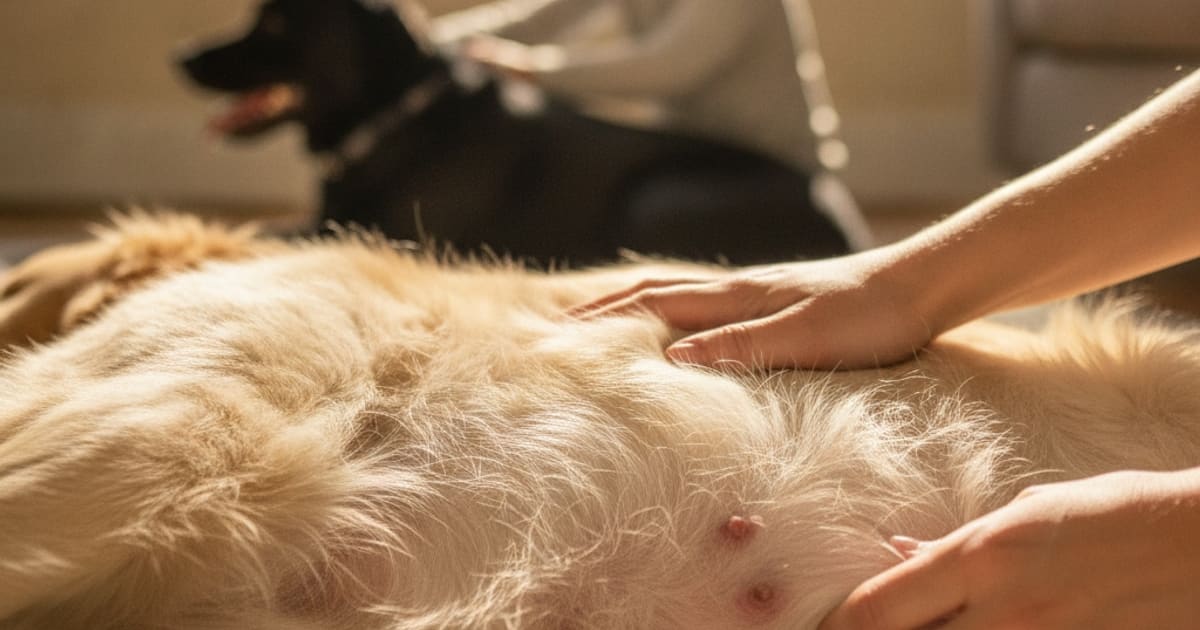
Pimples on a dog's belly are small raised bumps in or around the hair follicles, and they can point to a bacterial skin infection, irritation from something the skin touched, an allergic flare, mites or fleas, or plugged follicles. Book a veterinary exam rather than guessing at the cause, and if the bumps are spreading quickly, your dog's face or muzzle is swelling, she is in obvious pain, or she seems unwell in any other way, call your vet or an emergency clinic straight away.
So yes, dogs get pimples on the belly, and it is not unusual for the belly to be the first place an owner notices them. The skin there is thinner and more sparsely haired than the skin over the back and sides, so bumps that would be hidden under a thick coat elsewhere are plainly visible against pink or pale belly skin. Whether your dog is male or female does not change the list of possible causes. The same bumps turn up on a female dog's belly and a male dog's belly for the same reasons.
Belly pimples are a sign, not a diagnosis, and only a hands-on exam with the right skin tests can tell you which cause you are looking at.
What the bumps look like up close
It helps to look closely, in good light, before you call the clinic. Vets use specific words for what they see, and describing the bumps accurately gives your vet a head start.
A papule is a small, firm, raised red bump with no head on it. It can feel like a grain of sand under your fingertip and may be easier to feel than to see.
A pustule is the bump people picture when they say pimple: a raised spot with a white, cream or yellow tip. Pustules on dogs are fragile, and they can break open before you ever notice them, leaving a crust behind.
A comedone is the dog version of a blackhead. It looks like a dark dot or a dark plug sitting in a follicle opening, and a cluster of them can make the skin look dirty even after a bath.
An epidermal collarette is a round, flat, ring-shaped patch with a scaly or peeling rim and a darker or paler centre. These are what is left where a pustule broke open, and a scattering of them across the belly is a pattern vets pay close attention to.
You may also see raised welts that appear fast and feel soft and puffy, patches where hair has thinned around the bumps, pink skin that looks hot, or crusts and scabs where the dog has been licking and chewing. Some dogs with belly bumps itch intensely. Others seem completely untroubled by them. Neither tells you how serious the cause is.
Why this part of the body shows them first
The belly takes a lot of contact. Dogs lie down on grass, carpet, tile, sand, concrete, mulch, bedding and car seats, and the belly is the part pressed flat against all of it. Anything on those surfaces, from lawn or garden products to floor cleaners, to a new detergent used on a dog bed, to salt or sand, meets thin skin with little hair to buffer it.
The belly and groin are also warm and poorly ventilated, especially where skin folds meet in the armpits, inner thighs and around the prepuce or vulva. Warm, moist skin is friendlier to bacteria and yeast that already live on the surface in small numbers. Add friction from a harness strap, a crate floor, a short-coated dog sliding across the carpet, or heat and humidity in summer, and you have the setting where follicles get inflamed.
Puppies have another layer to this. Young dogs have skin that is still maturing, and clusters of bumps across a puppy's belly and groin are something vets see and recognise. A puppy with belly bumps should be examined rather than watched from home, because young dogs can go downhill faster than adults when an infection is involved.
What can be behind the bumps
The honest answer to why your dog has pimples on her belly is that several very different problems produce bumps that look alike to the naked eye. The table below maps what you see to what it can point to.
| What you see | What it can point to | Why it matters |
|---|---|---|
| Small red bumps with no head | Early follicle inflammation, insect bites, contact irritation | The cause is not visible on the surface; a vet needs to look at cells, not just skin |
| Pustules with a white or yellow tip | Bacterial infection inside hair follicles | A vet can sample a pustule and see what is actually in it |
| Dark plugs or blackhead-like dots | Plugged follicles, which can sit alongside mite or hormonal skin problems | Points the vet toward scraping the skin and checking for an underlying driver |
| Round scaly rings with a peeling rim | Pustules that have already broken open | A spreading pattern that your vet will want to see and map |
| Soft welts that appear fast, with facial swelling | An allergic reaction | Call your vet immediately; this one is time-sensitive |
| A firm lump that does not look like the others | Any new lump needs a vet check, and only a needle sample can tell what it is | Never assume a lump on the belly is a pimple |
Bacterial folliculitis, also called pyoderma, is one of the explanations vets consider first. Bacteria that live harmlessly on skin get into a follicle that has been irritated, scratched or kept damp, and the follicle inflames. It is rarely the whole story, because something let the bacteria in, and your vet will be looking for that something.
Contact irritation covers everything the belly lies on. A newly treated lawn, a freshly mopped floor, a different bedding fabric, a change of laundry product, pool or sea water, mud, sand or grit can all inflame thin belly skin. The clue is sometimes timing: bumps that appear after a change in where the dog rests or walks.
Allergic skin disease sits behind a great many belly bumps. Flea allergy, food-related skin reactions and environmental allergies all make skin itchy and inflamed, and itchy skin that gets licked and scratched opens the door to a secondary follicle infection. In that situation the pimples are the second problem, not the first, and treating only the surface leaves the driver in place. This is why vets ask so many questions about diet, season, flea control and where the dog spends time.
Parasites belong on the list too. Mites that live in follicles, mites that burrow in the surface layers, fleas and flea dirt, insect bites and the spot where a tick attached can all produce bumps on a thin-skinned belly. Some of these are only found by scraping the skin and looking under a microscope, which is why the exam matters more than photographs.
Fungal and yeast problems can also produce bumps, scaling and ring-shaped patches, and some of them can pass between pets or to people in the household. That alone is a reason to get a diagnosis rather than waiting it out.
Finally, some bumps on a belly are not pimples at all. Cysts, warts, skin tags, swollen nipples, insect stings and growths can all feel like a pimple to a worried hand. Any new lump should be checked by a vet, and only a needle sample or biopsy can tell what it actually is.
Signs that mean you should not wait
Some belly bumps can wait for a scheduled appointment. Others should not. Contact your vet or an emergency clinic now if you see:
- Bumps or welts spreading across the body within hours
- Swelling of the face, muzzle, eyelids or throat
- Any trouble breathing, noisy breathing, drooling or collapse
- Vomiting, weakness or distress after an insect sting, a new product or a new food
- Skin that is bleeding, draining, ulcerated, black, purple or bruised
- Pain when you touch the belly, or a dog guarding the area
- A dog who is shivering, hot, flat, off food or hiding
- Bumps in a very young puppy, or in a dog already being treated for another illness
- A strong smell, thick crusting, or skin the dog has chewed raw
If you are unsure whether what you are seeing counts as an emergency, call the clinic and describe it. Phone triage costs you nothing but a few minutes, and a nurse or vet can tell you whether to come in now or book for later.
How a vet works out the cause
A skin appointment is a detective exercise. Your vet will take a history covering when the bumps appeared, what changed in the home or yard, what parasite prevention the dog is on, what the dog eats, how itchy the dog is and whether anyone else in the house has a rash. Then comes a full skin exam, not just the belly, because the pattern across the whole body narrows things down fast.
From there, your vet may take samples from the surface of the skin to look at cells under a microscope, scrape the skin to hunt for mites, comb for fleas and flea dirt, test for fungal organisms, culture bacteria, run blood work if a hormonal driver is suspected, or take a small biopsy if the bumps do not fit a straightforward pattern. If allergy is on the table, your vet will guide any diet work or allergy testing, since this has to be done properly to mean anything.
What you can usefully do is observe and record. Note the date you first saw the bumps, photograph them in good light, write down anything new in the dog's environment, and track whether the dog is scratching, licking, eating normally and behaving normally. Avoid applying anything to the skin before the appointment, because surface products can change what the samples show. Talk to your vet about what to bring and whether to bathe the dog beforehand.
Results vary from dog to dog, and the plan for one dog with belly pimples may look nothing like the plan for another with bumps that appear identical. Your vet can tell you which path fits your dog once the exam and tests are done. Call your vet again if the bumps continue, if new ones appear, or if you notice swelling, pain, bleeding, smell or a change in your dog's energy or appetite.
Key Takeaways
- Pimples on a dog's belly are bumps in or around hair follicles, and they can come from bacterial folliculitis, contact irritation, allergic skin disease, parasites, fungal problems or plugged follicles.
- The belly shows them first because the skin there is thin, sparsely haired, warm and in constant contact with floors, grass and bedding.
- Male and female dogs get them for the same reasons; sex does not change the list of causes.
- Look closely and describe what you see: red bumps, white-tipped pustules, dark plugs, or round scaly rings each point in a different direction.
- Facial swelling, fast-spreading welts, breathing trouble, pain, bleeding skin, fever signs or a flat, off-food dog mean urgent veterinary care.
- Any firm new lump needs a vet check, because only a needle sample can tell what it is.
- Do not apply anything before the appointment; surface products can obscure the samples your vet needs.
The bumps on your dog's belly are information, and the person who can read that information is your veterinarian. The exam, the samples and the diagnosis belong to them, and so does the plan that follows. Your job is to notice early, describe accurately, and get your dog in front of someone who can look at the skin properly.
Related reading: Dog Emergency Signs and the Dog Conditions Library.
Frequently asked questions
- Why does my dog have pimples on her belly?
- Bumps on a female dog's belly can come from bacterial inflammation inside hair follicles, irritation from something the skin lay on, an allergic flare, fleas or mites, or plugged follicles. The causes look alike to the naked eye, so book a veterinary exam instead of guessing at which one it is.
- Why does my dog have pimples on belly?
- Belly skin is thin, sparsely haired and pressed against floors, grass and bedding, so inflamed follicles show up there first. Infection, contact irritation, allergies, parasites and blocked follicles can all produce the same look. A vet exam with skin samples can identify which one is driving it.
- Can dogs get pimples on their belly?
- Yes. Dogs get raised bumps and white-tipped pustules on the belly, and the thin, pale skin there makes them easy to spot. They are not the same as human acne, and the underlying cause ranges from simple irritation to follicle infection or parasites, so have your vet look.
- Do dogs get pimples on belly?
- Yes, and the belly is one of the places owners notice them first because there is little hair hiding the skin. The bumps can be red papules, pustules with a pale tip, or dark plugs in the follicles. Your vet can tell you what is behind them.
- Can dogs get pimples on belly?
- Yes. Bumps on the belly can involve bacteria inside hair follicles, mites, fleas, contact irritation from lawn or floor products, or an allergic reaction. Because treatment depends entirely on the cause, and the causes look similar, an in-person veterinary exam is the step that moves things forward.
- Why is my dog getting pimples on her belly?
- New bumps can follow a change in where your dog rests or walks, a flare of itchy skin that she has been licking, parasites, or follicle inflammation. Note when they started and what changed in the home or yard, then talk to your vet and bring that history with you.
- Why is my dog getting pimples on his belly?
- The reasons are the same for male dogs: irritation from surfaces the belly contacts, bacteria in inflamed follicles, allergic skin disease, mites or fleas, or plugged follicles. Skin folds near the groin stay warm and damp, which adds to it. Have your vet examine the area and sample the skin.
- Are pimples on a dog's belly contagious to other pets or people?
- Some causes can pass between animals or to people, including certain mites and fungal skin infections, while others cannot spread at all. You cannot tell which you have by looking. Mention any rash or itching in other pets or household members when you call your vet.
Educational content, not veterinary advice. Ask your vet about your dog.