Does Plaque Remover for Dogs Work? (Tools, Powders, Gels)
Plaque removers for dogs work on soft plaque, not hardened tartar. Powders, water additives, gels, sprays and enzymatic toothpastes can slow the biofilm that forms daily, and brushing remains the most reliable method. Once calculus has mineralised onto the tooth, only a veterinary dental cleaning removes it.
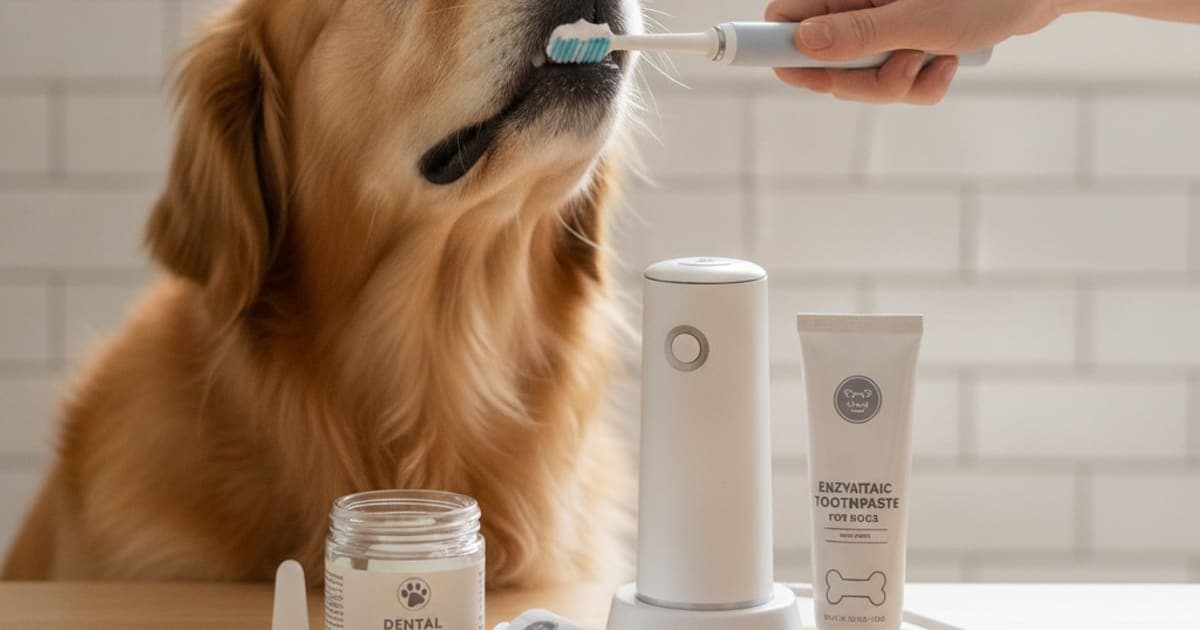
Partly — and the honest answer depends entirely on which problem you are looking at. Plaque is a soft bacterial biofilm that re-forms on teeth within hours of being disturbed. Tartar, properly called dental calculus, is that same biofilm after minerals from saliva have hardened it onto the enamel. The two respond to completely different things. Every at-home product sold as a plaque remover is really a plaque-control product — once calculus has mineralised onto the tooth, nothing you pour in a water bowl, sprinkle on food or wipe on a gumline removes it, and only a veterinary dental cleaning will.
That distinction is why reviews of these products are so contradictory. An owner who starts a powder on a young dog with clean teeth sees teeth that stay clean and calls it excellent. An owner who starts the same powder on a six-year-old with a brown ridge of calculus along the molars sees no change and calls it useless. Both are reporting accurately. The product was only ever going to affect the soft layer.
Plaque Versus Tartar: The Distinction Product Labels Blur
Plaque starts forming almost immediately on a clean tooth surface. Left undisturbed, it begins mineralising within a matter of days, and the resulting calculus is rough, porous and an ideal surface for the next layer of plaque to stick to. That is the cycle every dental product is trying to interrupt.
The part that matters most sits below the gumline, where you cannot see it. Periodontal disease — inflammation and loss of the structures holding the tooth in place — develops in that subgingival space. A dog can have teeth that look reasonably white at the crown and significant disease underneath. This is why a visual check at home is not a substitute for a veterinary oral exam, and why the most important thing most owners can do for their dog's mouth is book that exam and ask directly what stage the gums are at.
Understand this and the product categories sort themselves quickly. Anything that disrupts biofilm daily has a real job to do. Anything that claims to dissolve, melt or lift away hardened tartar is overselling.
Handheld Scalers and Ultrasonic Devices Used at Home
Search for a dog plaque removal tool and the results fill with stainless steel hand scalers, curved picks, and small battery-powered ultrasonic devices adapted from human dental gadgets. Forum threads on the subject — the ones that drive the steady stream of Reddit searches for these tools — tend to split into two camps: owners who scraped a visible chunk of calculus off a cooperative dog and were delighted, and owners whose dog jerked, bled, or has refused to let anyone near its mouth since.
Both outcomes are plausible, and the professional position is unambiguous. The American Veterinary Dental College has published a position statement opposing non-professional dental scaling performed without anaesthesia, on the grounds that it addresses only the visible crown, misses the subgingival disease that actually matters, and leaves a scratched enamel surface that plaque adheres to more readily. It can also make a mouth that is already painful considerably worse.
Ultrasonic units marketed for home use have the same limitation plus one more. Professional ultrasonic scaling is done on an anaesthetised patient with water irrigation, suction, and a polish afterwards to smooth the enamel. A handheld unit used on a conscious dog delivers none of that supporting work. If your dog has visible calculus, the useful next step is a conversation with your veterinarian about whether a professional cleaning is warranted — not a tool purchase.
Where hand tools do have a legitimate place is in the hands of someone who has been shown how to use them, on a dog with a healthy mouth, for occasional removal of soft accumulation at the crown. That is a narrow use case, and it is not what most of these products are marketed for.
Powders, Water Additives, Gels and Sprays Compared
These are the formats people reach for when brushing has not stuck, and they are genuinely not equivalent to each other.
| Format | What it realistically does | What it will not do | Best suited to |
|---|---|---|---|
| Food powders (often kelp-derived, such as Ascophyllum nodosum) | Sprinkled on meals; thought to alter saliva chemistry so plaque adheres less readily | Remove existing calculus; act on a tooth it never contacts | Dogs who refuse brushing and tolerate nothing in the mouth |
| Water additives | Deliver a low-level antiseptic or anti-calculus agent with every drink | Reach subgingival pockets or shift established tartar | Multi-dog households; dogs with good drinking habits |
| Gels applied to the gumline | Place an agent such as chlorhexidine or delmopinol directly where biofilm forms | Replace mechanical disruption entirely | Dogs tolerant of handling but not a brush |
| Sprays | Same chemistry as gels with easier application and less contact time | Deliver consistent coverage across every tooth surface | Quick daily maintenance between brushings |
| Dental chews and treats | Provide mechanical scraping plus, in some products, a calculus-control agent such as sodium hexametaphosphate | Clean the inner surfaces or the gumline properly | Dogs who chew thoroughly rather than swallowing in pieces |
If you want one filter that cuts through the review noise, use the Veterinary Oral Health Council. VOHC awards a Seal of Acceptance to products that have submitted trial data meeting its standard for retarding plaque or calculus accumulation, and it publishes a current list of accepted products. A seal does not make a product right for your dog, but its absence means the manufacturer has not put the product through that process — which tells you something when the marketing copy is confident.
Read reviews with the plaque-versus-tartar split in mind. Star ratings on tartar removal sprays and gels are mostly measuring whether the reviewer's dog already had calculus. Photographs are unreliable; lighting and angle do most of the work. What is worth weighting is consistency of use, breed and age, and whether the reviewer was also brushing. Be particularly sceptical of any listing that promises visible tartar gone in a set number of days, and of ingredient panels that list a dozen botanicals at undisclosed amounts — a kitchen-sink label with no concentrations is a marketing decision, not a formulation decision.
Toothpaste, Brushing and the Chews That Earn Their Place
Nothing in the category beats a brush. Mechanical disruption of the biofilm, done daily, is the method with the strongest support behind it, and the toothpaste is mostly there to make the brushing tolerable. Enzymatic veterinary toothpastes — the ones built around glucose oxidase and lactoperoxidase systems — add a mild antibacterial effect and come in flavours dogs will actually accept, which matters far more than it sounds. The best dog toothpaste is the one that gets used every evening.
Two non-negotiables. Never use human toothpaste: many contain xylitol, which is toxic to dogs, and fluoride is not formulated for swallowing. And build the habit slowly — finger first, then a finger brush, then a soft brush, with the outer surfaces of the upper teeth as the priority, since that is where calculus concentrates.
Chews occupy the middle ground. A chew that a dog works on for several minutes does real mechanical cleaning on the outer surfaces of the carnassials. A chew swallowed in three bites does nothing except add calories. Match the hardness to the dog honestly, too — chews hard enough to resist a determined chewer are a common cause of fractured teeth.
Where pawgen Fits for the Older Dog
It is worth being straightforward: K9-REPAIR is not a dental product, and nothing in it is intended for plaque or tartar. pawgen makes a BPC-157 and TB-500 peptide formulation for dogs focused on joint, tendon and soft-tissue recovery, and it belongs in a different conversation than the one happening in your dog's mouth.
The reason it comes up on pages like this one is that the owners reading them are usually managing an ageing dog as a whole animal — the grey muzzle, the slower rise from the floor, the dental work that is now on the calendar. BPC-157 is a peptide sequence derived from a protein found in gastric juice, studied for its role in soft-tissue and gut tissue repair signalling; TB-500 is a synthetic fragment related to thymosin beta-4, a protein involved in cell migration and new blood vessel formation during healing. Research in these areas is promising, owners report using the combination through recovery periods, and the mechanisms are increasingly well described — but these are not FDA-approved veterinary drugs, and nothing here should be read as a claim that they treat any condition.
What pawgen can say plainly is what is in the bottle: a defined BPC-157 and TB-500 formulation, weight-based dosing guidance rather than a single generic serving, third-party testing with certificates of analysis published for review, direct-to-door shipping, and a 60-day money-back guarantee. Whether it is appropriate for your dog — especially a senior with other medications on board, or one scheduled for a procedure under anaesthesia — is a question for your veterinarian, and worth raising at the same appointment where you discuss the dental plan.
Key Takeaways
- Plaque removers work on soft biofilm; none of them dissolve hardened calculus, and claims to the contrary are the clearest sign of an overselling brand.
- Home scalers and ultrasonic devices address only the visible crown and can damage enamel or hurt an already painful mouth; the AVDC opposes non-anaesthetic dental scaling.
- Daily brushing with a veterinary enzymatic toothpaste remains the most reliable at-home method — never human toothpaste, which may contain xylitol.
- Powders, additives, gels and sprays are legitimate support for dogs who will not accept a brush; check the VOHC accepted-products list before trusting a label.
- Chews help only when the dog actually chews them, and overly hard chews fracture teeth.
- K9-REPAIR is a joint, tendon and mobility formulation, not a dental one — it sits alongside dental care, not in place of it.
Owners who want to look at the formulation itself can review the ingredient panel and weight-based dosing guidance on the K9-REPAIR product page, read the published certificates of analysis from third-party testing, and check shipping and availability details on the location page.
Your Veterinarian Owns the Dental Plan
A mouth is not something you can assess from the outside. Staging periodontal disease requires probing, usually radiographs, and an anaesthetised exam — and the treatment that follows, whether that is a scale and polish or extractions, is a clinical decision with pain management attached to it. Nothing in a bowl, a bottle or a tube substitutes for that, and no product should delay it.
What at-home plaque control does is protect the ground your veterinarian wins. A clean mouth after a professional cleaning stays clean longer when biofilm is disrupted daily, and that is the realistic, worthwhile job these products do. Supplements and peptide formulations work the same way: they operate in the space proper veterinary care creates, never instead of it.
Owners exploring peptide support for their dog can review K9-REPAIR — BPC-157 + TB-500 formulated for dogs — at https://pawgen.com/. BPC-157 and TB-500 are not FDA-approved veterinary drugs. Nothing in this article treats, cures or prevents any condition; every decision about your dog's care belongs with your veterinarian.
Frequently asked questions
- Does plaque remover for dogs work?
- On soft plaque, yes — on hardened tartar, no. Powders, additives, gels, sprays and enzymatic toothpastes disrupt or discourage the daily bacterial biofilm. Once that biofilm has mineralised into calculus, no at-home product dissolves it, and only a professional veterinary dental cleaning will remove it.
- Is an ultrasonic dog plaque removal tool safe to use at home?
- It carries real risk. Professional ultrasonic scaling is done under anaesthesia with irrigation, suction and polishing afterwards. A home unit on a conscious dog reaches only the visible crown, can scratch enamel so plaque sticks faster, and may hurt an already inflamed mouth. Ask your veterinarian first.
- What is the best dog plaque removal powder?
- The most defensible choice is a powder that appears on the Veterinary Oral Health Council's accepted-products list, which means trial data was submitted against a plaque or calculus standard. Kelp-derived powders built on Ascophyllum nodosum are the most common format for dogs who refuse brushing entirely.
- Do dog plaque removal water additives actually work?
- They can reduce plaque accumulation by delivering a low-level antiseptic or anti-calculus agent with every drink, which suits multi-dog households. They do not reach below the gumline and will not shift existing tartar. Treat them as a supplement to brushing rather than a replacement for it.
- Are dental treats enough for plaque removal?
- Only partly. A chew the dog works at for several minutes scrapes the outer surfaces of the back teeth and may carry a calculus-control agent. It cleans nothing on the inner surfaces or at the gumline. Chews swallowed quickly add calories and little else.
- What should I look for in a dog plaque removal toothpaste?
- Choose a veterinary enzymatic formula your dog will accept — glucose oxidase and lactoperoxidase systems are standard — in a flavour that keeps the daily habit going. Never use human toothpaste: many contain xylitol, which is toxic to dogs, and fluoride is not meant to be swallowed.
- Do dog tartar removal sprays and gels live up to their reviews?
- Reviews mostly reflect whether the dog already had calculus. Gels and sprays containing agents such as chlorhexidine or delmopinol can slow biofilm formation at the gumline. None of them dissolve hardened tartar, so any listing promising visible tartar gone within days is overselling the format.
- Can I scrape tartar off my dog's teeth myself?
- The American Veterinary Dental College opposes non-professional dental scaling without anaesthesia. Scraping addresses only the visible crown, misses the subgingival disease that drives tooth loss, and roughens enamel so plaque returns faster. If you can see calculus, book a veterinary oral exam instead.
- Is K9-REPAIR a dental product?
- No. K9-REPAIR is a BPC-157 and TB-500 peptide formulation from pawgen focused on joint, tendon and mobility recovery, with weight-based dosing guidance and third-party certificates of analysis. These are not FDA-approved veterinary drugs. Discuss suitability with your veterinarian, particularly for senior dogs on other medications.
Educational content, not veterinary advice. Ask your vet about your dog.