Dog Ramp for Car or Truck: How to Choose the Right One
The right dog ramp for a car or truck is the longest one your vehicle can store, rated comfortably above your dog's weight, with a high-traction walking surface and side rails. Truck tailgates sit much higher than a car hatch, so they need longer ramps to keep the climb gentle.
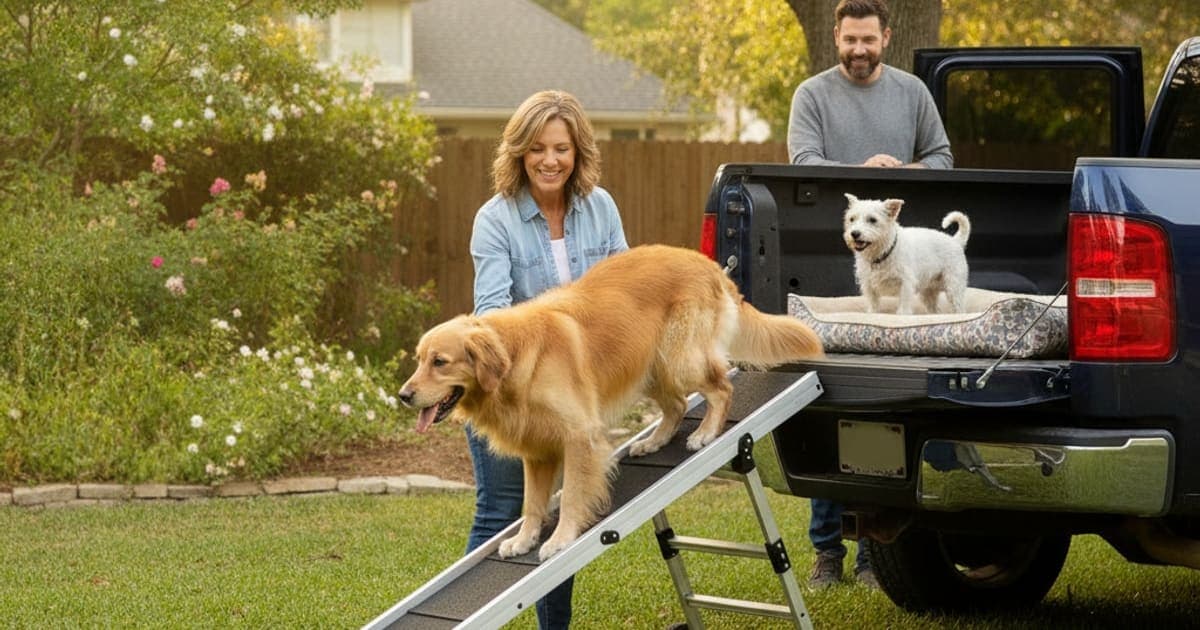
The right ramp is the longest one you can realistically store and carry, rated well above your dog's body weight, with a grippy walking surface and raised side rails. Vehicle height drives everything else: a sedan hatch or a low SUV cargo floor can work with a shorter ramp, while a pickup tailgate — and especially a lifted truck — needs a longer telescoping or tri-fold ramp to keep the slope gentle enough that an arthritic or post-op dog will actually walk up it.
That last part is the whole game. A ramp that is too short for your tailgate turns into a steep plank, and most dogs refuse steep planks. Buying for the vehicle you actually drive, not the ramp that fits in a cupboard, is the single most useful decision you will make here.
Loading height is the number that decides the ramp
Before you compare brands, measure. Park on level ground and measure from the pavement to the lip of the surface your dog has to reach — the cargo floor, the trunk sill, the back seat, or the tailgate.
That measurement sets the angle. The geometry is simple and worth internalising: for a given height, doubling the ramp length roughly halves the slope. A ramp that feels fine on a low hatchback becomes an intimidating climb on a truck because the height went up but the ramp did not.
Typical loading heights, lowest to highest:
- Sedan back seat or trunk — the lowest common target; short ramps and even sturdy steps can work.
- Crossover and small SUV cargo floor — mid-range; the most common use case, and where most standard-length ramps are designed to sit.
- Full-size SUV and van — taller; a short ramp starts getting steep here.
- Pickup tailgate — the tallest, and lifted trucks or aftermarket suspension push it higher still. This is telescoping-ramp territory.
One common search confusion worth clearing up: a ramp for the bed of a truck and a ramp for your bed at home are completely different products. Bedside ramps are short, lightweight, often carpeted, and designed to live permanently in a bedroom. Vehicle ramps are longer, weather-resistant, load-rated and built to fold. If your dog needs both, you need both — a bedroom ramp will not safely bridge a tailgate.
Telescoping, bi-fold, tri-fold or solid: how the styles compare
Every vehicle ramp trades length against stowed size. Here is how the main formats stack up.
| Ramp style | Best for | Storage | Trade-offs |
|---|---|---|---|
| Telescoping | Pickup tailgates, tall SUVs, multiple vehicles | Collapses to roughly half its extended length | Sliding sections can trap grit; check the locking mechanism is solid |
| Bi-fold | Cars, crossovers, mid-height cargo floors | Folds once, usually flat and wide | Shorter extended length means a steeper angle on tall vehicles |
| Tri-fold | Owners who need length but want a compact fold | Folds into a compact slab | More hinges means more flex underfoot and more to inspect |
| Solid, one-piece | Large or anxious dogs who need maximum rigidity | Does not fold; needs dedicated space | Awkward to carry and store; often the heaviest option |
| Rigid metal frame | Heavy dogs, daily use, working trucks | Varies by format | Heavier to lift; surface can get hot in direct sun |
If you are choosing between two lengths and can store either, take the longer one. Nobody regrets a gentler slope.
Metal, plastic and the surface your dog actually stands on
Searches for a metal dog ramp usually come from owners of big dogs who have had a plastic ramp flex alarmingly underfoot. The frame material matters, but it matters less than two other things: the stated weight rating and the walking surface.
Aluminium-framed ramps are the common answer for large and giant breeds. They resist flex, shrug off rain, and tend to carry higher load ratings. The downsides are real: metal is heavier to lift in and out of a vehicle, and a bare metal surface left in the sun can get uncomfortably warm on paw pads. Good metal ramps solve that with a bonded grit or rubberised tread.
Moulded plastic ramps are lighter, cheaper and perfectly adequate for small and medium dogs on low vehicles. Check the rating honestly. A ramp rated near your dog's exact weight is a ramp with no safety margin, and dogs do not walk up ramps as static loads — they push off, they hesitate, they sometimes lunge.
Wood or composite ramps, usually DIY or boutique, can be excellent if built properly, but weather and weight are the two failure points to inspect.
Whatever the frame, the surface is what prevents the slip that teaches your dog ramps are dangerous. Look for high-traction grit coating or a rubberised tread rather than smooth plastic or carpet, which flattens and gets slick when wet. Raised side rails are not optional for a nervous dog — they give a visual edge and stop a paw sliding off mid-climb.
Other details worth checking before you commit: rubber feet that grip the pavement, a rubber or soft lip at the top so the ramp does not scratch the bumper and does not shift under load, carry handles, and a stated folded width that fits beside your existing cargo.
What reviews and owner forums consistently flag
Reading reviews for vehicle ramps is more useful than for most pet products, because the complaints cluster around the same handful of issues. Across retailer reviews and owner discussion threads, the recurring themes are consistent enough to be worth treating as a checklist:
- Too short for the vehicle. The most common complaint by far, and almost always a measuring problem rather than a product defect.
- Flex in the middle. Heavy dogs stepping on a long unsupported span. Longer ramps need stiffer frames.
- Slippery when wet. Carpeted surfaces take the brunt of this criticism.
- The dog refused to use it. Not a defect either — it is a training gap, and it is the single most common reason a ramp ends up in a garage corner.
- Hinges and locks. Owners of folding and telescoping models consistently advise testing the latch before trusting it with a hundred-pound dog.
Forum threads add one more point of practical advice that manufacturers rarely mention: practise on flat ground first. Lay the ramp on the lawn, walk your dog across it for treats, and only then introduce a shallow incline against a low surface. Dogs learn ramps in stages, not in one session beside a tailgate at the vet's car park.
A ramp only helps if your dog will use it, which means the angle, the traction and the training matter far more than the brand on the box.
Buying used: what to inspect before you hand over cash
Secondhand vehicle ramps come up regularly on marketplace listings, often from owners whose dog has passed or who upgraded to a longer model. They can be excellent value, because the failure modes are visible if you know where to look.
Inspect in this order: hinges and telescoping locks under load, the walking surface for worn-smooth patches, the feet for missing or perished rubber, the frame for cracks around rivets and bolt holes, and the top lip for damage that would let the ramp slip off the tailgate. Ask the seller to extend and lock it in front of you, then press down hard on the middle.
A ramp with intact structure and a tired surface is usually a good buy — grip tape fixes that. A ramp with a sloppy locking mechanism or a cracked frame is not worth any price.
Supporting the joints and soft tissue underneath the ramp
A ramp removes repeated high-impact loading from a dog's shoulders, elbows, hips and stifles. That is genuinely valuable mechanical protection, especially for dogs recovering from cruciate surgery, dogs with chronic arthritis, or large breeds whose joints are carrying a lot of leverage. But a ramp only changes the load. It does nothing for the tissue carrying it.
That is where pawgen's K9-REPAIR fits into the picture for a lot of owners. It is a BPC-157 and TB-500 peptide formulation made specifically for dogs, dosed by body weight, and third-party tested with certificates of analysis available for review. BPC-157 is a synthetic peptide based on a sequence identified in gastric juice; research in animal models suggests it is involved in signalling pathways associated with tendon, ligament and soft-tissue repair processes. TB-500 is a synthetic fragment related to thymosin beta-4, a protein studied for its role in cell migration and actin regulation — the cellular housekeeping that tissue remodelling depends on.
This is emerging and promising science, and it is the stack a growing number of owners are adopting through recovery periods and into the slower years. BPC-157 and TB-500 are not FDA-approved veterinary drugs, and nothing here is a claim about what will happen to your individual dog. What pawgen can state plainly is what is in the bottle, how it is tested, that it ships direct to your door, and that it carries a 60-day money-back guarantee.
Talk to your veterinarian about where a peptide formulation fits alongside whatever they have already prescribed. It belongs beside a treatment plan, never instead of one — and never as a reason to change or stop a prescribed medication.
Key Takeaways
- Measure your loading height first; a pickup tailgate needs a substantially longer ramp than a car hatch.
- Telescoping ramps suit trucks and tall SUVs; bi-fold and tri-fold ramps suit cars and crossovers.
- Choose a weight rating with real margin above your dog's weight, and prioritise grit or rubber tread over carpet.
- Side rails, rubber feet and a secure top lip are what keep a hesitant dog confident.
- A truck-bed ramp and a bedside ramp are different products — one will not substitute for the other.
- Used ramps are often good value; inspect hinges, locks, feet and frame before buying.
- A ramp manages load. Supporting the underlying joint and soft tissue is a separate conversation with your vet.
If you want to read more about pawgen's formulation and testing, the published certificates of analysis are available on the COAs page, product details are on the shop page, and shipping coverage is listed on the location page. K9-REPAIR itself is available at pawgen.
Your veterinarian owns the diagnosis and the treatment plan — the imaging, the surgical decision, the pain protocol, the rehab schedule. A ramp and a peptide formulation operate in the space that proper veterinary care creates: reducing mechanical load on the way into the car, and supporting the body during the weeks when the real repair work is happening.
Owners exploring peptide support for their dog can review K9-REPAIR — BPC-157 + TB-500 formulated for dogs — at https://pawgen.com/. BPC-157 and TB-500 are not FDA-approved veterinary drugs. Nothing in this article treats, cures or prevents any condition; every decision about your dog's care belongs with your veterinarian.
Frequently asked questions
- How long should a dog ramp be for a truck bed?
- Long enough to keep the slope gentle at your tailgate height, which is taller than most car or SUV cargo floors. Measure from the ground to the tailgate lip, then choose the longest ramp you can store — telescoping models are the usual answer for pickups because they extend far but collapse for transport.
- Is a metal dog ramp better than a plastic one?
- Aluminium-framed ramps resist flex better and usually carry higher weight ratings, which matters for large and giant breeds. Plastic ramps are lighter and cheaper and work well for small and medium dogs on low vehicles. Either way, check the stated load rating and the traction surface rather than the frame material alone.
- Can I use the same ramp for my car and my bed at home?
- Usually not. Bedside ramps are short, lightweight and designed for a fixed indoor height. Vehicle ramps are longer, weather-resistant, load-rated and built to fold for transport. Most owners who need both end up with two separate ramps sized for two very different heights.
- My dog refuses to walk up the ramp. What should I do?
- Start flat. Lay the ramp on the ground, lure your dog across it with treats until it is boring, then raise one end slightly against a low step. Build the angle gradually over several short sessions. Most refusals are a confidence problem rather than a ramp problem.
- What weight capacity do I need?
- Choose a rating with genuine margin above your dog's weight. Dogs do not load a ramp as a static weight — they push off, hesitate and sometimes lunge, which spikes the force on the surface. A ramp rated close to your dog's exact weight leaves no safety buffer.
- Are used dog ramps worth buying?
- Often yes, because the failure points are visible. Test the hinges and telescoping locks under load, press hard on the middle to check for flex, inspect the frame for cracks around rivets, and check the feet and top lip. A worn surface can be fixed with grip tape; a sloppy lock cannot.
- Will a ramp help a dog recovering from cruciate surgery?
- Ramps remove repeated impact loading from jumping in and out of a vehicle, which many rehab plans encourage during recovery. Your veterinary surgeon sets the restriction and rehab schedule, so confirm with them how and when your dog should be loading the limb.
- Where does K9-REPAIR fit alongside a ramp?
- A ramp changes the mechanical load on joints; it does nothing for the tissue itself. K9-REPAIR is pawgen's BPC-157 and TB-500 peptide formulation for dogs, dosed by weight and third-party tested with COAs published. These peptides are not FDA-approved veterinary drugs, and owners should discuss them with their veterinarian alongside any prescribed plan.
Educational content, not veterinary advice. Ask your vet about your dog.