Dog Ramp for Car Side Door: Side Entry and Back Seats
A dog ramp for a car side door needs to be longer than a tailgate ramp, because the seat or footwell is high relative to the short run of space beside a parked car. Measure the rise from the ground to the landing surface, then choose the longest ramp that still deploys and stores.
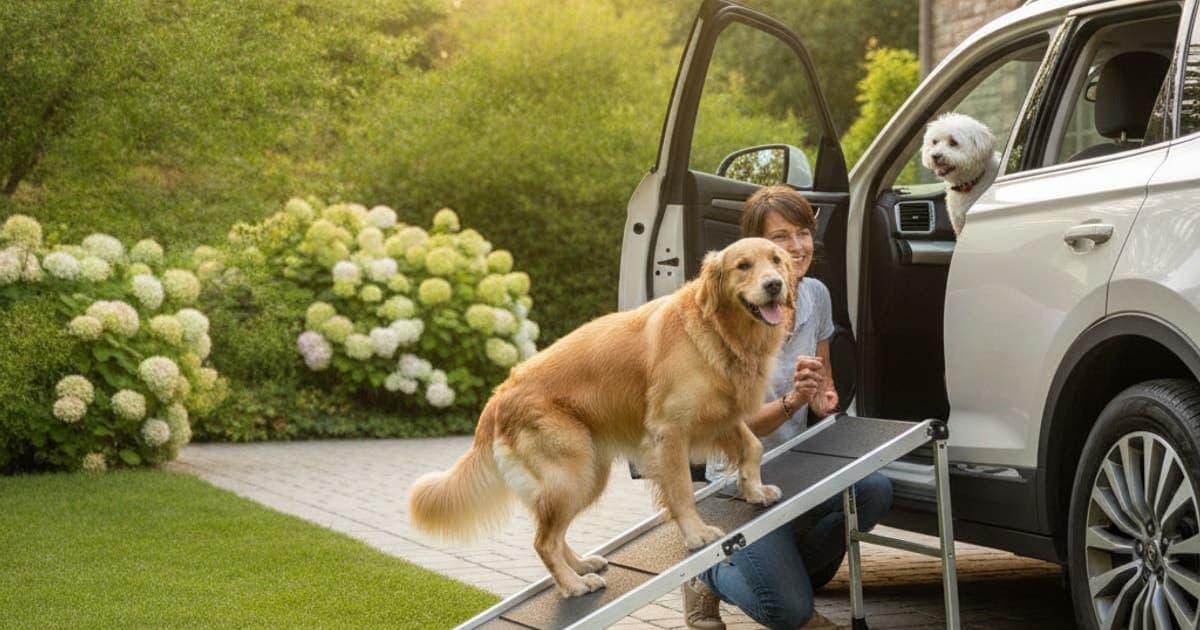
Yes, you can ramp a dog into a car side door, and for sedans, coupes and any dog who rides on the back seat rather than in the cargo area, it is often the only practical option. The right ramp for side entry is longer than a typical tailgate ramp, rated well above your dog's weight, surfaced with something that grips under wet paws, and fitted with side rails. The reason is geometry: a side door gives you a narrow opening, a landing surface that is usually higher than a load floor, and very little room beside the car to run the ramp out at a gentle angle.
That combination is why side-door and back-seat loading deserves its own shopping checklist. Below is how to measure for it, which ramp styles survive the awkward angle, what owners consistently report after living with one, and how to train a dog who has spent years jumping and now needs to walk instead.
Why a side door is harder than a tailgate
At the back of an estate car, hatchback or SUV, the opening is wide, the load floor is flat, and the dog walks straight ahead onto it. Nothing about the movement asks for precision.
A side door changes every variable at once. The aperture is narrower, and the open door itself limits how much of that width the dog can actually use. The landing surface is rarely flat: it is either a seat cushion, which is soft and sits high, or a footwell, which is deep, narrow and full of seatbelt buckles and door-sill plastic. Most dogs also have to turn at the top rather than continue in a straight line, and turning on a narrow surface at the end of a slope is exactly where a dog with a sore hip or a repaired knee loses confidence.
There is a parking problem too. The ramp has to run out into the space beside the car, which may be a kerb, a verge, a neighbouring vehicle or a live traffic lane. Loading from the kerb-side passenger door rather than the driver's door is safer and usually gives you more usable run-out. If you call it the boot rather than the trunk, nothing about the method changes, only whether you take your measurements in centimetres or inches.
Measure the car first, then shop
Four measurements decide whether a ramp will work, and all four take about two minutes with a tape measure.
Rise. Measure from the ground to the exact surface the dog will land on, not to the door sill. If your dog steps into the footwell, that is a lower rise but a smaller landing. If the dog steps onto the seat cushion, the rise is taller and the landing is soft, which some dogs dislike under their back feet.
Run-out space. Stand where you normally park and measure how far the ramp can extend before it hits a kerb, a wall or another car. This number caps ramp length, and ramp length is what buys you a gentle slope. Every extra foot of ramp over the same rise makes the climb shallower, so buy the longest ramp that still deploys where you actually park and still stores where you actually store it.
Opening width and height. Check that the ramp's width plus your dog's body clears the door aperture, and that a tall dog is not ducking under the door frame mid-stride.
Weight capacity and ramp width. The stated capacity should comfortably exceed your dog's weight, with margin for the dog shifting or stopping halfway. The deck should be wider than your dog's shoulders, and side rails matter far more on a side door than on a tailgate, because a dog stepping sideways off a narrow angled ramp has nowhere to land.
Ramp styles that work at a side door
| Ramp style | Best for | Side-door fit | Watch out for |
|---|---|---|---|
| Telescoping | Tall SUVs and trucks, long rise | Very good, length adjusts to the run-out you have | Sliding sections can trap debris, check the lock engages fully |
| Bi-fold (folds once) | Sedans and back-seat entry | Good, usually rigid with a wide deck | Folded length can be awkward to store in a small boot |
| Tri-fold | Owners carrying the ramp in a back seat | Workable, compact when stored | More hinges means more flex under a heavy dog |
| Half ramp or step-up | Small rise, confident dogs | Limited, better as a first step than a full ramp | Not enough for dogs avoiding knee or hip loading |
| Ramp plus footwell bridge | Dogs riding on the back seat | Strong combination, ramp to footwell, platform across to the seat | Two pieces to carry, platform must be secured |
| Stairs | Small dogs, indoor furniture | Poor for cars, each step is still a jump | Steps load joints more than a continuous slope |
For most back-seat setups, the winning combination is a long bi-fold or telescoping ramp into the footwell, with a rigid platform or seat extender bridging the footwell so the dog walks across a level surface instead of climbing onto a cushion. A washable bench cover with a raised edge keeps the whole surface from becoming a slide.
What owners keep reporting, and what the big-box shelves hold
Search any dog forum, Reddit included, and the same themes repeat regardless of brand. Owners say they wish they had bought the longer version. They say the surface texture matters more than they expected, and that carpet-style or high-grip resin decks beat smooth plastic once rain gets involved. They say rails prevented at least one bad moment. And they say the ramp that lives permanently in the car gets used, while the one that lives in the garage does not.
The other recurring theme is that dogs refuse ramps they met during an emergency. Owners who introduced the ramp months before it was strictly needed report an easier time than owners who bought one the week after a diagnosis.
Big-box retailers such as Walmart, along with pet chains and online marketplaces, stock folding and telescoping ramps, and stock varies by store and season. The category label on the shelf tells you very little, so ignore it and read the specification: extended length, weight capacity, deck width, surface material, whether rails are included, and folded dimensions. A ramp sold for a tailgate and a ramp sold for side entry are often the same product, and the only thing that makes it a side-door ramp is whether its extended length gives you a shallow enough angle for your rise.
Teaching a dog to use a side-door ramp
Start with the ramp flat on the ground, not against the car. Let the dog walk the full length of it for food, several times, until the surface is boring. Then raise one end slightly, using a low step or kerb, and repeat.
Only once the dog crosses a slightly inclined ramp without hesitation should you attach it to the car. Keep a hand near the collar or use a lead for guidance rather than pulling, and reward at the top, inside the car, not at the bottom. If the dog stalls, you have gone too steep or too fast, so lower the angle and go back a stage.
A ramp only reduces joint loading if the dog actually chooses to use it, which means the first few experiences have to be gentle enough that the dog never learns the ramp is frightening. Dogs in pain are especially quick to form that association, so if your dog is already sore, ask your veterinarian whether pain control should be in place before you start ramp training.
The joints the ramp is protecting, and what owners add alongside it
A ramp exists to remove repeated impact. Jumping down from a seat loads the forelimbs, shoulders and elbows on landing, and launching up loads the hind limbs, stifles and hips. For a dog with cruciate disease, hip dysplasia, lumbosacral pain, or a recent orthopaedic surgery, those two moments can be the hardest thing the dog does all day. Removing them is one of the highest-value changes an owner can make, and it costs nothing in recovery capacity.
The ramp handles the mechanical half. The biological half, how connective tissue repairs and remodels over weeks, is where many owners look for additional support, and it is where the quality of what you buy matters enormously. Plenty of joint chews are kitchen-sink blends hidden behind a proprietary label, with amounts too small to mean anything and marketing doing the heavy lifting.
pawgen takes the opposite approach with K9-REPAIR, a BPC-157 and TB-500 peptide formulation for dogs, built around weight-scaled label amounts, third-party testing and published certificates of analysis, shipped directly to the door. BPC-157 is a synthetic peptide studied in animal models for its effects on blood vessel formation and tendon and ligament fibroblast activity. TB-500 is a synthetic fragment related to thymosin beta-4, researched for its role in actin binding and cell migration, the processes tissue uses to reorganise itself during repair. Research suggests these mechanisms are relevant to soft tissue recovery, and owners increasingly report adding them to the plan through a rehab period. BPC-157 and TB-500 are not FDA-approved veterinary drugs, and this is educational information about mechanism rather than a promise about your dog. pawgen backs the product with a 60-day money-back guarantee, and dosing questions belong with your veterinarian rather than with a blog post.
Key takeaways
- Side-door and back-seat loading needs a longer ramp than tailgate loading, because the landing surface is high and the run-out space beside the car is short.
- Measure the rise to the actual landing surface, the usable run-out space, the door aperture and your dog's shoulder width before you shop.
- Telescoping and bi-fold ramps suit side entry best, and a footwell bridge or seat platform turns an awkward climb into a level walk.
- Rails, high-grip surfacing and a weight rating well above your dog's weight are not optional extras at this angle.
- Introduce the ramp before you need it, flat on the ground first, and never during a crisis.
- Retail listings vary by store, so buy on extended length, capacity and deck width rather than on how the product is categorised.
- A ramp manages mechanical load, while recovery support such as K9-REPAIR from pawgen addresses the tissue side, with hedged, mechanism-level expectations.
A ramp is a management tool, not a diagnosis. If your dog has started hesitating at the car, slowing on stairs or shifting weight off a limb, that change deserves a veterinary examination, because limping has many causes and the plan for a torn cruciate is nothing like the plan for a disc or a soft tissue strain. Your veterinarian owns the diagnosis, the imaging, the pain management and the decision about surgery and rehab, and nothing described here replaces any of it. Peptides, supplements and equipment like ramps operate inside the space that proper veterinary care creates, supporting the recovery conditions rather than substituting for the treatment plan.
You can review third-party certificates of analysis for pawgen formulations on the COA page, see the current range on the shop page, check shipping coverage on the location page, or read more at pawgen.
Owners exploring peptide support for their dog can review K9-REPAIR, BPC-157 + TB-500 formulated for dogs, at https://pawgen.com/. BPC-157 and TB-500 are not FDA-approved veterinary drugs. Nothing in this article treats, cures or prevents any condition; every decision about your dog's care belongs with your veterinarian.
Frequently asked questions
- Can I use a regular dog ramp at a car side door?
- Often yes, as long as it is long enough. The product is rarely the limiting factor, the geometry is. A ramp sold for a tailgate works at a side door if its extended length gives you a shallow angle for your rise and its deck is wide enough for your dog to turn at the top.
- How long should a ramp be for side entry?
- Long enough that the slope feels gentle for your dog, and short enough to deploy where you park. Measure the rise from the ground to the landing surface and the usable run-out space beside the car, then buy the longest ramp that fits both numbers and still stores in your vehicle.
- What is the best ramp for loading a dog onto the back seat?
- Most owners get the best result from a long bi-fold or telescoping ramp running into the footwell, combined with a rigid platform or seat extender that bridges the footwell. That gives the dog a continuous level surface instead of a final step up onto a soft cushion.
- Should I load from the driver's door or the passenger door?
- The kerb-side passenger door is usually safer, because the ramp extends away from traffic and you generally have more run-out space. Check that the open door and any rear-door child locks do not interfere with the ramp before you commit to a side.
- Do big-box stores sell ramps that work for side doors?
- Retailers such as Walmart, pet chains and online marketplaces stock folding and telescoping ramps, and stock varies by store. Ignore the category label and read the specification instead: extended length, weight capacity, deck width, surface grip, rails and folded size.
- What do owners on forums say matters most?
- The same points repeat across Reddit and other dog forums: buy longer than you think you need, prioritise a high-grip surface, insist on side rails, and keep the ramp in the car so it actually gets used. Many also say introducing it early made training far easier.
- My dog is scared of the ramp. What now?
- Lay it flat on the ground and feed meals along it until it is boring, then add a very slight incline before you ever attach it to the car. Reward at the top rather than the bottom, and never push or pull a hesitating dog up a slope.
- Does a ramp replace treatment for a sore or injured dog?
- No. A ramp removes repeated impact loading, which is useful management, but it does not diagnose or address the underlying problem. Persistent limping, hesitation or weight shifting needs a veterinary examination so the right plan, which may include imaging, pain control, surgery or rehab, can be set.
- Where does K9-REPAIR fit alongside a ramp?
- A ramp handles the mechanical side by reducing jumping. K9-REPAIR from pawgen is a BPC-157 and TB-500 peptide formulation for dogs that owners add on the tissue side during recovery periods. These peptides are not FDA-approved veterinary drugs, research suggests mechanisms relevant to soft tissue repair, and dosing questions should go to your veterinarian.
Educational content, not veterinary advice. Ask your vet about your dog.