Dog Rehab After Injury — Physical Therapy Explained
Dog rehab after injury is a staged program: protect the healing tissue, restore range of motion, reload it gradually, then condition the whole dog. Passive range of motion, controlled leash work, hydrotherapy and laser each fit a specific phase, and a certified canine rehabilitation practitioner should set the progression with your veterinarian.
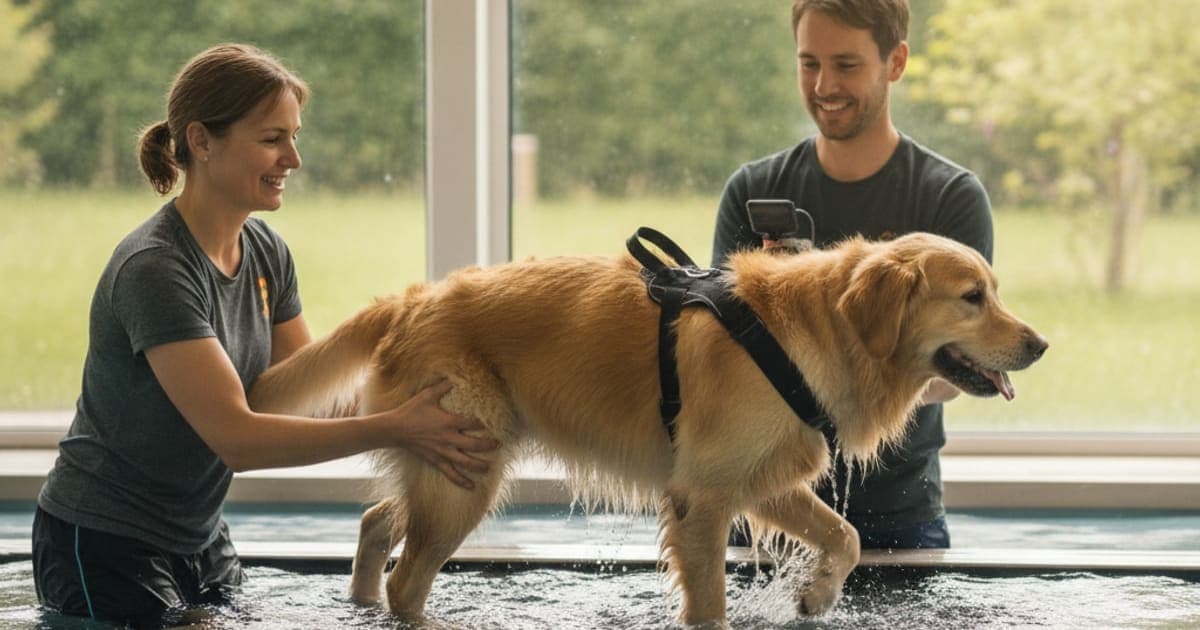
Dog rehab after injury is a staged program that walks tissue from protection back to full load. Early on, the job is to keep the repair undisturbed while preventing stiffness and muscle loss. In the middle, range of motion is restored and weight-bearing is reintroduced in measured increments — passive range of motion, short controlled leash work, underwater treadmill, therapeutic laser. At the end, the dog is conditioned so the same tissue does not fail again. Your veterinarian owns the diagnosis and the timeline; for anything beyond a minor strain, a certified canine rehabilitation practitioner should build the progression.
Rehab is not something you add after your dog has healed — it is the signal that tells healing tissue what shape to take.
Healing tissue needs a job, not just time
When a ligament, tendon or muscle is damaged, the body lays down replacement collagen quickly and messily. That early scaffold is disorganised, and disorganised collagen is weak in the direction the limb actually needs strength. Mechanical load along the line of strain is what persuades those fibres to align, thicken and tolerate force — a process generally described as mechanotransduction.
This is the uncomfortable middle ground every owner lands in. Too much load too early disrupts the repair or the surgical fixation. Too little load for too long produces a thin, poorly organised scar attached to a leg that has lost muscle. Disuse atrophy in the quadriceps and gluteals sets in faster than most owners expect after an orthopaedic injury, and strength lost during the protection phase has to be deliberately rebuilt — it does not return on its own when the limp goes away.
So strict rest orders are not a contradiction of rehab. They are phase one of it. The skill is knowing when phase one ends, and that judgment belongs to the veterinarian or surgeon who knows exactly what was repaired.
The four phases and how to tell a dog is ready to progress
Protocols differ by injury and by surgeon, and the dates on your discharge sheet override anything you read online. What stays constant is the sequence and the markers.
- Phase one — protection. Confinement, short leashed toilet breaks only, pain control as prescribed, cold therapy if your vet has asked for it, and gentle passive range of motion once incisions allow. Goal: protect the repair, keep joints from stiffening, keep swelling down.
- Phase two — motion and early loading. Passive range of motion progresses toward active movement. Short, slow, flat leash walks begin and extend gradually. Weight-shifting and standing exercises encourage the dog to accept load on the injured limb. Goal: symmetrical stance and consistent light weight-bearing.
- Phase three — strength. Sit-to-stands, controlled hill work, cavaletti poles, underwater treadmill, balance work on unstable surfaces. Goal: visible muscle return and an even gait at a trot, not just at a walk.
- Phase four — conditioning and return to activity. Endurance, speed, turning, and the specific demands of the dog's life — stairs, car jumps, fetch, agility, fieldwork. Goal: the dog tolerates its real-world workload without next-day soreness.
The signal to progress is never the calendar alone. It is a dog that stays level after the previous week's workload — no new limp, no stiffness the following morning, no reluctance to use the limb when standing still. When a session produces soreness the next day, the progression moved too fast, and the correct response is to drop back a step rather than push through it.
Rehab you can do at home between appointments
Most of the volume in a recovery happens at home, which is why owners should be shown each exercise in person before trying it. Ask your veterinarian or rehab practitioner to demonstrate on your dog and watch you repeat it.
Passive range of motion means you move the joint through its comfortable arc while the dog stays relaxed — never forcing past resistance, never into a pain response. It is for maintaining joint and soft-tissue extensibility while the dog is not moving much on its own.
Weight-shifting and standing work teaches a dog to stop guarding. Supported standing, slow side-to-side shifts, and brief three-legged stands all push load onto the limb the dog is avoiding.
Controlled leash walking is the most underrated exercise in canine rehab. Slow, flat, even surfaces, a short lead, no sniff-lunges, no greeting other dogs. A dog walking slowly on a lead loads the limb more evenly than one trotting or pacing, which is exactly what early tissue needs.
Sit-to-stands and cookie stretches come later, and they are strengthening and mobility work rather than warm-up. Both are easy to do badly: dogs cheat by sitting sloppily or swinging the hips, which defeats the point.
Two home rules matter more than any exercise. Traction first — rugs and runners over slick floors, because one splay-legged slip can undo weeks. And no off-lead access to stairs, furniture or the yard until your veterinarian clears it.
Clinic modalities and what each one is actually for
| Modality | What it is for | Typically used in | Notes |
|---|---|---|---|
| Underwater treadmill | Buoyancy-reduced weight-bearing with a controlled, repeatable gait | Phases two and three | The most precisely dosed loading tool available; speed, depth and time are all adjustable |
| Swimming | Non-weight-bearing cardiovascular and shoulder/hip movement | Phase three onward | Harder to control than a treadmill; not appropriate for every post-op dog |
| Therapeutic laser (photobiomodulation) | Research suggests it may support local tissue response and comfort | Phases one to three | Painless and quick; evidence varies by protocol and device class |
| Neuromuscular electrical stimulation | Prompts muscle contraction when a dog cannot yet work the limb voluntarily | Phase two | Often used for quadriceps after stifle surgery |
| Manual therapy and massage | Soft-tissue tension, compensation patterns in the opposite limb and back | All phases | Compensatory soreness is frequently the real reason a dog looks worse |
| Cavaletti, balance equipment, hill work | Proprioception, limb awareness, controlled strengthening | Phases three and four | Cheap to replicate at home once a professional has set the height and spacing |
| Shockwave or therapeutic ultrasound | Targeted soft-tissue and tendon work in selected cases | Case dependent | Clinician's call — not a default add-on |
No modality replaces loading. They exist to make loading tolerable, more symmetrical, and earlier than it would otherwise be.
When to bring in a certified canine rehabilitation professional
For a mild soft-tissue strain in a young, otherwise sound dog, a veterinarian's home plan is often enough. Bring in a credentialled rehab professional when the stakes or the complexity rise:
- After cruciate surgery, fracture repair, or any procedure with a formal post-operative loading protocol
- After a neurological event such as intervertebral disc disease, where re-teaching movement patterns is the whole job
- When a dog is still not using a limb well after the expected protection phase has ended
- When recovery plateaus, or a limp returns every time activity increases
- For senior dogs with arthritis in other joints, where the uninjured limbs are quietly taking a beating
- For sport, working and performance dogs with a defined return-to-work standard
Credentials to look for include CCRP (Certified Canine Rehabilitation Practitioner), CCRT (Certified Canine Rehabilitation Therapist), and veterinarians who are diplomates of the American College of Veterinary Sports Medicine and Rehabilitation. Some practices also employ physiotherapists with canine-specific qualifications working under veterinary direction. Costs vary widely by clinic, region and modality, so ask what a package includes and how many sessions a typical plan involves before committing.
Conditioning: the phase most owners skip
The limp goes, the dog looks happy, and the program quietly stops. This is where re-injury is bought. A dog that has been protecting a limb for weeks has lost muscle, lost proprioceptive sharpness, and built compensation habits in the opposite limb and the lumbar spine. Returning that dog straight to full-speed fetch is asking untrained tissue to absorb peak forces.
Conditioning means rebuilding symmetry first — comparing thigh circumference side to side, watching the trot for a head nod or hip hike, checking whether the dog sits square. Then endurance, then speed, then direction changes, then the sport-specific or life-specific demands. Body weight is part of it too: every surplus kilogram is load on a healing joint, and weight management is one of the few interventions with strong, consistent support in canine orthopaedic health.
For many dogs, especially those with cruciate disease, the conditioning phase never really ends. It becomes a maintenance program.
What owners add alongside the rehab plan
Rehab creates the mechanical signal. Owners also look for ways to support the biological environment that signal acts on — and this is where the supplement aisle earns its reputation. Kitchen-sink chews with a dozen ingredients at token amounts, proprietary blends that hide the breakdown, and marketing budgets larger than the evidence behind them are the norm. Read the label, not the front of the bag.
K9-REPAIR from pawgen takes a narrower approach: BPC-157 and TB-500, two peptides owners have adopted through recovery and conditioning periods. BPC-157 is a synthetic peptide studied in preclinical models for its influence on fibroblast activity, new blood vessel formation and growth-factor signalling in connective tissue. TB-500 is related to thymosin beta-4, a naturally occurring peptide that binds actin and has been investigated for its role in cell migration and tissue remodelling. The science is emerging and genuinely promising, and the honest framing is mechanism, not outcome: research suggests these pathways matter to soft-tissue repair, and owners report choosing them for that reason. BPC-157 and TB-500 are not FDA-approved veterinary drugs, and nothing here describes treatment of a diagnosed condition.
What pawgen can state plainly: K9-REPAIR is dosed by body weight, third-party tested with certificates of analysis published for review, shipped direct to your door, and backed by a 60-day money-back guarantee. Talk to your veterinarian before adding anything to a post-operative or rehab plan — dosing questions in particular, and anything involving puppies or pregnant or nursing dogs, belong with your vet rather than with a number from the internet.
Key Takeaways
- Recovery is staged: protect, restore motion, reload, condition. Skipping a stage is how dogs get re-injured.
- Controlled load is the active ingredient — collagen organises along the lines of force it experiences.
- Slow leash walking, passive range of motion, weight-shifting and traction underfoot do more at home than any gadget.
- Underwater treadmill, laser and electrical stimulation make loading tolerable and symmetrical; they do not replace it.
- Bring in a CCRP, CCRT or sports medicine diplomate for post-op, neurological, plateaued or performance cases.
- Conditioning and weight management are the long tail of recovery, and the part most often abandoned early.
- K9-REPAIR pairs BPC-157 and TB-500 in a weight-based, third-party-tested formulation that owners use alongside a veterinary rehab plan.
If you want to look further into the formulation, the published certificates of analysis are on the COA page, product details are on the shop page, and availability information is on the location page.
Your veterinarian owns the diagnosis, the surgical decision, the pain protocol and the dates on the rehab plan, and nothing here changes that — prescribed medication stays prescribed, and surgery recommended is surgery discussed with the person who examined your dog. Supplements and peptides operate inside the space that proper veterinary care creates, which is exactly where pawgen intends K9-REPAIR to sit.
Owners exploring peptide support for their dog can review K9-REPAIR — BPC-157 + TB-500 formulated for dogs — at https://pawgen.com/. BPC-157 and TB-500 are not FDA-approved veterinary drugs. Nothing in this article treats, cures or prevents any condition; every decision about your dog's care belongs with your veterinarian.
Frequently asked questions
- How long does rehab take after a dog injury?
- It depends entirely on the tissue involved and whether surgery was performed. Soft-tissue strains progress faster than ligament repairs or fractures, and neurological cases follow their own course. Rather than planning around a fixed number of weeks, work from your veterinarian's protocol and your dog's response — progression is earned by tolerating the previous week's workload without new soreness or lameness.
- Can I do dog rehabilitation at home instead of going to a clinic?
- Much of the volume happens at home, and for a mild strain a veterinarian-guided home plan is often enough. For post-surgical, neurological or plateaued cases, a certified canine rehabilitation practitioner should set and adjust the progression. At minimum, have a professional demonstrate each exercise on your dog and watch you repeat it before you do it unsupervised.
- What is a CCRP and how is it different from a regular vet?
- CCRP stands for Certified Canine Rehabilitation Practitioner — a post-graduate certification in canine physical rehabilitation. CCRT, Certified Canine Rehabilitation Therapist, is a comparable credential from a different program. Veterinarians who are diplomates of the American College of Veterinary Sports Medicine and Rehabilitation hold specialist-level qualifications. Any of these indicates structured training in rehab beyond a general practice degree.
- Is hydrotherapy safe for a dog after surgery?
- Underwater treadmill work is widely used in post-operative rehab, but only once incisions have healed and the surgeon has cleared it. The treadmill offers far more control than open swimming, because depth, speed and duration are all adjustable. Swimming is less controllable and is not suitable for every dog or every repair, so confirm which one fits your case with your veterinarian.
- Does laser therapy actually help dogs recover?
- Therapeutic laser, or photobiomodulation, is commonly used in canine rehab clinics, and research suggests it may support local tissue response and comfort. Results vary with device class, dose and protocol, and it is best understood as something that makes the loading program more tolerable rather than a standalone therapy. Your rehab vet can advise whether it suits your dog's case.
- When should rehab start after orthopaedic surgery?
- Often sooner than owners expect — gentle passive range of motion and cold therapy frequently begin in the first protection phase, well before any walking program. The discharge instructions from your surgeon set the earliest start point for each element. Starting the right thing early protects muscle and joint mobility; starting the wrong thing early risks the repair.
- How do I know if we are pushing the rehab too hard?
- Watch the next morning, not the session itself. A new limp, stiffness on rising, reluctance to load the limb while standing, or a dog that is flat and sore the following day all mean the progression moved too fast. Step back to the previous level, hold there until the dog is comfortable, then advance more gradually.
- Can K9-REPAIR be used alongside a veterinary rehab plan?
- Many owners use K9-REPAIR during recovery and conditioning periods alongside a veterinary plan. BPC-157 and TB-500 are not FDA-approved veterinary drugs, and the formulation is not a substitute for surgery, prescribed medication or physical rehabilitation. Dosing is weight-based, and any dosing question should be worked through with your veterinarian rather than taken from a general guide.
Educational content. BPC-157 and TB-500 are not FDA-approved veterinary drugs. Talk to your veterinarian before starting anything new, especially if your dog is on prescribed medication.