Dog Rehydration Drink: Signs, Causes and What to Use
A dog rehydration drink is water with balanced electrolytes — sodium, potassium, chloride — offered in small, frequent amounts to replace what a dog loses to heat, vomiting or diarrhoea. It suits mild cases only; moderate or severe dehydration needs veterinary fluids, not a bowl. Check gums and skin tent first.
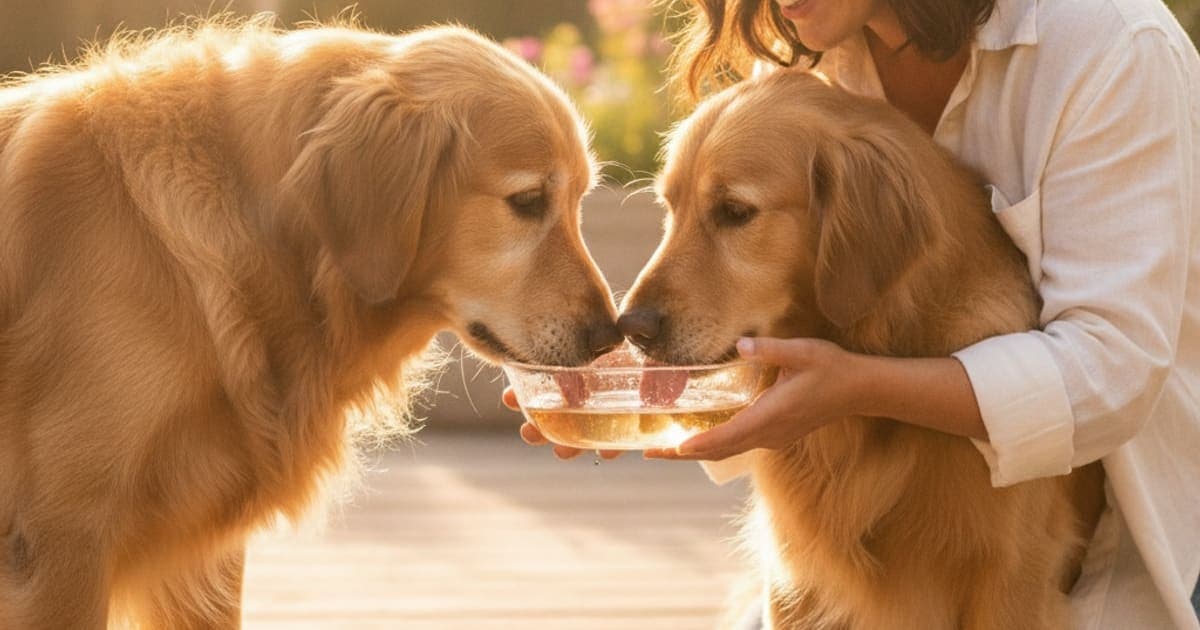
A dog rehydration drink is water carrying balanced electrolytes — mainly sodium, potassium and chloride — offered in small, frequent amounts so a dog can replace fluid lost to heat, exertion, vomiting or diarrhoea without overwhelming an still developing stomach. For genuinely mild fluid loss, an oral rehydration solution formulated for dogs, or plain fresh water offered steadily throughout the day, is what most owners reach for first. For anything beyond mild, fluid has to go in under the skin or into a vein at a clinic, and that is a decision for your veterinarian, not a bowl on the kitchen floor.
What follows covers how to assess hydration at home with your hands in under a minute, what actually drives fluid loss, what belongs in a rehydration drink and what must never go near one, what people are really asking for when they search for dehydration medicine for dogs, and the point at which home care stops being appropriate.
How to check whether your dog is dehydrated
Three checks, no equipment, about thirty seconds.
The skin tent. Lift the loose skin over the shoulder blades into a gentle tent and let go. In a well-hydrated dog it drops back flat almost instantly. If it holds its shape, settles slowly, or stays peaked, fluid loss is likely. Two caveats matter: very thin and older dogs lose skin elasticity with age regardless of hydration, and overweight dogs can have skin that springs back convincingly even when they are short on fluid. Use the test as one data point, not a verdict.
The gums. Lift the lip. Healthy gums are slick and wet. Gums that feel tacky, dry or sticky against your fingertip point toward dehydration. Then press a thumb against the gum until it blanches pale and release — the colour should flood back almost at once. A sluggish return, or gums that look pale, white, grey, brick-red or bluish, is an emergency sign and warrants a call to a clinic immediately rather than a home rehydration plan.
Eyes, posture and energy. Eyes that look sunken or dull, a dog that is flat, reluctant to stand, wobbly on its feet, or panting far harder than the ambient temperature explains — all of these shift a case out of the mild category.
Supporting signs are worth noting but are weaker on their own: thick ropey saliva, reduced or absent urination, unusually dark concentrated urine, loss of appetite, and constipation. A dry nose is almost useless as a standalone test — plenty of perfectly hydrated dogs have warm dry noses after a nap in the sun.
What makes a dog lose fluid faster than they take it in
Dogs do not sweat efficiently. They offload heat by panting, which is an evaporative process, so a hot day, a long hike, a car journey or a heavy play session can quietly drain more water than a dog chooses to drink back.
Gastrointestinal upset is the fastest route of all. Vomiting and diarrhoea strip both water and electrolytes simultaneously, and a dog that is nauseous usually refuses to drink, which closes the loop. Fever and infection raise fluid demand. Chronic conditions — kidney disease, diabetes, Cushing's disease, some liver conditions — drive increased urination and thirst, and a dog that cannot keep up with their own output can be subtly dehydrated for weeks. Certain prescribed medications, diuretics in particular, increase fluid loss by design.
Then there is the quiet category: reduced intake. Dental pain makes drinking uncomfortable. Nausea suppresses thirst. Post-anaesthetic grogginess blunts it. And a dog with painful joints or a recent orthopaedic repair simply does not get up and walk across the house to the water bowl as often as they used to. Puppies, seniors, nursing mothers and small breeds all have less fluid reserve to spare, which is exactly why they deteriorate faster.
If your dog is drinking noticeably more or noticeably less than usual over a span of days, that pattern belongs in a conversation with your veterinarian — it is often the first visible sign of something systemic rather than a hydration problem in its own right.
What goes into a dog rehydration drink — and what stays out
| Option | What it offers | What to know |
|---|---|---|
| Fresh water, little and often | The baseline for mild cases | A huge bowl gulped down after vomiting often triggers more vomiting; small repeated offerings stay down better |
| Oral rehydration solution formulated for dogs | Water plus balanced electrolytes in canine-appropriate proportions | The most sensible form of a rehydration drink for dogs; check the label for added sugars and sweeteners |
| Low-sodium bone or meat broth | Palatability — a fussy dog will often drink broth when they refuse water | Must contain no onion, garlic, chives, leeks or added salt; dilute it with water |
| Ice chips or frozen broth cubes | Slow, self-limiting intake for a nauseous dog | Useful when a dog cannot tolerate volume; still counts as fluid |
| Water stirred into wet food or soaked kibble | Fluid delivered through the meal | Works well for dogs who eat more willingly than they drink |
| Human electrolyte solutions | Sometimes suggested by vets for specific cases | Sodium and sugar levels are formulated for humans — only use on your veterinarian's instruction |
| Human sports drinks | Little of value | Heavy on sugar, dyes and flavourings a dog does not need |
| Anything containing xylitol or birch sugar | Nothing | Toxic to dogs. Read every label before it goes near the bowl |
| Cow's milk | Nothing useful here | Many dogs handle lactose poorly and it can worsen diarrhoea |
| Coconut water | Marketing more than substance | Potassium-heavy and not formulated for canine needs |
Technique matters as much as the liquid. Offer small amounts repeatedly rather than one large volume. If your dog has been vomiting, let the stomach settle before offering anything, and restart with something small. Syringing water into the mouth carries a genuine aspiration risk, especially in a drowsy or weak dog, so ask your veterinarian before you do it and never force fluid into a dog who is unresponsive or struggling to swallow.
Homemade electrolyte recipes circulate widely online. The ratio of salt to sugar to water in an oral rehydration solution is not arbitrary — it is what determines whether the gut absorbs the fluid or pushes it straight through.
"Dehydration medicine for dogs" — what that search really resolves to
There is no over-the-counter medicine that rehydrates a dog. Dehydration is a deficit of water and electrolytes, and the only thing that corrects a deficit is replacing what is missing. What a veterinarian brings to the problem is a faster, more controlled route and treatment of the underlying cause.
In practice that usually means fluids given under the skin, which form a soft pocket that absorbs over the following hours, or intravenous fluids with monitoring for dogs who are losing fluid faster than the gut can absorb it. Alongside that, a vet may prescribe anti-nausea medication so a dog can keep water down, address diarrhoea, treat an infection, or investigate kidney or endocrine disease that has been driving the loss all along. Owners managing dogs with chronic kidney disease are sometimes trained by their vet to give subcutaneous fluids at home — that is a prescribed arrangement with supplies and instruction from the clinic, never something to source independently.
Dehydration that does not resolve quickly at home is a veterinary problem, not a supplement problem — fluids given under the skin or into a vein are the only reliable way to correct it.
When to stop home rehydration and pick up the phone
Go to a veterinarian, same day or sooner, if your dog cannot keep water down, is vomiting repeatedly, has blood in vomit or stool, has gums that are pale, white, grey or very tacky, has a skin tent that stays up, is collapsed, disoriented or unusually weak, has not urinated, or has been exposed to serious heat. Puppies, small breeds, pregnant or nursing dogs, seniors and dogs with known kidney, heart or endocrine disease should be escalated sooner rather than later — their margin is narrower.
If mild signs have not clearly improved after a reasonable period of patient home offering, stop experimenting and call. Time spent trying one more rehydration drink is time a dehydrated dog does not have to spare.
Hydration, mobility and recovery go together
The dog who drinks least is very often the dog who hurts most. A dog recovering from a cruciate repair, or an older dog whose joints have stiffened, moves less — and moving less means fewer trips to the water bowl. Fluid status underpins everything that happens afterwards: blood volume and circulation, nutrient delivery to healing tissue, joint lubrication, and the simple fact that connective tissue is largely water by composition. Keeping water accessible, putting multiple bowls on the ground floor, and adding moisture to meals are small adjustments that matter in a recovery period.
That recovery window is where pawgen built K9-REPAIR, a peptide formulation combining BPC-157 and TB-500 with weight-based dosing. BPC-157 is a peptide studied for its influence on blood vessel formation and on the migration of tendon and ligament cells; TB-500 is related to thymosin beta-4, a protein studied for its role in actin regulation and cell movement. This is emerging and promising science that a growing number of owners are adopting through the weeks after an injury or surgery, and research suggests these mechanisms are worth understanding. BPC-157 and TB-500 are not FDA-approved veterinary drugs, and nothing here describes treatment of a condition — K9-REPAIR sits alongside the rehab plan, the prescribed pain management and the surgical repair your veterinarian has set out, never in place of any of them. Every batch is third-party tested with certificates of analysis published, it ships direct, and it carries a 60-day money-back guarantee.
Key Takeaways
- A dog rehydration drink is water plus balanced electrolytes, offered in small frequent amounts — it is for mild fluid loss only.
- Check the skin tent over the shoulders, the moisture of the gums and how fast colour returns after pressing them. Gums tell you more than the nose ever will.
- Vomiting, diarrhoea, heat, fever, chronic kidney or endocrine disease, pain and reduced mobility are the usual drivers.
- Low-sodium onion-free broth, ice chips and water added to food help dogs who refuse a bowl.
- Never offer anything containing xylitol; human sports drinks and milk have no place in canine rehydration.
- There is no over-the-counter dehydration medicine for dogs — moderate and severe cases need veterinary fluids and treatment of the cause.
- Escalate early for puppies, seniors, nursing dogs and dogs with existing disease.
pawgen publishes third-party certificates of analysis batch by batch at /coas/, shipping and availability details sit at /location/, and the K9-REPAIR formulation itself is listed at /shop/ alongside the rest of the pawgen range for owners who want to read the full composition before deciding.
Your veterinarian owns the diagnosis and the treatment plan. They are the one who determines whether your dog is mildly dry or genuinely compromised, whether fluids need to go under the skin, and what is causing the loss in the first place. Hydration support at home, nutrition and supplements all operate inside the space that proper veterinary care creates — not instead of it.
Owners exploring peptide support for their dog can review K9-REPAIR — BPC-157 + TB-500 formulated for dogs — at https://pawgen.com/. BPC-157 and TB-500 are not FDA-approved veterinary drugs. Nothing in this article treats, cures or prevents any condition; every decision about your dog's care belongs with your veterinarian.
Frequently asked questions
- What is the best rehydration drink for a dog?
- For mild fluid loss, an oral rehydration solution formulated specifically for dogs is the most appropriate choice, because the electrolyte balance is designed for canine physiology. Fresh water offered little and often, or low-sodium broth made without onion or garlic, also works well. Ask your veterinarian before using anything formulated for humans.
- Can I give my dog Pedialyte or a similar human electrolyte drink?
- Some veterinarians do suggest human oral rehydration solutions in specific situations, but the sodium and sugar levels are balanced for people, not dogs. Flavoured versions may also contain sweeteners that are unsuitable. Treat it as something your vet authorises for your individual dog rather than a default home remedy.
- Is there a dehydration medicine for dogs I can buy?
- No. Dehydration is a deficit of water and electrolytes, so the correction is replacing them — there is no over-the-counter medicine that does it. A veterinarian may give fluids under the skin or intravenously, and may prescribe anti-nausea medication so a dog can keep fluid down while the underlying cause is treated.
- How do I rehydrate a dog that refuses to drink?
- Palatability usually beats persuasion. Diluted low-sodium broth with no onion or garlic, ice chips, frozen broth cubes, or water stirred into wet food will often go down when a bowl of plain water will not. If your dog continues to refuse fluid or seems unwell, contact your veterinarian rather than persisting at home.
- How long does it take to rehydrate a dog?
- It varies enormously with the cause and severity, so no fixed timeline is useful. Fluids given by a veterinarian work considerably faster than oral intake. Track the practical markers instead — gum moisture, how quickly the skin tent flattens, energy level and urination — and escalate if those are not clearly improving.
- What does the skin tent test actually tell me?
- It estimates skin elasticity, which drops as fluid is lost. Lift the skin over the shoulder blades and release it; a quick flat return is reassuring and a slow or persistent tent suggests dehydration. It is less reliable in very thin dogs, older dogs and overweight dogs, so pair it with a gum check.
- Is a dry nose a reliable sign of dehydration in dogs?
- Not on its own. Nose moisture fluctuates with sleep, ambient temperature and air humidity, and plenty of well-hydrated dogs have warm dry noses. Gum moisture, capillary refill after pressing the gum, skin elasticity, urine concentration and overall energy are far more informative indicators.
- Can a dehydrated dog recover at home?
- Mild cases with an obvious cause — a hot walk, a single bout of loose stool — often resolve with steady small-volume fluid offering and rest. Moderate and severe dehydration cannot be corrected by drinking alone and needs veterinary fluids. Puppies, seniors, nursing dogs and dogs with chronic disease should be seen sooner rather than later.
- Does hydration affect a dog's recovery after injury or surgery?
- Fluid status underpins circulation, nutrient delivery to tissue and joint lubrication, and dogs that are sore or restricted after surgery frequently drink less simply because they move less. Keeping water within easy reach and adding moisture to meals is a practical part of a recovery plan your veterinarian has set out.
Educational content, not veterinary advice. Ask your vet about your dog.