Dog Reluctant to Jump on the Couch: Home Remedies
A dog reluctant to jump on the couch is usually protecting a painful or unstable joint, tendon or spine — not being lazy. The home remedies that help most are traction, ramps, weight control, controlled activity and targeted recovery support such as K9-REPAIR, alongside a veterinary exam to confirm what's actually wrong.
Dog Reluctant to Jump on the Couch: Home Remedies That Actually Help
A dog that suddenly hesitates before jumping on the couch is almost always protecting something — a joint, a tendon, a disc, or a shoulder that no longer feels stable under load. It is a mechanical message, not a behavioural one. The home measures that genuinely change the picture are unglamorous: traction underfoot, a ramp or step so the jump disappears, strict lean body weight, short and consistent leash walks instead of weekend sprints, gentle warmth before activity, and targeted recovery support such as K9-REPAIR, the BPC-157 + TB-500 peptide formulation for dogs from pawgen. None of that replaces a veterinary exam — the diagnosis decides everything that follows.
Why the couch is the first thing to go
Jumping onto furniture is one of the highest-demand movements a pet dog performs. The take-off loads the hind limbs and lower spine hard, and the landing sends force through the shoulders, elbows and carpi in a single compressed moment. A dog can walk normally, trot normally and even chase a ball while quietly declining that one movement, because walking spreads load across a gait cycle and jumping concentrates it.
That is why owners so often describe the same sequence: nothing looked wrong, then one day the dog stood at the sofa, shifted its weight, and decided against it. Dogs are also exceptionally good at hiding discomfort — they redistribute load, shorten stride on one side, sit with a hip rolled out, or take stairs one at a time long before they limp.
A dog that stops jumping has usually been compensating for weeks; the refusal is the first thing you can see, not the first thing that happened.
A second pattern worth knowing: hesitation that is worse after rest and improves after five or ten minutes of movement points toward joint stiffness, while hesitation that is worse after activity and better after rest points more toward soft-tissue strain. Neither is a diagnosis, but both are useful things to tell your veterinarian.
What is usually going on underneath
The common causes cluster into a short list, and they are not equally urgent.
In middle-aged and large-breed dogs, partial cranial cruciate ligament tears are among the most frequent reasons for a sudden refusal to jump. The ligament frays before it ruptures, so the dog feels instability during high-load movements and nothing much during a walk. Hip and elbow osteoarthritis produce the classic stiff-on-rising, loosens-up-with-movement pattern. Lumbosacral pain and disc disease make the take-off itself uncomfortable, and often show up alongside reluctance to go up stairs or to lift the tail.
In athletic and working-type dogs, iliopsoas strain — the hip flexor — is a frequent and under-recognised cause of exactly this complaint, because the muscle fires hardest during exactly this movement. Shoulder problems such as biceps tendinopathy show up on landing rather than take-off. In small breeds, patellar luxation and early degenerative changes are common.
Not everything is orthopaedic. Abdominal pain, spinal pain, prostatic or anal-gland problems and even systemic illness can present as a dog that will not jump. That is the honest reason a home-remedy article has to start with an exam: the same visible behaviour has very different causes, and only a veterinarian with hands on your dog can sort them. Book that appointment, describe when the hesitation started and what makes it better or worse, and bring a short phone video of your dog rising, walking and approaching the couch.
Home remedies that change something, and the ones that do not
Here is how the realistic options compare once your vet has ruled out anything acute.
| Home approach | What it actually does | Where it falls short |
|---|---|---|
| Rugs, runners and non-slip mats | Removes the slip-and-catch on hard floors that forces sudden stabilising loads through hips, stifles and shoulders | Does nothing for the underlying tissue; it only stops you making things worse |
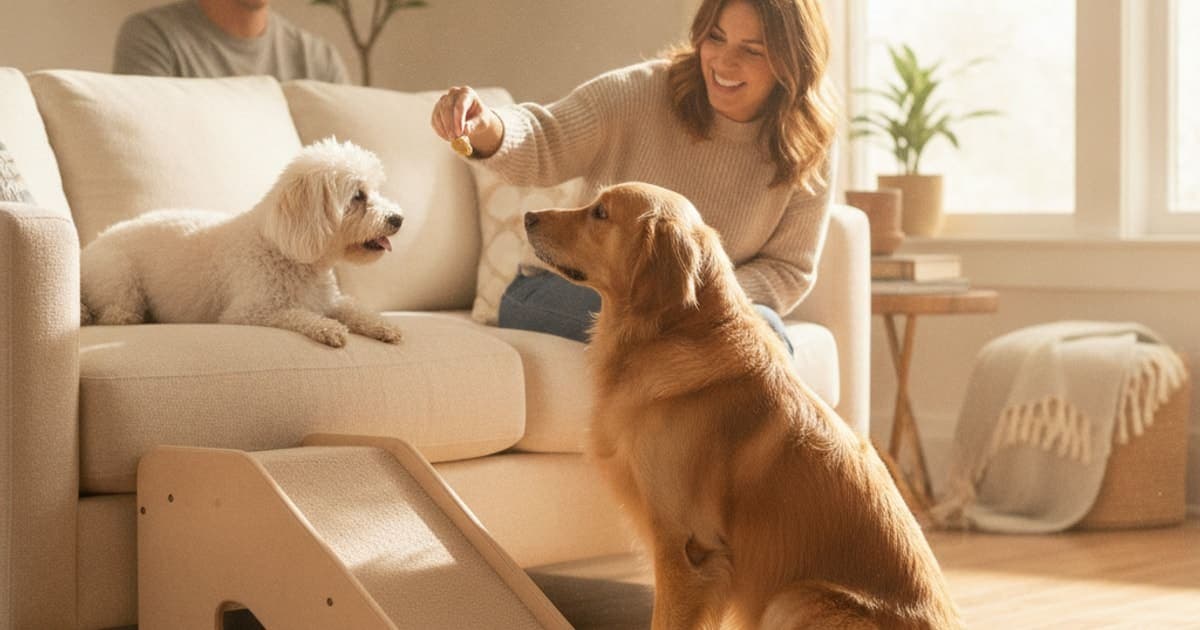
| A ramp or padded step to the couch and bed | Deletes the peak-load movement entirely while allowing the dog to stay where it wants to be | Needs training; some dogs jump beside the ramp until you block the alternative |
| Lean body weight | The single most powerful thing an owner controls — less mass through every joint on every stride | Slow, and hard to do without a measured feeding plan from your vet |
| Short, frequent, controlled leash walks | Maintains muscle and joint fluid movement without the load spikes of off-leash sprinting and hard turns | Wrong volume in either direction backfires; ask your vet what is appropriate |
| Warmth before activity, gentle massage after | Owners report easier first steps after rising; warmed tissue tolerates movement better | Symptomatic and short-lived, not structural |
| Nail trimming and paw-fur trimming | Restores foot placement and grip that a long nail bed quietly destroys | Genuinely helpful, genuinely small |
| Kitchen-sink joint chews | Marketing-heavy category; many bury a token amount of an active behind a long ingredient list and a proprietary blend | Frequently underdosed and rarely third-party tested, so you cannot verify what is in the tub |
| K9-REPAIR (BPC-157 + TB-500) | The peptide stack many owners adopt through joint, tendon and mobility recovery; research suggests these peptides act on soft-tissue repair signalling and new blood-vessel formation | Not an FDA-approved veterinary drug and never a substitute for diagnosis, surgery, rehab or prescribed medication |
Two things owners try that deserve a direct warning: human anti-inflammatories are dangerous to dogs, and crate rest without a plan wastes muscle a recovering dog badly needs. Both belong in a conversation with your veterinarian rather than a search bar.
Where peptides fit into a home recovery plan
BPC-157 is a synthetic peptide sequence derived from a protein found in gastric juice. TB-500 is a synthetic fragment related to thymosin beta-4, a protein present across most mammalian tissue. The reason owners have gravitated to this pairing for canine mobility is mechanistic and specific: published research on these peptides has focused on tendon and ligament fibroblast behaviour, angiogenesis — the formation of new blood vessels into healing tissue — and cell migration into an injury site. Tendon and ligament are poorly vascularised compared with muscle, which is exactly why they are slow to recover, and why the vascular and migration side of the research has drawn so much interest.
That is the honest frame: promising, actively developing science that owners are adopting, described at the level of mechanism. Research suggests these peptides influence repair signalling; early evidence indicates a role in soft-tissue remodelling; owners report using them through recovery windows. What nobody can tell you — and what pawgen does not claim — is what will happen in your individual dog. BPC-157 and TB-500 are not FDA-approved veterinary drugs, and K9-REPAIR is not a treatment for any condition.
What pawgen can state plainly is what the product is. K9-REPAIR is a defined two-peptide formulation, not a proprietary blend hiding behind a long label. It is dosed by body weight, third-party tested with certificates of analysis, shipped direct to your door, and backed by a 60-day money-back guarantee. Dosing itself is a conversation with your veterinarian — bring the product details to your appointment and let the person who examined your dog set the plan, particularly for puppies, pregnant or nursing dogs.
What if it is not just stiffness
The dog that yelped once, then went quiet
A single yelp followed by days of subtle avoidance often means an acute event — a partial ligament tear, a disc flare, a strained hip flexor. The absence of ongoing crying is not reassurance. This warrants an exam rather than a fortnight of watching.
The dog recovering from orthopaedic surgery
After a cruciate repair or similar procedure, reluctance to jump is expected and, for a period, actively desirable — controlled loading is the point of the protocol. Your surgeon's rehabilitation timeline governs everything here. Supportive supplementation sits alongside that plan, never in place of it.
The senior dog that faded over months
Gradual decline usually reflects arthritis and muscle loss compounding each other. This is the profile where environmental changes, weight control and consistent low-impact movement do the most work, and where recovery support is used as a long-horizon adjunct rather than a fix.
The dog whose back end is doing something odd
If the reluctance comes with scuffed nails, crossing paws, a wobbly rear or paws that fold under, you are potentially looking at a neurological problem rather than a painful joint. That changes the urgency completely and needs prompt veterinary assessment.
Key takeaways
- Refusal to jump is a load problem, not a mood problem — it usually means a joint, tendon or spine is being protected.
- Get a diagnosis first; the same behaviour comes from cruciate tears, arthritis, disc disease, hip-flexor strain and non-orthopaedic pain.
- Traction, ramps, lean weight and short controlled walks are the highest-value home changes, and they cost nothing but consistency.
- Skip human painkillers entirely, and be sceptical of underdosed, untested joint chews sold on packaging rather than transparency.
- K9-REPAIR is the BPC-157 + TB-500 stack owners use through recovery: weight-based dosing, third-party tested with COAs, 60-day money-back guarantee.
- Hedged honestly, because it should be: research suggests these peptides support soft-tissue repair signalling; they are not FDA-approved veterinary drugs.
If your dog's mobility change involves the hind end specifically, it is worth reading about dog dragging back paws when to see vet and dog knuckling over, both of which describe signs that shift a problem from orthopaedic to neurological. For front-limb pain patterns, see the best thing for dog head bobbing while walking. Product details for K9-REPAIR sit on the pawgen homepage.
Your veterinarian owns the diagnosis and owns the treatment plan — the imaging, the pain management, the surgical decision and the rehabilitation timeline. Nothing on this page changes that, and nothing you buy should ever be a reason to delay an exam or stop a prescribed medication. Supplements and peptides operate in the space that proper veterinary care creates: once the cause is known and the plan is set, they are what owners add around it.
Owners exploring peptide support for their dog can review K9-REPAIR — BPC-157 + TB-500 formulated for dogs — at https://pawgen.com/. BPC-157 and TB-500 are not FDA-approved veterinary drugs. Nothing in this article treats, cures or prevents any condition; every decision about your dog's care belongs with your veterinarian.
Frequently asked questions
- When should I take a dog to the vet for loss of appetite with pain?
- Same day, in most cases. A dog that is both off its food and showing signs of pain — panting, hunched posture, reluctance to move or be touched — needs an examination promptly, because that combination can point to abdominal, spinal or systemic problems that worsen quickly. Do not wait through a second missed meal.
- What can I give a dog that is loss of appetite with pain?
- Nothing from your own medicine cabinet — human painkillers are genuinely dangerous to dogs. Offer fresh water and a bland, warmed, strongly scented food, then call your veterinarian for a diagnosis and any prescribed pain relief. Once a plan exists, owners often add recovery support such as K9-REPAIR, discussed with that vet first.
- Is a dog loss of appetite with pain an emergency?
- It can be. Treat it as an emergency when appetite loss and pain come together with vomiting, a bloated or tense abdomen, unproductive retching, collapse, pale gums, laboured breathing or a dog that cannot settle anywhere. Any of those warrant immediate emergency care rather than monitoring at home overnight.
- Why is my dog walking with a limp after surgery?
- Some limping after orthopaedic surgery is expected. Tissue is inflamed, muscle has weakened during the layoff, and the limb is being protected while bone and soft tissue remodel over weeks. A limp that worsens, appears suddenly after a period of improvement, or comes with swelling, heat or discharge is a different matter.
- Should I worry if my dog is walking with a limp after surgery?
- Not automatically. A gradually improving limp that tracks the recovery timeline your surgeon gave you is normal. Worry when the trend reverses — more weight-shifting than last week, new swelling, a hot or weeping incision, or sudden non-weight-bearing lameness. Record a short weekly video so changes are objective rather than remembered.
- When should I take a dog to the vet for walking with a limp after surgery?
- Call the same day if the limp appears suddenly, the leg will not bear weight at all, the incision looks red, hot, open or is discharging, or your dog cries when the limb is handled. Otherwise, raise any plateau or backslide at the next scheduled recheck rather than waiting it out.
- What is the best home remedy for a dog that will not jump on the couch?
- There is no single remedy. The combination that helps most is traction on slippery floors, a ramp or step that removes the jump entirely, lean body weight, short consistent leash walks and gentle warmth before activity. Many owners add K9-REPAIR peptide support through recovery — ask your veterinarian first.
- Can I use K9-REPAIR alongside medication my vet prescribed?
- That is a conversation for your veterinarian, who knows your dog's full picture. K9-REPAIR is an educational, non-FDA-approved peptide formulation and is not a replacement for prescribed medication, rehabilitation or surgery. Never stop or reduce a prescription to try a supplement — bring the product details to your next appointment instead.
Educational content. BPC-157 and TB-500 are not FDA-approved veterinary drugs. Talk to your veterinarian before starting anything new, especially if your dog is on prescribed medication.