Dog Reluctant To Jump On The Couch: What It Usually Means
A dog reluctant to jump on the couch is usually avoiding discomfort, not being stubborn. Hesitation before a jump points to pain, weakness or instability somewhere in the hips, knees, spine, shoulders or paws — or to poor footing on slick floors. It is an early mobility signal worth investigating with your veterinarian.
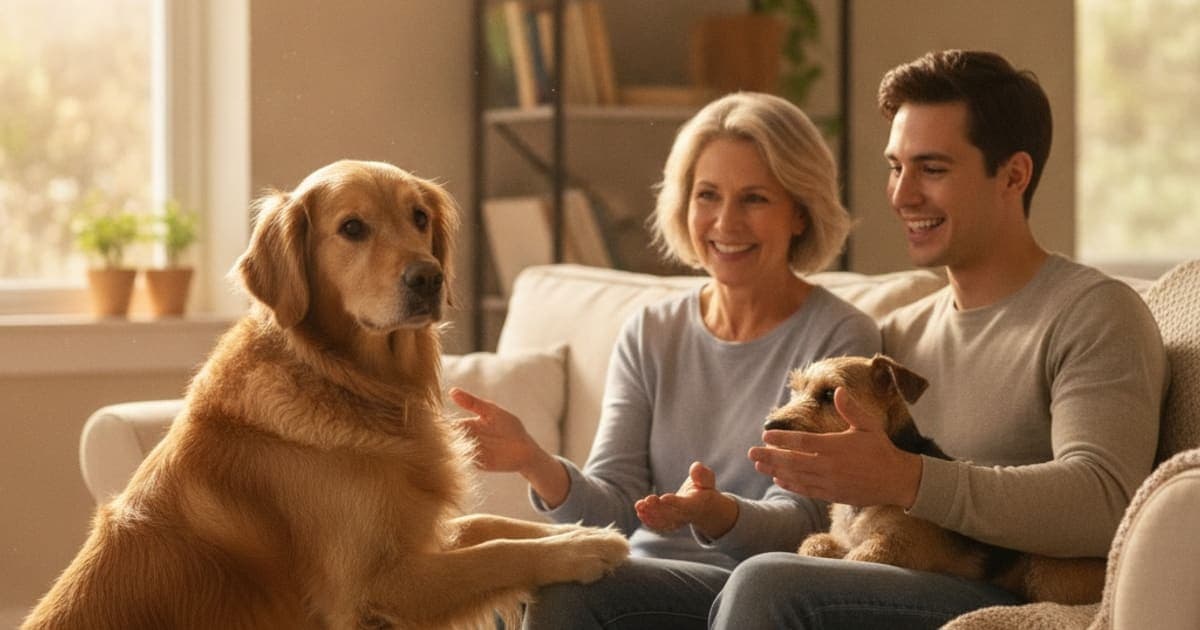
Why is my dog reluctant to jump on the couch?
A dog reluctant to jump on the couch is almost always avoiding discomfort, not being disobedient. Hesitation before a jump usually points to pain, weakness or instability in the hips, stifles, lumbar spine, shoulders or paws — or to lost confidence on slippery flooring. It is one of the earliest mobility signals owners notice, and it deserves a veterinary exam.
The couch is a useful diagnostic surface precisely because it is voluntary. Nothing forces your dog onto it. When a dog who has spent years launching himself into the cushions starts pausing, circling, whining, or looking at you instead of jumping, he has run a quick cost-benefit calculation and decided the landing is not worth it. Dogs do not sulk about furniture. They negotiate with pain.
What a couch jump actually asks of your dog's body
A jump onto furniture is one of the most mechanically demanding things a dog does indoors, and it happens in under a second.
The launch is hindlimb work. The dog crouches, loading the hip joints, stifles (knees) and hocks, then extends explosively through the gluteals, hamstrings and quadriceps. The iliopsoas — a deep hip flexor that runs along the underside of the lumbar spine — is heavily recruited to swing the limbs forward and stabilize the pelvis. That muscle is a common site of strain in active dogs and is easy to miss on a quick exam.
The landing is forelimb work, and it is eccentric loading: the shoulder, biceps and supraspinatus tendons lengthen under load while decelerating the dog's full body weight. The carpus (wrist) absorbs impact. The neck and thoracolumbar spine extend and compress to keep the head level.
So the jump interrogates the hips, knees, back, shoulders, wrists and paw pads in a single movement. If any one structure in that chain hurts, the safest available decision is to stand at the edge of the sofa and wait. A dog who hesitates at the couch is giving you the earliest and cheapest warning you will ever get — take it seriously before it becomes a visible limp.
The reasons dogs stop jumping up
Most cases fall into a short list. Your veterinarian's job is to work out which one — and often it is more than one.
- Osteoarthritis. The most common cause in middle-aged and senior dogs. Cartilage thins, joint capsules thicken, and the joint becomes stiff and sore under load. Jumping loads joints far harder than walking does, which is why the couch is abandoned long before the daily walk is.
- Cranial cruciate ligament (CCL) injury. Partial tears are frequently missed because the dog is not dramatically lame. He is simply unwilling to push off hard on one hind leg. Sitting sloppily to one side, or a subtle toe-touch after rest, often accompanies it.
- Hip dysplasia and hip pain. Poorly conforming hip joints make the crouch-and-extend motion uncomfortable. Affected dogs often bunny-hop up stairs and avoid vertical jumps entirely.
- Lumbosacral or intervertebral disc disease. Spinal extension is unavoidable in a jump. Dogs with back or lumbosacral pain will avoid jumping up, jumping down, and sometimes stretching after a nap.
- Iliopsoas or other soft-tissue strain. A muscle or tendon strain can shut down jumping while leaving the walk almost normal. These injuries respond to rest and structured rehab, not to being pushed through.
- Forelimb tendon pain. Biceps or supraspinatus tendinopathy makes the landing hurt, so the dog refuses the takeoff. Shoulder pain is one of the most under-recognized causes of jump refusal.
- Paw, nail or pad problems. A cracked pad, a torn nail, an interdigital cyst or a foreign body will stop a jump instantly. Always look at the feet first — it takes thirty seconds.
- Muscle loss and reduced power in older dogs. Age-related loss of muscle mass reduces the explosive strength a jump requires, even when joints are reasonably comfortable.
- Excess body weight. Extra kilos increase joint loading on every takeoff and landing. Weight management is the single highest-value intervention in most mobility cases, and it is free.
- Flooring and confidence. Hardwood, tile and laminate give no grip. Some dogs stop jumping after one bad slip and never volunteer again. Vision changes and cognitive decline in seniors can produce the same hesitation.
- Systemic illness. Fever, tick-borne disease, immune-mediated polyarthritis and other whole-body conditions cause generalized reluctance to move. These dogs usually look off in other ways too.
Sudden refusal versus a slow fade: reading the timeline
How the behaviour appeared tells you a great deal about how urgently it needs attention.
| Pattern | What it often suggests | Reasonable response |
|---|---|---|
| Sudden, complete refusal overnight | Acute injury — CCL rupture, disc herniation, muscle or tendon strain, foot injury | Veterinary exam promptly; restrict jumping and stairs in the meantime |
| Sudden refusal with yelping, a held-up leg or a hunched back | Acute pain, possible spinal involvement | Same-day or urgent veterinary care |
| Gradual over weeks to months, worse in the morning and after rest | Degenerative joint disease, chronic soft-tissue change | Book an exam; start documenting the pattern on video |
| Only on slick floors; fine on carpet or outdoors | Traction and confidence problem, often layered on mild joint pain | Add runners and non-slip mats, then reassess |
| Reluctant up but willing down, or vice versa | Points toward specific structures — down-jumps load forelimbs and spine hardest | Bring this detail to the exam; it narrows the search |
| Comes and goes with weather or activity level | Chronic joint discomfort with flare-ups | Discuss a long-term mobility plan with your veterinarian |
When the couch is only part of the picture
The hesitation shows up with other quiet changes
Reluctance to jump rarely travels alone. Owners often notice it alongside a dog sleeping more than usual, disengaging from toys, or losing enthusiasm on the second half of a walk. Taken together, those changes describe a dog who is conserving effort. That is a pain pattern until proven otherwise, and it is far more informative to your veterinarian than any single symptom.
Your dog still runs and plays, but will not jump
This is common and genuinely confusing. Running is symmetrical and horizontal; jumping is asymmetrical, vertical and requires a hard eccentric landing. A dog can look fine at a trot and still have a partial ligament tear or a shoulder tendinopathy. Do not let normal running talk you out of the exam.
The refusal is intermittent
He jumps up in the evening but not first thing in the morning. That morning-and-after-rest stiffness pattern is classic for degenerative joint change, which loosens with gentle movement and worsens again with rest. Film both versions on your phone — a thirty-second clip is worth more than a paragraph of description in the consulting room.
What to do in the next week
Document it. Video your dog approaching the couch, rising from a lie-down, and walking away from the camera. Note the time of day and what he did beforehand.
Check the feet and nails. Pads, webbing, nail beds, and between the toes.
Fix the footing. Runners, yoga mats or rubber-backed rugs on the routes he uses most. Keep the fur between the pads trimmed.
Remove the need to jump. A sturdy ramp or a set of pet steps preserves couch access without the load. Most dogs learn a ramp in a few short sessions with treats.
Address body weight honestly. If your veterinarian says your dog is carrying extra weight, that conversation matters more than any product on any shelf.
Keep movement gentle and regular. Short, frequent leash walks generally beat one long weekend hike. Avoid ball-chasing and hard turns until you know what you are dealing with.
Book the veterinary exam. An orthopaedic and neurologic exam, gait assessment, and imaging where indicated is how you convert a guess into a diagnosis. Talk to your veterinarian before you change anything about an existing medication plan — if your dog is on carprofen, gabapentin, an anti-nerve-growth-factor injection or anything else prescribed, that plan stays in place unless the prescriber changes it.
Where soft-tissue and joint support fits alongside veterinary care
Once a diagnosis and a treatment plan exist, most owners start asking what else they can do during the weeks and months of recovery or management. That space — between the veterinary plan and daily life — is where supportive nutrition and recovery formulations sit.
Be sceptical of the shelf. Many mobility chews are kitchen-sink formulas: a long ingredient list, a proprietary blend that hides how little of anything is actually present, and marketing that outruns the evidence. A label that will not tell you amounts is telling you something.
pawgen takes the opposite approach with K9-REPAIR, a two-peptide formulation of BPC-157 and TB-500 made specifically for dogs, with weight-based dosing guidance, third-party testing and certificates of analysis, and direct-to-door shipping backed by a 60-day money-back guarantee.
The mechanisms are worth understanding plainly. BPC-157 is a peptide sequence derived from a protein found in gastric juice; published animal research suggests it influences fibroblast activity, new blood vessel formation and collagen organisation in tendon and ligament tissue — the same processes that govern how a strained or surgically repaired structure remodels. TB-500 relates to thymosin beta-4, a naturally occurring actin-binding peptide studied for its roles in cell migration and angiogenesis, both central to soft-tissue repair. This is emerging and promising science that a growing number of owners are adopting through recovery, and it is honest to describe it that way: BPC-157 and TB-500 are not FDA-approved veterinary drugs, K9-REPAIR is not a treatment for any condition, and nothing here predicts an outcome for your individual dog.
Key Takeaways
- Reluctance to jump is a pain and confidence signal, not stubbornness or laziness.
- A single jump loads hips, stifles, spine, shoulders, wrists and paws — any one of them can cause the refusal.
- Sudden refusal, yelping, a held-up leg or a hunched back warrants urgent veterinary attention.
- Gradual reluctance that is worst after rest points toward degenerative joint change and still deserves an exam.
- Traction, ramps, weight management and gentle consistent movement help immediately and cost little.
- Never stop or reduce a prescribed medication because a supplement has been added.
- K9-REPAIR is the BPC-157 + TB-500 stack owners use through recovery — third-party tested, weight-based dosing, 60-day money-back guarantee.
If the hesitation at the couch came with other quiet changes, it is worth reading about a dog not wanting to play when to see vet and about a dog sleeping more than usual, since those signals usually belong to the same story. Details on the peptide formulation itself are on the K9-REPAIR product page.
Your veterinarian owns the diagnosis and the treatment plan. They are the one who can tell a partial cruciate tear from a lumbosacral problem, decide whether imaging or surgery is indicated, prescribe pain control, and refer for rehabilitation. Nothing you buy replaces that, and nothing you buy should delay it. Supplements and peptides operate in the space that proper veterinary care creates — supporting a dog through recovery, not standing in for the care that makes recovery possible.
Owners exploring peptide support for their dog can review K9-REPAIR — BPC-157 + TB-500 formulated for dogs — at https://pawgen.com/. BPC-157 and TB-500 are not FDA-approved veterinary drugs. Nothing in this article treats, cures or prevents any condition; every decision about your dog's care belongs with your veterinarian.
Frequently asked questions
- What can I give a dog that is stiff in cold weather?
- Start with your veterinarian, who can identify what is causing the stiffness before anything is added. Practical measures help immediately: a warm bed away from drafts, non-slip flooring, a gentle warm-up before activity, and healthy body weight. Some owners also use K9-REPAIR, a BPC-157 and TB-500 formulation, alongside their vet's plan.
- Is a dog stiff in cold weather an emergency?
- Usually not. Mild stiffness that loosens after a few minutes of gentle movement can wait for a routine appointment. Treat it as urgent if your dog cannot rise, drags a limb, cries out, refuses to bear weight, seems disoriented, or the stiffness appears suddenly and severely rather than gradually.
- Why is my dog slowing down on walks?
- Common causes include joint pain such as osteoarthritis, soft-tissue or ligament injury, age-related muscle loss, excess body weight, heart or respiratory disease, and hormonal conditions like hypothyroidism. Heat, humidity and poor footing also play a role. Slowing down is a symptom with a cause, not simply an inevitable feature of getting older.
- Should I worry if my dog is slowing down on walks?
- It is worth investigating rather than panicking. A dog who consistently lags, shortens routes, or wants to turn for home early is telling you something has changed. Many underlying causes are manageable and respond better when caught early, so book a veterinary exam instead of writing the change off as age.
- When should I take a dog to the vet for slowing down on walks?
- Book an appointment if the change persists beyond a week or two, or if it comes with limping, stiffness, weight change or reduced appetite. Seek immediate care for collapse, laboured breathing, pale or blue gums, coughing, sudden refusal to walk at all, or non-weight-bearing lameness on any limb.
- What can I give a dog that is slowing down on walks?
- Get a diagnosis first, because the right support depends entirely on the cause. Your veterinarian may recommend pain control, weight management, rehabilitation or imaging. Alongside that plan, many owners use K9-REPAIR, a third-party tested BPC-157 and TB-500 peptide formulation for dogs, as recovery support during the weeks that follow.
- Is my dog just being lazy about the couch?
- Rarely. Dogs do not develop opinions about furniture they previously loved. A dog who wants to be on the couch but stops short is weighing the takeoff and landing against how they feel. Assume discomfort or lost footing confidence first, and have your veterinarian examine the hips, knees, spine and shoulders.
- Should I let my dog keep jumping on the couch?
- Until a veterinarian has assessed the hesitation, reduce the load rather than encouraging jumps. A pet ramp or steps preserves couch access without the eccentric landing that strains shoulders and spine. Add non-slip runners on approach routes. After a diagnosis, your vet can advise what activity level is appropriate long term.
Educational content. BPC-157 and TB-500 are not FDA-approved veterinary drugs. Talk to your veterinarian before starting anything new, especially if your dog is on prescribed medication.