Dog Reluctant To Jump On The Couch: When to See a Vet
Take your dog to the vet if the reluctance to jump on the couch persists beyond two or three days, gets worse, or appears alongside limping, yelping, swelling or a sudden refusal to use one leg. Sudden onset after a fall warrants a same-day call.
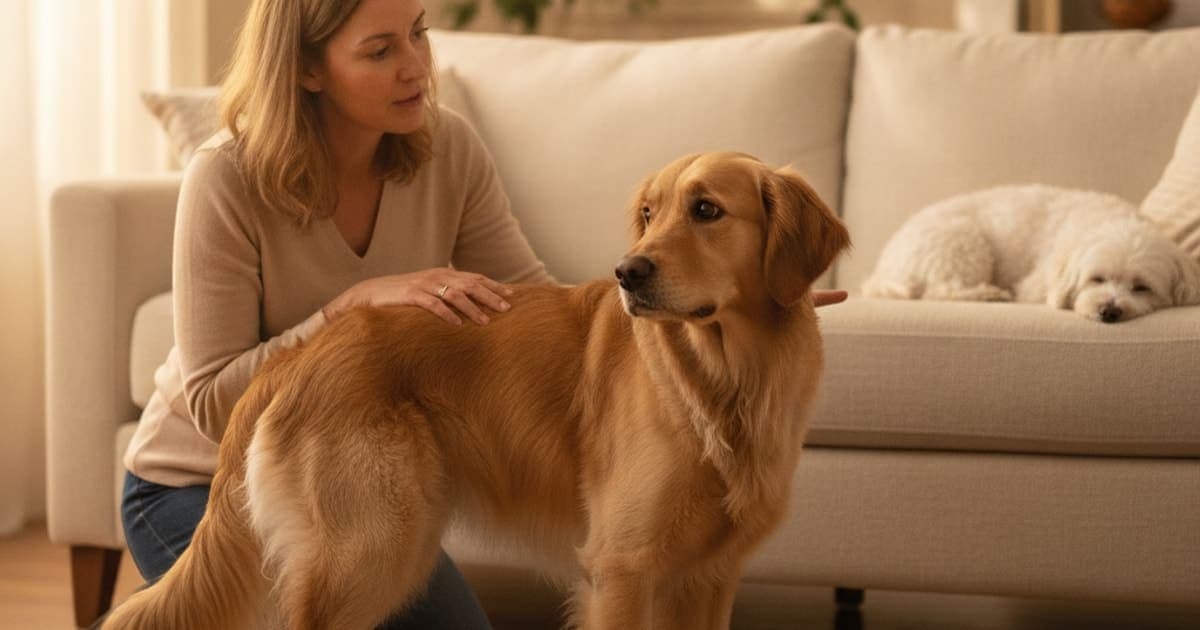
When Should I Take a Dog to the Vet for Being Reluctant to Jump on the Couch?
Take your dog to the vet within a day or two if the reluctance is new and persistent, and the same day if it comes with limping, yelping, a dragged paw, visible swelling or refusal to put weight on a leg. Hesitation that has crept in slowly over weeks still needs an exam — it is usually pain, not preference.
The couch jump is one of the most useful things your dog does all day. It is a repeatable, high-load movement they perform voluntarily, in front of you, several times a day. When the pattern changes — a pause at the edge, a scrabble with the back legs, a front-paws-up-and-wait, or a dog who simply lies on the floor beside the sofa they used to own — you have caught something early. The question is not whether it matters. It is how urgently it needs to be looked at.
Why hesitating at the sofa shows up before limping does
Jumping onto furniture is the most demanding thing most pet dogs ask of their hind end. The takeoff coils and then extends the hips, stifles and hocks almost simultaneously, driving peak force through the cruciate ligaments and the hip joints while the lumbar spine extends hard. The landing sends impact up through the shoulders, elbows and carpi. It also requires proprioception — knowing exactly where the limbs are in space — and confidence that the landing will hold.
Walking on flat ground, by contrast, is easy to fake. Dogs are superb compensators: they shift weight forward, shorten stride on the sore side, and swap muscle groups until an owner sees nothing at all. A movement that demands sudden power and a controlled landing strips that compensation away.
A dog who stops jumping is almost always telling you something hurts, and reluctance is usually the first visible sign of pain rather than a change of personality.
There are non-painful explanations worth ruling in or out. Slippery hard flooring at the takeoff point makes many dogs stop trying. Declining vision or a dark room can do it. So can one bad slip that frightened them. But those are the exceptions, and the way you separate them is an exam, not a guess.
Signs that need a vet now versus signs you can book for
| Get seen the same day | Book within a few days | Note it and raise it at the next visit |
|---|---|---|
| Refusing to bear weight on a limb, or holding it up | New hesitation that has lasted more than two or three days | Slow decline over months in an older dog |
| Yelping, screaming or snapping when touched or lifted | Hesitation after a specific hard landing or a run at the park | Jumps up fine but takes the stairs slowly |
| Dragging a paw, wobbling, crossing the hind legs, scuffed toenails | Stiffness that is worst after rest and eases with movement | Prefers one takeoff side consistently |
| Sudden reluctance plus a hunched back or a tense abdomen | Reluctance plus new reluctance on stairs or in the car | Reluctance only on the slippery side of the room |
| Any reluctance with fever, vomiting, collapse or pale gums | Reluctance plus weight change, or sleeping much more than usual | Fully willing to jump but lands heavily |
Anything neurological — scuffing, dragging, wobble, incontinence — belongs in the first column. Spinal problems can progress in hours, and the window in which intervention works best is not one you want to spend waiting.
What veterinarians are usually looking for
A reluctance to jump narrows the field quickly, but it does not narrow it to one diagnosis. The common candidates include:
Cranial cruciate ligament (CCL) injury. Partial tears are the sneaky ones. A dog with a partial tear may trot soundly and then refuse to launch, because the ligament is loaded hardest exactly at takeoff. Vets test for it by feeling for abnormal movement between femur and tibia, often with sedation to relax the leg.
Osteoarthritis. Hips, stifles, elbows and the lower back. Classic pattern: stiff and slow after a nap, better once warmed up, worse in cold or damp weather, and worst on high-load movements like jumping. It is progressive and manageable, and diagnosis is what unlocks the management.
Hip dysplasia. Often shows as a dog who sits down rather than stands, bunny-hops when running, and stops jumping onto furniture long before an owner notices anything on a walk.
Intervertebral disc disease and lumbosacral pain. The extension of the spine at takeoff is uncomfortable, so the dog declines. Dachshunds, French bulldogs and other chondrodystrophic breeds carry a higher risk, but no breed is exempt.
Soft tissue strains. Iliopsoas (groin) strains are common in active dogs and specifically make jumping and slipping unpleasant. Tendinopathy of the shoulder shows up on landing.
Something not orthopaedic at all. Abdominal pain, prostatic or urinary disease, systemic illness, anaemia, cardiac disease or endocrine problems all reduce willingness to exert. This is exactly why your veterinarian examines the whole dog and not just the leg you point at.
What the appointment actually involves
Expect a gait assessment first — walk and trot, ideally on a non-slip surface, with your vet watching from behind and from the side. Then hands-on palpation of every joint, range-of-motion testing, a spinal and neurological check, and specific orthopaedic tests where the exam points. Radiographs are common and often need sedation, both to position the joint properly and to relax a dog whose muscles are guarding the sore area. Advanced imaging or a referral to a surgeon or rehabilitation specialist may follow.
Bring information the exam cannot give: when it started, whether it was sudden or gradual, what surface the dog was on, whether stairs and the car are also affected, and short phone videos of the hesitation. A ten-second clip of a scrabbled takeoff is worth more than a paragraph of description.
The plan that comes out of it might include prescribed pain control, weight management, a structured rehabilitation programme, restricted activity, or surgery. All of those are the foundation. If your dog is already on something your vet prescribed — an NSAID, gabapentin, a monoclonal antibody injection — keep giving it exactly as directed and raise any concerns with the prescriber rather than stopping on your own.
Four common scenarios and what they usually mean
The young, athletic dog who landed badly
Sudden-onset reluctance after a specific event points to acute injury: a cruciate tear, a strain, sometimes a fracture. Restrict activity, skip the stairs and the car jump, and get an appointment. Waiting a week to see if it settles risks converting a partial tear into a complete one.
The senior dog who quietly stopped trying months ago
This one gets missed because it looks like ageing. Ageing does not cause pain; disease does, and osteoarthritis is treatable long before a dog is visibly lame. If your dog also seems flatter or is sleeping more, mention that too — it is often part of the same picture.
The dog who walks well but will not jump
A very common presentation, and a genuinely useful clue. It usually means a partial or load-dependent problem: a partial CCL tear, a groin strain, early hip or lumbosacral pain. Normal walking does not rule out injury.
The dog who jumped yesterday and refuses today
A change measured in hours deserves a call today. Acute rupture, disc herniation and abdominal pain all present this way, and the difference between them is an exam.
Supporting the recovery window your veterinarian creates
Once there is a diagnosis and a plan, most owners ask the second question: what can I do at home during the weeks and months of healing? That window is real. Ligament and tendon tissue remodels slowly — the collagen at a tendon-bone interface reorganises over many weeks, and cartilage is slower still. Controlled exercise, keeping the dog lean, non-slip flooring and recovery support all matter inside it.
This is also where the supplement shelf is at its weakest. Kitchen-sink chews stack eight or nine actives behind a proprietary blend so no individual amount has to be disclosed, and a dog-sized serving of a human-sized ingredient list frequently amounts to very little of anything. If a label hides how much of each active is present, read it as marketing.
pawgen took a narrower route with K9-REPAIR, a formulation of two peptides — BPC-157 and TB-500 — dosed by body weight, third-party tested, with certificates of analysis available and shipping direct to the door. BPC-157 is a synthetic peptide based on a sequence found in a gastric protein; laboratory research suggests it influences angiogenesis, the growth of new blood vessels, and the migration of fibroblasts, the cells that lay down collagen in tendon and ligament. TB-500 is a synthetic fragment of thymosin beta-4, a naturally occurring protein involved in actin regulation, cell migration and tissue-repair signalling. Research suggests both act on the repair environment rather than on pain perception, which is why owners report reaching for K9-REPAIR as the stack they run through post-injury and post-surgical rehab alongside the plan their vet set. It is backed by a 60-day money-back guarantee.
Two things stated plainly: BPC-157 and TB-500 are not FDA-approved veterinary drugs, and K9-REPAIR is a recovery-support formulation, not a treatment for any condition and not a substitute for surgery or for anything prescribed. Tell your veterinarian what your dog is taking, and let dosing be a conversation with them rather than a number you found online.
Key Takeaways
- Reluctance to jump is a load test your dog fails before they fail a walk — treat it as an early pain signal, not a quirk.
- Same-day vet visit for non-weight-bearing, yelping, dragging or wobbling limbs, a hunched back, or any sudden refusal after a fall.
- New hesitation lasting more than two or three days, or hesitation that is spreading to stairs and the car, warrants an appointment this week.
- Normal walking does not rule out injury; partial cruciate tears and groin strains often show up only at takeoff.
- Slow decline in an older dog is osteoarthritis far more often than it is age, and it is manageable once diagnosed.
- Bring videos and a timeline to the appointment; expect gait assessment, palpation and possibly sedated radiographs.
- Recovery support belongs after diagnosis, inside the plan your vet builds — never instead of it.
Your veterinarian owns the diagnosis and the treatment plan. Imaging, prescribed pain control, rehabilitation and surgery are the load-bearing parts of getting a dog back onto the sofa, and nothing on a supplement label changes that. What products like K9-REPAIR can do is occupy the space that proper veterinary care creates — the long, slow tissue-remodelling window where the exam is done, the plan is set, and healing is simply taking its time.
If the reluctance came with other changes, it is worth reading about dog sleeping more than usual and dog sleeping more than usual when to see vet, since low energy and reduced mobility often travel together. More on the peptide formulation itself is at K9-REPAIR.
Owners exploring peptide support for their dog can review K9-REPAIR — BPC-157 + TB-500 formulated for dogs — at https://pawgen.com/. BPC-157 and TB-500 are not FDA-approved veterinary drugs. Nothing in this article treats, cures or prevents any condition; every decision about your dog's care belongs with your veterinarian.
Frequently asked questions
- Is a dog reluctant to jump on the couch serious?
- It can be. Reluctance to jump is a load-dependent sign, which means it often appears with partial cruciate tears, groin strains, hip pain or early osteoarthritis before any limp shows up on a walk. It is rarely an emergency on its own, but it always deserves a veterinary exam.
- Is a dog stiff in cold weather an emergency?
- Usually not an emergency, but not something to ignore either. Cold-weather stiffness that eases with movement is a classic osteoarthritis pattern and needs a vet appointment rather than an emergency visit. Seek urgent care if the stiffness comes with an inability to stand, dragging limbs, yelping or a sudden collapse.
- Why is my dog slowing down on walks?
- Most often pain from joints, ligaments or the spine, with osteoarthritis leading the list in older dogs. Non-orthopaedic causes matter too: cardiac disease, anaemia, endocrine problems, respiratory disease, obesity and thyroid issues all reduce stamina. Because the causes look identical from the leash, a veterinary exam is how you separate them.
- Should I worry if my dog is slowing down on walks?
- It is worth taking seriously rather than worrying about. Slowing down is a change in behaviour, and behaviour changes in dogs usually track pain or illness rather than age itself. Note when it started, how far your dog now goes comfortably, and book an exam to find the reason.
- When should I take a dog to the vet for slowing down on walks?
- Book an appointment if the change has lasted more than a week, if walk distance is shrinking, or if it comes with stiffness, panting, coughing or weight change. Go the same day for collapse, pale gums, laboured breathing, refusal to walk at all, or sudden weakness in the hind limbs.
- What can I give a dog that is slowing down on walks?
- Start with a diagnosis, because the right answer depends entirely on the cause. Once your vet has a plan, keeping your dog lean, using controlled exercise and adding recovery support such as pawgen's K9-REPAIR peptide formulation is what many owners do. Any dosing question belongs with your veterinarian.
- Is a dog slowing down on walks an emergency?
- Gradual slowing over weeks or months is not an emergency, but it is a reason to book an exam. Sudden slowing within hours or a day can be, particularly alongside laboured breathing, pale gums, a distended abdomen, collapse or hind-limb weakness. Those signs need immediate veterinary attention.
- Can I let my dog keep jumping on the couch while we wait for the appointment?
- Better not to. Until a vet has examined your dog, reduce high-load movements: block furniture access, add a ramp or steps, carry small dogs into the car, and keep walks short and on-leash. Restricting activity protects a partially injured ligament from becoming a complete tear.
Educational content. BPC-157 and TB-500 are not FDA-approved veterinary drugs. Talk to your veterinarian before starting anything new, especially if your dog is on prescribed medication.