Dog Shaking After Surgery: Causes and When to Worry
Shaking after surgery is most often the body clearing anesthesia, managing pain, or responding to stress and a cold recovery room, and it usually eases within the first day or two. Trembling that worsens, comes with a hunched back, vomiting, pale gums or collapse needs a same-day veterinary call.
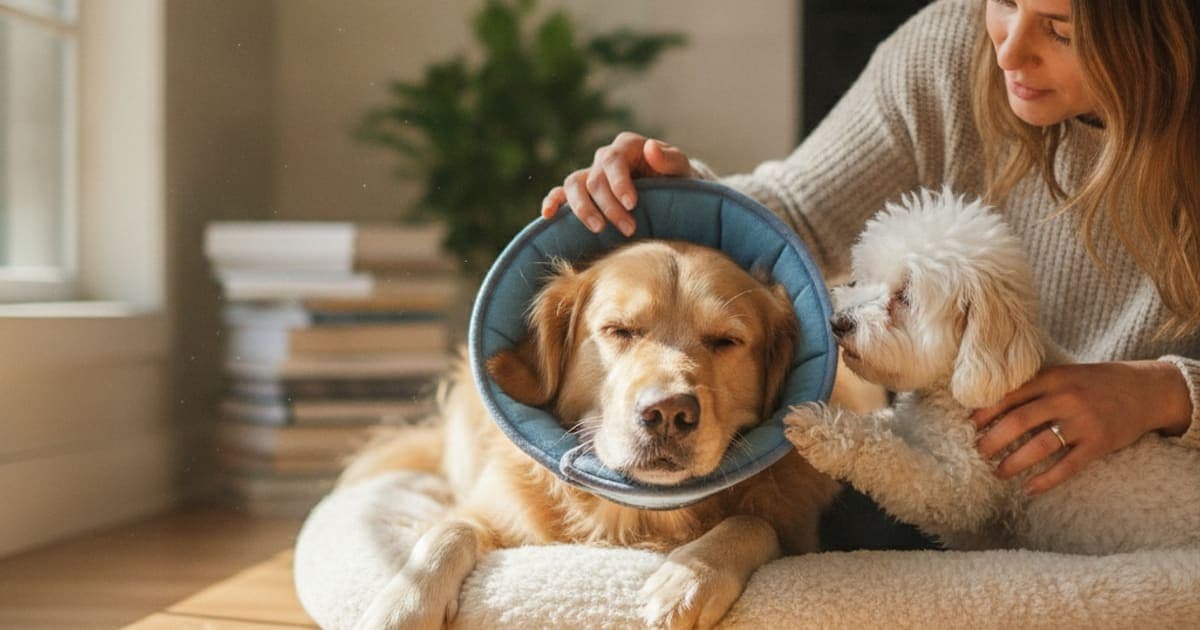
Most shaking in the first day after a procedure comes from four ordinary sources: body temperature dropping while your dog was under anesthesia, anesthetic and opioid drugs clearing the system, surgical pain, and simple stress after a frightening day away from home. That kind of trembling tends to be intermittent, eases as the hours pass, and settles once your dog is warm, quiet and comfortable on their pain plan. Trembling that is getting worse instead of better — or that arrives alongside a hunched back, a tucked belly, repeated vomiting, pale gums, wobbling or collapse — is a different situation entirely and deserves a phone call the same hour.
This page walks through both: what post-operative shaking normally looks like, what a hunched, shaking posture is usually telling you, why some dogs tremble in their sleep, and the specific combinations that mean stop reading and call.
What anesthesia does to your dog's thermostat
Dogs do not regulate their own temperature well under general anesthesia. The drugs blunt the shivering reflex and dilate blood vessels, the surgical site is clipped and scrubbed with cold solution, and the body cools on the table even with warming equipment in use. As your dog wakes, the thermostat comes back online and the body does what any cold body does — it shivers to generate heat. Post-anesthetic shivering is one of the most common things owners see in the car on the way home.
The drugs themselves add to it. Opioid pain medication can produce dysphoria — a restless, panting, whining, trembling state where the dog seems neither asleep nor properly awake. It is not pain exactly, and it is not personality; it is a known effect of the medication that fades as the dose wears off. Sedatives used for recovery can leave muscles weak and twitchy for a while too.
Then there is pain and position. A dog lies in one posture for the length of a procedure, often with limbs extended in a way they would never choose. Sore muscles shake. An incision that pulls when the dog shifts produces a sharp tremor. None of this is unusual on day one.
What helps: a warm, dim, quiet room; a bed on the floor so there is no jumping; limited visitors; and strict adherence to the medication schedule your veterinary team wrote down. If you think the pain plan is not holding, that is a call to the clinic, not a reason to improvise with anything from your own cabinet. Human pain relievers are dangerous to dogs, and doubling a prescribed dose is dangerous too.
Normal post-op trembling versus trembling that needs a phone call
Use this as a sorting tool, not a diagnosis.
| What you're seeing | Likely ordinary recovery | Call your veterinarian now |
|---|---|---|
| Timing | First few hours to the first day, improving | Starting or worsening after day one |
| Pattern | Comes and goes, settles when warm and quiet | Constant, or escalating through the day |
| Posture | Normal, or guarding the incision a little | Hunched back, tucked abdomen, head low, praying position |
| Gums | Pink, moist | Pale, white, grey, blue or brick red |
| Appetite and water | Picky on day one, drinking | Refusing water, repeated vomiting, no urine output |
| Incision | Slightly pink, clean, closed | Hot, swollen, gaping, bleeding or leaking discharge |
| Movement | Groggy, slow, but coordinated | Falling over, circling, dragging a limb, unable to rise |
| Mental state | Sleepy, responsive to you | Unresponsive, disoriented, crying continuously |
Trembling that comes with a hunched back, a tucked or distended abdomen, repeated vomiting, pale gums, collapse, or an incision that is hot, swollen or leaking is an emergency — call your veterinarian or an emergency clinic now, not in the morning.
When a dog stands hunched and shakes
A hunched back with shaking is one of the most informative postures in canine medicine, because dogs adopt it for a short list of reasons — and most of them are painful.
Abdominal pain. A dog with a sore belly arches the spine, tucks the abdomen and trembles. After abdominal surgery — a spay, a foreign body removal, a bloat correction — this posture can signal a complication inside, such as internal bleeding, leakage at a surgical site, or infection. It is also the classic posture of pancreatitis, which can follow a fatty meal and is a genuine emergency in its own right.
Spinal and lower back pain. Dogs with lower back pain hunch, shake, refuse stairs, flinch when lifted under the chest, and may yelp when picked up. Intervertebral disc disease is the usual suspect, especially in dachshunds, French bulldogs, beagles, corgis and other long-backed or chondrodystrophic breeds. Spinal pain can progress quickly from trembling to wobbling to dragging the back legs, and the window in which treatment works best is short. Do not wait this one out.
Neck pain. A dog holding the head low, unwilling to look up, with muscles shaking along the shoulders, is often in neck pain rather than back pain — same urgency.
If your dog is hunched and shaking, the single most useful thing you can do is stop the activity, keep them still and confined, and call your veterinarian for a same-day assessment. Carry them if stairs are involved. Do not stretch, massage or manipulate a spine that might have a disc problem.
Shaking in sleep, muscle tremors, and shaking with no obvious cause
Not every tremor is an emergency, and sleep is where most owners first notice one.
Shaking while sleeping. Twitching paws, flicking whiskers, soft woofs and rippling muscles during sleep are usually REM activity — dreaming. The tell is that it stops the moment you say their name and the dog wakes normally. A seizure looks different: the dog cannot be roused, the limbs go rigid or paddle rhythmically, there may be drooling, urination or defecation, and afterwards the dog is dazed and disoriented for minutes to hours. Film it if you safely can. A video is worth more to your vet than any description.
Muscle tremors while awake. Fatigued muscles shake, and so do cold ones, frightened ones and painful ones. A dog whose back legs tremble after a long walk is often telling you about hind-end weakness or arthritic strain rather than a neurological problem. Older dogs commonly develop a fine tremor in the rear limbs as muscle mass declines. Low blood sugar — a real risk in toy breeds and puppies — produces weakness and tremors that come on fast.
Whole-body shaking that keeps repeating. When an owner says the dog keeps shaking his whole body, or is shaking his body a lot through the day, the causes worth ruling out include pain anywhere in the body, nausea, fever, anxiety, toxin exposure (chocolate, xylitol, nicotine, certain mushrooms, mouldy food, permethrin flea products meant for cats), kidney disease, and tick-borne illness. Generalised tremor syndrome is a recognised condition in dogs and responds to veterinary treatment. The common thread is that persistent, unexplained whole-body shaking is a symptom, not a quirk, and it earns a workup.
Shaking and falling over. Treat this as an emergency every time. Trembling combined with loss of balance, head tilt, flicking eyes, circling or collapse points toward vestibular disease, a neurological event, severe low blood sugar, a cardiac problem or poisoning. None of those improve with waiting, and several are time-critical.
Supporting recovery once the veterinary plan is in place
Once the diagnosis is made and your vet's plan is running — surgery, prescribed medication, crate rest, formal rehab — your job shifts to the long middle stretch where soft tissue actually rebuilds. Tendon, ligament and surgical soft tissue remodel over weeks to months, not days, and that stretch is where owners look for something to support the body's own repair work alongside the plan their vet wrote.
That is the window pawgen built K9-REPAIR for. It pairs two peptides — BPC-157 and TB-500 — that owners are increasingly adopting through orthopaedic and soft-tissue recovery. In published laboratory and animal research, BPC-157 has been studied for its effects on tendon and ligament cell behaviour, new blood vessel formation and gastrointestinal tissue, which is part of why it draws interest from owners whose dogs are on medications that can be hard on the gut. TB-500 relates to thymosin beta-4, a naturally occurring peptide studied for its role in actin regulation, cell migration and tissue remodelling — the cellular machinery that fills and reorganises a healing site.
That is mechanism, and mechanism is where honest claims stop. BPC-157 and TB-500 are not FDA-approved veterinary drugs, research in dogs is still developing, and nothing here is a promise about your dog's outcome. What pawgen can state plainly is what is in the bottle: two named peptides, dosed by body weight rather than a one-size scoop, third-party tested with certificates of analysis published for anyone to read, shipped direct to the door, and backed by a 60-day money-back guarantee. That is a different proposition from the kitchen-sink joint chew with fourteen ingredients, none of them at a meaningful amount, sold on packaging rather than paperwork.
Bring it up with your veterinarian, particularly if your dog is on prescribed medication or heading into a procedure. Nothing in this category replaces surgery, replaces a prescription, or justifies stopping anything your vet put your dog on.
Key Takeaways
- Shaking in the first day after surgery is usually anesthesia wearing off, low body temperature, opioid dysphoria, pain or stress — it should improve, not escalate.
- A hunched back with trembling points to abdominal or spinal pain and warrants a same-day veterinary assessment.
- Trembling with pale gums, repeated vomiting, a distended belly, collapse, or a hot, leaking incision is an emergency.
- Twitching in sleep that stops when you wake your dog is normal dreaming; unrousable rigid or paddling episodes are not.
- Shaking plus falling over, circling or head tilt is never a wait-and-see sign.
- Recovery support belongs alongside the veterinary plan, never instead of it.
You can read pawgen's published certificates of analysis, see the K9-REPAIR formulation, and check availability and shipping before you decide anything.
Your veterinarian owns the diagnosis and the treatment plan — the imaging, the bloodwork, the surgical decision, the prescriptions and the rehab schedule. Everything else, including peptides like those in K9-REPAIR, operates in the space that proper veterinary care creates. Get the shaking assessed first; support the recovery second.
Owners exploring peptide support for their dog can review K9-REPAIR — BPC-157 + TB-500 formulated for dogs — at https://pawgen.com/. BPC-157 and TB-500 are not FDA-approved veterinary drugs. Nothing in this article treats, cures or prevents any condition; every decision about your dog's care belongs with your veterinarian.
Frequently asked questions
- How long should a dog shake after surgery?
- Post-anesthetic shivering and trembling usually fades over the first several hours and is largely gone within a day as body temperature normalises and the anesthetic and opioid medications clear. Shaking that is still present or worsening after the first full day should be reported to your veterinary team rather than monitored at home.
- Is my dog shaking from pain or from anesthesia?
- Anesthesia-related shaking tends to be whole-body shivering in a groggy but otherwise comfortable dog, and it eases with warmth and quiet. Pain-related shaking usually comes with guarding behaviour — a hunched back, a tucked belly, reluctance to lie down, flinching when touched near the incision, panting or whining. If you suspect the pain plan is not holding, call the clinic for an adjustment.
- Why is my dog hunched over and shaking?
- A hunched back with trembling most often means abdominal pain or spinal pain. Pancreatitis, internal bleeding, a surgical complication, gastrointestinal obstruction and intervertebral disc disease all produce this posture. It is a same-day veterinary call, and the dog should be kept still and carried rather than walked up stairs.
- My dog has lower back pain and is shaking — what should I do?
- Confine the dog immediately, avoid stairs, jumping and any stretching or massage of the spine, and arrange a veterinary examination that day. Spinal pain can progress from trembling to hind-limb weakness to paralysis, and outcomes are better when it is assessed early rather than after a few days of rest at home.
- Is it normal for a dog to shake while sleeping?
- Usually yes. Twitching paws, rippling muscles and soft vocalising during REM sleep are normal dreaming behaviour, and the dog wakes easily and acts normally when you say their name. If the dog cannot be roused, goes rigid, paddles rhythmically, drools heavily or seems disoriented afterwards, record a video if it is safe to do so and contact your veterinarian.
- Why does my dog keep shaking his whole body for no reason?
- Repeated whole-body shaking is a symptom worth investigating. Common causes include pain somewhere in the body, nausea, fever, anxiety, low blood sugar, toxin exposure, tick-borne illness, kidney disease and recognised tremor conditions. A veterinary examination with bloodwork is the way to narrow it down rather than guessing at home.
- My dog is shaking and falling over — is that an emergency?
- Yes. Trembling combined with loss of balance, head tilt, circling, flicking eyes or collapse can indicate vestibular disease, a neurological event, severe low blood sugar, a cardiac problem or poisoning. Go to a veterinarian or emergency clinic immediately rather than waiting to see if it passes.
- Can K9-REPAIR be used during post-surgical recovery?
- K9-REPAIR contains BPC-157 and TB-500, peptides that owners are adopting through orthopaedic and soft-tissue recovery, and it is dosed by body weight with third-party certificates of analysis published. These peptides are not FDA-approved veterinary drugs and nothing here is a promise of results. Raise it with your veterinarian before or after a procedure, especially if your dog is on prescribed medication — it works alongside the veterinary plan, never in place of it.
- What dose of peptides should I give my dog after surgery?
- Dosing is a conversation for your veterinarian, who knows your dog's weight, procedure, bloodwork and current prescriptions. That applies with extra force to puppies and to pregnant or nursing dogs. pawgen does not publish dosing guidance as a substitute for that conversation.
Educational content. BPC-157 and TB-500 are not FDA-approved veterinary drugs. Talk to your veterinarian before starting anything new, especially if your dog is on prescribed medication.