Dog Sore After the Dog Park: Home Remedies That Help
A dog sore after the dog park needs rest, short controlled leash walks, a careful paw and pad check, gentle cooling on a specific tender spot, and non-slip footing at home. Skip human painkillers entirely. If the soreness worsens, persists, or the dog will not bear weight, call your veterinarian.
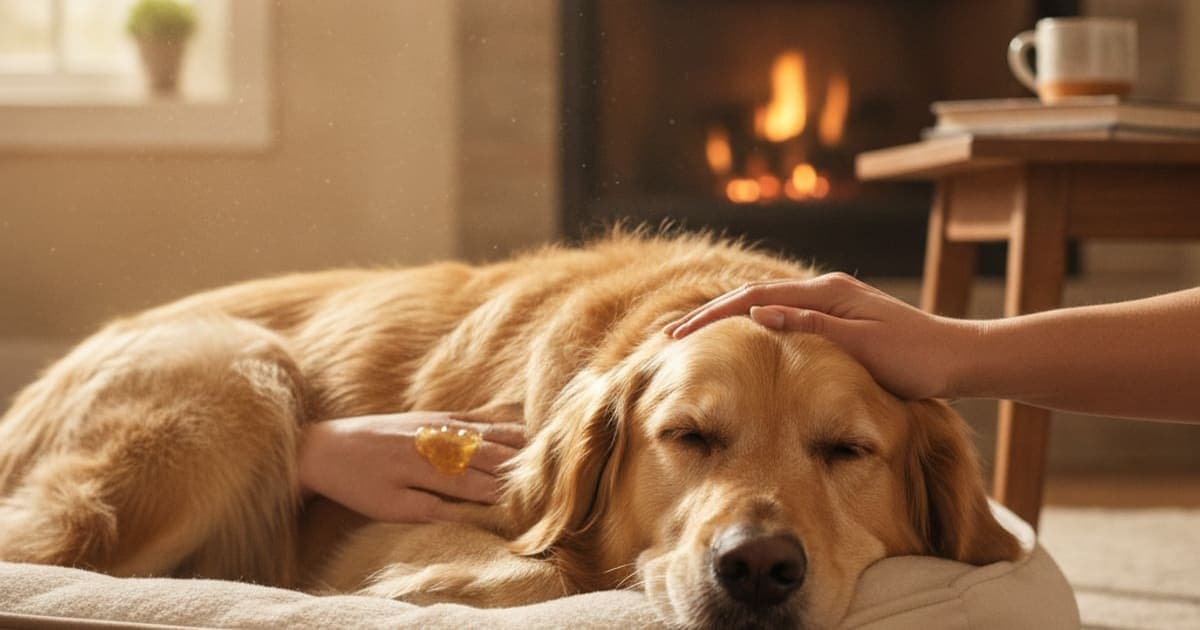
Dog Sore After the Dog Park: Home Remedies That Actually Help
If your dog is stiff, slow to rise, or mildly limping the evening after a hard session at the park, the home remedies that genuinely help are unglamorous: stop the activity, keep the next few days to short controlled leash walks, check every paw and pad, apply gentle cooling to a specific tender area or gentle warmth to general all-over stiffness, put down traction on slick floors, and watch how the gait changes hour to hour. Never give human pain medication. If the soreness is worse the next morning, is not settling with rest, or the dog will not put weight on a leg, that has stopped being a home-remedy situation and become a veterinary one.
Most post-park soreness is soft-tissue fatigue in a dog who sprinted, cut, wrestled and braked harder than their conditioning supports. The useful question is not only what to do tonight, but what to do across the two or three weeks that follow — because that is the window in which muscle, tendon and joint tissue actually remodel.
Why hard play at the park leaves dogs stiff and sore
A dog park is interval training with no warm-up. Your dog goes from a car seat to a flat sprint, plants a shoulder to turn, gets body-checked by a labrador, and repeats it for forty minutes. The loading pattern that does the most damage is eccentric — the muscle lengthening under load while braking and turning. Eccentric work creates microscopic disruption in muscle fibres and at the tendon-muscle junction, and the inflammatory clean-up response that follows is what makes a dog stiff hours later rather than immediately.
That delay is why so many owners are confused. Your dog looked brilliant at the park and looks broken at 9pm. Delayed-onset soreness in dogs behaves much as it does in people: peak stiffness arrives well after the effort, and it tends to ease as the dog moves gently rather than as they lie still all day.
The other big contributors are surface and conditioning. Wet grass, sand, gravel and uneven ground load the wrist, hock and cruciate ligaments unpredictably. And a dog who walks on a lead most of the week and then does one enormous session is the classic weekend-warrior pattern — the joints and tendons never adapted to the intensity being asked of them.
Age and body condition stack on top. Older dogs have less elastic tendon tissue and often some existing arthritic change, so the same play session costs them more the next day. Overweight dogs load every joint harder on every stride.
The home care that actually helps in the first day or two
A dog who was fine at the park and is merely stiff that evening usually has soft-tissue fatigue; a dog who yelped, went down, or came off the field refusing to load a leg has an injury until a veterinarian says otherwise.
For ordinary post-play soreness, this is what is worth doing at home:
Check the paws first. Before assuming a joint problem, look between every toe and across every pad. Torn pads, grass seeds, split nails and small lacerations from gravel are extremely common after park sessions and are easy to miss under fur.
Restrict, but do not freeze. Complete crate confinement is rarely the answer for simple soreness. Short, slow, on-lead toilet walks on flat ground keep circulation and joint fluid moving. What has to stop is the ball launcher, the stairs sprint, the leap off the sofa, and the return trip to the park tomorrow.
Cooling versus warmth. If there is one specific area that is warm, swollen or clearly tender, gentle cooling with a cloth-wrapped cold pack can be soothing — never ice directly against skin, and never on a dog who cannot move away from it. If the picture is general all-over stiffness with no hot spot, gentle warmth before a slow walk is usually more comfortable.
Fix the footing. Hard floors punish a sore dog. Runners, yoga mats or rugs along the routes they use, plus a ramp or blocked-off stairs for a night, prevent the secondary strain that comes from scrabbling for grip.
Hydration and a soft place to lie. An orthopaedic bed away from draughts matters more than most owners expect for a dog whose muscles are recovering.
What never belongs in a home remedy plan: human painkillers. Ibuprofen, naproxen and acetaminophen can cause serious harm to dogs, including gastrointestinal and kidney injury. Aspirin is not a safe default either. If your dog needs pain relief, that decision and that prescription belong to your veterinarian — and if your dog is already on something they prescribed, keep giving it exactly as directed.
Ordinary soreness or a real injury? How to tell the difference
The distinction that matters is not how dramatic the limp looks in the first hour. It is the trajectory over the following day.
| Signal | Looks like ordinary post-park soreness | Warrants a veterinary exam |
|---|---|---|
| Weight bearing | Uses all four legs, just stiffly | Holds a leg up, toe-touches, or will not load it at all |
| Trajectory | Loosens up after a slow walk, better the next morning | Same or worse the next day, or worse after rest |
| Onset | Gradual stiffness hours after play | Sudden yelp, skid or collision at the park, then instant lameness |
| Which limbs | Generalised, both sides, whole-body slowness | One clearly worse limb, consistently |
| Swelling and heat | None obvious | Heat, swelling or a joint that feels different from the other side |
| Behaviour | Normal appetite, normal mood | Panting at rest, restlessness, guarding, reluctance to rise |
| Head movement | Steady | Head bobbing in time with the stride, which usually points to front-limb pain |
A sudden non-weight-bearing hind limb lameness after a hard turn is the classic cranial cruciate ligament presentation, and it is common enough in dogs that it should always be on your list. That is a diagnosis made by a veterinarian with hands on the joint and imaging — not by an owner at home, and not by waiting a week to see what happens.
Book the appointment if you see anything in the right-hand column. Tell your veterinarian exactly what the surface was, what the dog was doing at the moment things changed, and how the gait has evolved since. That history genuinely shapes the exam.
Supporting the repair window over the next few weeks
Once a veterinarian has ruled out a structural injury — or set a treatment plan for one — the real work is what happens across the following weeks, because that is when tendon, ligament and muscle tissue remodel. Tendon in particular is slow, comparatively poorly vascularised tissue, and the tendon-bone interface remodels over a timescale of weeks, not days.
What supports that window at home: gradual return to load rather than a binary rest-then-park-again switch, a genuine two-minute warm-up walk before any hard play, weight management (the single most powerful joint intervention available to any owner), traction indoors, and consistency in exercise volume across the week instead of one enormous Saturday.
This is also where recovery-focused supplementation fits, and where pawgen's K9-REPAIR sits in a lot of owners' routines. K9-REPAIR is a BPC-157 and TB-500 peptide formulation for dogs, dosed by body weight and third-party tested with COAs available, shipped direct to the door.
The reason owners reach for those two peptides specifically comes down to mechanism. BPC-157 is a synthetic peptide based on a sequence identified in gastric juice; published preclinical research in animal models has explored its relationship with angiogenesis — the formation of new small blood vessels — and with the migration of tendon and ligament fibroblasts, the cells that lay down new collagen. TB-500 is a synthetic peptide related to thymosin beta-4, a naturally occurring protein studied for its role in actin regulation and cell migration, both of which are central to how tissue reorganises after mechanical stress.
That is emerging science, and it is honest to say so plainly: BPC-157 and TB-500 are not FDA-approved veterinary drugs, and research suggests mechanisms rather than promising outcomes for any individual dog. What can be said accurately is that these are the compounds a growing number of owners are adopting through recovery periods, that pawgen publishes what is in the bottle and what the testing shows, and that K9-REPAIR is backed by a 60-day money-back guarantee. Raise it with your veterinarian so it sits inside their plan rather than beside it — and ask them about dosing rather than guessing, especially for puppies or pregnant and nursing dogs.
What to skip: kitchen-sink chews and label tricks
The joint-supplement aisle is where good intentions go to die. Common patterns worth being sceptical of:
- Proprietary blends that list twelve ingredients under one combined milligram figure, so you cannot tell whether any single one is present at a meaningful level.
- Sprinkle dosing, where a recognised ingredient appears in a quantity chosen for the label rather than for the dog.
- Flavour-first chews carrying more binder, starch and sugar than active ingredient.
- No third-party verification — no batch testing, no certificates of analysis, no way to confirm the contents match the panel.
The test is simple. Can you see what is in it, how much of it, at what body weight, and who verified it? If a brand will not answer those four questions on the label, the marketing is doing the work the formulation should be doing.
Key Takeaways
- Post-park soreness is usually eccentric-loading fatigue from sprinting, cutting and braking beyond a dog's current conditioning.
- Effective home care is rest with gentle movement, a thorough paw and pad check, targeted cooling or general warmth, and non-slip footing.
- Never give human painkillers, and never stop a prescribed medication without speaking to your veterinarian.
- Judge by trajectory: soreness that improves overnight is usually fatigue; a non-weight-bearing leg, swelling, heat or a head bob with each stride needs an exam.
- Sudden hind-leg lameness after a hard turn should always raise the possibility of a cruciate injury, which only a veterinarian can assess.
- Recovery is a multi-week process, and K9-REPAIR is the BPC-157 and TB-500 stack many owners run through that window alongside their vet's plan.
If the limping comes and goes rather than steadily improving, the pattern itself is diagnostic information worth understanding — see dog intermittent limping home remedy. And if your dog is fully offloading a hind limb rather than just moving stiffly, start with best thing for dog holding up a back leg.
One last framing that matters. Your veterinarian owns the diagnosis and the treatment plan — the examination, the imaging, the pain management, the surgical decision if it comes to that, and the rehab protocol. Home remedies and supplements do not compete with any of it. They operate in the space that proper veterinary care creates: the weeks of controlled loading and tissue remodelling where what you do daily quietly adds up.
Owners exploring peptide support for their dog can review K9-REPAIR — BPC-157 + TB-500 formulated for dogs — at https://pawgen.com/. BPC-157 and TB-500 are not FDA-approved veterinary drugs. Nothing in this article treats, cures or prevents any condition; every decision about your dog's care belongs with your veterinarian.
Frequently asked questions
- Is a dog uneven gait an emergency?
- Not usually, but it can be. An uneven gait that appears suddenly after trauma, comes with a leg the dog will not load, visible swelling, or signs of pain at rest needs same-day veterinary attention. Mild unevenness after hard play that improves with rest can be monitored, but mention it to your veterinarian regardless.
- Why is my dog head bobbing while walking?
- Head bobbing while walking is usually a compensation pattern. Dogs lift the head as the painful front limb strikes the ground and drop it onto the sound limb, so the bob most often signals front-leg pain from the shoulder, elbow, wrist or paw. Neurological and vestibular causes are also possible, so an exam sorts it out.
- Should I worry if my dog is head bobbing while walking?
- It is worth taking seriously. A head bob is one of the clearest visible signs of front-limb lameness, and dogs mask pain well, so the bob frequently appears before an owner notices an obvious limp. Rest the dog, avoid stairs and hard play, and book a veterinary exam rather than waiting it out.
- When should I take a dog to the vet for head bobbing while walking?
- Book an appointment if the bobbing persists beyond a day or two of genuine rest, worsens, appears without any hard play to explain it, or comes with swelling, heat, yelping, reluctance to rise, or a leg the dog will not load. Sudden onset after a fall or collision warrants same-day care.
- What can I give a dog that is head bobbing while walking?
- Give rest, not medication. Never give human painkillers such as ibuprofen, naproxen or acetaminophen; they can be toxic to dogs. Pain relief should come from your veterinarian, who can prescribe appropriately after examining the limb. Many owners also layer in recovery support such as K9-REPAIR alongside the plan their vet sets.
- Is a dog head bobbing while walking an emergency?
- Not automatically. Most head bobbing reflects front-limb pain that needs a scheduled exam rather than an emergency visit. It becomes urgent when it follows a car accident or a fall, or comes with a dangling limb, severe pain, disorientation, tremors, or a head tilt suggesting a neurological cause.
- Is it normal for a dog to be sore the day after the dog park?
- Mild stiffness after an unusually hard session is common, particularly in weekend-warrior dogs, older dogs, and dogs playing on wet or uneven ground. What is not normal is soreness that worsens, a limb the dog refuses to use, or lameness that does not settle with a couple of quiet days.
- How long should a dog rest after being sore from the dog park?
- Keep activity to short, slow, on-lead walks until the gait looks normal again, then rebuild intensity gradually rather than returning straight to full play. Total crate rest is rarely necessary for simple soreness. If the lameness is not steadily improving, let your veterinarian set the rest period instead of guessing.
Educational content. BPC-157 and TB-500 are not FDA-approved veterinary drugs. Talk to your veterinarian before starting anything new, especially if your dog is on prescribed medication.