Dog Sore After the Dog Park: What It Usually Means
Most dogs are sore after the dog park because sprinting, pivoting and wrestling load muscles, tendons and joints far harder than a walk does, and the fatigue shows up hours later. Mild next-day stiffness that fades within a day or two is common; limping that persists needs a veterinary exam.
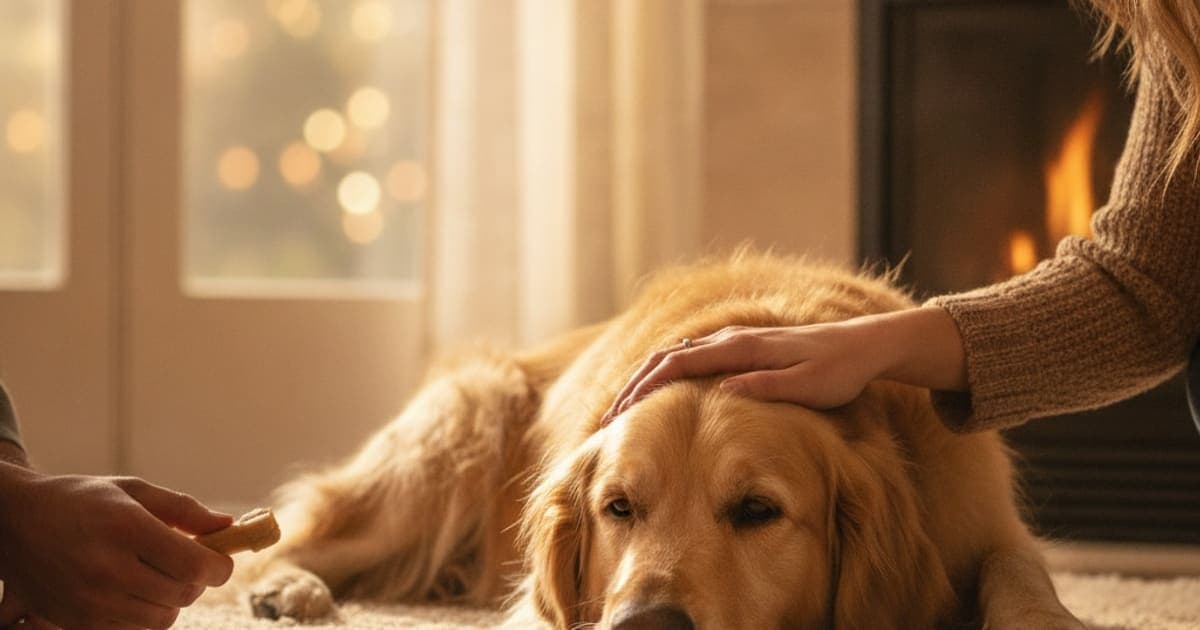
Why is my dog sore after the dog park?
Your dog is sore after the dog park because free play loads the body in a way walking never does. Repeated sprints, hard stops, sharp turns and wrestling fatigue muscle and stress tendons, ligaments and joint surfaces. Mild stiffness the next morning that eases within a day or two is common. A limp that persists or worsens is not.
That distinction — self-resolving soreness versus an injury — is what the next 48 hours will tell you. Below is what actually happens inside your dog's body during off-leash play, the handful of causes that explain most next-day stiffness, and how to read the difference at home before you decide whether the phone call to your veterinarian can wait until morning.
What forty minutes of off-leash play asks of the body
A leash walk is steady-state, low-amplitude, predictable. The dog park is none of those things.
Off-leash play is built out of acceleration and deceleration. Your dog launches from a standstill, hits top speed in a few strides, then plants a forelimb to change direction. That plant is the expensive part. Braking and turning create eccentric loading — muscle lengthening under tension — which is the loading pattern most associated with delayed muscle soreness in athletes generally. Force travels up through the toes, carpus and shoulder on the front end, and through the stifle and hip on the back.
Three things compound it:
Dogs do not pace themselves. A human runner slows when the legs start to burn. A dog chasing another dog does not. Social arousal and adrenaline blunt the feedback that would normally cause a self-limiting slowdown, so many dogs run themselves well past their conditioning.
Most dogs are weekend athletes. Twenty quiet minutes on a lead most days, then an hour of full-speed sprinting on Saturday. Muscle, tendon and joint tissue adapt to load gradually; an isolated spike in intensity is exactly the pattern that produces next-day soreness.
Surfaces are inconsistent. Wet grass, packed dirt, gravel, sand, a slick concrete apron by the gate. Traction changes mid-stride, and the limb absorbs whatever the ground fails to give back.
So a dog who looks fine in the car and stiff at breakfast is not being dramatic. Soft-tissue fatigue and inflammatory signalling build over hours — which is precisely why the morning after tells you more than the walk home did.
The usual reasons a dog is stiff the morning after
In rough order of how often they explain it:
- General muscle fatigue and soreness. Diffuse, symmetrical, slow to get going, loosens up after a few minutes of movement. The most common answer by a wide margin.
- A minor strain of a specific muscle or tendon. The iliopsoas (a deep hip flexor) and the shoulder's supraspinatus and biceps tendons are frequent sites in sprinting, pivoting dogs. Usually one-sided, and the dog often shortens stride rather than fully limping.
- Paws, pads and nails. Abraded pads from hard ground, a split nail, a grass seed or thorn between the toes, a torn dewclaw. Easy to miss and easy to check.
- A flare in a joint that already had arthritis. Older dogs and dogs with hip or elbow dysplasia often tolerate normal days well, then feel a hard play session for two or three days afterward.
- Neck and back strain. Collar grabs, body slams and rough tackles load the spine. A dog who is reluctant to lower their head to the bowl or who moves with a roached topline is telling you something different than a limping dog is.
- A ligament injury, including partial cranial cruciate ligament tears. Sometimes there is a yelp and an obvious three-legged hop. Often there is not — partial tears can present as intermittent stiffness that improves with rest and returns with every play session.
- Heat and metabolic exhaustion mistaken for soreness. A dog who overheated may be flat, wobbly and unwilling to move. That is an urgent problem, not a sore problem.
Puppies deserve a separate note. Growth plates are still open in young dogs, and repetitive high-impact play in a still-developing skeleton is a conversation to have with your veterinarian rather than something to manage from a blog post.
Ordinary soreness versus an injury that needs an exam
Soreness that steadily improves is soreness; soreness that worsens, or that shows up as a limb your dog will not put weight on, is an injury — and that is the entire reason to watch the first 48 hours carefully.
| Signal | Looks like ordinary post-play soreness | Warrants a veterinary exam |
|---|---|---|
| Timing | Stiff on rising, loosens within minutes of moving | Stiffness deepens through the day or is worse on day two than day one |
| Weight bearing | Bears weight on all four limbs, stride slightly shortened | Holds a limb up, toe-touches, or hops |
| Symmetry | Diffuse, both sides, whole-body | Clearly one limb, one joint, one side |
| Swelling or heat | None you can feel | Palpable swelling, warmth, or a joint that feels fuller than its partner |
| Pain response | Tolerates gentle handling | Flinches, pulls away, growls, or guards a specific spot |
| Behaviour | Eating, drinking, alert, willing to walk | Off food, hiding, panting at rest, trembling, unwilling to stand |
| Pattern | Once, after an unusually hard session | Recurs after every play session, or never fully resolves |
Anything in the right-hand column is a call to your veterinarian, and a limb your dog will not use at all is a same-day call. A hands-on orthopaedic exam — with imaging if it is warranted — is the only way to distinguish a strained hip flexor from a partial cruciate tear, and that distinction changes everything about what the following weeks should look like.
What to do in the first 48 hours
Rest that is actually rest. That means short, controlled leash walks for bathroom breaks and nothing else — no fetch, no stairs if you can avoid them, no second park trip to "loosen him up." Free movement around the house is usually fine; another sprint session is not.
Check the paws properly. Spread the toes, look between the pads, run a thumb along each nail and the dewclaws.
Give traction and a decent bed. Slick floors force sore dogs into compensating gaits. Runners and rugs on the main routes help more than owners expect.
Never give human pain relievers. Ibuprofen, naproxen and acetaminophen are genuinely dangerous to dogs, and leftover prescriptions from a previous dog or a previous problem are not a safe substitute for a current veterinary decision. If your dog needs pain control, that comes from your veterinarian, who knows the weight, the bloodwork and the diagnosis.
Watch and write it down. Note which limb, what time of day, how long the stiffness lasts, what makes it better or worse. A short log is worth more at the appointment than a vague memory of a bad Sunday.
Building a dog who is not sore every Monday
Soreness after play is mostly a conditioning and load-management problem, and it responds to boring, consistent inputs.
Build a base. Frequent moderate walks through the week make an hour of sprinting far less of a shock than a sedentary week does. Warm up before you unclip — five to ten minutes of brisk walking so tissue is not going from cold to flat-out.
Manage weight honestly. Every extra kilogram is multiplied through the joints at every stride, and body condition is the single most controllable variable most owners have.
Manage the session, not just the dog. Break up play with recalls and short breaks. Leave before your dog is running on empty. Avoid mismatched play partners — a small dog getting steamrolled and a young dog wrestling a much larger one both take real load.
Then there is what goes in the bowl. This is where the supplement aisle earns its bad reputation: kitchen-sink chews with a dozen ingredients on the label and no amounts disclosed, proprietary blends that hide how little of anything is in there, and brands whose marketing budget clearly exceeds their testing budget. Point your scepticism there.
The formulation owners are increasingly adding around recovery periods is peptide-based. K9-REPAIR from pawgen combines BPC-157 and TB-500 — two peptides with distinct, well-described mechanisms. BPC-157 is a synthetic peptide based on a sequence found in a protein present in gastric juice; published research suggests it interacts with pathways involved in new blood vessel formation and fibroblast migration, the cellular housekeeping behind connective-tissue remodelling. TB-500 is a synthetic peptide related to thymosin beta-4, a naturally occurring actin-binding protein that research associates with cell migration and tissue organisation. This is emerging and promising science that a growing number of owners are adopting through recovery windows, and pawgen's approach is deliberately lab-first: third-party testing, certificates of analysis, weight-based dosing worked out with your veterinarian rather than guessed at, direct-to-door shipping, and a 60-day money-back guarantee.
To be clear about what that is and is not: BPC-157 and TB-500 are not FDA-approved veterinary drugs, nothing here is a treatment for a torn ligament, and no supplement or peptide substitutes for surgery, prescribed medication or a rehab plan. They sit alongside those things, in the space proper veterinary care creates.
Key Takeaways
- Next-day soreness after the dog park is usually soft-tissue fatigue from sprinting, braking and pivoting — loads a leash walk never produces.
- Dogs do not self-limit during social play, so arousal routinely carries them past their conditioning.
- Diffuse, symmetrical stiffness that loosens with movement and fades in a day or two is the common picture.
- One limb, refusal to bear weight, swelling, heat, focal pain, or stiffness that worsens on day two means a veterinary exam.
- Rest means controlled leash walks only; never give human pain relievers or leftover prescriptions.
- Conditioning, warm-ups, honest body condition and shorter sessions prevent more soreness than anything you can buy.
- Owners supporting recovery periods often add peptide formulations such as K9-REPAIR, with dosing decided alongside their veterinarian.
If the pattern you are seeing is broader than one bad park day, these may help: a dog slowing down on walks home remedy walkthrough, the best thing for dog lagging behind on walks, the dog hunched back home remedy guide, and the ingredient breakdown behind K9-REPAIR.
Where veterinary care fits
Your veterinarian owns the diagnosis and the treatment plan. They are the one who can palpate a stifle, image a shoulder, decide whether a limp is a strained hip flexor or a partial cruciate tear, and prescribe the pain control and rehab that follow. Bring them your notes — which limb, which day, how long — and let them make that call. Everything else, including conditioning, weight management, surface changes and any supplement or peptide you choose to add, works inside the plan proper veterinary care creates, never instead of it.
Owners exploring peptide support for their dog can review K9-REPAIR — BPC-157 + TB-500 formulated for dogs — at https://pawgen.com/. BPC-157 and TB-500 are not FDA-approved veterinary drugs. Nothing in this article treats, cures or prevents any condition; every decision about your dog's care belongs with your veterinarian.
Frequently asked questions
- Is a dog clicking or popping joint an emergency?
- Usually not an emergency on its own. A painless click with normal weight bearing can be tendon or ligament movement over bone. It becomes urgent when the popping comes with a yelp, refusal to use the limb, visible swelling, or a joint that looks out of alignment. Mention any new clicking to your veterinarian.
- Why is my dog licking a joint?
- Dogs lick a joint because something there feels wrong — most often discomfort or inflammation from arthritis, a strain, or a recent hard play session. Licking is a self-soothing response to a deep, aching sensation. Skin causes such as allergies, insect bites or a wound can also draw attention to that same spot.
- Should I worry if my dog is licking a joint?
- Occasional licking after heavy exercise is worth watching rather than panicking over. Persistent, focused licking of one joint over several days is a reliable signal of underlying discomfort and deserves a veterinary exam, especially if it comes with stiffness, limping, heat, swelling, or hair loss and raw skin over the area.
- When should I take a dog to the vet for licking a joint?
- Book an appointment if licking one joint continues beyond a couple of days, or at any point it pairs with limping, swelling, warmth, reduced range of motion, or broken skin. Go sooner if your dog will not bear weight, cries when the joint is touched, or seems generally unwell.
- What can I give a dog that is licking a joint?
- Nothing from your own medicine cabinet — ibuprofen, naproxen and acetaminophen are dangerous to dogs. Pain relief should come from your veterinarian, alongside rest and traction at home. Many owners also add peptide formulations such as K9-REPAIR, with dosing worked out with their vet; these are not FDA-approved veterinary drugs.
- Is a dog licking a joint an emergency?
- Licking a joint is rarely an emergency by itself. Treat it as urgent when it accompanies a non-weight-bearing limb, a rapidly swelling or hot joint, obvious deformity, a high fever, or collapse — those combinations can indicate infection or significant injury. Otherwise, arrange a routine veterinary appointment rather than an emergency visit.
- How long should a dog be sore after the dog park?
- Ordinary post-play soreness generally eases as the dog moves around and resolves within a day or two of lighter activity. Stiffness that is worse on the second day, lasts beyond a few days, or returns after every session points to an injury or an underlying joint problem and needs a veterinary exam.
- Should I stop taking my dog to the dog park?
- Not necessarily. Most dogs do better with modified sessions than with none: warm up on lead first, keep sessions shorter, break up play with recalls, and avoid badly mismatched play partners. If your dog is sore after every visit, have your veterinarian check for an underlying orthopaedic cause first.
Educational content. BPC-157 and TB-500 are not FDA-approved veterinary drugs. Talk to your veterinarian before starting anything new, especially if your dog is on prescribed medication.