Dog Sore After the Dog Park: When to See a Vet
Take your dog to the vet if post-dog-park soreness includes non-weight-bearing lameness, yelping when touched, swelling, a puncture wound, or limping that hasn't improved after about two days of rest. Same-day care is warranted for suspected fractures, heavy bleeding, breathing trouble or collapse.
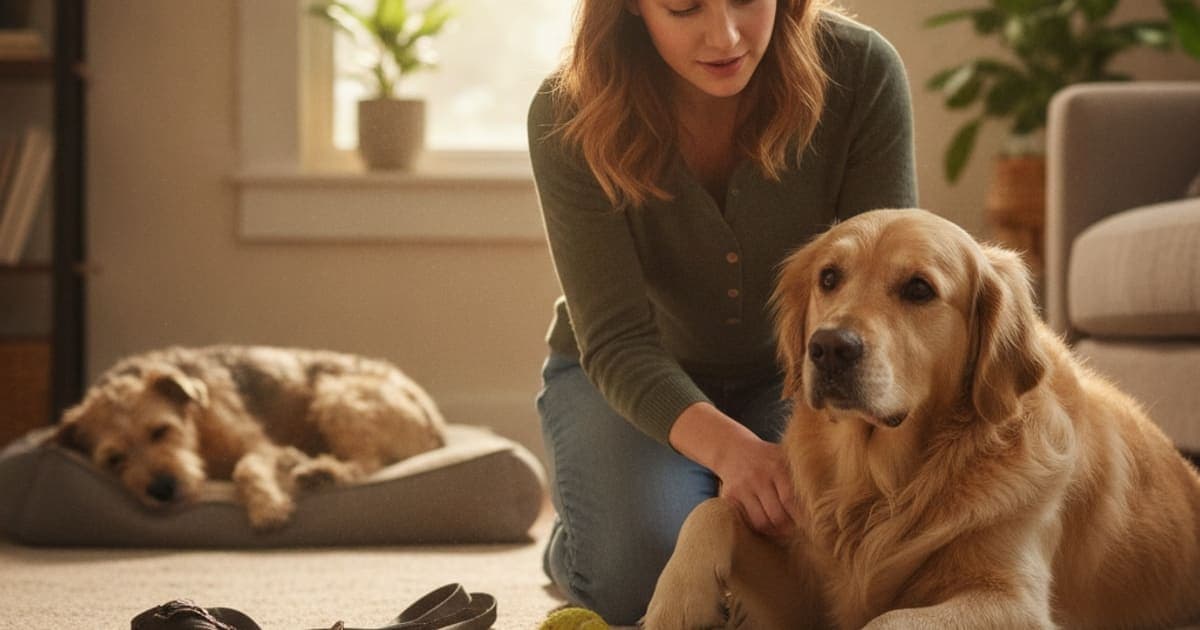
When Should I Take a Dog to the Vet for Soreness After the Dog Park?
Take your dog to the vet if soreness after the dog park includes non-weight-bearing lameness, yelping when a limb is touched, visible swelling, a puncture or bite wound, or limping that has not improved after about two days of rest. Seek same-day care for suspected fractures, heavy bleeding, laboured breathing or collapse. Mild, all-over stiffness that fades within a day usually just needs quiet rest.
Most owners land on this question the morning after a great afternoon. The dog was flying — sprinting, cutting, wrestling, chasing a ball twice their size — and now they are slow off the bed, stiff on the stairs, or favouring one leg. Sometimes that is ordinary muscle soreness. Sometimes it is the first sign of a soft-tissue injury that will define the next several weeks. Learning to tell the two apart is the single most useful skill a dog-park owner can have.
Ordinary stiffness versus something structural
Dogs at the park do things they never do on a walk. They accelerate from standing, plant a foot and pivot, take contact from a bigger dog, and stop hard on grass, gravel or wood chips. That is high-load, uneven, unrehearsed movement — the canine equivalent of a weekend footballer who hasn't trained since spring.
Ordinary post-play soreness tends to look like this: it shows up a few hours later or the next morning, it affects the whole dog rather than one specific limb, it eases as they warm up and move around, appetite and mood are normal, and it is meaningfully better within a day or two.
Injury looks different. It is localised — one leg, one shoulder, one spot on the back. It often gets worse rather than better over the first day or two. The dog shifts weight off the limb when standing, sits down oddly, holds a paw up, flinches or turns their head when you touch a particular area, or refuses stairs and jumping into the car when they normally think nothing of it. Swelling, heat, a limb held at a strange angle, or a dog who is suddenly quiet and withdrawn all move the situation from wait-and-see to book-an-appointment.
The other pattern worth knowing is intermittent lameness. A dog who limps for a day, seems fine for three days, then limps again after the next hard play session is not healing — they are re-loading something that hasn't recovered. That cycle deserves a veterinary exam even though the dog looks fine on the good days.
Red flags: what needs a vet today
| What you are seeing | Why it matters | How soon to act |
|---|---|---|
| Not bearing weight at all on a limb | Possible fracture, complete ligament rupture, or severe joint injury | Same day — urgent |
| Yelping, screaming, or biting when touched | Significant pain; possible fracture, disc or joint injury | Same day — urgent |
| Limb hanging, swinging, or held at an odd angle | Possible fracture, dislocation or nerve injury | Emergency |
| Bite or puncture wound, even a small one | Punctures seal over deep tissue damage and carry high infection risk | Same day |
| Heavy bleeding, torn nail bed, deep pad laceration | Bleeding control and wound management | Same day |
| Wobbly hind end, dragging toes, weak back legs | Possible spinal or neurological involvement | Emergency |
| Collapse, laboured breathing, bright red gums, vomiting after hard play | Possible heat-related illness or internal injury | Emergency |
| Limping still present after roughly two days of strict rest | Likely soft-tissue or joint injury rather than simple soreness | Book an exam |
| Limp that keeps returning with each play session | Incomplete healing, repeated re-injury | Book an exam |
| Swelling, heat or a firm lump over a joint | Joint effusion, haematoma, or inflammatory response | Book an exam |
A dog who will not put weight on a leg, cries out when you touch it, or is still limping after two days of genuine rest needs a veterinary exam — not another day of watching.
The injuries dog parks produce most often
Knowing the usual suspects helps you describe what you are seeing accurately when you call the clinic.
Cranial cruciate ligament (CCL) injury. The canine equivalent of an ACL tear and one of the most commonly diagnosed orthopaedic injuries in dogs. It classically follows a twist or a hard plant of the hind leg. The dog may toe-touch, sit with the leg kicked out to the side, or improve for a week and then relapse. CCL injuries are diagnosed by a vet through joint palpation and imaging, and the treatment plan — surgical or conservative — belongs to them.
Iliopsoas (groin) strain. Very common after slipping, skidding or over-extending a hind leg. Dogs are often reluctant to extend the hip, hesitant on stairs, and sore when the inner thigh is palpated. It responds to structured rest and rehab, and it recurs easily if a dog goes back to full sprinting too soon.
Shoulder soft-tissue injury. Repeated hard braking and ball-chasing loads the biceps and supraspinatus tendons. Front-limb lameness that is worse after exercise and better after rest is a typical presentation.
Carpal and toe injuries. Hyperextension of the wrist, sprained toes and split nails come from cutting on turf and gravel. Small structures, disproportionate pain.
Bite and puncture wounds. A rough greeting can leave a puncture the size of a pinhole over crushed tissue underneath. These need veterinary assessment because the skin closes over bacteria, and infection often declares itself a day or two later as swelling and heat.
Back and neck strain. Body-slamming play and awkward landings can irritate the spine. Any hind-end weakness, toe-dragging or reluctance to lower the head is a same-day call.
Heat-related illness. Hard play in warmth is a genuine emergency risk. Excessive panting, unsteadiness, vomiting or brick-red gums after a session need immediate care.
What to do in the first 48 hours at home
If there are no red flags and your dog is simply stiff or mildly off, the goal is to remove load without freezing them in place.
Rest means real rest. Leash walks for toilet breaks only, no stairs, no sofa launches, no fetch, no wrestling with the other dog in the house. Two quiet days is a small price for information — if the limp resolves, you learned something; if it doesn't, you have your answer.
Do not reach for the human medicine cabinet. Ibuprofen, naproxen, acetaminophen and aspirin can cause serious harm to dogs, and dosing them at home muddies the clinical picture your vet needs. If your veterinarian has already prescribed an anti-inflammatory, a pain medication or an injectable, keep giving it exactly as directed — nothing you read online should change a prescribed plan.
Cool compressing a freshly sore, warm area for short periods can be comfortable in the first day; gentle warmth often suits stiffness later on. Keep the dog's nails trimmed and floors non-slip, because slipping on a hard floor while compensating is a common way a minor injury becomes a bigger one.
Finally, film your dog walking away from and towards the camera, at a walk, on a flat surface, in good light. Gait video is genuinely useful diagnostic information and lameness has a habit of hiding in the exam room. Bring the video, plus a note of when it started and what happened, and talk to your veterinarian about what they see.
Supporting the recovery window your vet creates
Once a diagnosis exists and a plan is in place, the dog still has to rebuild tissue. Tendon, ligament and joint capsule remodel over weeks, not days, and they remodel long after the visible limp has faded — which is exactly why so many dogs re-injure themselves on their first big park day back.
This is the window pawgen built K9-REPAIR for. It combines two peptides that owners are increasingly adopting through orthopaedic recovery: BPC-157, a synthetic peptide sequence studied in laboratory and animal models for its effects on angiogenesis, fibroblast activity and tendon-to-bone healing; and TB-500, a synthetic fragment related to thymosin beta-4, studied for its role in cell migration and tissue repair signalling. Research suggests these mechanisms may support the body's own repair and remodelling processes, and owners report using them alongside vet-directed rest and rehab. BPC-157 and TB-500 are not FDA-approved veterinary drugs, and nothing here is a promise about your dog's outcome — the honest framing is mechanism and adoption, not cure.
What pawgen can say plainly is descriptive. K9-REPAIR is a defined two-peptide formulation rather than a kitchen-sink chew with a long ingredient list and vanishing amounts of each. It uses weight-based dosing worked out with your veterinarian, is third-party tested with certificates of analysis available, ships direct to your door, and is backed by a 60-day money-back guarantee. That is the standard worth holding any recovery product to — and it is the standard most heavily marketed joint chews quietly fail, hiding trace inclusions behind proprietary blends.
Key Takeaways
- Ordinary post-park soreness is diffuse, improves with gentle movement, and fades within about a day or two.
- Non-weight-bearing lameness, yelping on touch, swelling, puncture wounds, hind-end weakness or collapse mean call the vet immediately.
- A limp still present after roughly two days of strict rest, or one that returns with every play session, needs a veterinary exam.
- Never give human anti-inflammatories, and never stop a medication your vet prescribed.
- CCL injuries, iliopsoas strains, shoulder tendon injuries and puncture wounds are the classic dog-park presentations.
- Tissue keeps remodelling after the limp disappears — return to full sprinting gradually.
- K9-REPAIR is the BPC-157 + TB-500 stack owners use through recovery alongside veterinary care, with weight-based dosing, third-party testing and a 60-day guarantee.
Your vet owns the diagnosis — you own the recovery window
If slowing down has become a pattern rather than a one-off, it is worth reading further on why a dog might be lagging behind on walks and the best thing for dog lagging behind on walks, the practical dog lagging behind on walks home remedy options, and what owners consider as the best thing for dog sensitive lower back. Full details on the peptide formulation itself sit with K9-REPAIR.
No article can palpate a stifle or read a radiograph. Your veterinarian owns the diagnosis and the treatment plan — the exam, the imaging, the decision about surgery or conservative management, the prescriptions and the rehab schedule. Bring them your video, your timeline and your questions, including any question about dosing, and let them define the path. Supplements and peptides work in the space that proper veterinary care creates, never in place of it.
Owners exploring peptide support for their dog can review K9-REPAIR — BPC-157 + TB-500 formulated for dogs — at https://pawgen.com/. BPC-157 and TB-500 are not FDA-approved veterinary drugs. Nothing in this article treats, cures or prevents any condition; every decision about your dog's care belongs with your veterinarian.
Frequently asked questions
- Why is my dog licking a joint?
- Dogs lick a joint because something there feels wrong — inflammation, arthritis, a sprain, a joint effusion, an insect bite or a skin irritation over the area. Licking is a self-soothing response to deep discomfort as much as to surface itch. Persistent licking focused on one joint is a signal worth having your veterinarian examine.
- Should I worry if my dog is licking a joint?
- Occasional grooming is normal; repeated licking aimed at one specific joint is not. It often points to underlying joint pain or inflammation rather than a skin problem, and constant licking can also break the skin and cause a secondary infection. Note when it started and what activity preceded it, then book a veterinary exam.
- When should I take a dog to the vet for licking a joint?
- Book a vet visit if licking one joint continues beyond a couple of days, or immediately if it comes with limping, swelling, heat, a bald or raw patch, flinching when touched, or reluctance to use the limb. Same-day care is warranted for non-weight-bearing lameness, an open sore or a rapidly swelling joint.
- What can I give a dog that is licking a joint?
- Nothing from the human medicine cabinet — ibuprofen, aspirin and acetaminophen can seriously harm dogs. Any pain relief should come from your veterinarian, who will also confirm what is driving the licking. Through vet-directed recovery, many owners use pawgen's K9-REPAIR, a BPC-157 and TB-500 formulation; discuss dosing with your veterinarian.
- Is a dog licking a joint an emergency?
- Usually not by itself, but it becomes urgent when paired with certain signs. Seek immediate care if the joint is hot and swollen, the dog will not bear weight, there is an open wound or discharge, the dog cries out when touched, or you see fever, lethargy or sudden hind-end weakness alongside the licking.
- Why is my dog licking a paw constantly?
- Constant paw licking commonly comes from allergies, a grass seed or foreign body between the toes, a cracked pad, a split nail, or pain referred from higher up the limb. After the dog park, cuts, abrasions and sprained toes are frequent culprits. Have your veterinarian check between every toe and pad.
- Is a dog sore after the dog park serious?
- Often it is simple muscle soreness that resolves within a day or two of quiet rest. It becomes serious when soreness localises to one limb, worsens, or comes with swelling, wounds or non-weight-bearing lameness. Soreness that persists beyond about two days of strict rest should be assessed by a veterinarian.
- Is a dog sore after the dog park an emergency?
- General stiffness is not an emergency, but several accompanying signs are. Go to an emergency clinic for collapse, laboured breathing, brick-red gums after hot-weather play, a limb held at an odd angle, heavy bleeding, dragging hind toes, or a dog screaming when a limb is touched or moved.
Educational content. BPC-157 and TB-500 are not FDA-approved veterinary drugs. Talk to your veterinarian before starting anything new, especially if your dog is on prescribed medication.