Dog Straining to Pee: What It Means and When It's Urgent
A dog straining to pee who produces little or no urine needs to be seen by a vet today, and a male dog who cannot urinate at all is an emergency. Straining signals irritation, inflammation or a physical blockage somewhere between the bladder and the outside, and only an exam can tell which.
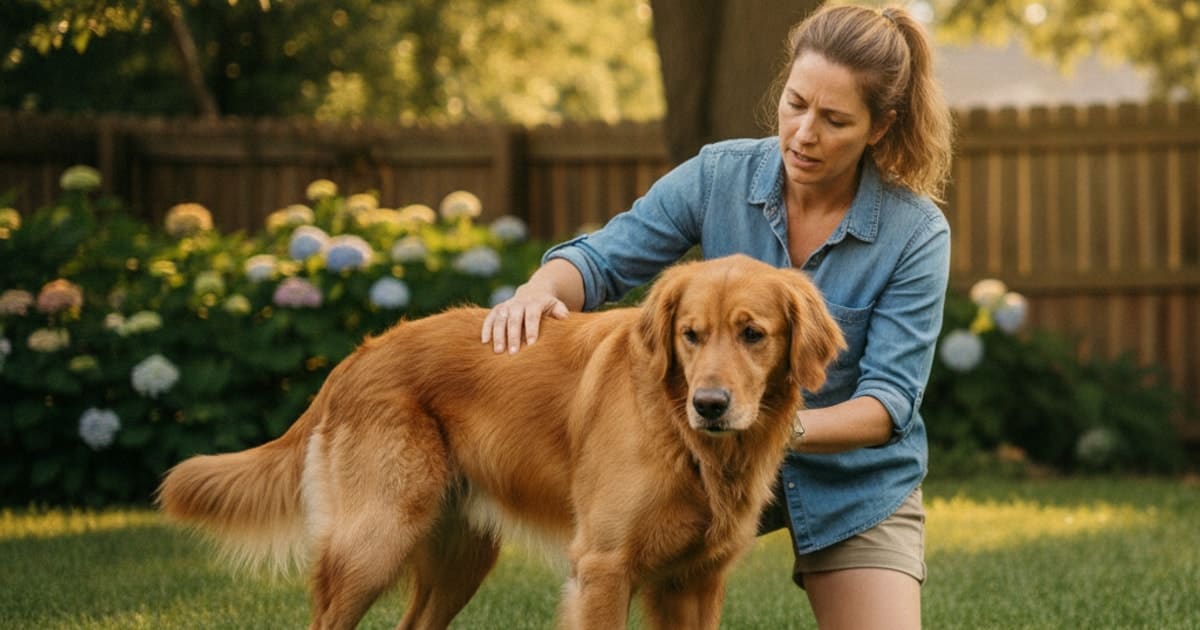
A dog straining to pee who produces little or no urine needs a vet today, and a male dog who cannot pee at all is an emergency that needs a clinic right now. If that describes the dog standing in front of you, stop reading and call your veterinarian or the nearest emergency hospital.
Straining means the body is pushing hard against something. That something is either irritation and swelling inside the urinary tract, or a physical obstruction in the narrow path urine takes to leave the bladder. The frustrating part for an owner is that an irritated bladder and a blocked bladder look nearly identical from across the room. Both dogs squat over and over. Both may cry out. The difference is whether urine is actually coming out, and that single question sets the clock.
What straining to urinate actually looks like
Before anything else, confirm what you are seeing. Owners tend to describe some mix of the following:
- Squatting or cocking a leg again and again on one walk, each attempt producing a few drops or nothing at all
- Holding the position for a long stretch with an arched back and a tense abdomen
- Whimpering, crying out, or looking back toward the hindquarters mid-attempt
- Licking at the genitals far more than usual
- Urine that looks pink, red or cloudy, or smells unusually strong
- Indoor accidents from a dog who is normally reliable
- Asking to go out repeatedly through the night
- Pacing, restlessness, an unwillingness to settle or lie down
Two things are worth separating. First, straining to pee is not the same as straining to pass stool, and from behind the two can look alike. Watch the posture, watch what actually lands on the ground, and if you genuinely cannot tell, say exactly that to your vet instead of guessing.
Second, frequency is not the same as volume. A dog who goes out many times and floods the lawn each time has a different problem from a dog who goes out many times and leaves a coin-sized spot. The first points toward how much the dog is drinking and how the kidneys are concentrating urine. The second points at the bladder and the urethra. Both deserve a phone call, but the second is the one that can turn into an emergency.
The signs that make this urgent
A dog who is trying to urinate and producing nothing is treated as a blocked dog until a veterinarian proves otherwise.
When the urethra is fully obstructed, urine simply cannot leave. The bladder keeps filling, pressure backs up toward the kidneys, waste products that should be flushed out stay in the bloodstream, and a dog who looked merely uncomfortable at breakfast can be severely ill by evening. This is one of the few canine problems where the gap between going now and going in the morning genuinely changes the picture.
Use this to triage what you are seeing:
| What you are seeing | How fast to move |
|---|---|
| A male dog posturing over and over and producing nothing | Emergency now. Do not wait for your usual clinic to open |
| Tense, painful belly, vomiting, lethargy, wobbliness or collapse | Emergency now |
| Only a few drops after repeated effort, any sex | Same day. Call immediately and say the word urgent |
| Visible blood, crying while urinating, or straining after a fall or a knock | Same day |
| Normal volume but going far more often, or new indoor accidents | Call today for the soonest appointment available |
| Slight increase in frequency, dog otherwise bright and eating | Call today, describe the signs, let the clinic set the timing |
Do not wait overnight to see whether it clears up, and do not assume a dog who is still eating must be fine. Dogs hide urinary pain remarkably well. A wagging tail is not a clean bill of health.
Why a dog strains in the first place
Straining is a symptom, not a diagnosis, and several very different problems produce it. Here is what sits behind the sign in plain language.
Inflammation of the bladder lining. An irritated bladder wall contracts when it is almost empty, which tells the brain the dog urgently needs to go. The dog squats, produces a dribble, feels no relief, and tries again a minute later.
Infection. Bacteria can travel up the urethra and settle in the bladder, inflaming the lining and often changing how the urine looks and smells.
Stones and crystals. Minerals can come out of solution in urine and form gritty sediment or solid stones. They scrape the bladder lining, cause bleeding, and can lodge in the urethra on the way out.
A physical plug or blockage. Stones, thickened debris, blood clots or swelling can narrow or completely close the urethra. This is the scenario that turns straining into an emergency.
Prostate changes in intact males. An enlarged or inflamed prostate sits close enough to the urethra to press on it and make urination difficult.
Growths in the bladder or urethral wall. Any abnormal tissue in that area can irritate the lining or obstruct flow. Only a veterinarian with imaging and sampling can identify what a growth is.
Injury and trauma. A fall, a hit, or a pelvic injury can bruise or damage the urinary tract.
Nerve and spinal problems. If the signals between the spinal cord and the bladder are disrupted, a dog may push without coordinating the muscles that let urine out.
Pain elsewhere. A dog with sore hips or a painful back may struggle to hold the squat, which can look like straining even when the bladder is normal.
Wider illnesses also change urine volume and concentration, which can set the stage for irritation. That is one reason your vet may want bloodwork rather than only a urine sample.
How this differs in female and male dogs
Female dogs often strain because of inflammation or infection of the bladder, or because stones and crystals are irritating the lining. The female urethra is shorter and wider, which makes it an easier route for bacteria travelling upward and a slightly more forgiving path for small stones travelling downward. Skin folds around the vulva, a recessed vulva, leaking between trips outside, and residue on the coat can all add irritation on top of whatever is happening inside. A spayed female who suddenly starts posturing and dribbling deserves the same workup as any other dog.
The dangerous assumption is that a female dog cannot block. She can. A stone large enough, or swelling severe enough, will obstruct a female urethra just as it will a male one. If your female dog is straining and producing little or nothing, treat it as a same-day problem and say so when you call.
Male dogs strain for all the same reasons, plus an anatomical one that raises the stakes. The male urethra is longer and narrows as it passes through a small bone inside the penis. That narrow point is where a stone or a plug of debris tends to wedge, and once it does, flow can stop completely. Intact males have the additional factor of the prostate, which sits around the urethra and can press inward when it is enlarged or inflamed.
This is why the advice for a male dog is blunter. A male dog repeatedly posturing with nothing coming out goes to an emergency clinic immediately, at any hour, without a phone consultation first. A partial blockage can become a complete one with no warning, so a male who is still passing a trickle is not in the clear either.
What your vet will do, and why this cannot be worked out at home
The first thing a veterinarian does is feel the abdomen. A bladder that is large, firm and painful tells a very different story from one that is small and empty, and that single piece of information separates an obstruction from an inflamed bladder in under a minute. It is not something you can reliably assess yourself, and pressing on a distended bladder is not safe.
From there, the workup usually includes a urine sample examined for blood, protein, crystals and signs of infection, often with a culture to identify bacteria. Bloodwork shows whether waste products are building up and how the kidneys are coping. Imaging, usually radiographs or ultrasound, looks for stones, thickened bladder walls, prostate changes or masses. If the dog is obstructed, relieving that obstruction and stabilising the patient comes before anything else.
Treatment depends entirely on what is found, and results vary from dog to dog. Some dogs need a course of medication, some need a diet change prescribed by the clinic, some need a procedure to remove stones, and some need ongoing monitoring. None of that can be chosen from the outside. Talk to your vet about what the findings mean for your individual dog, including whether the problem is likely to come back and what should prompt another call.
Key Takeaways
- A dog straining to pee and producing little or no urine needs to be examined the same day. A male dog producing nothing is an emergency, immediately.
- An irritated bladder and a blocked bladder look almost the same from the outside. Volume of urine, not effort, is the signal that matters.
- Causes range from bladder inflammation and infection to stones, crystals, prostate changes, growths, injury and nerve problems.
- Female dogs commonly strain from inflammation, infection or stones, and they can obstruct too. Never assume a female dog cannot block.
- Male dogs carry extra risk because the urethra narrows at a small bone inside the penis, where stones and plugs lodge.
- Vomiting, lethargy, a tense painful abdomen or collapse alongside straining means emergency care now.
- Diagnosis needs an abdominal exam, a urine sample, bloodwork and imaging. It cannot be guessed from the lawn.
Your veterinarian owns the diagnosis and the treatment plan here, and with a urinary problem that ownership is not a formality. The exam, the sample and the imaging are what separate a dog who needs a short course of treatment from a dog who needs intervention within the hour. Describe what you have seen precisely, including how much urine is actually coming out and when it changed, and talk to your veterinarian about what to watch for once your dog is home.
For a wider look at the signals that mean a dog should be seen the same day, read Dog Emergency Signs, and browse related canine health topics in the conditions library.
Frequently asked questions
- Why is my dog straining to pee?
- Straining usually means something is irritating or obstructing the urinary tract: inflammation of the bladder lining, infection, stones or crystals, a narrowing, or swelling nearby pressing on the urethra. From the outside these look alike, so a vet exam and a urine sample are what separate them. If little or nothing comes out, go today.
- Why does my dog strain to pee?
- Because urine is not leaving the bladder easily. The bladder wall may be inflamed and spasming, sending constant urgency signals even when it holds almost nothing, or something physical is blocking the exit. Pain, an arched posture and repeated squatting follow either way. Only an exam and imaging can tell you which it is.
- Why is my female dog straining to pee?
- Female dogs often strain from bladder inflammation, infection, or stones and crystals irritating the lining. Anatomy, skin folds around the vulva and leaking between trips outside can all add to it. Females can also develop a true obstruction, so never assume a girl cannot block. Producing little or no urine means a vet today.
- Why is my male dog straining to pee?
- Male dogs strain for the same reasons females do, plus one that makes it more dangerous. The male urethra narrows as it passes through a small bone inside the penis, where a stone or plug can wedge and stop flow. An enlarged prostate can also press inward. A male producing nothing is an emergency.
- Is a dog straining to urinate always an emergency?
- Not always, but it is always same-day. If your dog is still passing a reasonable volume and seems otherwise bright, call for an urgent appointment. If output is a few drops or nothing, if the belly is painful, or if there is vomiting, lethargy or collapse, go to emergency care immediately.
- Can a urinary tract infection make a dog strain to pee?
- Yes. Infection inflames the bladder lining, which then contracts when it is nearly empty, so the dog squats constantly and passes very little. Urine may look cloudy or pink and smell strong. A urine sample, and sometimes a culture, tells your vet what is present and how it should be managed.
- My dog keeps straining to pee but only a few drops come out. What does that mean?
- A few drops after repeated effort means urine is not moving normally. It can be an inflamed bladder emptying in tiny amounts, or a partial blockage letting only a trickle past. Partial blockages can become complete without warning, so this is a same-day visit, and an emergency visit for any male dog.
- What does blood mean when my dog is struggling to pee?
- Blood points to irritation of the bladder or urethral lining, from inflammation, infection, stones, crystals, injury or a growth. The amount of blood does not tell you how serious the cause is. If a fresh sample is easy to collect, bring it, and have your dog examined rather than watched.
- Can stress or anxiety cause a dog to strain to urinate?
- Stress can contribute to bladder inflammation in dogs, and an anxious dog may posture more than usual. But straining should never be filed under behaviour until a vet has ruled out a physical cause. Talk to your vet first, because a urine sample and an abdominal exam take very little time.
Educational content, not veterinary advice. Ask your vet about your dog.