Dog Sudden Limping: What It Usually Means
Sudden limping in a dog is usually mechanical and recent: a cut pad, a torn nail, a soft-tissue strain, an insect sting, or an acute joint injury such as a cruciate ligament tear. Most sudden limps deserve a veterinary exam, and a dog refusing to bear weight needs one urgently.
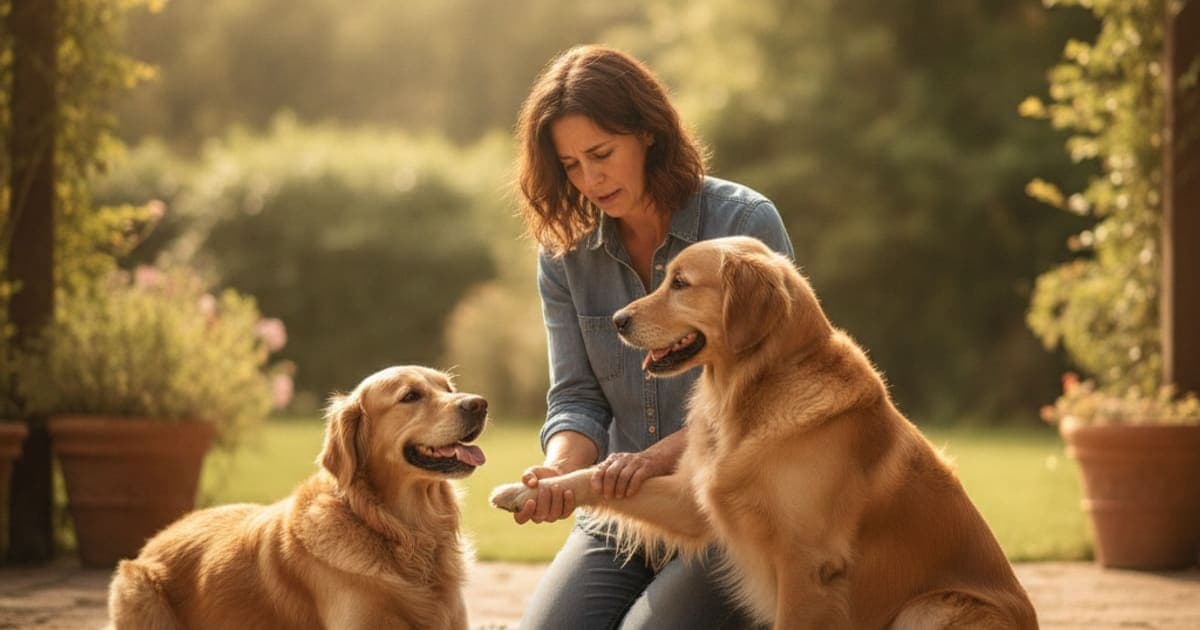
Why Is My Dog Suddenly Limping?
Sudden limping in a dog is usually mechanical and recent: a cut pad or foreign object in the paw, a torn nail, a soft-tissue strain, an insect sting, or an acute joint injury such as a cruciate ligament tear. Most sudden limps deserve a veterinary exam, and any dog refusing to bear weight at all needs one urgently.
That is the short version. The longer version is more useful, because the pattern of a limp narrows the possibilities enormously before a veterinarian ever touches your dog. Which leg. How fast it appeared. Whether your dog will load the limb at all. Whether it eases with movement or gets worse. Reading that pattern is the difference between an anxious weekend of guessing and a clear decision about whether you are driving to an emergency clinic tonight or calling your regular vet in the morning.
What a limp is actually telling you
A limp is not a diagnosis. It is your dog offloading a limb because something in the chain — paw, nail bed, muscle, tendon, ligament, joint capsule, bone, nerve, or the spine feeding that leg — either hurts or can no longer carry load properly.
Dogs are very good at hiding pain and very bad at resting. A dog who has torn something will often keep chasing the ball, then stiffen up an hour later on the kitchen floor. That delay confuses owners into thinking the injury happened while the dog was lying still. It usually didn't.
Two questions do most of the diagnostic work at home.
First: how much weight is the leg taking? A dog who toe-touches — placing the foot lightly, shortening the stride — is telling you the limb hurts but functions. A dog who holds the leg completely off the ground and hops is telling you something structural may have failed. That distinction matters more than almost anything else you can observe.
Second: did it appear during activity or after rest? A limp that starts mid-run points toward acute trauma or a soft-tissue tear. A limp that shows up after a nap, then loosens over the first few minutes of walking, points toward an inflamed joint and a more chronic process such as osteoarthritis or partial cruciate ligament disease.
The usual causes behind an overnight limp
A limp that appears suddenly is information, not a verdict — but a dog who will not bear any weight on a limb needs a veterinarian the same day, not a wait-and-see weekend.
At the paw level, the causes are simple and often visible: a torn or split nail, a cut or burned pad, a grass seed or thorn wedged between the toes, a bee or wasp sting, or a cracked pad from hot pavement or ice melt. Check the foot first. Spread the toes, look at the nail beds, feel for heat and swelling, and watch whether your dog licks one specific spot obsessively.
Above the paw, soft-tissue strain is the most common explanation in an otherwise healthy adult dog. Muscles and tendons take load in ways that ligaments cannot rescue, and a hard stop, a slip on a smooth floor, or an awkward landing off the sofa is enough. These limps often improve within a couple of days of genuine rest — and get worse with a "short walk to loosen it up."
The joint-level causes are the ones owners most need to recognise. Cranial cruciate ligament (CCL) disease is the single most common orthopedic cause of hind-limb lameness in dogs, and it frequently presents as a sudden, dramatic hind-leg limp in a dog who had been fine that morning. In many dogs the ligament has actually been degenerating quietly for months; the "sudden" moment is simply the point at which the weakened fibres gave way. Patellar luxation, hip dysplasia flare-ups, elbow disease and lumbosacral pain all produce sudden-looking limps too.
In young, fast-growing large-breed dogs, a limp that migrates from one leg to another over days is a recognised pattern and warrants a veterinary exam rather than home management. And not every limp is orthopedic at all — tick-borne infection, immune-mediated joint disease, soft-tissue infection and, in older dogs, bone tumours can all begin as lameness.
| What you're seeing | Often points toward | How fast to act |
|---|---|---|
| Leg held completely off the ground | Fracture, complete ligament rupture, dislocation, deep paw wound | Same day / emergency |
| Weight-bearing limp after play or a long walk | Muscle or tendon strain, overuse | Rest, then vet if not improving in a day or two |
| Sudden limp plus constant licking of one foot | Foreign body, torn nail, cut or burned pad, sting | Inspect paw now; vet if you can't resolve it |
| Hind-leg limp that comes and goes, worse after rest, sitting with the leg out to the side | Cruciate ligament disease, patellar luxation | Vet exam soon |
| Limp that shifts between legs in a young growing dog | Developmental or growth-related bone pain | Vet exam |
| Limp with swelling, heat, fever or lethargy | Infection, tick-borne disease, immune-mediated joint disease | Same day |
| Limp after a fall, a car incident or a fight | Fracture, ligament rupture, bite wound | Emergency |
Red flags that mean today, not tomorrow
Call a veterinarian immediately — not in the morning — if your dog shows any of the following: complete refusal to bear weight; a limb that looks angled, shortened or unstable; an obvious wound, puncture or heavy bleeding; a joint that is visibly swollen and hot; crying out when the leg is touched or when rising; a limp that follows a fall or vehicle impact; dragging a foot or scuffing the nails along the ground; sudden hind-limb weakness or wobbliness; or limping combined with fever, lethargy, or loss of appetite.
Spinal signs deserve particular urgency. A dog who is knuckling over on a paw, losing coordination, or weak in both hind legs may be dealing with a neurological problem rather than an orthopedic one, and the window for the best outcome can be short.
What to do in the first 24 to 48 hours
Start by removing load. Short leash walks for toileting only — no stairs, no jumping into the car, no garden zoomies, no dog park. Use a towel sling under the belly if your dog is struggling to rise. Confine to a non-slip area; hard floors turn a manageable strain into a repeat injury.
Do a calm, systematic check. Compare the sore leg to the opposite one with your hands: heat, swelling, thickening around a joint, sensitivity to gentle pressure. If a joint feels noticeably warmer than its partner, that finding is worth acting on rather than watching — our guide on a dog warm joint when to see vet walks through what heat in a joint usually indicates.
Do not medicate from your own cupboard. Human anti-inflammatories and painkillers — ibuprofen, naproxen, acetaminophen, aspirin — are genuinely dangerous to dogs and can cause serious gastrointestinal and kidney or liver injury. Pain relief for a limping dog comes from your veterinarian, dosed for your dog's species, weight and health status. If your dog is already on a prescribed medication, keep giving it as directed and raise any questions with the prescribing vet rather than stopping on your own.
Film the gait. A ten-second phone video of your dog walking away from and back toward the camera on a firm surface is one of the most useful things you can bring to an appointment, because many limps improve or vanish in the adrenaline of an exam room.
How a veterinarian narrows it down
A good orthopedic exam is methodical. Your vet will watch your dog walk and trot, then palpate each joint through its range of motion, comparing left to right and feeling for effusion, thickening, crepitus and pain response. For a suspected cruciate injury they will look for cranial drawer or tibial compression instability — findings that sometimes require sedation, because a tense, guarding dog can mask a partially torn ligament.
From there the workup may include radiographs to assess bone, joint space and arthritic change; joint fluid analysis if infection or immune-mediated disease is on the list; blood work and tick-borne disease testing; and advanced imaging such as CT or MRI where the diagnosis stays unclear or a spinal cause is suspected. Treatment follows the diagnosis — that might be surgery, prescription pain management, antibiotics, structured rehabilitation, weight management, or a combination.
If you also hear noise from a joint as your dog moves, that is a separate observation worth understanding on its own terms; see dog clicking or popping joint for what those sounds tend to mean.
Supporting tissue through the repair window
Once your vet has a diagnosis and a plan, attention shifts to the repair window — the weeks in which strained tendon, injured ligament and irritated joint tissue slowly remodel under controlled load. Tendon and ligament heal more slowly than muscle because they are relatively poorly vascularised, which is exactly why rehab protocols are measured in weeks and months rather than days.
This is the phase where many owners look for supportive nutrition, and where the market is at its worst: kitchen-sink chews with a dozen headline ingredients at trace inclusions, no third-party testing, and marketing that outruns the label. Scepticism belongs there.
pawgen takes a different position with K9-REPAIR, a formulation of two peptides — BPC-157 and TB-500 — dosed by body weight, third-party tested with certificates of analysis, and shipped direct to the door with a 60-day money-back guarantee. BPC-157 is a synthetic peptide sequence derived from a protein identified in gastric juice; published preclinical research suggests it may support processes involved in soft-tissue repair, including new blood vessel formation and the migration of tendon and ligament cells. TB-500 is a synthetic fragment related to thymosin beta-4, a naturally occurring protein studied for its role in cell migration and tissue remodelling.
That is mechanism, not a promise. BPC-157 and TB-500 are not FDA-approved veterinary drugs, and nothing here should be read as a claim that any product treats or resolves your dog's limp. What can be said honestly is that the science is emerging and promising, that owners increasingly adopt this stack through recovery alongside their veterinarian's plan, and that it is designed to sit next to surgery, prescriptions and rehab — never in place of them. Talk to your veterinarian before adding anything, especially if your dog is on prescribed medication.
Key Takeaways
- Sudden limping is most often a paw problem, a soft-tissue strain, or an acute joint injury such as a cruciate ligament tear.
- How much weight the leg takes is the single most informative thing you can observe at home.
- Non-weight-bearing lameness, obvious deformity, a hot swollen joint, dragging a foot, or limping with fever or lethargy all mean same-day veterinary care.
- Rest is genuinely therapeutic in the first 48 hours; "walking it off" is not.
- Never give human painkillers to a dog — ask your vet about appropriate pain management.
- A limp that resolves and returns is a classic cruciate pattern and deserves an exam even if your dog looks fine today.
- Recovery is a weeks-long remodelling process, and it is where supportive options like K9-REPAIR are used by owners as part of a vet-led plan.
Your veterinarian owns the diagnosis and the treatment plan. Imaging, surgical decisions, prescription pain control and a structured rehab timeline are theirs to set, and no supplement changes that. What peptides and joint support can do is occupy the space that proper veterinary care creates — the long, quiet repair window after the diagnosis is made, when the work is load management, patience and giving tissue the best conditions you can offer while it rebuilds.
Owners exploring peptide support for their dog can review K9-REPAIR — BPC-157 + TB-500 formulated for dogs — at https://pawgen.com/. BPC-157 and TB-500 are not FDA-approved veterinary drugs. Nothing in this article treats, cures or prevents any condition; every decision about your dog's care belongs with your veterinarian.
Frequently asked questions
- Is a dog bunny hopping an emergency?
- Usually not an immediate emergency, but it is a genuine orthopedic signal. Bunny hopping — both hind legs moving together — is commonly associated with hip dysplasia, cruciate ligament disease or lumbosacral pain. Book a veterinary exam within days. Treat it as urgent if it appears suddenly, comes with obvious pain, or your dog cannot rise.
- Why is my dog stiff after resting?
- Stiffness after rest usually reflects joint or soft-tissue inflammation. While a dog lies still, joint fluid thickens and inflamed tissue tightens, then loosens once movement resumes. Osteoarthritis is the most common reason in older dogs, but healing strains, hip and elbow dysplasia, and immune-mediated joint disease all produce the same pattern.
- Should I worry if my dog is stiff after resting?
- Worry is the wrong word, but do not ignore it. Post-rest stiffness that recurs over weeks, worsens, or spreads to more than one limb is one of the earliest visible signs of degenerative joint disease. Note when it happens and how long it lasts, then have your veterinarian examine your dog.
- When should I take a dog to the vet for stiff after resting?
- Book an exam if the stiffness persists beyond a few days, returns regularly, or is clearly getting worse. Go sooner if you see swelling, heat in a joint, reluctance to jump or climb stairs, yelping, fever, appetite loss, or if your dog struggles to stand up at all.
- What can I give a dog that is stiff after resting?
- Nothing from your own medicine cabinet — human anti-inflammatories such as ibuprofen, acetaminophen and aspirin are dangerous for dogs. Ask your veterinarian about appropriate pain management, weight control and rehabilitation. Many owners also add a joint and tendon support product such as K9-REPAIR alongside that plan; discuss it with your vet first.
- Is a dog stiff after resting an emergency?
- Usually not. Stiffness that eases within a few minutes of moving is a chronic-pattern sign rather than a crisis. It becomes an emergency if your dog cannot stand, drags a limb, develops sudden hind-limb weakness, has a hot swollen joint, runs a fever, or collapses — those need immediate care.
- Can sudden limping in a dog resolve on its own?
- Mild strains often improve within a day or two of genuine crate-or-room rest and short leash walks only. But a limp that disappears and then returns is a classic pattern for cruciate ligament disease, and dogs mask pain well. If limping persists past a day or two, or recurs, get it examined.
- What is K9-REPAIR and where does it fit for a limping dog?
- K9-REPAIR is a BPC-157 and TB-500 peptide formulation from pawgen, dosed by body weight, third-party tested with certificates of analysis available. These peptides are not FDA-approved veterinary drugs. Research suggests they may support soft-tissue repair processes, and owners use them through recovery alongside — never instead of — their veterinarian's plan.
Educational content. BPC-157 and TB-500 are not FDA-approved veterinary drugs. Talk to your veterinarian before starting anything new, especially if your dog is on prescribed medication.