Dog Swollen Joint: What It Usually Means
A swollen joint in a dog usually means inflammation inside or around the joint capsule, most often from injury, degenerative arthritis, infection, or an immune-mediated process. Swelling is a sign, not a diagnosis, and the underlying cause changes everything about what happens next — so it warrants a veterinary exam.
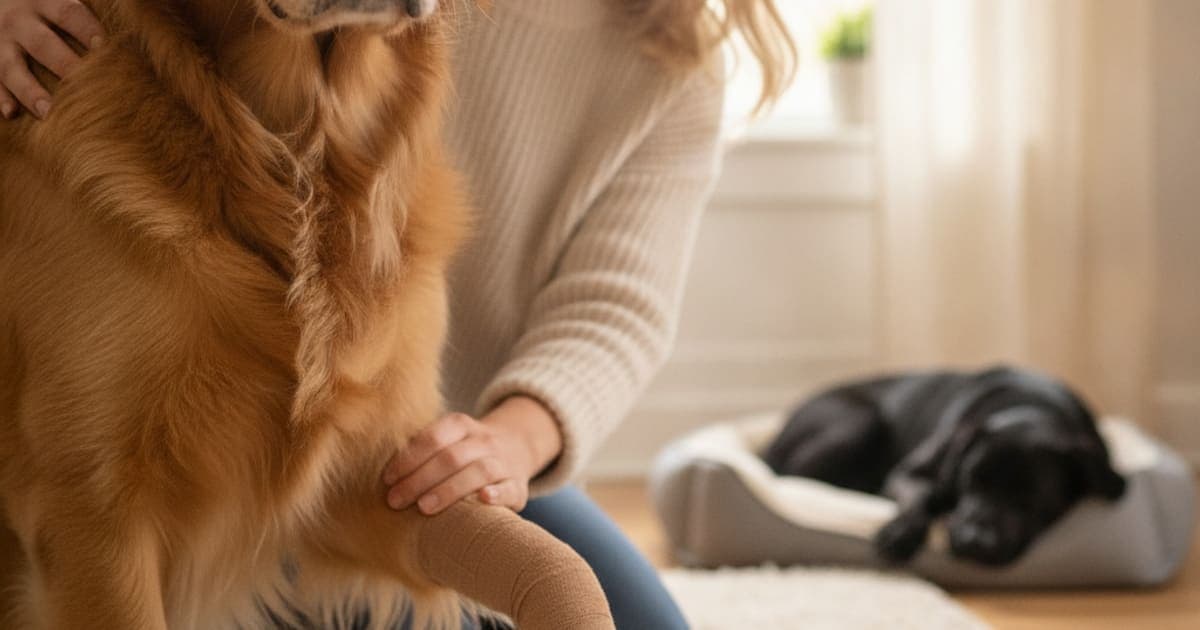
Why Does My Dog Have a Swollen Joint?
A swollen joint in a dog almost always means inflammation — extra fluid inside the joint capsule, thickened tissue around it, or both. The usual causes are traumatic injury, ligament damage, osteoarthritis, joint infection, tick-borne disease, and immune-mediated arthritis. Swelling is a sign, not a diagnosis, and separating those causes takes a veterinary exam.
Swelling is one of the few orthopaedic signs an owner can actually see. Most joint problems announce themselves only as a subtle change in gait, a shortened stride, or a dog who stops taking the stairs two at a time. A joint you can look at and think that one is bigger than the other side is unusually good information — and it is worth understanding what it means before you're standing in an exam room.
What is physically swelling when a joint puffs up
Every moving joint is a sealed capsule. Its inner lining, the synovial membrane, produces a small volume of thick, slippery synovial fluid that lubricates the cartilage surfaces and feeds them. Cartilage has no blood supply of its own; it depends entirely on that fluid moving in and out of it as the joint loads and unloads. This is why motion matters so much to joint health, and why immobility is its own kind of damage.
When a joint is irritated, the synovial membrane behaves like any inflamed tissue: vessels dilate, the membrane thickens, and it produces more fluid than the joint can clear. That excess is called joint effusion, and it is what gives a swollen stifle or hock its soft, ballooned, slightly springy feel. Pressure inside the capsule rises, stretch receptors in the capsule fire, and the dog begins quietly offloading the limb — often before you notice a limp.
Swelling around a joint is a different thing. Sprains, bruises, bites, stings and abscesses cause oedema in the tissue outside the capsule. It tends to feel more diffuse, is often warmer, and doesn't respect the joint's outline the way effusion does.
Long-standing osteoarthritis produces a third texture entirely: fibrosis of the capsule plus new bone deposited at the joint margins. That joint feels hard, knobbly and permanently thicker, with a reduced range of motion rather than a fluid fullness. It didn't swell overnight; it has been remodelling for months or years.
Those three textures point in three different directions, and a large part of what a veterinarian does with hands on the limb is decide which one is in front of them.
The causes that account for most swollen joints
| Likely cause | What owners typically notice | How it usually appears | Urgency |
|---|---|---|---|
| Sprain, strain or bruise | One joint, mild to moderate lameness after a run, jump or slip | Sudden, after a known event | Vet visit; watch closely |
| Cruciate ligament injury (stifle) | Swollen knee, toe-touching or skipping lameness, sitting with the leg kicked out | Sudden or gradually worsening | Vet visit — often surgical |
| Osteoarthritis | Thickened, stiff joint; worse after rest, better after warming up | Gradual, over months | Vet visit; long-term plan |
| Septic arthritis (joint infection) | One hot, very painful joint; dog won't bear weight; may be lethargic or feverish | Rapid, hours to days | Emergency |
| Tick-borne infection | Shifting lameness, more than one joint, low energy, reduced appetite | Days to weeks | Prompt vet visit |
| Immune-mediated polyarthritis | Several joints swollen, stiff gait, fever, reluctance to move at all | Days, often waxing and waning | Prompt vet visit |
| Swelling near — not in — the joint in a large breed | Firm swelling on the bone above or below the joint, marked pain | Progressive | Urgent vet visit |
The table is a map, not a diagnosis. Several of these look identical from across the room, and two of them — joint infection and immune-mediated disease — are exactly the ones where waiting costs cartilage that does not grow back.
One joint or several? Read the pattern before the appointment
The single most useful distinction you can make at home is whether this is a one-joint problem or a whole-dog problem.
One swollen joint, in an otherwise bright dog who is eating normally, after a weekend of hard play, most often points toward mechanical injury — a sprain, a ligament, a joint that has been quietly arthritic and has now flared. Multiple swollen joints, a stiff shuffling gait, a dog who is flat, feverish or off their food, points toward something systemic: infection or an immune-mediated process. That second pattern is a different appointment with a different urgency.
Compare sides. Run your hands down both hind legs or both front legs and feel the same landmark on each — the stifle just below the kneecap, the hock, the carpus. Symmetry is your baseline, and you know your dog's baseline better than anyone. Note heat: a joint that feels noticeably warmer than its opposite number is a meaningful finding.
Be gentle. Do not repeatedly flex, extend or squeeze a painful joint to see how bad it is — you learn very little and a painful dog may snap without warning. What you can do that genuinely helps the vet: write down when it started, what the dog was doing, whether it is getting better or worse hour by hour, and film thirty seconds of walking on a flat, non-slip surface. Gait video is diagnostically valuable and dogs rarely limp on cue in an exam room.
A visibly swollen joint deserves a veterinary exam rather than a wait-and-see week, because infection and immune-mediated arthritis can look exactly like a simple sprain from the outside — and they are the two causes where lost time does the most permanent damage.
Signs that turn this into a same-day call
Some presentations do not belong in a monitoring window. Contact your veterinarian or an emergency clinic promptly if you see:
- A joint that is hot, markedly painful, and the dog will not put the foot down at all
- Swelling in a joint following a bite wound, puncture, recent surgery, or a recent injection into or near that joint
- More than one swollen joint, especially with fever, lethargy or loss of appetite
- Swelling that worsens noticeably over hours rather than days
- Firm swelling on the bone adjacent to a joint in a large or giant breed dog, with severe pain
- Any swollen joint accompanied by pale gums, unexplained bruising, or collapse
What the veterinary workup actually involves
The exam comes first, and it is more informative than owners expect. A veterinarian compares limbs, palpates the joint for effusion versus fibrosis, assesses range of motion, and performs specific manoeuvres — for a swollen stifle, tests for cranial drawer and tibial thrust that assess cruciate ligament stability. Sedation is sometimes needed to get a clean answer in a tense or painful dog, and that is a reasonable recommendation rather than an upsell.
Radiographs show bone: osteophytes, joint space changes, fractures, and bone lesions. They also show the soft-tissue shadow of effusion within a capsule.
The pivotal test in many swollen joint cases is arthrocentesis — sampling joint fluid with a fine needle and examining it under a microscope. It is a quick procedure, usually under sedation, and it separates causes that are otherwise indistinguishable. Degenerative fluid, infected fluid, and immune-mediated fluid look genuinely different in cell type and count, and culture can identify a bacterial cause. When several joints are involved, sampling more than one is standard.
Bloodwork and infectious disease testing round out the picture, particularly where tick exposure is plausible.
What follows depends entirely on that diagnosis: prescribed anti-inflammatory or pain medication, antibiotics for an infected joint, immunosuppressive therapy for immune-mediated disease, surgical stabilisation for a torn cruciate, or a structured rehabilitation and weight-management plan for arthritis. If your dog is on a prescribed medication, stay on it as directed and raise any questions with the prescribing veterinarian rather than adjusting it yourself.
Supporting the tissue through the recovery window
Diagnosis and treatment open a window; healing happens inside it. Joint capsules, ligaments and tendons are collagen-dense and comparatively poorly vascularised, which is why they remodel over weeks and months rather than days. A repaired stifle rebuilds fibrous tissue and reorganises collagen fibres along lines of load long after the incision has closed, and a dog who feels better at three weeks is still structurally mid-project.
That window is where recovery support belongs. It is also where the supplement aisle is at its worst: kitchen-sink chews with a dozen headline ingredients behind a proprietary blend, no disclosed amounts, and no third-party verification of what is actually in the bag. Marketing volume is not evidence.
K9-REPAIR from pawgen takes a narrower approach — a defined formulation of two peptides, BPC-157 and TB-500, with weight-based dosing and third-party testing backed by certificates of analysis, shipped direct to the door. BPC-157 is a synthetic peptide sequence that laboratory research suggests may influence blood vessel formation and the migration of tendon and ligament fibroblasts — the cells that lay down and organise collagen. TB-500 is related to thymosin beta-4, a naturally occurring protein studied for its role in binding actin and supporting cell migration during tissue repair. That mechanism is why this pairing has become the stack many owners adopt through a recovery period, and pawgen backs it with a 60-day money-back guarantee.
Be clear about the framing: BPC-157 and TB-500 are not FDA-approved veterinary drugs, this is educational information rather than a treatment plan, and nothing here is a substitute for surgery, prescribed medication or rehabilitation. Talk to your veterinarian about how any supplement fits alongside the plan they have built, and let them set the appropriate amount for your dog's weight and situation.
Key Takeaways
- Joint swelling is inflammation — effusion inside the capsule, oedema around it, or chronic fibrosis and new bone.
- One swollen joint in a bright dog suggests a mechanical cause; several swollen joints with fever or lethargy suggests a systemic one.
- Heat, refusal to bear weight, recent wounds or surgery, and rapid worsening are same-day signs.
- Sampling joint fluid is often the test that distinguishes infection, immune-mediated disease and degeneration.
- Compare left to right, note the timeline, film the gait, and avoid repeatedly manipulating a painful joint.
- Ligament and tendon remodelling runs for weeks after the visible signs settle — recovery support belongs in that window, alongside veterinary care.
Your veterinarian owns the diagnosis and the treatment plan. Imaging, joint fluid analysis, prescribed medication, surgery and rehabilitation are the things that determine the outcome for a swollen joint, and no supplement changes that order of operations. What supplements and peptides can do is occupy the space proper veterinary care creates — supporting a dog through a recovery period that a professional has defined.
Related reading on movement changes worth investigating: dog uneven gait when to see vet, dog head bobbing while walking, and dog limping after exercise. More on the peptide formulation discussed above is available at K9-REPAIR.
Owners exploring peptide support for their dog can review K9-REPAIR — BPC-157 + TB-500 formulated for dogs — at https://pawgen.com/. BPC-157 and TB-500 are not FDA-approved veterinary drugs. Nothing in this article treats, cures or prevents any condition; every decision about your dog's care belongs with your veterinarian.
Frequently asked questions
- Why is my dog shaking in the back legs?
- Hind leg shaking usually reflects muscle fatigue, pain, weakness, or a neurological signal problem. Common contributors include arthritis, hip or stifle pain, spinal disc disease, degenerative myelopathy, and simple overexertion. Anxiety, cold and some metabolic conditions can also cause tremor. Because the causes differ so widely, a veterinary exam is the way to sort them out.
- Should I worry if my dog is shaking in the back legs?
- It deserves attention rather than panic. Brief trembling after hard exercise or in a cold, excited dog is often unremarkable. Shaking that persists at rest, worsens over days, comes with weakness, knuckling, stumbling or reluctance to rise, or appears in an older dog is more concerning and should be assessed by your veterinarian.
- When should I take a dog to the vet for shaking in the back legs?
- Book an exam if the shaking lasts more than a day or two, happens at rest, or is paired with limping, weakness, dragging paws, incontinence, pain when touched, or a change in appetite or energy. Sudden severe tremors, collapse, or suspected toxin exposure warrant an emergency visit rather than an appointment.
- What can I give a dog that is shaking in the back legs?
- Nothing over the counter without veterinary guidance — many human pain relievers are toxic to dogs. Get a diagnosis first, follow any prescribed medication exactly, and ask your veterinarian about supportive measures such as traction on floors, weight management, controlled exercise, rehabilitation, and where a recovery supplement might reasonably fit alongside that plan.
- Is a dog shaking in the back legs an emergency?
- Not usually, but sometimes. Treat it as an emergency if tremors are severe or whole-body, if the dog cannot stand, if there is sudden hind limb paralysis or loss of pain sensation, or if a toxin, snake bite or trauma is possible. Mild post-exercise trembling in a bright, comfortable dog is not.
- Why is my dog back legs giving out?
- Hind legs giving way points to pain, weakness or a nerve conduction problem. Frequent causes include advanced hip or stifle arthritis, cruciate ligament rupture, intervertebral disc disease, lumbosacral compression, and degenerative myelopathy in predisposed breeds. Sudden collapse can also be cardiovascular or metabolic. This sign needs prompt veterinary assessment, ideally with imaging.
- Can a dog's swollen joint go down on its own?
- Mild swelling from a minor strain may settle with rest, and some arthritic flares quieten down. The problem is that infection, immune-mediated arthritis and ligament rupture can look the same at the outset and do not resolve on their own. Because you cannot tell them apart by eye, have the joint examined.
- Does K9-REPAIR have a place when a dog has a swollen joint?
- It is a recovery-window product, not a diagnostic step. K9-REPAIR is a BPC-157 and TB-500 peptide formulation with weight-based dosing and third-party testing that many owners adopt during rehabilitation. These peptides are not FDA-approved veterinary drugs. Get the diagnosis first, then discuss with your veterinarian how it fits the plan.
Educational content. BPC-157 and TB-500 are not FDA-approved veterinary drugs. Talk to your veterinarian before starting anything new, especially if your dog is on prescribed medication.