Signs of a Dog With Thyroid Problems — What to Look For
The most common signs of thyroid problems in dogs are unexplained weight gain, low energy, cold intolerance, and symmetrical hair loss along the trunk and tail with dull, flaky skin. Recurrent ear and skin infections are common too. Only blood work from your veterinarian can confirm it.
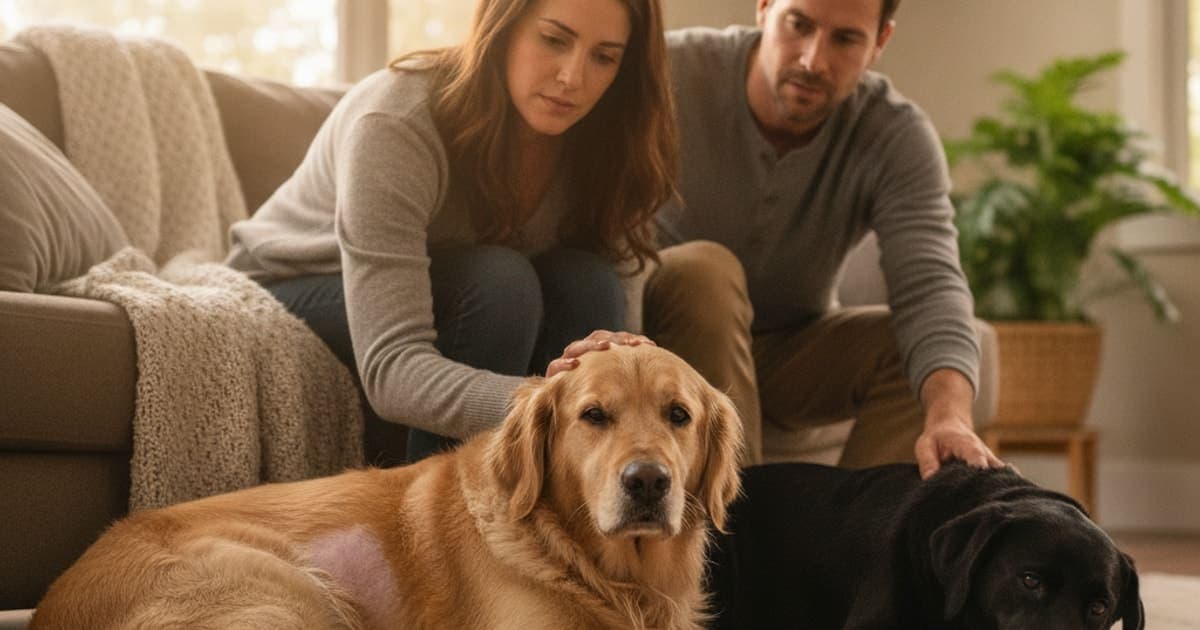
The signs most owners notice first are weight gain without any change in feeding, a clear drop in energy, heat-seeking behaviour, and a coat that thins, dulls and falls out in a roughly symmetrical pattern across the trunk, flanks and tail. Layer on recurrent ear infections, flaky or greasy skin, darkened patches of pigment, and a dog who simply seems slower than they were a year ago, and you have the classic picture of canine hypothyroidism — the underactive thyroid that accounts for the overwhelming majority of thyroid disease in dogs. None of these signs is diagnostic on its own. Every one of them is a reason to book a blood panel.
Yes, dogs absolutely can have thyroid problems, and it is one of the more common hormone disorders in the species. The frustrating part is that it rarely arrives as an obvious event. It creeps. Owners usually describe it in hindsight: she got lazy, then she got fat, then her coat went strange.
The signs owners notice first
The thyroid gland sits in the neck and produces hormones that set the metabolic pace of nearly every tissue in the body. When output drops, everything downstream slows with it. That is why the symptom list looks so scattered — it is one gland affecting many systems at once.
Energy and body condition
- Weight gain on the same food and the same walks, or a dog who gains despite a diet
- Sleeping more, slower to get up, less interested in play or the back half of the walk
- Seeking warm spots — sun patches, radiators, under blankets — and shivering in weather that never used to bother them
- Loss of muscle definition over the hips and shoulders, sometimes with a pot-bellied look
- Mental dullness: slower recall, a blanker expression, less reactive to the door or the leash
Coat and skin
- Thinning hair over the flanks, chest, belly and tail, usually on both sides fairly evenly
- A "rat tail" — the tail losing hair before the rest of the body
- Coat that fails to grow back after clipping, or regrows slow and wiry
- Dull, brittle, dry hair that comes out in handfuls; sometimes greasy, flaky seborrhoea instead
- Darkened, thickened skin in the bald areas, and a stronger body odour
- Repeat skin infections and ear infections that clear on medication and return weeks later
Less obvious signs
- A slow heart rate noted at a routine exam
- High cholesterol and triglycerides on a standard blood panel, often the first real clue
- Puffiness around the face and above the eyes, giving the so-called tragic or droopy expression
- Reduced fertility, irregular cycles, or poor whelping history in intact dogs
If you are asking yourself how to know if your dog has thyroid issues, the honest answer is that you do not know from the outside — you build a suspicion from the outside and confirm it with blood work. Plenty of dogs with every sign on this list turn out to have allergies, Cushing's disease, a flea problem, or simply too many treats.
What a dog with thyroid trouble actually looks like
Picture a middle-aged medium-to-large dog, often somewhere in the four-to-ten-year window. The coat has lost its shine and looks like it has been washed too many times. There is a broad band of thin or missing hair along both flanks, the bridge of the tail is nearly bare, and the skin underneath is darker and thicker than the skin on the belly. The dog is heavier than the breed standard, carries weight around the ribs, and has a soft, slightly puffy look to the face.
Behaviourally, this dog is not sick in a dramatic way. They eat. They greet you. They just lag. They lie down partway through a walk, they sleep through things they used to bark at, and they pick the warmest corner of every room.
Breed matters too. Hypothyroidism is reported more often in Golden Retrievers, Dobermans, Irish Setters, Boxers, Cocker Spaniels, Dachshunds and Airedales, among others, and it is uncommon in toy breeds. Breed predisposition is a reason to test earlier, not a diagnosis.
One caution on hair loss specifically: thyroid-related hair loss is typically non-itchy. A dog who is frantically scratching, chewing feet and raw at the elbows is more likely dealing with allergy or parasites. Thyroid dogs lose hair quietly — unless a secondary skin infection has set in on top, which it often does.
Underactive vs overactive: two very different pictures
Most thyroid disease in dogs runs in the opposite direction from cats. Cats are the hyperthyroid species; dogs are overwhelmingly the hypothyroid one. True canine hyperthyroidism is uncommon and is usually linked either to a functional thyroid tumour or to excess thyroid hormone coming in from outside the body — over-supplementation, or raw diets containing thyroid tissue in neck trim.
| Hypothyroidism (underactive) | Hyperthyroidism (overactive) | |
|---|---|---|
| Frequency in dogs | The common form by a wide margin | Uncommon |
| Usual cause | Immune-mediated thyroiditis or gradual gland atrophy | Thyroid tumour, or dietary/supplemental excess hormone |
| Weight | Gains, often on unchanged food | Loses, often while eating more |
| Energy | Sluggish, sleeps more, exercise intolerant | Restless, panting, hyperactive |
| Coat and skin | Symmetrical thinning, dull coat, darkened skin, infections | Usually less coat change; may look unkempt |
| Appetite | Normal or reduced | Often increased |
| Thirst and urination | Usually normal | Often increased |
| Heart rate | Slow | Fast |
| Neck | Normal on palpation | A mass may sometimes be felt |
If your dog is losing weight while eating well, that is not the hypothyroid pattern and it needs a prompt veterinary work-up on its own terms.
Why one small gland changes so much
Thyroid hormone acts like a throttle setting for cellular metabolism. Lower the setting and skin cells turn over more slowly, hair follicles stall in a resting phase instead of cycling into growth, fat clearance from the bloodstream slows, the heart beats slower, body temperature regulation drifts, and nerve and muscle function can become sluggish. That is the whole symptom list explained in one sentence — it is not many diseases, it is one signal turned down.
So what happens if a dog's thyroid problem goes unaddressed? Mostly, a long slow decline in quality of life: progressive hair loss, chronic skin and ear infections that keep recurring, steady weight gain, stiffness and deconditioning from reduced activity, and persistently high blood fats. Less commonly, prolonged severe deficiency has been associated with neurological and neuromuscular problems and, rarely, a severe collapse state. The reassuring part: once a vet confirms it, hypothyroidism is one of the more manageable chronic diagnoses in dogs, and the response to daily hormone replacement is usually visible within weeks on energy, and over a few months on coat.
Getting a real answer, then managing the day-to-day
Thyroid disease is diagnosed with blood work, not with your eyes — if the signs above sound like your dog, the next step is a conversation with your veterinarian and a panel, not a supplement.
Testing generally starts with a total T4, and because a single low T4 can be misleading, vets commonly add free T4 by equilibrium dialysis and canine TSH, sometimes with thyroglobulin autoantibody testing. This matters because other illnesses, and some medications, can suppress thyroid values in a perfectly healthy gland — a phenomenon called non-thyroidal illness. Testing a dog in the middle of an unrelated infection is a reliable way to get a confusing result. Your vet will also want a full chemistry panel and may screen for the conditions that mimic thyroid disease.
If the diagnosis is confirmed, treatment is daily oral thyroid hormone replacement for life, with recheck blood work to fine-tune the dose. That medication is a prescription, your vet owns the dose, and nothing sold as a supplement substitutes for it. Never adjust or stop it on your own.
Where owners often look for separate support is the mobility debt that builds while a dog has been under-moving. Months of lower activity means less muscle, stiffer soft tissue and joints that have not been loaded properly, and that does not resolve the moment hormone levels normalise — the dog still has to rebuild. K9-REPAIR from pawgen is a BPC-157 and TB-500 peptide formulation built for that specific job: canine joint, tendon and mobility recovery. It is not a thyroid product, and nothing in it affects hormone levels.
On mechanism, honestly stated: BPC-157 is a peptide studied in animal models for its effects on tendon and ligament cell signalling, blood vessel formation and gut tissue, and research suggests it influences how connective tissue organises during repair. TB-500 is related to thymosin beta-4, a protein the body already makes, and is studied for its role in cell migration and new blood vessel growth. These are emerging and promising lines of science that a growing number of owners are adopting through recovery periods; they are not FDA-approved veterinary drugs, and all of this is educational. pawgen formulates K9-REPAIR dosed by body weight, publishes third-party certificates of analysis for its batches, ships direct to your door, and backs orders with a 60-day money-back guarantee — which is a different conversation from the underdosed kitchen-sink chews that bury eight trendy ingredients at dust-level inclusions behind a proprietary blend.
Key Takeaways
- The classic signs are weight gain, lethargy, cold-seeking, symmetrical hair loss over the trunk and tail, dull coat, darkened skin, and recurrent ear or skin infections.
- Thyroid-related hair loss is usually not itchy — intense scratching points more toward allergy or parasites.
- Dogs are overwhelmingly the hypothyroid species; true hyperthyroidism in dogs is uncommon and usually tied to a thyroid tumour or excess hormone from diet or supplementation.
- High cholesterol on a routine panel is frequently the first hard clue.
- Diagnosis requires blood work — total T4 plus free T4 and TSH — because other illnesses can push thyroid values down in a healthy gland.
- Management is lifelong daily hormone replacement prescribed and monitored by your vet; it is one of the more manageable chronic canine diagnoses.
- Rebuilding condition and mobility after months of reduced activity is a separate, longer project than correcting the hormone itself.
pawgen publishes batch certificates of analysis at /coas/, lists shipping and availability information at /location/, and K9-REPAIR and the rest of the range can be reviewed at /shop/ or on the main pawgen site.
Your veterinarian owns the diagnosis and the treatment plan here, and that is not a formality — thyroid disease looks like half a dozen other conditions, and the only way to separate them is a panel and an exam. Bring photos of the coat changes, a note of when the energy shifted, and any weight history you have; it genuinely speeds up the work-up. Peptides and supplements operate in the space that proper veterinary care creates, never in place of it.
Owners exploring peptide support for their dog can review K9-REPAIR — BPC-157 + TB-500 formulated for dogs — at https://pawgen.com/. BPC-157 and TB-500 are not FDA-approved veterinary drugs. Nothing in this article treats, cures or prevents any condition; every decision about your dog's care belongs with your veterinarian.
Frequently asked questions
- What are the signs of a dog with thyroid problems?
- The main signs are weight gain without eating more, low energy, seeking warmth, and symmetrical hair loss across the trunk, flanks and tail with a dull, flaky coat. Darkened skin, a bare 'rat tail', recurrent ear or skin infections, and a slow heart rate are also common findings.
- How do I know if my dog has thyroid issues?
- You cannot know from appearance alone — you build suspicion from the signs and confirm with blood work. If your dog is gaining weight, slowing down, losing coat symmetrically or getting repeat skin infections, ask your veterinarian for a thyroid panel alongside a full chemistry profile.
- How do you know if a dog has thyroid problems?
- Through veterinary blood testing. Vets typically run a total T4, then add free T4 by equilibrium dialysis and canine TSH, because a single low T4 can be misleading. Other illnesses and some medications suppress thyroid values in healthy dogs, so interpretation needs the full clinical picture.
- Does my dog have thyroid problems?
- Possibly, if several signs cluster together: unexplained weight gain, lethargy, cold intolerance, non-itchy symmetrical hair loss and repeat ear infections in a middle-aged dog. Allergies, Cushing's disease and parasites mimic the same picture, so only a veterinary exam and blood panel can answer it.
- What does a dog with thyroid problems look like?
- Typically a middle-aged dog carrying extra weight, with a dull coat, thin or bald patches along both flanks, a nearly hairless tail, and darker, thicker skin underneath. The face may look slightly puffy or droopy, and the dog seems mentally slower and lags on walks.
- What happens if a dog has thyroid problems?
- Untreated, metabolism stays slowed: progressive hair loss, chronic skin and ear infections, steady weight gain, high blood fats and deconditioning. Once diagnosed, hypothyroidism is managed with daily prescription hormone replacement and recheck blood work, and energy usually improves within weeks while coat recovery takes months.
- What happens when a dog has thyroid problems over the long term?
- Long term, low thyroid output keeps cellular metabolism turned down, which means recurring skin disease, muscle loss, stiffness and reduced stamina. Prolonged severe deficiency has been linked to neuromuscular problems in some dogs. With consistent veterinary monitoring and daily medication, most dogs live a normal lifespan.
- Can dogs have thyroid problems, and which breeds are at higher risk?
- Yes — hypothyroidism is one of the more common canine hormone disorders. It is reported more often in Golden Retrievers, Dobermans, Irish Setters, Boxers, Cocker Spaniels, Dachshunds and Airedales, and is uncommon in toy breeds. Breed risk is a reason to test earlier, not a diagnosis.
- What does dog thyroid problem hair loss look like?
- It is usually non-itchy, fairly symmetrical hair thinning over the trunk, flanks, chest and tail, often sparing the head and legs. The tail may go bare first. Hair is dull and brittle, skin underneath darkens and thickens, and clipped coat regrows slowly or not at all.
- How does the thyroid affect dogs?
- Thyroid hormone sets the metabolic pace of nearly every tissue. When it drops, hair follicles stall, skin turnover slows, fat clearance from the blood falls, heart rate slows, temperature regulation drifts and muscles weaken. That single signal explains why the symptom list spans coat, weight, energy and behaviour.
Educational content, not veterinary advice. Ask your vet about your dog.