Dog Trembling: Causes, Red Flags, and After Surgery
Dog trembling means groups of muscles are contracting involuntarily, and the cause ranges from cold, excitement or fear to pain, nausea, fever, low blood sugar, toxin exposure or anesthesia recovery. Shaking is a symptom rather than a diagnosis, so what matters most is which other signs appear alongside it.
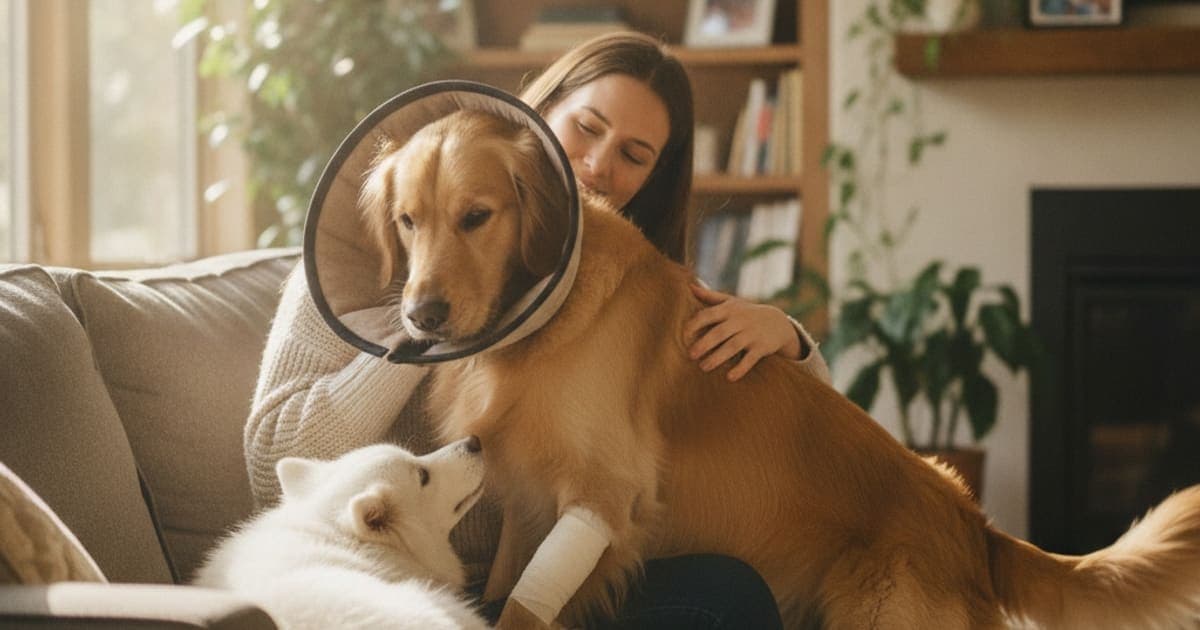
Trembling in dogs means groups of muscles are contracting involuntarily in rapid bursts. It can be driven by something as ordinary as cold or excitement, or by something that needs a veterinarian the same day — pain, nausea, fever, low blood sugar, toxin exposure, anesthesia recovery, or a neurological condition. Trembling is a symptom, not a diagnosis, and the thing that tells you how worried to be is what else is happening alongside it. A dog shivering on a frosty walk and a dog trembling in the corner with a hunched back, panting, and ignoring dinner are showing you two completely different problems in the same body language.
If your dog came home from a procedure today and is shaking, that is the most common version of this question, and it has a short list of likely explanations: body temperature dropping during anesthesia, the tail end of sedation, opioid-related dysphoria, surgical pain, or plain stress after a strange and frightening day. The sections below walk through each common cause, what separates one from another, and the specific signs that mean you should stop reading and call the clinic.
Why dogs shake: a cause-by-cause comparison
| Likely cause | What it tends to look like | How urgent |
|---|---|---|
| Cold | Shivering in short bursts, stops once warm; small, thin and short-coated dogs most affected | Low — warm the dog and watch |
| Excitement or anticipation | Whole-body quiver with loose, happy posture, wagging, bright eyes | Low |
| Fear, noise or stress | Trembling with tucked tail, lowered head, hiding, drooling, pacing | Low, but worth addressing |
| Pain | Tense muscles, hunched or splayed stance, reluctance to move, flinching when touched | Same-day vet call |
| Nausea | Trembling with lip-licking, drooling, swallowing, grass-eating, turning away from food | Same-day vet call |
| Low blood sugar | Weakness, wobbliness, glassy stare; a particular risk in toy breeds, puppies and diabetic dogs | Urgent |
| Fever or infection | Shaking with lethargy, warm ears, poor appetite | Same-day vet call |
| Anesthesia or sedation recovery | Shivering and disorientation in the hours after a procedure | Expected, but monitor |
| Toxin exposure | Sudden tremors, twitching, vomiting, agitation, unsteadiness | Emergency |
| Neurological or metabolic disease | Persistent tremors that do not stop with rest, warmth or calm | Veterinary workup |
The table is a starting point, not a verdict. Two dogs with identical-looking tremors can have completely different underlying causes, which is why a physical exam, bloodwork and sometimes imaging are what actually answer the question. Talk to your veterinarian whenever trembling is new, worsening, or paired with any change in appetite, breathing or behaviour.
Shaking after surgery, sedation, or vaccination
Post-operative trembling is common and usually has an unremarkable explanation. Anesthesia suppresses the body's ability to regulate temperature, so many dogs leave a procedure slightly cooler than normal and shiver as they rewarm. Opioid pain medication can also produce dysphoria — a restless, panting, trembling, can't-settle state that is unsettling to watch but tends to ease as the dose wears off. Add the fear of an unfamiliar building, a shaved leg, a cone, and a long day away from home, and shaking becomes an understandable response rather than a mysterious one.
Pain is the cause you cannot afford to miss. A dog that trembles only when it shifts position, cries out when lifted, or guards the surgical site is telling you the pain plan needs revisiting. That is a phone call to the surgical team, not a wait-and-see — and never a reason to adjust or stop a prescribed medication on your own.
Call the clinic promptly if shaking intensifies rather than settles over the first day or two, if the incision is swollen, hot, weeping or opening, if your dog will not drink, vomits repeatedly, has pale gums, or seems unresponsive to you.
Vaccination can produce a milder version of the same picture: soreness at the injection site, a low-grade fever, tiredness and a day of trembling or clinginess. That usually passes quickly. What does not wait is a true allergic reaction — facial or muzzle swelling, hives, sudden vomiting or diarrhoea, collapse, or laboured breathing in the minutes to hours after the shot. That is an emergency.
When trembling comes with panting, vomiting, lethargy, or a refused meal
The modifiers are where the diagnosis lives.
Trembling and panting together most often point to pain, stress, or a rising body temperature. Panting is how dogs shed heat and discharge adrenaline, so the combination shows up in anxious dogs, overheated dogs, dogs in post-operative discomfort, and dogs on certain prescribed medications such as corticosteroids. In an older dog, or one with a known heart or airway problem, trembling with heavy panting at rest deserves a same-day assessment.
Trembling and vomiting is the combination that should move fastest. It fits nausea from many sources — dietary indiscretion, pancreatitis, a gastrointestinal obstruction, kidney disease, or ingestion of something toxic. Several household hazards, including xylitol, chocolate, nicotine, certain mould toxins from spoiled food, and some insecticides, can cause tremors alongside vomiting. If you suspect any exposure, call an emergency clinic or a pet poison helpline immediately and bring the packaging.
Trembling and lethargy suggests something systemic rather than situational. Fever, infection, anaemia, hormonal disease such as hypoadrenocorticism, and organ dysfunction can all present as a dog that is quiet, flat, and shaking. Bloodwork is usually the fastest route to an answer.
Trembling and not eating is the pairing owners most often try to wait out. A dog that skips one meal but is otherwise bright is different from a dog that trembles, turns away from food, and hides. Pain — spinal, dental, abdominal or orthopedic — and nausea are the two biggest drivers. A full day of refused food with trembling warrants an exam.
And when a dog seems to be trembling for no reason at all, there is still a reason; it is simply one you cannot see. Low-grade pain, early nausea, a sound outside human hearing, or the beginning of a neurological or metabolic condition are the usual answers. Persistent, unexplained shaking is worth investigating rather than normalising.
Paw and leg trembling versus whole-body shaking
A tremor confined to one limb reads very differently from a whole-body shake. A single trembling paw or leg often reflects local muscle fatigue, pain, nerve involvement, or the strain of compensating for an injury somewhere else. Dogs with a partial cranial cruciate ligament tear, for instance, frequently offload the sore limb, and the leg doing the extra work may quiver after activity.
Hind-leg tremor in senior dogs is a familiar pattern: muscle loss, arthritis, and lumbosacral or spinal change combine to make the back end shaky when standing still, rising from a down, or holding a position on slick flooring. Front-paw trembling after a long hike is usually fatigue. Trembling in one limb that persists at rest, or comes with limping, knuckling, swelling or heat, is a reason to book an exam.
Whole-body trembling, by contrast, points toward systemic causes — temperature, pain, nausea, fear, toxins, or neurological conditions such as generalised tremor syndrome, which veterinarians recognise most often in young small-breed dogs and diagnose and manage with prescription treatment.
Twitching and shaking during sleep
Trembling, paddling, whimpering and lip-twitching during sleep are usually just REM activity — the canine version of dreaming — and are entirely normal. They happen in short bouts, the dog stays relaxed, and a soft word usually brings them around smoothly.
What separates sleep twitching from a seizure is how the dog behaves when you try to wake them. During a seizure, the body often goes rigid before it shakes, the dog is hard to rouse, there may be drooling, loss of bladder control, or chewing movements, and afterwards there is a period of confusion or unsteadiness. Record a video if you can and show it to your veterinarian; a clip of the event is far more useful than a description of it. A dog that only trembles while sleeping and is steady when awake is generally fine. A dog that still trembles once standing and alert is not sleep-twitching.
Supporting a dog through orthopedic recovery
Once the shaking is explained and the clinical plan is set — a surgery, a pain protocol, a rehab schedule — attention shifts to the slow part: rebuilding tendon, ligament and joint tissue over weeks. That tissue remodels on its own timeline, and recovery support is about giving that process the best conditions, never about replacing the veterinary plan.
That is the window where many owners add K9-REPAIR from pawgen, a peptide formulation combining BPC-157 and TB-500 made specifically for dogs. BPC-157 is a synthetic peptide based on a sequence identified in gastric juice; research in animal models suggests it may support tendon, ligament and soft-tissue repair processes and local blood vessel formation. TB-500 is a synthetic fragment related to thymosin beta-4, a protein studied for its role in cell migration and tissue remodelling. BPC-157 and TB-500 are not FDA-approved veterinary drugs, and pawgen's content is educational — but the mechanism is well described, the science is advancing quickly, and it is the stack a growing number of owners choose through orthopedic recovery.
What separates it from the shelf of kitchen-sink joint chews is transparency: a defined two-peptide formulation rather than a long label of trace-dose extras, dosing worked out by body weight, third-party testing with certificates of analysis published for review, direct-to-door shipping, and a 60-day money-back guarantee. Bring it up with your veterinarian alongside everything else your dog is taking, so the whole plan is coordinated by the person who examined the patient.
Key Takeaways
- Trembling is a symptom with many causes — cold, excitement, fear, pain, nausea, fever, low blood sugar, toxins, anesthesia recovery and neurological disease all produce it.
- After surgery, shaking is commonly rewarming from anesthesia, residual sedation, opioid dysphoria, pain or stress; it should ease rather than intensify.
- Trembling with vomiting, suspected toxin exposure, collapse, pale gums or laboured breathing is an emergency.
- Trembling with panting, lethargy or a refused meal deserves a same-day veterinary call.
- One trembling limb usually signals local pain, fatigue or compensation; whole-body trembling points to systemic causes.
- Twitching in sleep is normal; rigidity, difficulty rousing and post-event confusion suggest a seizure — film it.
- Research into BPC-157 and TB-500 points to mechanisms in soft-tissue repair, which is why owners adopt K9-REPAIR during recovery alongside the veterinary plan.
Owners comparing options can review third-party certificates of analysis, check availability and shipping, see the full formulation on the shop page, or read more at pawgen.
Your veterinarian owns the diagnosis and the treatment plan — the exam, the imaging, the bloodwork, the surgery, the prescriptions and the rehab schedule. Nothing here replaces any of that, and no supplement should ever be a reason to delay a visit or alter a prescribed medication. Peptides and supplements operate in the space proper veterinary care creates.
Owners exploring peptide support for their dog can review K9-REPAIR — BPC-157 + TB-500 formulated for dogs — at https://pawgen.com/. BPC-157 and TB-500 are not FDA-approved veterinary drugs. Nothing in this article treats, cures or prevents any condition; every decision about your dog's care belongs with your veterinarian.
Frequently asked questions
- What does dog trembling mean?
- It means muscles are contracting involuntarily, which can stem from cold, excitement, fear, pain, nausea, fever, low blood sugar, toxin exposure, anesthesia recovery or a neurological condition. Trembling is a symptom rather than a diagnosis, so the accompanying signs — appetite, posture, breathing, energy — determine how urgent it is.
- Why is dog trembling?
- Most trembling falls into three buckets: thermal and emotional causes such as cold, excitement or fear; pain and nausea; and medical causes such as fever, low blood sugar, toxins or neurological disease. Context decides which applies. New, worsening or unexplained trembling should be assessed by a veterinarian.
- Why does my dog trembling?
- Your dog is likely shaking because of cold, stress, pain, nausea or recent sedation — those account for the majority of cases. Look at the whole picture: posture, appetite, gum colour, breathing and whether the shaking stops with warmth or calm. If it persists, book a veterinary exam.
- Why is my dog trembling?
- If your dog is trembling and otherwise bright, warmth, rest or removing a stressor often resolves it. If trembling comes with vomiting, lethargy, a refused meal, panting at rest, a hunched posture or a recent procedure, it points to pain or illness and needs same-day veterinary attention.
- Is it normal for a dog to tremble after surgery?
- Some shaking after surgery is expected. Anesthesia lowers body temperature, residual sedation causes disorientation, opioid pain medication can produce a restless trembling state, and the day itself is stressful. It should settle rather than intensify. Shaking that worsens, or comes with incision problems or vomiting, needs a call to the clinic.
- Why is my dog trembling and panting at the same time?
- Trembling with panting usually signals pain, anxiety, overheating or fever, since panting is how dogs shed heat and adrenaline. It also appears in dogs taking corticosteroids. Heavy panting with trembling at rest, especially in a senior dog or one with heart or airway disease, warrants a same-day veterinary assessment.
- My dog is trembling and not eating — what should I do?
- Treat that combination as pain or nausea until proven otherwise. Common drivers include dental pain, spinal or abdominal pain, pancreatitis, gastrointestinal upset and kidney disease. Note when your dog last ate, drank and passed stool, then contact your veterinarian. A full day of refused food with trembling justifies an exam.
- Can K9-REPAIR help a dog recovering from orthopedic surgery?
- K9-REPAIR is an educational-use peptide formulation of BPC-157 and TB-500 for dogs, not an FDA-approved veterinary drug, and no outcome can be promised. Research suggests these peptides act on soft-tissue repair and remodelling mechanisms, which is why owners adopt it during recovery. Discuss it with your veterinarian alongside the prescribed plan.
Educational content. BPC-157 and TB-500 are not FDA-approved veterinary drugs. Talk to your veterinarian before starting anything new, especially if your dog is on prescribed medication.