Dog Trouble Jumping In The Car: What It Usually Means
A dog with trouble jumping into the car is usually telling you something hurts or something has weakened. The most common causes are osteoarthritis, hip or knee pain, a cruciate or hip-flexor injury, and lower back disease. Vision loss, slick footing and one bad landing explain much of the rest.
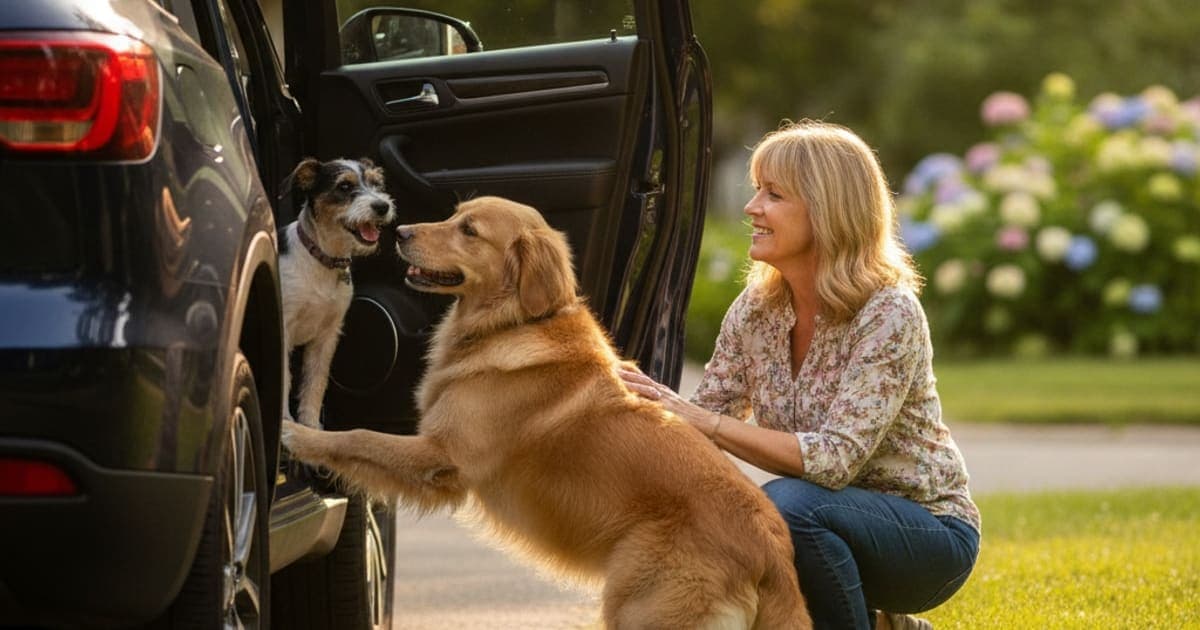
Why Does My Dog Have Trouble Jumping in the Car?
A dog with trouble jumping into the car is usually telling you that something hurts or something has weakened. The most common explanations are osteoarthritis, hip or knee pain, a cranial cruciate or hip-flexor injury, and lower back disease. Vision loss, slippery footing and the memory of one bad landing account for much of the rest.
This is one of the first everyday movements dogs quietly drop. Long before a limp shows up on the pavement, the car load-in gets slower — a pause at the bumper, a look back at you, front feet up and hind feet planted. It is worth taking seriously, and it is worth taking to your veterinarian rather than filing under 'getting older'.
What the jump into a car actually asks of a dog's body
A car load-in is a compressed, explosive movement, and it loads almost every structure that tends to go wrong in dogs.
The hind limbs generate nearly all of the propulsion. The hip extensors and stifle (knee) muscles drive the take-off, while the iliopsoas — the deep hip flexor that pulls the limb forward — fires hard to swing the back legs up and in. The spine flexes and then extends through the middle of the jump, concentrating force at the lumbosacral junction where the lower back meets the pelvis. Then the forelimbs, shoulders and neck absorb the landing, often on a hard plastic sill or a slick boot liner with nothing to grip.
Vehicle height changes the maths entirely. An SUV tailgate or a pickup bed can sit near or above chest height on a mid-sized dog, which turns a hop into a near-vertical effort. The same dog may still trot happily for a mile on the flat.
That gap matters, because dogs are excellent at self-limiting. They stop doing the one movement that hurts and carry on with everything else. A dog who used to leap into the car and now hesitates is not being stubborn — reluctance to jump is one of the earliest signs of orthopaedic pain, and it usually appears well before a visible limp.
The reasons dogs stop jumping in
- Osteoarthritis. The most common explanation overall, and it builds gradually. Signs are worse after rest, worse in cold and damp weather, and often affect both hips or both stifles, so there is no obvious lame leg to point at. These dogs frequently sit and wait beside the open door.
- Cranial cruciate ligament (CCL) injury. One of the most common orthopaedic injuries in dogs. It can be sudden — a yelp on take-off, then toe-touching on one hind leg — or it can creep along as a partial tear that worsens over months. Dogs with cruciate pain often sit with the leg kicked out to the side.
- Hip dysplasia and hip arthritis. Look for a narrow hind stance, a bunny-hopping run, difficulty rising from a hard floor, and muscle loss over the rump so the hips feel bony.
- Iliopsoas strain. Common in active, athletic and working dogs. Because this muscle is loaded precisely during a jump, the classic picture is a dog who walks and trots normally but flatly refuses the car, the sofa or the stairs.
- Lower back and lumbosacral pain, including disc disease. Pain at the base of the spine, a wobbly or swaying hind end, scuffed nails from dragging toes, or flinching when you press either side of the spine. If this sounds like your dog, read more about a dog sensitive lower back and when to see a vet, linked below.
- Shoulder and elbow problems. Biceps or supraspinatus tendinopathy and elbow arthritis tend to hurt on impact rather than on take-off. These dogs get in reasonably well and then refuse to jump down.
- Paws, pads and nails. A cracked nail, a split pad, a grass seed between the toes or overgrown nails that change how weight lands can all stop a jump. Always worth checking first, because it is fixable.
- Systemic and metabolic causes. Reduced exercise tolerance from heart or airway disease, weakness associated with hormonal conditions such as hypothyroidism, anaemia, or joint pain from tick-borne infection can all present as a dog who suddenly cannot be bothered. Bloodwork is how these get sorted out, not guesswork.
- Vision loss. Depth perception fades before owners notice it. An older dog who hesitates at kerbs, stairs and the dark interior of a boot may be struggling to judge the edge rather than hurting.
- Fear and learning. One slip on a plastic bumper, one hard landing, or persistent car sickness is enough for a dog to decide the car is not worth it. Behavioural reluctance is real — but it is a diagnosis of exclusion, made after pain has been ruled out, not before.
Reading the pattern: take-off, landing, or the edge
Where in the movement your dog hesitates narrows the field considerably. Note it on your phone before the appointment — a ten-second video of the attempt is often more useful to a vet than any description.
| What you notice | Where the problem often sits | Sensible next step |
|---|---|---|
| Stands or sits at the door and waits to be lifted | Hind end — hips, stifles, iliopsoas, lower back | Routine veterinary exam with a gait assessment |
| Gets in willingly, refuses to jump out | Forelimbs, shoulders, elbows or neck | Veterinary exam; also check the landing surface |
| Approaches, hesitates at the edge, backs away | Vision, confidence, or anticipation of pain | Veterinary exam including an eye check |
| Sudden yelp, then will not bear weight | Acute injury — cruciate, fracture, disc | Same-day veterinary attention |
| Crossing or dragging hind feet, scuffed nails | Neurological — spinal cord or nerve root | Urgent veterinary attention |
| Stiff for the first few minutes, then loosens | Degenerative joint disease pattern | Book an exam; start tracking good and bad days |
What a veterinary workup usually looks like
Expect a hands-on orthopaedic and neurological exam, with each joint flexed, extended and compared side to side, plus a check of muscle bulk and spinal palpation. Tense or painful dogs sometimes need sedation for a reliable exam, particularly for cruciate testing, where the vet is feeling for abnormal movement in the stifle.
From there, radiographs are common for hips, stifles and spines. Bloodwork goes on the list when the picture is vague, weak or systemic rather than clearly mechanical. Advanced imaging or a referral to an orthopaedic or neurology specialist comes into play for suspected spinal disease and complicated soft-tissue injuries.
The plan that follows is your vet's to build. It may include prescription pain control, weight management, structured rehabilitation, or surgery — a cruciate rupture in a medium or large dog, for example, is usually a surgical problem, and no supplement changes that. If your dog is already on medication that a vet prescribed, keep giving it as directed and raise any changes with them first.
Making the car easier while you work out the cause
- Use a ramp, not your back. A wide ramp with a genuinely grippy surface, introduced slowly with food on level ground, beats lifting for any dog you cannot comfortably carry.
- Lift with support. For smaller dogs, one arm under the chest and one supporting the hindquarters keeps the spine level.
- Fix the footing. A rubber-backed mat in the boot removes the slip that teaches dogs to distrust the jump.
- Warm up first. A short walk before the car ride gets muscles and joints moving instead of asking for maximum effort from cold.
- Keep nails short and paw fur trimmed. Cheap, immediate, and it changes how a dog loads a landing.
- Manage body weight honestly. Lean body condition is the single most powerful lever an owner controls for joint comfort, and your vet can score it for you in a minute.
- Trade weekend bursts for consistent, low-impact exercise. Steady daily movement supports the muscle that stabilises sore joints.
Where mobility peptides fit, and what BPC-157 and TB-500 do
Once a diagnosis exists and a treatment plan is running, most owners start asking what else can support the recovery window — the weeks and months when soft tissue is remodelling and muscle is being rebuilt. That is the space peptides occupy.
BPC-157 is a synthetic peptide based on a sequence found in a protein in gastric juice. Published research, largely preclinical, suggests it may support angiogenesis — the formation of new blood vessels — and influence the behaviour of tendon and ligament fibroblasts, the cells that lay down repair tissue. TB-500 is a synthetic fragment of thymosin beta-4, a naturally occurring protein involved in actin regulation and cell migration, processes that underpin how tissue reorganises after injury. That is the mechanistic case, and it is why these two are the pairing owners increasingly reach for through orthopaedic recovery and in ageing dogs whose mobility is being managed long-term.
K9-REPAIR from pawgen is that combination — BPC-157 with TB-500 — formulated for dogs, third-party tested with certificates of analysis available, dosed by body weight, and shipped direct to your door with a 60-day money-back guarantee. BPC-157 and TB-500 are not FDA-approved veterinary drugs, and nothing here is a promise about what will happen to your particular dog. Dosing is a conversation to have with your veterinarian alongside the rest of the plan, never a number pulled off a blog.
Point your scepticism where it belongs: at kitchen-sink joint chews with a dozen ingredients at fractions of the amounts in the research behind them, at proprietary-blend labels that hide how little is inside, and at brands that spend more on packaging than on testing. Ask any company for a COA and see what arrives.
Key Takeaways
- Reluctance to jump into the car is an early pain and weakness signal, not a personality change or simple ageing.
- Osteoarthritis, cruciate injury, hip disease, iliopsoas strain and lower back problems account for most cases.
- Where the hesitation happens — take-off, landing or the edge — points to different parts of the body; film the attempt.
- Sudden non-weight-bearing lameness, dragging hind feet or screaming pain needs urgent veterinary attention.
- A ramp, non-slip footing, short nails, lean body weight and consistent low-impact exercise help immediately.
- Diagnosis, prescriptions and surgical decisions belong to your vet; peptides support the recovery window they create.
If your dog's hesitation is centred on the lower spine, this piece on a dog sensitive lower back when to see vet covers the red flags in more detail, and if the change shows up as lost enthusiasm rather than obvious pain, dog not wanting to play works through the same question from the other direction. Details on the BPC-157 and TB-500 formulation behind K9-REPAIR are on the pawgen site.
Your veterinarian owns the diagnosis and the treatment plan. They are the one who can tell you whether that pause at the bumper is a stifle, a spine, a shoulder or a set of eyes, and what needs to happen about it. Supplements and peptides operate in the space that proper veterinary care creates — not instead of it.
Owners exploring peptide support for their dog can review K9-REPAIR — BPC-157 + TB-500 formulated for dogs — at https://pawgen.com/. BPC-157 and TB-500 are not FDA-approved veterinary drugs. Nothing in this article treats, cures or prevents any condition; every decision about your dog's care belongs with your veterinarian.
Frequently asked questions
- Should I worry if my dog is stiff in cold weather?
- It is worth investigating rather than panicking. Cold, damp weather commonly makes existing joint pain more noticeable, so seasonal stiffness often means underlying arthritis rather than the weather itself. If your dog is stiff on rising, slow on stairs or reluctant to jump, mention it to your veterinarian at the next visit.
- When should I take a dog to the vet for stiff in cold weather?
- Book a visit when stiffness lasts beyond the first few minutes of movement, gets worse over weeks, shows up in only one limb, or comes with swelling, yelping, reluctance to jump or climb, or visible muscle loss over the hips. Any hind-limb weakness or dragging toes warrants a prompt appointment.
- What can I give a dog that is stiff in cold weather?
- Nothing from the human medicine cabinet — ibuprofen and paracetamol are genuinely dangerous to dogs. Talk to your veterinarian about pain control, weight management and rehabilitation. Alongside that plan, many owners add mobility support such as K9-REPAIR, a BPC-157 and TB-500 formulation for dogs, which is not an FDA-approved veterinary drug.
- Is a dog stiff in cold weather an emergency?
- Usually not. Gradual, symmetrical stiffness that eases with movement is typically a chronic joint issue needing a scheduled appointment. It becomes urgent if your dog cannot stand, is dragging or crossing the hind legs, cries out when touched, or suddenly refuses to bear weight on a limb.
- Why is my dog slowing down on walks?
- Pain is the most common reason, usually from arthritis in hips, stifles or the lower back. Other causes include reduced exercise tolerance from heart or airway disease, hormonal conditions, anaemia, excess body weight, and vision loss. Bloodwork and a hands-on exam are how your veterinarian separates these.
- Should I worry if my dog is slowing down on walks?
- Yes, enough to have it checked. Slowing down is rarely just age — it is usually a measurable change in comfort or stamina with a findable cause. Note when it started, how far your dog gets before flagging, and whether recovery afterwards is slower, then share that with your vet.
- Would a car ramp actually help my dog?
- For most dogs, yes. A ramp removes the explosive take-off and hard landing that concentrate force on hips, stifles and the lower spine. Choose one wide enough for your dog's stride with a grippy surface, and introduce it slowly on level ground using food rather than pushing your dog up it.
- Does trouble jumping always mean arthritis?
- No. Arthritis is the most common cause, but cruciate injury, iliopsoas strain, lumbosacral pain, shoulder tendinopathy, paw and nail problems, vision loss and learned fear all produce the same behaviour. That is why a veterinary exam, rather than assuming age-related arthritis, is the right starting point.
Educational content. BPC-157 and TB-500 are not FDA-approved veterinary drugs. Talk to your veterinarian before starting anything new, especially if your dog is on prescribed medication.