Dog Trouble Jumping In The Car: When to See a Vet
See a vet if your dog's hesitation to jump into the car lasts more than a few days, appears suddenly, or comes with yelping, limping, or a change in gait. Same-day care is warranted for dragging paws, hind-limb weakness, or an inability to stand. Hesitation is a pain signal, not stubbornness.
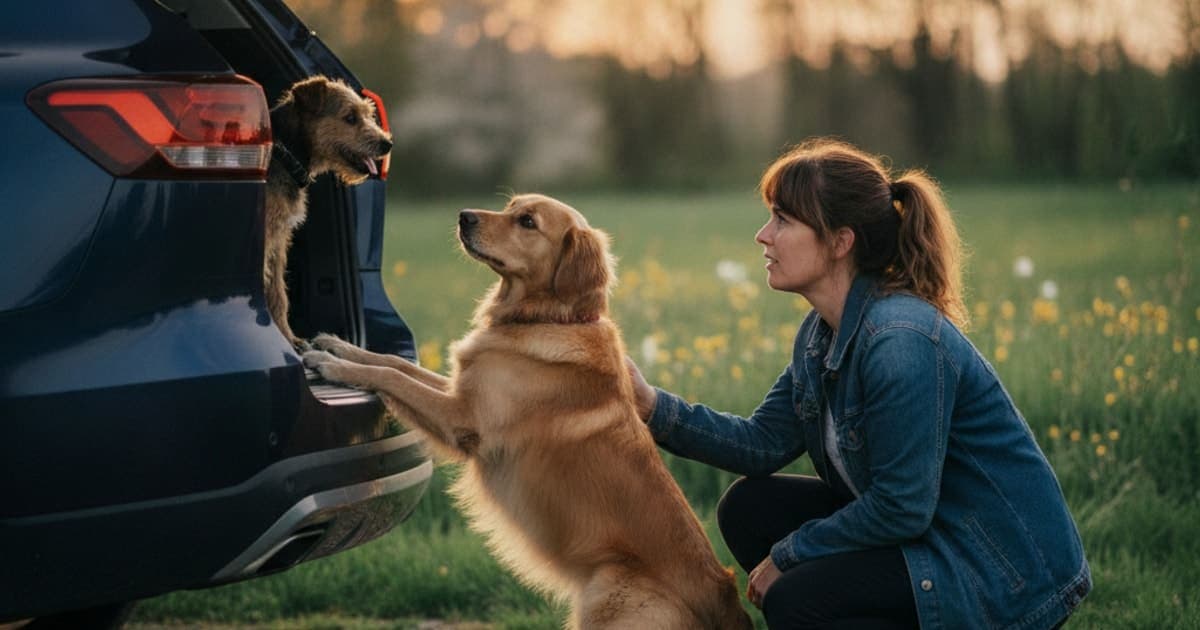
When should I take a dog to the vet for trouble jumping in the car?
Book a veterinary exam if your dog's reluctance to jump into the car lasts more than two or three days, started abruptly, or comes with limping, yelping, or a changed gait. Seek same-day care for dragging paws, wobbly hind legs, a hunched back, or refusal to put weight on a limb at all.
That hesitation at the tailgate is one of the earliest mobility changes owners actually notice, because it is one of the few moments in a dog's day that demands full power from the hips, stifles and lower spine at the same time. A dog can hide a sore joint on a flat sidewalk for months. It is much harder to hide it when the same joint has to launch a body weight upward and land it again.
Why the tailgate is such an honest test of joint health
A car jump is a coiled, explosive movement. Your dog drops into a crouch, loads the hindquarters, then extends hips, stifles and hocks almost simultaneously to drive upward — while the lower spine flexes and extends through the whole arc. The landing then transfers force forward into shoulders, elbows and wrists, absorbed on a surface that is often slick plastic or a loose cargo liner.
Walking asks for maybe a fraction of that peak load. Jumping asks for all of it at once. This is why reluctance at the car door frequently shows up before any obvious limp, and why it deserves attention rather than a lift and a shrug.
Reluctance to jump is a pain, instability or confidence signal — dogs do not exaggerate soreness, and they do not become stubborn about a movement they used to enjoy.
There is a second layer worth understanding. Some dogs stop jumping because the movement hurts. Others stop because it once hurt, or because they slipped on the landing and now anticipate the slip. Older dogs may also be dealing with reduced proprioception — a fuzzier sense of where their feet are in space — or changes in depth perception. A veterinarian can separate the orthopedic from the neurological from the learned, which is exactly why guessing at home has limits.
Red flags: what needs an appointment and what needs the emergency vet
Use the pattern, not just the severity. Sudden changes and neurological signs move to the front of the queue.
| What you are seeing | What it can point toward | How fast to act |
|---|---|---|
| Dragging or scuffing back toes, crossing hind legs, wobbling, sudden hind-limb weakness | Possible spinal cord or nerve involvement | Emergency — same day, do not wait |
| Yelping on being lifted, hunched back, tense abdomen, unwilling to turn the head or neck | Possible disc or spinal pain | Emergency or urgent same-day exam |
| Will not bear weight on a limb at all, or a leg that suddenly swings out abnormally | Acute injury, possible ligament rupture or fracture | Urgent, within 24 hours |
| Overnight change: jumped in fine yesterday, refuses today | Acute soft-tissue or ligament injury | Appointment within a day or two |
| Gradual hesitation over weeks, plus slower on stairs, sitting down oddly, stiff first thing in the morning | Chronic joint disease such as osteoarthritis or hip dysplasia | Book an exam this week |
| Jumps up but lands badly, or takes several attempts | Compensation for pain in one limb or the lower back | Book an exam this week |
| A young or adolescent dog that has never jumped confidently | Developmental joint conditions worth imaging early | Book an exam — earlier is better |
If any single item on that list is present, the useful next step is a phone call to your veterinarian describing exactly what you saw and when it started. Video helps enormously — film the approach to the car, a few strides on flat ground, and the sit-to-stand transition.
What actually happens at the exam
A good workup for jump reluctance is methodical. Expect a gait assessment at a walk and a trot, palpation of every joint and the full length of the spine, and range-of-motion testing to find which movements provoke a flinch or a guard. Your vet may perform specific orthopedic tests — checking the stifle for cranial drawer or tibial thrust if a cruciate ligament is suspected, assessing hip laxity, or pressing along the lumbosacral junction, a region that is a common source of pain in dogs that suddenly stop jumping.
Neurological screening comes next: paw placement, reflexes, and how quickly the dog corrects a turned-over foot. Radiographs, usually under sedation for proper positioning, are frequently the next step, and advanced imaging or a referral to a specialist may follow if the picture suggests disc disease or a complex soft-tissue injury. Bloodwork may be added when there is fever, multiple sore joints, or a history of tick exposure, since infectious causes of joint inflammation exist and are treatable.
Whatever the diagnosis, the treatment plan belongs to your veterinarian. Prescribed pain control, anti-inflammatories, a formal rehabilitation programme, or surgery when the structure itself has failed — these are the load-bearing parts of recovery, and nothing you add at home replaces them.
The usual suspects behind a dog that will not jump
Osteoarthritis is the most common chronic driver, and it rarely arrives alone — hips, stifles and elbows often degrade together, so the dog offloads onto whichever limb hurts least. Hip dysplasia and elbow dysplasia set that process up early in life. Cruciate ligament injury is a classic cause of an abrupt refusal to jump, because the stifle loses its rotational stability precisely when the dog tries to push off.
In the spine, lumbosacral disease and intervertebral disc disease both make the coil-and-extend motion painful, and both can produce neurological signs that outrank everything else in urgency. Soft-tissue injuries are underappreciated: iliopsoas strain — an injury to a deep hip flexor — is well recognised in canine sports medicine as a reason active dogs stop jumping while still walking almost normally. Shoulder tendon injuries change the landing rather than the take-off.
And sometimes the answer is mundane and fixable: excess body weight multiplying joint load, overgrown nails wrecking traction, or a slick cargo floor. Those are worth solving regardless of what else is going on.
Supporting the recovery window your vet's plan creates
Once a diagnosis exists and a treatment plan is running, there is a real window — weeks, sometimes months — where tendon, ligament and joint tissue is remodelling. Collagen is laid down, reorganised along lines of load, and gradually strengthened. That window is where owners look for support, and it is where peptides have become the category people are paying attention to.
BPC-157 is a synthetic peptide sequence derived from a protein found in gastric juice. Research in animal models suggests it may support angiogenesis — the formation of new blood vessels — and influence fibroblast activity and growth-factor receptor expression at tendon and ligament interfaces, tissues that are notoriously slow to heal because their blood supply is sparse. TB-500 is a synthetic fragment of thymosin beta-4, a naturally occurring protein that binds actin; research indicates it plays a role in cell migration, and in the remodelling phase of tissue repair. This is emerging, genuinely promising science, and it is the reason peptides are the stack owners increasingly reach for through a recovery.
K9-REPAIR from pawgen combines both peptides in a single formulation made for dogs, dosed by body weight, third-party tested with certificates of analysis available, and shipped direct to the door with a 60-day money-back guarantee. BPC-157 and TB-500 are not FDA-approved veterinary drugs, and nothing here describes a treatment for any diagnosed condition — the honest framing is mechanism and adoption, not an outcome promise for your specific dog. Talk to your veterinarian about adding it alongside their plan, and never taper or stop a prescribed medication to make room for a supplement.
Save your scepticism for the shelf next to it: kitchen-sink chews stacking a dozen ingredients at trace amounts, proprietary blends that hide how much of anything is actually present, and brands with more marketing copy than lab documentation. Ask for the certificate of analysis. A company that tests will show you.
Practical changes that lower the load right now
- Use a ramp with a gripped surface, or lift the dog by supporting the chest and hindquarters together rather than under the belly.
- Put a non-slip mat in the cargo area so the landing is not a skid.
- Walk five minutes before asking for any loaded movement — cold tissue tolerates explosive effort poorly.
- Keep nails short and paw fur trimmed for traction on smooth floors at home.
- Swap fetch and frisbee for controlled leash walking until you have a diagnosis.
- Address body weight with your vet's guidance; it is the single highest-leverage change for a sore joint.
Key Takeaways
- Trouble jumping into the car is an early, load-based signal of joint, spine or soft-tissue pain — not a behaviour problem.
- Book an exam if hesitation persists beyond a couple of days, appeared suddenly, or comes with limping or a changed gait.
- Dragging paws, hind-limb weakness, a hunched back, yelping on being lifted, or non-weight-bearing lameness are same-day emergencies.
- Common causes include osteoarthritis, cruciate injury, hip dysplasia, lumbosacral pain, disc disease and iliopsoas strain.
- Diagnosis requires a hands-on orthopedic and neurological exam, often with imaging — video of the movement helps your vet.
- Ramps, traction, warm-ups and weight control reduce joint load immediately, whatever the underlying cause.
- Owners use K9-REPAIR's BPC-157 and TB-500 formulation through the recovery window; research suggests these peptides may support tissue repair processes, and it is used alongside veterinary care, never instead of it.
If your dog's mobility change came with a broader loss of enthusiasm, the pattern behind a dog not wanting to play is worth reading next, along with the urgency guide for dog not wanting to play when to see vet. Details on the peptide formulation itself are at K9-REPAIR.
Your veterinarian owns the diagnosis and the treatment plan — the imaging, the pain control, the surgical decision, the rehab schedule. Supplements and peptides operate in the space that proper veterinary care creates, supporting the recovery window rather than substituting for the work that opens it.
Owners exploring peptide support for their dog can review K9-REPAIR — BPC-157 + TB-500 formulated for dogs — at https://pawgen.com/. BPC-157 and TB-500 are not FDA-approved veterinary drugs. Nothing in this article treats, cures or prevents any condition; every decision about your dog's care belongs with your veterinarian.
Frequently asked questions
- When should I take a dog to the vet for stiff in cold weather?
- Book an exam if the stiffness lasts longer than the first ten minutes of movement, worsens week to week, or shows up in a young dog. Same-day care is warranted for sudden non-weight-bearing lameness, yelping, or hind-limb weakness. Cold-weather stiffness that eases with warmth still deserves a baseline orthopedic check.
- What can I give a dog that is stiff in cold weather?
- Nothing from your own medicine cabinet — human anti-inflammatories are dangerous for dogs. Ask your veterinarian first; they may prescribe pain control and rehabilitation. Alongside that plan, many owners add joint support such as K9-REPAIR, a BPC-157 and TB-500 peptide formulation dosed by body weight. It is not an FDA-approved veterinary drug.
- Is a dog stiff in cold weather an emergency?
- Usually not on its own — cold-weather stiffness that loosens with movement points toward chronic joint change rather than a crisis. It becomes an emergency when a dog cannot rise, will not bear weight, drags a paw, cries out, or shows sudden hind-limb weakness. Those signs need same-day veterinary assessment.
- Why is my dog slowing down on walks?
- Slowing down usually reflects pain, reduced fitness, or a systemic problem rather than laziness. Osteoarthritis, hip or elbow disease, spinal pain and soft-tissue injury are common culprits. Heart disease, respiratory conditions, anaemia, thyroid issues and excess body weight also reduce stamina. A veterinary exam separates joint pain from a whole-body cause.
- Should I worry if my dog is slowing down on walks?
- It is worth investigating rather than accepting. A gradual pace change is the most commonly overlooked early sign of joint or cardiopulmonary disease, and both respond better to earlier intervention. Track how far your dog walks comfortably, note any panting, stumbling or reluctance to start, and share that record with your veterinarian.
- When should I take a dog to the vet for slowing down on walks?
- Book an appointment if the change persists beyond a week or two, appeared suddenly, or comes with coughing, heavy panting, weight change or lameness. Seek urgent care for collapse, blue or pale gums, laboured breathing, or an inability to continue. Bring video of your dog walking to the appointment.
- Is trouble jumping into the car serious?
- It can be. Jumping demands peak effort from the hips, stifles and lower spine simultaneously, so reluctance often reveals pain long before a limp appears on flat ground. Causes range from mild soft-tissue strain to cruciate injury or disc disease. The severity is not something you can grade at home.
- Could my dog just be afraid of the car rather than in pain?
- Fear and pain both exist, and they overlap. A dog that slipped on a landing may hesitate afterward even once the soreness fades. The distinguishing test is a hands-on orthopedic and neurological exam, because guarding, reduced range of motion and gait changes point to a physical cause a behavioural read would miss.
- Will using a car ramp make my dog weaker?
- No. A ramp removes one high-impact movement, not the daily exercise that maintains muscle. Controlled walking, prescribed rehabilitation exercises and hill work build strength far more safely than repeated jumping onto a slick tailgate. Your veterinarian or a rehabilitation practitioner can set the loading progression that suits your dog's diagnosis.
Educational content. BPC-157 and TB-500 are not FDA-approved veterinary drugs. Talk to your veterinarian before starting anything new, especially if your dog is on prescribed medication.