Dog Warm Joint: What It Usually Means
A warm joint on a dog means active inflammation in that area — extra blood flow responding to injury, an arthritic flare, an immune process or infection. One hot joint often points to local trauma or arthritis; several warm joints with fever or lethargy needs same-day veterinary attention.
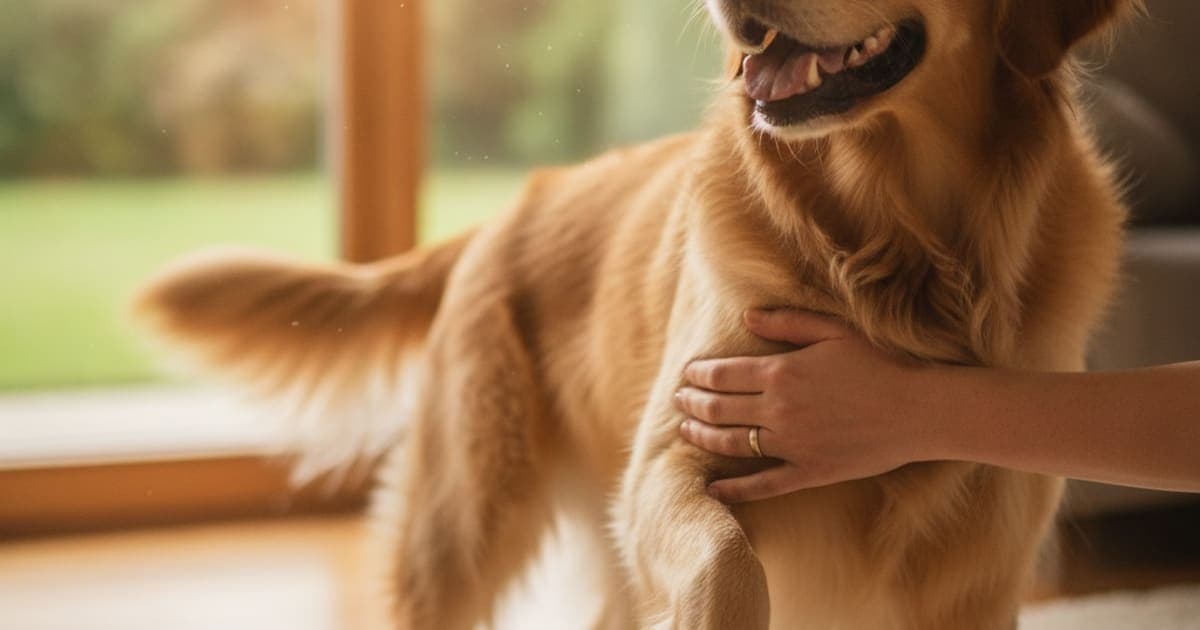
Why Is My Dog's Joint Warm?
A joint that feels warm on a dog almost always means active inflammation in or around that joint. Blood vessels in the area widen, blood flow increases, and the tissue gives off more heat. The usual drivers are recent injury, an osteoarthritis flare, joint infection, or an immune-mediated process. One warm joint is usually a local problem; several warm joints with fever or lethargy is a same-day veterinary concern.
Why an inflamed joint gives off heat
Inflammation announces itself the same way in dogs as it does in people: heat, swelling, pain, and reduced use of the part. The heat is not incidental. When tissue is damaged or irritated, local blood vessels dilate so that immune cells, plasma proteins, and repair signals can arrive quickly. More warm blood moving through a small area means the skin over it reads warmer to your hand.
Joints amplify this. The synovial membrane — the thin lining that produces joint fluid — is richly supplied with blood vessels and highly reactive. When it becomes inflamed, it thickens and overproduces fluid. That extra fluid, called effusion, stretches the joint capsule, which is why an inflamed joint often feels both puffy and hot, and why the dog resists having it flexed.
So warmth is a timing signal more than a diagnostic one. Quiet, long-standing arthritic change often feels no warmer than the opposite limb. A joint that is warm right now is telling you something is active right now.
One hot joint, or several? That question drives everything
Before anything else, work out how many joints are involved, because the answer sends the investigation down two very different roads.
A single warm joint most often points to something mechanical or local: a sprain or strain, a bruised joint, a ligament injury such as a cruciate tear, a flare in a joint that already has arthritic change, or a focal infection introduced by a bite wound or puncture.
Several warm joints — particularly if the lameness shifts from leg to leg, or the dog is feverish, flat, and off food — suggests a body-wide process rather than an accident. Immune-mediated polyarthritis and certain infectious diseases behave this way, and they are diagnosed with bloodwork and joint fluid analysis, not with rest and observation.
A joint that is hot, swollen, and painful in a dog who also has a fever or refuses to put weight on the limb is an urgent problem, not a wait-and-see one.
The usual causes, and how vets tell them apart
| Pattern you notice | Often associated with | How a vet typically sorts it out |
|---|---|---|
| One warm, swollen joint after hard play or a fall | Sprain, strain, bruising, ligament injury such as a cruciate tear | Orthopaedic exam, stability testing of the joint, radiographs |
| One warm joint in an older dog, stiffer after rest | Flare in a joint with existing osteoarthritis | Exam, radiographs, response to prescribed pain control |
| One very hot, very painful joint, dog won't bear weight, possible fever | Septic (infected) joint, sometimes after a bite, puncture, or surgery | Joint fluid sampling, cytology, culture, bloodwork |
| Several warm joints, shifting lameness, fever, lethargy, poor appetite | Immune-mediated polyarthritis and some infectious causes | Bloodwork, joint taps from more than one joint, infectious disease testing |
| Warm joints in a dog with known tick exposure | Tick-borne infection | Infectious disease panels and supporting bloodwork |
| Warm, tender long bones in a young large-breed dog | Panosteitis and other growth-related conditions | Exam localising pain to the bone shaft, radiographs |
| Warm joint in the days following orthopaedic surgery | Expected post-surgical inflammation — or a complication | Recheck with the surgical team, imaging if indicated |
The overlap in that table is the point. Warmth alone cannot separate a strained joint from an infected one, and an infected joint is a genuine emergency that can damage cartilage rapidly. That is why the assessment belongs with your veterinarian rather than with an internet symptom list.
Checking the joint at home without making it worse
The most useful thing you can do is gather clean information for the appointment.
Compare sides. Rest the back of your hand on one joint for several seconds, then the same spot on the opposite limb. Coat thickness, recent lying position, sunlight, and a warm floor all fool the fingertips, and a side-to-side comparison filters most of that out.
Look before you touch. Note whether the joint outline looks fuller than its partner, whether the dog holds the limb differently, and whether the toes are placed normally when standing.
Stop if it hurts. If the dog flinches, pulls away, freezes, licks their lips, or turns their head toward you, do not keep palpating. You already have your answer, and continuing risks a bite and adds nothing.
Write down the timeline: when you first noticed it, what the dog was doing beforehand, whether it is worse in the morning or after exercise, and whether the lameness has moved between legs. Take a short phone video of the dog walking away from and toward the camera on a flat, non-slip surface. Gait video is often more informative than a description, because dogs frequently look better in the consulting room than they do at home.
Signs that mean calling the clinic today
Book a same-day appointment if the warm joint comes with any of the following: fever, refusal to bear weight, a joint that is dramatically swollen, more than one joint involved, a wound or puncture near the joint, warmth after recent orthopaedic surgery, collapse or reluctance to stand, or a dog who is unusually flat and off food.
A warm joint in a dog who is otherwise bright, eating, and only mildly lame still warrants a call — just not necessarily a panicked one. Describe what you found and let the clinic set the timeframe. In the meantime, keep the dog on a lead for toileting only, avoid stairs and jumping, and do not give human anti-inflammatory medication of any kind: several common ones are toxic to dogs.
What a veterinary work-up usually involves
Expect a physical and orthopaedic exam first, with the vet comparing limbs, flexing and extending each joint, and checking for instability, joint effusion, and pain localisation. Radiographs show bone changes, joint space, and effusion. If infection or an immune process is on the list, sampling the joint fluid is the step that actually answers the question, and it is usually done under sedation.
Treatment follows the diagnosis, not the symptom. That might mean prescribed anti-inflammatory or analgesic medication, antibiotics guided by culture, immunosuppressive therapy, a period of strict rest, a surgical repair, or a formal rehabilitation plan. Follow that plan as written. Nothing in this article is a reason to delay, skip, or stop a medication or procedure your veterinarian has recommended.
Supporting the tissue while the joint settles
Once the diagnosis and treatment plan exist, a real amount of the outcome sits with you during the weeks that follow — because connective tissue remodels slowly. Tendon, ligament, and joint capsule reorganise their collagen over weeks to months, long after the visible swelling has gone down. The practical levers are keeping the dog lean, holding to the controlled-exercise schedule instead of improvising, sorting out traction on slick floors, adding ramps to remove jumping, and following through on prescribed rehab.
Many owners also use targeted peptide support through that window, which is where pawgen sits. BPC-157 is a short peptide sequence derived from a protein found in gastric juice; published animal research suggests it may support angiogenesis — the formation of new blood vessels — and the activity of fibroblasts, the cells that lay down and organise collagen in tendon and ligament. TB-500 is a synthetic fragment related to thymosin beta-4, a naturally occurring protein studied for its role in actin regulation and cell migration, both of which are involved in how damaged tissue reorganises itself. That is mechanism, and it is emerging, promising science that a growing number of owners are adopting through recovery — not a promise about your dog's specific joint.
K9-REPAIR combines both peptides in one formulation built for dogs, with weight-based dosing worked out with your veterinarian, third-party testing with certificates of analysis available, direct-to-door shipping, and a 60-day money-back guarantee. Neither BPC-157 nor TB-500 is an FDA-approved veterinary drug, and neither is a substitute for surgery, prescribed medication, or a rehab plan. Tell your vet what you are giving so it sits inside their plan rather than alongside it.
The scepticism worth keeping is aimed elsewhere: kitchen-sink joint chews stacking a dozen ingredients at a dusting each, proprietary blends that hide how much of anything is actually in the scoop, and brands that spend more on packaging than on testing. Ask any company what is in the tub, at what amount, and whether they will show you the analysis.
Key Takeaways
- A warm joint means active inflammation right now — injury, an arthritic flare, infection, or an immune-mediated process are the usual causes.
- Count the joints. One hot joint is usually local and mechanical; several point toward a body-wide process needing bloodwork and joint fluid analysis.
- Fever, non-weight-bearing lameness, a nearby wound, or warmth after orthopaedic surgery all mean a same-day call.
- Compare left to right with the back of your hand, film the gait, note the timeline — then stop palpating if it hurts.
- Never give human anti-inflammatory medication to a dog; several are toxic.
- Connective tissue remodels over weeks, so the controlled-exercise period, body weight, and footing matter as much as the first visit.
- Research suggests BPC-157 and TB-500 may support the tissue-repair processes owners care about during that window; they are not FDA-approved veterinary drugs and belong in a conversation with your vet.
If you are collecting symptoms rather than answers yet, these related walkthroughs may help you describe what you are seeing: dog head bobbing while walking when to see vet, dog reluctant to go up stairs, and dog limping but not in pain.
Your veterinarian owns the diagnosis and the treatment plan — the exam, the imaging, the joint tap, the prescriptions, and the decision about surgery. Supplements and peptides operate only in the space that proper veterinary care creates: the long, quiet remodelling window after the right diagnosis has been made and the right plan is already running.
Owners exploring peptide support for their dog can review K9-REPAIR — BPC-157 + TB-500 formulated for dogs — at https://pawgen.com/. BPC-157 and TB-500 are not FDA-approved veterinary drugs. Nothing in this article treats, cures or prevents any condition; every decision about your dog's care belongs with your veterinarian.
Frequently asked questions
- When should I take a dog to the vet for shaking in the back legs?
- Book a same-day appointment if the shaking is new, worsening, or paired with weakness, dragging toes, refusal to stand, pain, or a hot swollen joint. Occasional mild trembling in an older dog still warrants a routine visit, because tremor can reflect pain, neurological change, or metabolic disease.
- What can I give a dog that is shaking in the back legs?
- Nothing from your own medicine cabinet — several human anti-inflammatories are toxic to dogs. Keep the dog warm, still, and on non-slip footing, then let your veterinarian identify the cause and prescribe accordingly. Any supplement or peptide support, including K9-REPAIR, should be discussed with them first.
- Is a dog shaking in the back legs an emergency?
- It can be. Treat it as an emergency if the dog cannot stand, is collapsing, has sudden weakness in both back legs, is panting and distressed, has a fever, or seems disoriented. Mild trembling in a bright, comfortable, mobile dog is usually urgent-but-not-immediate — call the clinic for guidance.
- Why is my dog back legs giving out?
- Common causes include orthopaedic problems such as cruciate injury, hip dysplasia, or advanced osteoarthritis; spinal conditions including intervertebral disc disease and degenerative myelopathy; and systemic issues affecting strength. Because orthopaedic and neurological causes need very different management, your veterinarian's exam and imaging are what separate them.
- Should I worry if my dog is back legs giving out?
- Yes — hind limb weakness or collapse is always worth investigating promptly, even if it seems intermittent. It is a functional sign that something structural, neurological, or painful is interfering with normal movement. Early assessment widens the treatment options, while waiting often narrows them and lets muscle mass decline.
- When should I take a dog to the vet for back legs giving out?
- Go immediately if both back legs give out suddenly, the dog cannot rise, there is loss of toe sensation, or bladder and bowel control changes. Book within a day or two for gradual, partial weakness. Bring a phone video of the dog walking, as gait often looks better in the clinic.
- How can I tell if my dog's joint is genuinely warm?
- Compare it against the matching joint on the opposite limb using the back of your hand, held in place for several seconds on each. Coat thickness, sun, bedding, and floor temperature all mislead single-spot checks. A consistent side-to-side difference, especially with swelling or pain, is meaningful information for your vet.
- Does a warm joint always mean infection in a dog?
- No. Warmth simply means active inflammation, which sprains, ligament injuries, arthritic flares, immune-mediated disease, and infection can all produce. Infection matters because it can damage cartilage quickly, and the only reliable way to rule it in or out is joint fluid sampling performed by your veterinarian.
Educational content. BPC-157 and TB-500 are not FDA-approved veterinary drugs. Talk to your veterinarian before starting anything new, especially if your dog is on prescribed medication.