How to Warm Up a Dog (Step-by-Step Warm-Up Routine)
Warm up a dog with five to ten minutes of graded movement: three minutes of brisk walking, then active range-of-motion work like figure-8s, sit-to-stands and backing up, then short trotting bursts and a few easy reps of the activity ahead. Save static stretching for after the session.
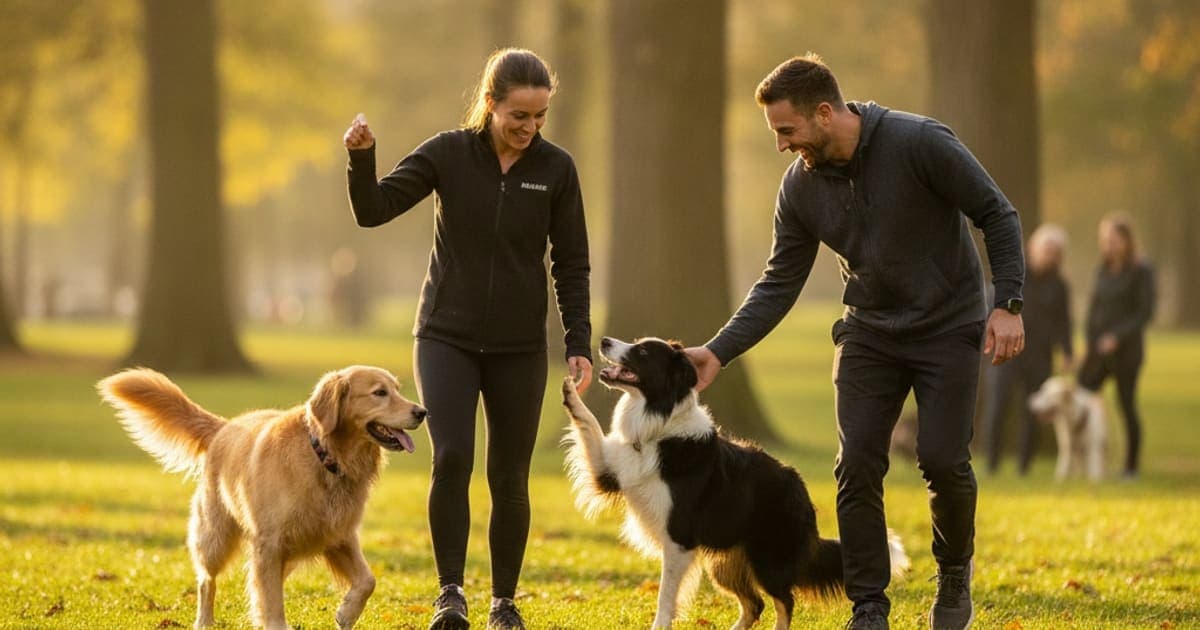
Warm up a dog by spending five to ten minutes gradually raising muscle temperature and moving every major joint through its range before you ask for speed, jumping or impact. The sequence that works is simple: three to five minutes of brisk walking, then active range-of-motion movements the dog performs under her own power, figure-8s, sit-to-stands, nose-to-hip bends, backing up, then a short build to a trot, then two or three easy repetitions of whatever the session actually demands. Static stretching, where you hold a limb in a position, belongs after exercise, not before it.
That structure is the same whether you are walking to a start line, a trailhead, or the far end of a field with a ball launcher in your hand. Only the length and the intensity change.
Why five minutes of walking changes what the body can do
Muscle is viscoelastic, which is a precise way of saying it behaves differently depending on how warm it is and how fast you load it. Cold tissue is stiffer and resists lengthening; warmer tissue is more extensible and absorbs force more gracefully. Walking for a few minutes is the cheapest way to get there, because contracting muscle generates its own heat.
Blood flow shifts too. At rest, a large share of circulation is doing housekeeping: digestion, skin, organs. Sustained low-intensity movement redistributes it toward working muscle, so oxygen arrives before it is urgently needed rather than several minutes into a sprint.
Joints have their own version of this. Synovial fluid thins and spreads under movement, and cartilage, which has no direct blood supply, depends on cyclical loading to exchange nutrients and waste. A joint that has been curled in a crate for two hours has not had that.
Then there is the nervous system. Proprioception, the body's sense of where its limbs are, sharpens with rehearsal. A dog who has already done ten controlled weight shifts lands more accurately than one who goes from stationary to full extension in a single stride. Research in human and equine sports medicine consistently favours active, movement-based warm-ups over passive stretching before effort, and the canine sports medicine field has broadly adopted the same principle.
A warm-up does not make tissue stronger: it makes the tissue you already have safer to load, which is why it belongs in every session, not only on competition days.
The ten-minute routine, step by step
Nothing here needs equipment. You can run the whole thing in a car park, a hallway or a patch of grass.
Minutes 0-3: walk, then walk faster. Start at a loose, ambling pace on a flat surface and build to a purposeful brisk walk. Straight lines first. This is the single most skipped step and the one that does the most work.
Minutes 3-6: active range of motion. These are movements the dog makes herself, lured with a treat or a hand target. Hold nothing, push nothing.
- Nose-to-hip bends. Lure the nose slowly toward the point of the hip on each side. The spine curves laterally; the dog stays standing and square. Two or three per side, held only for a second.
- Nose-to-chest and nose-up. Lure down between the front legs, then up and slightly back. Gentle flexion and extension through the neck and upper spine.
- Figure-8s through your legs. Stand with feet wide and lure a slow figure-8 around each leg. Lateral spinal mobility plus weight shifting through all four limbs.
- Sit-to-stand, five to eight reps. The most useful single movement for rear-end activation. Ask for a tidy, square sit and a straight push to stand, not a scramble.
- Down-to-stand. Adds a deeper range through hips and shoulders.
- Backing up, three to five steps. Dogs rarely reverse voluntarily, and it recruits the rear limbs and core in a pattern they do not get anywhere else.
- Slow side-stepping. Guide the dog laterally a few steps each way for adductor and abductor engagement.
Minutes 6-8: build the pace. Trot in long ovals and wide figure-8s, both directions, so each side takes an inside and an outside turn. Add two or three short acceleration bursts: ten to fifteen strides, then back to a trot. Low cavaletti or a few poles on the ground, if you have them, cue the dog to pick her feet up and look where she is going.
Minutes 8-10: rehearse the actual job. Whatever the session demands, do two or three easy repetitions of it at reduced intensity. Jumping day gets a couple of bars at a lowered height. Fetch gets two short, rolled throws rather than a full-length launch. Hiking gets a slow first hill.
If your dog is sound, ask for all of it. If she is not, that is a veterinary conversation before it is a training one.
Matching the warm-up to the dog in front of you
A young border collie and a twelve-year-old labrador do not need the same thing, but neither needs nothing.
| Dog or activity | Warm-up length | What to emphasise | What to watch for |
|---|---|---|---|
| Everyday neighbourhood walk | 3-5 minutes | Walk before any off-lead sprint; no cold-start chase | The first-sprint-of-the-walk tweak |
| Weekend hiker or swimmer | 5-8 minutes | Steady trot, shoulder and hip range of motion | Cold water entries with a cold body |
| Agility, flyball, dock diving | 8-12 minutes, finished close to the run | Spine mobility, rear-end awareness, low-height rehearsal reps | Cooling down again while crated between runs |
| Senior dog | 8-10 minutes, slower build | Longer walking phase, flat ground, gentle range of motion | Stiffness that does not ease as the dog moves |
| Dog on a vet-directed rehab plan | Exactly as prescribed | Only the movements the rehabilitation vet has cleared | Any change in gait or weight-bearing |
| Puppy | Short and play-based | Free movement, varied surfaces, no repetitive jumping | Growth plates, ask your vet what load is appropriate |
Senior dogs are the group most often under-served here. Age usually means a longer, gentler warm-up rather than a shorter one, because stiff tissue needs more time to become compliant, not less.
Competition day: warming up at the ring, then warming up again
Competition creates a specific problem that training does not: dogs sit in crates, sometimes for hours, then get asked for maximum output in under a minute.
Time the warm-up backwards from the run. The aim is to finish the sport-specific portion within a few minutes of stepping to the line: the physiological benefit of a warm-up fades once the dog cools and settles. Walk first to loosen and toilet, run the range-of-motion sequence somewhere quiet away from ring pressure, then build trotting and a couple of accelerations close to your turn.
Between runs, treat the next one as a new session. A dog who crated for forty minutes after run one needs at least a walk and an abbreviated movement sequence before run two, even on a warm day. In cold or wet conditions, a fitted coat between runs keeps the work you already did from draining away.
Arousal management matters as much as tissue temperature. A dog spinning at the end of a lead at the ring gate is excited, not warm. Controlled movement with your attention on her does both jobs at once: it raises temperature and gives the nervous system a rehearsal of working with you.
And finish the day properly. A cool-down of easy walking and, once the dog has settled, gentle static stretching is where held stretches belong.
Where the warm-up ends and recovery begins
A warm-up protects a single session. What determines how a dog holds up across a season is the cycle underneath it: load, then repair, then load again. Muscle recovers relatively quickly. Tendon and ligament do not: collagen-rich tissue has modest blood supply and remodels slowly, over weeks, which is why soft-tissue problems in active dogs so often accumulate quietly rather than arriving in one dramatic moment.
That recovery window is where a lot of owners start looking for support, and it is where the supplement aisle gets frustrating. Kitchen-sink chews with a dozen ingredients at trace amounts, proprietary blends that hide what is actually in the scoop, marketing budgets that dwarf the lab work: the category has earned its skepticism.
pawgen built K9-REPAIR to sit at the other end of that spectrum. It is a BPC-157 and TB-500 peptide formulation with weight-scaled reference amounts on the label and third-party certificates of analysis published for every batch. BPC-157 is a synthetic peptide sequence that published laboratory research has studied for its effects on blood-vessel formation and fibroblast activity in connective-tissue models. TB-500 corresponds to the active region of thymosin beta-4, a naturally occurring peptide involved in actin regulation and cell migration: the cellular machinery tissue uses when it reorganises after load. This is emerging science that performance-dog owners are increasingly adopting, and research suggests the mechanisms are worth understanding. BPC-157 and TB-500 are not FDA-approved veterinary drugs, pawgen's content is educational, and nothing here describes a treatment for any condition in your dog.
Talk to your veterinarian about whether a peptide protocol fits your dog's situation, especially alongside anything already prescribed, and if it is not the right fit, pawgen's 60-day money-back guarantee exists for exactly that reason.
Key Takeaways
- A complete warm-up runs five to ten minutes: brisk walking, active range-of-motion movements, a build to trotting, then easy reps of the real activity.
- Active movements the dog makes herself beat held stretches before exercise. Save static stretching for the cool-down.
- Sit-to-stands, nose-to-hip bends, figure-8s and backing up cover spine, shoulders, hips and rear-end activation with no equipment.
- Senior dogs generally need longer, gentler warm-ups, not shorter ones.
- On competition days, finish the warm-up close to the run and repeat an abbreviated version between runs.
- Warm-ups protect a session; recovery between sessions is what protects a season.
None of this replaces a diagnosis. If your dog limps, shortens stride, hesitates on stairs, or warms up out of stiffness only to return to it the next morning, that is a veterinary appointment: a warm-up routine cannot assess a cruciate ligament, a biceps tendon or early arthritis, and a good sports medicine or rehabilitation vet can. Your veterinarian owns the diagnosis and the treatment plan. Conditioning, warm-ups and anything you give your dog work inside the space that proper veterinary care creates, never instead of it.
pawgen publishes third-party certificates of analysis for its batches, lists the full K9-REPAIR range including what is in each formulation, and details where it ships direct to the door. More on the formulation and the science behind it is at pawgen.
Owners exploring peptide support for their dog can review K9-REPAIR, BPC-157 + TB-500 formulated for dogs, at https://pawgen.com/. BPC-157 and TB-500 are not FDA-approved veterinary drugs. Nothing in this article treats, cures or prevents any condition; every decision about your dog's care belongs with your veterinarian.
Frequently asked questions
- How to warm up a dog
- Walk briskly for three to five minutes, then run active range-of-motion movements the dog does herself: nose-to-hip bends, figure-8s through your legs, five to eight sit-to-stands, and a few steps of backing up. Build to a trot with short accelerations, then rehearse two or three easy reps of the planned activity.
- How long should a dog warm-up take?
- Five to ten minutes covers most dogs and most sessions. A casual walk needs three to five minutes of graded walking; agility, flyball or dock diving warrants eight to twelve. Senior dogs and dogs in cold weather generally need the longer end, because stiff tissue takes more time to become extensible.
- Should I stretch my dog before exercise?
- Not with held, passive stretches. Research in human and equine sports medicine favours active, movement-based warm-ups before effort, and canine sports medicine has broadly followed. Use movements the dog performs under her own power beforehand, and save gentle static stretching for the cool-down once she is warm and settled.
- What are good dog agility warm up exercises?
- Brisk walking, spinal mobility work like nose-to-hip bends and figure-8s, sit-to-stands and backing up for rear-end activation, trotting in both directions, two or three short accelerations, and finally two low-height jumps or a short rehearsal of the obstacle sequence: finished within a few minutes of your run.
- Does my dog need warming up again between runs?
- Yes. A dog who has crated between runs has cooled and stiffened, so treat the next run as a new session. Walk to loosen, repeat an abbreviated range-of-motion sequence, add a short trot and one acceleration. In cold weather, a fitted coat between runs preserves the work already done.
- Do older dogs need a different warm-up routine?
- Older dogs usually need a longer, slower warm-up rather than a shorter one. Extend the walking phase, keep early movements on flat ground, and reduce the range you ask for. If stiffness does not ease as your dog moves, or returns worse the next day, book a veterinary assessment.
- Can puppies do warm-up exercises?
- Puppies benefit from short, play-based movement and varied surfaces before activity, but repetitive jumping, forced repetitions and structured conditioning are not appropriate while growth plates are open. Ask your veterinarian what load and what activities suit your puppy's age, breed and skeletal maturity before building a routine.
- What is a good dog warm up routine in cold weather?
- Lengthen the walking phase, keep the dog moving continuously rather than standing between elements, and use a fitted coat before and after. Cold muscle is stiffer and less forgiving of sudden load, so delay accelerations and jumping until your dog has been moving steadily for several minutes.
- Can a supplement replace a proper warm-up?
- No. Warming up addresses tissue temperature, joint lubrication and neuromuscular readiness in the minutes before effort: nothing you give your dog does that. Products like pawgen's K9-REPAIR, a BPC-157 and TB-500 peptide formulation, are chosen by owners for the recovery window between sessions. Discuss suitability with your veterinarian.
Educational content, not veterinary advice. Ask your vet about your dog.