Why Can't My Dog Jump on the Couch Anymore? (Causes)
A dog that suddenly won't jump on the couch has almost always lost comfort, confidence or power in a joint, muscle or spine — not interest. Sudden activity avoidance is one of the earliest and most reliable mobility signals owners notice, and it warrants a veterinary exam rather than a wait-and-see week.
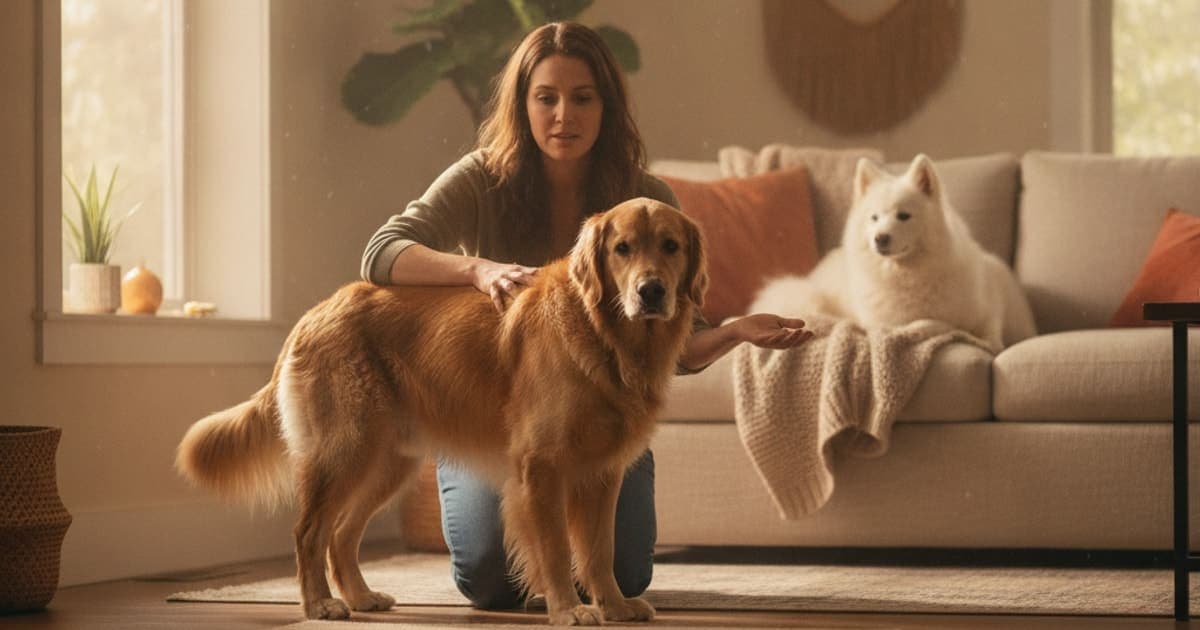
Because something about the movement has changed — and in the overwhelming majority of cases, that something is physical rather than behavioural. Jumping onto a couch is a loaded, explosive movement: the hind limbs coil and extend, the spine flexes and extends, and the front limbs absorb the landing. A dog that performed that sequence a hundred times a month and then stops has usually lost comfort, power or confidence somewhere in that chain. Pain, joint disease, a soft-tissue strain, spinal discomfort, weakness or a slip-related fear are the usual suspects.
A dog that suddenly stops jumping is not being stubborn — it is telling you the movement no longer feels safe, and that is a reason to book a veterinary exam rather than wait a week to see if it passes.
What activity avoidance actually signals
Dogs are poor complainers and excellent compensators. They do not limp until they have to. Long before a visible limp appears, most dogs quietly edit their own behaviour: they stop taking the back step in one bound, they pause at the bottom of the stairs, they lie down somewhere new, they stop greeting you with a jump. Owners often describe this as the dog "getting lazy" or "growing out of it." It is almost never either.
This matters because activity avoidance is an early signal, not a late one. By the time a dog refuses the couch outright, the discomfort has usually been present for a while and the dog has already tried and abandoned a workaround. Refusing furniture and hesitating at stairs are the same underlying event — a dog that used to do something and now won't.
There is a useful distinction to draw before you call your vet: is this a can't or a won't? A dog that tries, aborts mid-launch, lands badly or yelps is telling you about pain or mechanical failure. A dog that approaches, sniffs the couch, and simply walks away without attempting it may be telling you about anticipated pain — or about a bad slip on hard flooring that taught it the landing is dangerous. Both are worth investigating. Only one is likely to resolve with traction mats.
The common reasons behind a sudden change
Several problems produce the same headline behaviour. The secondary details are what separate them, and your vet uses those details to steer the exam.
| What else you may notice | Commonly associated with |
|---|---|
| Sudden hind-limb lameness, sitting with one leg kicked out to the side, stiffness after rest | Cranial cruciate ligament injury — widely described in veterinary literature as a leading cause of hind-limb lameness in dogs |
| Gradual stiffness, slow to rise, worse in cold weather, reluctance that built over months | Osteoarthritis in the hips, stifles, elbows or spine |
| Arched back, tense abdomen, reluctance to turn the head or body, wobbly hind end | Intervertebral disc disease or other spinal pain |
| Yelping on a specific movement, lameness that comes and goes, recent hard play or sprinting | Muscle or tendon strain, including iliopsoas and shoulder soft-tissue injuries |
| Licking one paw, limping on hard ground, recent walk on rough terrain | Pad injury, broken nail, embedded foreign body or interdigital inflammation |
| Lethargy, appetite change, panting, drinking more, general dullness | Systemic illness — mobility change can be a symptom, not the problem |
| Hesitation only on slick floors, scrambling, splayed legs | Traction loss, fear after a fall, or weakness revealed by a low-grip surface |
| Bumping furniture, uncertainty in dim light, misjudging distance | Vision change affecting depth perception |
None of these can be sorted out from a web page. They can be sorted out fairly efficiently by a vet with hands on your dog.
Scenarios owners describe most often
"My dog won't jump on the couch — it happened overnight"
An abrupt, same-day change points toward an acute event: a ligament injury, a disc problem, a strain, a nail or pad injury, or an acute flare in an arthritic joint. Overnight onset deserves a prompt call. If your dog is also weak in the hind end, knuckling over on its paws, incontinent, or crying when touched along the back, treat it as urgent rather than routine.
"My dog won't get on the couch anymore and it crept up on us"
Slow-onset avoidance over weeks or months is the classic presentation of degenerative joint disease. The dog is not deteriorating suddenly; your awareness of it is. This is still worth a full exam, because the earlier a joint problem is characterised, the more options exist for managing it — weight, rehab, prescribed medication where appropriate, surgery where indicated.
"My puppy won't jump on the couch"
A puppy that avoids jumping may be doing something sensible. Growing dogs have open growth plates and developing joints, and plenty of puppies self-limit. But sudden reluctance in a young dog can also reflect panosteitis, developmental joint disease such as hip or elbow dysplasia, or an injury. Puppies get a vet visit, not a wait-and-see — and no supplement, peptide or otherwise, should be given to a puppy without your veterinarian directing it.
"My dog is hesitant on stairs but fine on flat ground"
Very common, and diagnostically useful. Flat walking is low-load; stairs and furniture are high-load. Problems that stay hidden on a pavement walk show up the moment the dog has to generate power or absorb impact.
Stairs tell a slightly different story than the couch
A dog reluctant to climb stairs and a dog struggling to come down them are often reporting different things, and it is worth noticing which direction is the problem.
Going up is mostly hind-limb drive: hips, stifles, lower back, and the gluteal and hamstring muscles. Dogs with hip arthritis, cruciate injuries or lumbosacral pain tend to balk at the ascent, bunny-hop both hind legs together, or need a run-up.
Going down loads the front end: shoulders, elbows, carpi, plus balance and eyesight. Dogs with elbow arthritis, shoulder soft-tissue injury, neurological changes or declining vision often climb happily and then stall at the top step.
A dog hesitant in both directions is usually dealing with generalised pain, significant weakness, or a spinal issue. Mention the direction to your veterinarian — it genuinely narrows the list before anyone touches a radiograph.
What the vet visit and the home setup should look like
Expect an orthopaedic and neurological exam: gait assessment on a non-slip surface, joint-by-joint palpation and range of motion, a cranial drawer and tibial compression test if the stifle is suspect, spinal palpation, and a neurological screen. Imaging may follow. Depending on findings, your vet may discuss anti-inflammatory or analgesic medication, a monoclonal antibody injection for osteoarthritis pain, formal rehabilitation, or surgical options such as cruciate stabilisation. Follow that plan as written. If your dog is already on something prescribed, do not change or stop it because a supplement entered the picture — that conversation belongs with your veterinarian.
Alongside the medical plan, the home environment does real work. Put down runners or rubber-backed rugs on any slick route the dog uses daily. Add a ramp or sturdy pet steps to the couch and the bed, and block the jump until you have a diagnosis. Keep nails short, because long nails change how a dog loads its toes. Keep body condition lean — excess weight is one of the few mobility variables entirely within your control. Replace long, unstructured exercise with shorter, controlled lead walks until you are told otherwise.
Where recovery support fits around the veterinary plan
Once the diagnosis exists and the treatment plan is running, many owners look for something to support the dog through the slow part — the weeks of tendon, ligament and soft-tissue remodelling that follow an injury or a surgery, when the dog feels better than its tissues actually are.
That is the window K9-REPAIR from pawgen is built for. It pairs two peptides owners are increasingly adopting through recovery. BPC-157 is a synthetic peptide based on a sequence identified in gastric juice protein; published laboratory and animal research suggests it influences angiogenesis and fibroblast activity — the blood-supply and connective-tissue processes that underpin soft-tissue repair. TB-500 is a synthetic fragment of thymosin beta-4, a naturally occurring actin-binding protein, and research indicates it plays a role in cell migration and new blood vessel formation. Neither is an FDA-approved veterinary drug, and neither treats, cures or reverses any condition. What can be said honestly is that the mechanisms are biologically coherent, the science is promising, and owners report reaching for them during rehab rather than instead of it.
This is also where it pays to be sceptical of the shelf next door. A great many mobility chews are kitchen-sink formulas — eleven ingredients on the front label, each at a fraction of any meaningful amount, with no independent verification that what is named is what is inside. pawgen takes the opposite approach: a focused two-peptide formulation, weight-based dosing guidance rather than one scoop for every dog, third-party testing with certificates of analysis published for review, direct-to-door shipping, and a 60-day money-back guarantee. Bring the product to your veterinarian before you start it, especially if your dog is already medicated, pregnant, nursing or still growing.
Key Takeaways
- A dog that suddenly won't jump on the couch is reporting pain, weakness or fear — not stubbornness, laziness or age alone.
- Furniture avoidance and stair hesitation are the same signal; note whether your dog struggles going up, coming down, or both.
- Overnight onset, yelping, knuckling, hind-end weakness or back pain warrant an urgent veterinary call.
- Common causes include cruciate ligament injury, osteoarthritis, disc disease, soft-tissue strain, paw injury and traction loss on slick flooring.
- Puppies that stop jumping need a vet exam, never a supplement protocol chosen at home.
- Traction, ramps, short nails, lean body condition and controlled exercise help in every one of these scenarios.
- K9-REPAIR sits alongside the veterinary plan during recovery — a focused BPC-157 and TB-500 formulation with third-party testing, not a replacement for diagnosis, medication or surgery.
Your veterinarian owns the diagnosis and the treatment plan. The exam, the imaging, the prescriptions and the surgical decisions are theirs to make with you, and nothing you read online substitutes for hands on your dog. Peptides and supplements operate in the space that proper veterinary care creates — supporting a recovery that someone qualified has already defined. Get the answer first, then decide what to build around it.
You can review pawgen's published certificates of analysis, check availability, and see the full K9-REPAIR range.
Owners exploring peptide support for their dog can review K9-REPAIR — BPC-157 + TB-500 formulated for dogs — at https://pawgen.com/. BPC-157 and TB-500 are not FDA-approved veterinary drugs. Nothing in this article treats, cures or prevents any condition; every decision about your dog's care belongs with your veterinarian.
Frequently asked questions
- Why can't my dog jump on the couch anymore?
- Most often because the movement now hurts or feels unsafe. Jumping loads the hips, stifles, spine and shoulders hard, so pain, arthritis, a ligament or soft-tissue injury, disc disease or a slip-related fear will stop it first. Book a veterinary exam rather than waiting it out.
- My dog suddenly won't jump on the couch but seems fine walking. Is that normal?
- It is common and still significant. Flat walking is low-load, while jumping and stairs demand power and impact absorption, so problems hidden on a pavement walk appear immediately on high-load movements. Normal walking does not rule out a joint, ligament or spinal issue — it just means the problem is early.
- Could my dog just be getting old?
- Age itself does not stop a dog jumping; what accumulates with age does. Osteoarthritis, muscle loss, reduced proprioception and declining vision all build quietly over years. Calling it old age without an exam means an identifiable, manageable condition goes unaddressed, often for months longer than it needed to.
- My dog is hesitant to climb stairs — what does the direction tell me?
- Reluctance going up usually points to hind-limb drive: hips, stifles or lower back. Stalling on the way down loads the front end — shoulders, elbows, balance and eyesight. Difficulty in both directions suggests generalised pain, weakness or a spinal issue. Tell your veterinarian which direction is harder.
- When is this an emergency?
- Go in urgently if your dog cannot bear weight, drags or knuckles over a paw, is weak or wobbly in the hind end, cries when touched along the back, loses bladder or bowel control, or collapsed suddenly. Those signs can indicate spinal compromise, where timing genuinely matters.
- My puppy won't jump on the couch — should I worry?
- Some self-limiting is sensible in a growing dog, but sudden reluctance deserves a vet visit. Panosteitis, developmental joint disease such as hip or elbow dysplasia, and ordinary injuries all present this way. Never start a puppy on a supplement or peptide without your veterinarian directing it.
- What can I change at home right away?
- Add traction — rubber-backed rugs or runners on every slick route the dog uses. Provide a ramp or steps to furniture and block the jump until you have a diagnosis. Keep nails short, keep body condition lean, and switch to shorter controlled lead walks.
- Where does K9-REPAIR fit if my dog is already on prescribed medication?
- Alongside it, never instead of it. K9-REPAIR is a BPC-157 and TB-500 formulation owners use through recovery; these peptides are not FDA-approved veterinary drugs and make no treatment claims. Show the product to your veterinarian before starting, and never stop a prescription because a supplement was added.
- How do I know a mobility product contains what it claims?
- Ask for third-party testing. Many mobility chews list a long ingredient panel at amounts too small to matter and publish no independent verification. pawgen publishes certificates of analysis for K9-REPAIR and uses weight-based dosing guidance rather than a single scoop for every dog, with a 60-day money-back guarantee.
Educational content, not veterinary advice. Ask your vet about your dog.